If you are aiming for a management quota MBBS or BDS seat in Tamil Nadu, you have about a week left. The Selection Committee at the Directorate of Medical Education and Research (DME), Kilpauk, has fixed 23 July 2026, 5:00 PM as the last date to apply. The same deadline covers government quota seats.
The management quota window includes minority and NRI seats in private and self-financing colleges, alongside the state government quota. Both streams are handled through the Selection Committee online portal. You can browse the full list of MBBS and BDS colleges in Tamil Nadu before you decide where to apply.
The application window opened on 29 June, and the committee says it has already received over 41,000 completed applications. With the NEET UG 2026 result out on 16 July, it has kept the window open for one more week so candidates who were waiting on their scores can still apply. If you have your marks, you can check where your NEET rank is likely to land before you finalise your choices.
There will be no extension. The committee cited the time it needs to scrutinise applications, publish the list of ineligible candidates, run a grievance redressal window for them, and the short timelines expected for UG counselling by the DGHS. Candidates are advised to submit well before the 5:00 PM cut-off on 23 July rather than risk the final hours.
Key dates
Application window opened: 29 June 2026
NEET UG 2026 result declared: 16 July 2026
Last date to apply for management and government quota (MBBS & BDS): 23 July 2026, 5:00 PM
Apply and read the government and management quota prospectuses on the Selection Committee website, tnmedicalselection.net. Source: Notification No.006/SCS1(1)/2026 dated 17 July 2026.
The Karnataka Examinations Authority (KEA) has opened a fresh registration window for the 2026-27 medical, dental and AYUSH counselling in the state. A notification dated 16 July 2026 invites online applications from NEET UG 2026 candidates who had not registered for the Karnataka CET (UGCET) 2026. The “UGNEET-2026 new registration” link on the KEA portal opens at 2:00 PM on 17 July 2026 and closes at 11:00 AM on 24 July 2026.
Who needs to register
The window is meant only for candidates who did not register for UGCET-2026. If you already registered for the Karnataka CET-2026, you do not apply again. KEA will shortly publish a separate link on its website for you to add your NEET roll number to the existing CET-2026 application; no fresh registration is needed.
Why the 24 July cut-off matters
The seven-day window is a hard deadline. Per the notification, no new registrations will be allowed after 24 July for the first, second or third round of seat allotment. The only opening after that is the Stray Vacancy Round, for which KEA will publish a schedule later. A candidate who misses this window loses the three main allotment rounds and can enter only at the stray stage, when very few seats are left. Registering now is what keeps all the rounds open to you.
Courses and eligibility
The registration covers MBBS and BDS along with the AYUSH streams: Ayurveda, Homoeopathy and Unani. The minimum qualifying marks fixed by the competent authority after the UGNEET-2026 re-examination results will apply. SC, ST and OBC eligibility applies to Karnataka SC/ST/OBC candidates only. KEA advises every applicant to read the UGNEET-2026 Information Bulletin for the full eligibility rules and seat categories before applying.
Non-Karnataka candidates
Candidates from outside Karnataka can register online, pay the registration fee, and enter their Class 12 marks with a PDF upload in the marks-entry portal. They generally do not need to appear for document verification. The exception is OCI, PIO, NRI and foreign nationals, and any non-Karnataka candidate claiming an NRI ward, religious minority, or a Category RC-2 to RC-8 seat at St John’s Medical College, Bengaluru; they must book a slot and appear for verification at KEA, Bengaluru.
How to register
Register through the KEA portal at cetonline.karnataka.gov.in/kea and select the “UGNEET-2026 new registration” link once the window opens. KEA has reiterated that, following the NMC letter of 24 July 2023, all counselling rounds including the Stray Vacancy Round will be conducted only by KEA in online mode.
Key dates and details
Registration opens: 2:00 PM, 17 July 2026
Registration closes: 11:00 AM, 24 July 2026
Who should apply: NEET UG 2026 candidates who did not register for the Karnataka CET (UGCET) 2026
Already registered for KCET-2026? No fresh registration; add your NEET roll number through the link KEA will publish
Courses: MBBS, BDS, Ayurveda, Homoeopathy, Unani
Portal: cetonline.karnataka.gov.in/kea
Source: KEA notification No. ED/KEA/ADMN/CR-11/2026 dated 16 July 2026, “New Registration for admission to MBBS, BDS and Ayurveda / Homoeopathy / Unani Courses in the State of Karnataka – 2026”.
The National Testing Agency (NTA) declared the result of NEET (UG) 2026 on 16 July 2026. Scorecards are live on the official website, neet.nta.nic.in, and the full NTA press release carries the detailed break-up.
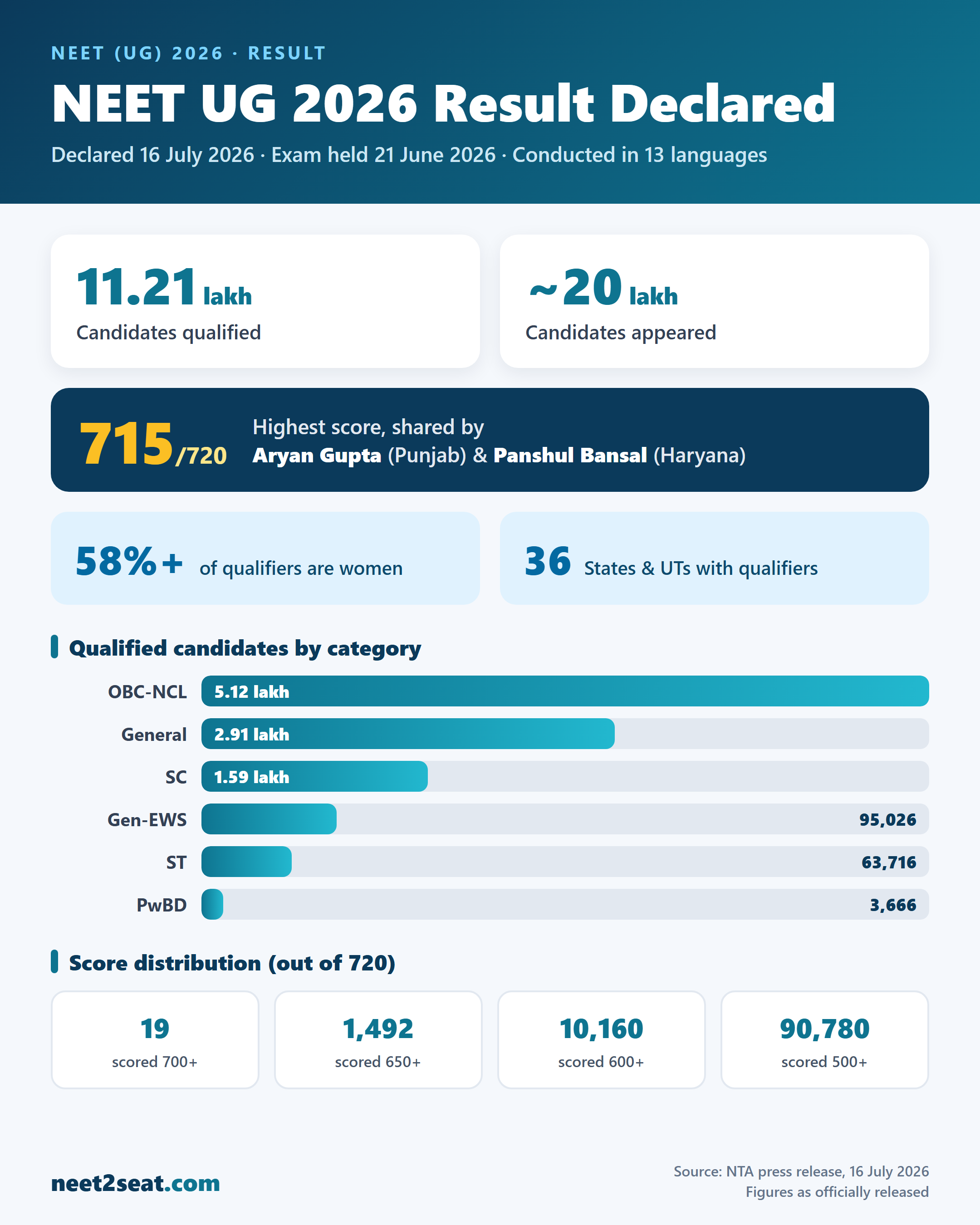
NEET UG 2026 result at a glance. Source: NTA press release, 16 July 2026.
Where to get your result
Your NEET UG 2026 scorecard is on the candidate result portal. Log in with your application number and date of birth:
Heavy traffic right after a result is declared can slow these portals or make them briefly unreachable. If a link will not open, wait a few minutes and try again, or switch between the two above rather than refreshing repeatedly, which only adds to the load.
How many qualified
Close to 20 lakh candidates sat the exam on 21 June 2026 across 5,440 centres in 551 cities in India and 14 cities abroad. Of them, 11.21 lakh qualified for undergraduate medical, dental, AYUSH and allied courses. More than 58 per cent of the qualified candidates are women, who cleared at a slightly higher rate than men (56.8 per cent against 55.1 per cent).
Category-wise, the qualified count is 2.91 lakh in General, 5.12 lakh in OBC-NCL, 1.59 lakh in SC, 63,716 in ST, 95,026 in Gen-EWS, 3,666 in PwBD and 303 in PwD. NTA has published category-wise cut-off marks alongside the result.
Toppers and score spread
The highest score of 715 out of 720 was shared by Aryan Gupta from Punjab and Panshul Bansal from Haryana. Nineteen candidates crossed 700 marks, 138 scored above 690, and 1,492 scored 650 or more. Wider still, 10,160 candidates scored 600 and above, and 90,780 scored 500 and above. The top 17 rankers, all above 705, came from eight states: Punjab, Haryana, Rajasthan, Uttar Pradesh, Maharashtra, Bihar, Tamil Nadu and Telangana.
Marks vs rank: what your score means for your AIR
NTA published the official rank-versus-marks breakup along with the result. Here is roughly where a given NEET UG 2026 score sits in the All India Rank (AIR) list:
NEET score (out of 720)
Approx All India Rank
715 (topper)
1
700
~20
690
~140
650
~1,450
600
~10,000
550
~37,000
500
~90,000
450
~1,68,000
400
~2,74,000
350
~4,17,000
300
~5,97,000
250
~8,14,000
200
~10,67,000
150
~13,50,000
These figures come from NTA’s official 2026 rank-vs-marks data; values between the published points are close approximations, not exact cut-offs. For a rank tuned to your exact marks, use our NEET rank predictor, now calibrated on this official 2026 data.
What your score means now
With your scorecard in hand, the next question is rank and reach. Use our NEET rank predictor to convert your score into a likely All India Rank, then study state and All India cut-off trends to see which colleges closed near your rank in past years. For a rank-matched shortlist and counselling guidance, the AI Counsellor works through realistic options with you.
Counselling comes next
NTA’s role ends at the score and All India Rank; merit lists, seat allotment and domicile are decided by the counselling authorities. All India Quota MBBS and BDS seats are filled by the Medical Counselling Committee at mcc.nic.in, while state quota seats go through each state’s own counselling. Watch those portals for schedules, and browse college details as you plan your choices.
One caution from NTA: it never calls or messages candidates asking for money, seat blocking or score improvement. Rely only on official websites and ignore any such offer.
The National Testing Agency (NTA) has released the final answer key for NEET (UG) 2026, the medical entrance examination held on 21 June 2026. Candidates can download it from the official website, neet.nta.nic.in, or open the final answer key PDF directly.
The key was published on 16 July 2026 for all four test booklet codes (50, 60, 70 and 80). Unlike the provisional key put out earlier, the final version is not open to objection, and the NEET UG 2026 result will be prepared on its basis.
Two changes carried over from the challenge round. NTA dropped one question, awarding full marks to every candidate who attempted the paper, and accepted two correct options for one more, so either answer earns the marks. Both adjustments apply across all booklet codes; the question numbers differ because the sequence is shuffled per code.
What to do now: match your recorded responses against the final key, then tally your score using the standard marking scheme of +4 for a correct answer and -1 for a wrong one. Count any dropped or dual-answer question in your favour. This gives you a firm score before the official scorecard arrives.
Once you have an estimated score, use our NEET rank predictor to gauge your likely All India Rank, then check state and All India cutoff trends to see which colleges your rank could reach. For a guided shortlist, the AI Counsellor maps your rank to realistic choices.
With the final key out, the result and All India Rank are the next step, and NTA is expected to declare them shortly. Keep your application number and date of birth ready to log in.
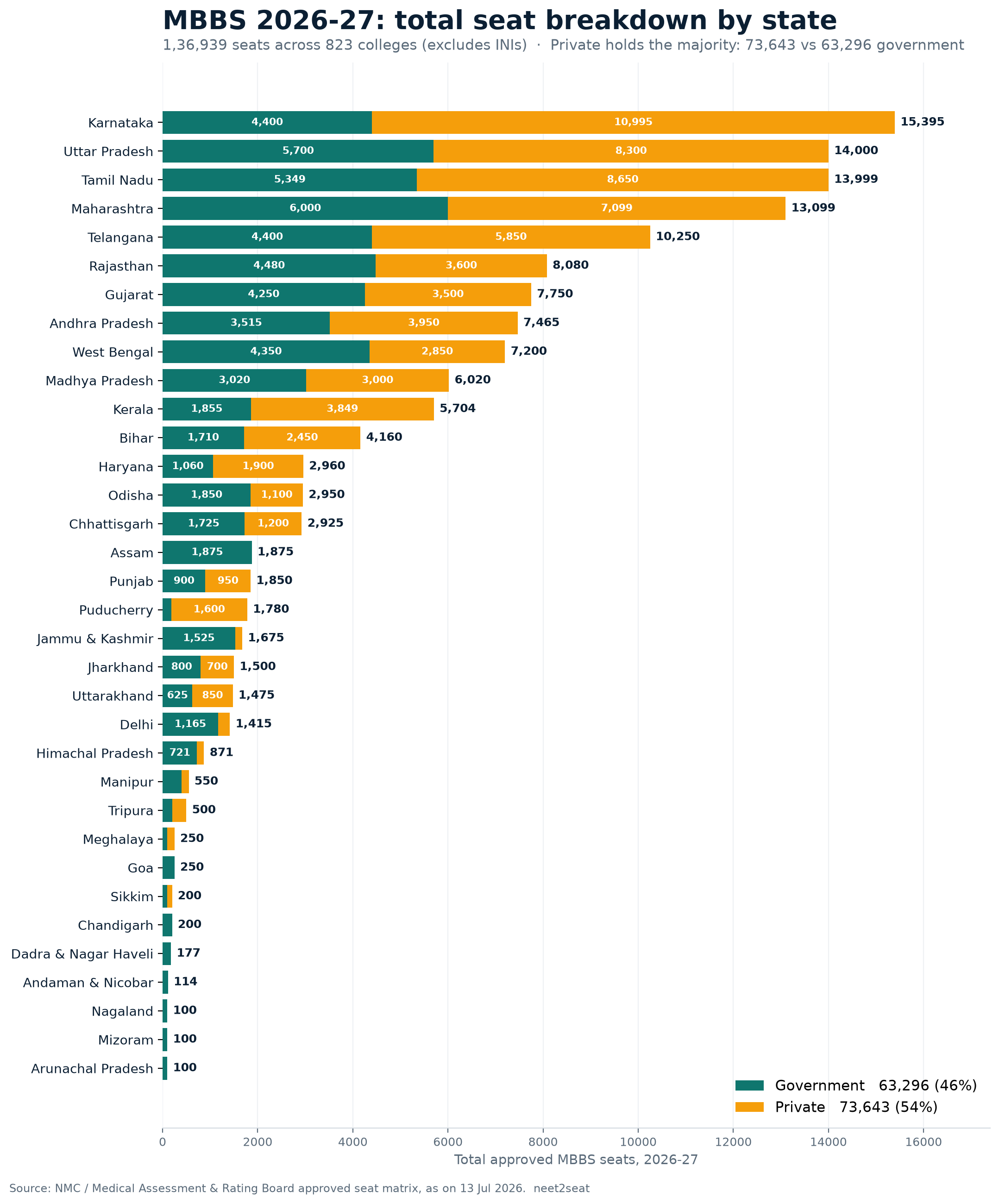
The National Medical Commission has notified the MBBS seat matrix for the 2026-27 session: 1,36,939 seats across 823 medical colleges, up 9,911 from the renewed base of 1,27,028. The count excludes the Institutes of National Importance (AIIMS, JIPMER and the like), so the true all-India total runs higher.
For a NEET aspirant the headline number reads well. One layer down, the picture is more specific: almost four of every five new seats this year sit in private colleges. Working out your own chances? Start with the free NEET rank predictor.
Where the seats are
Private colleges now hold the majority of MBBS capacity: 73,643 seats against the government’s 63,296. Government still runs more colleges (441 to 382), so the average government college is the smaller of the two, roughly 144 seats each versus about 193 for a private college. You can compare the state-wise MBBS cutoffs for each of these on neet2seat.
Total approved MBBS seats by state for 2026-27. Source: NMC / MARB seat matrix, as on 13 July 2026.
The expansion is almost entirely private
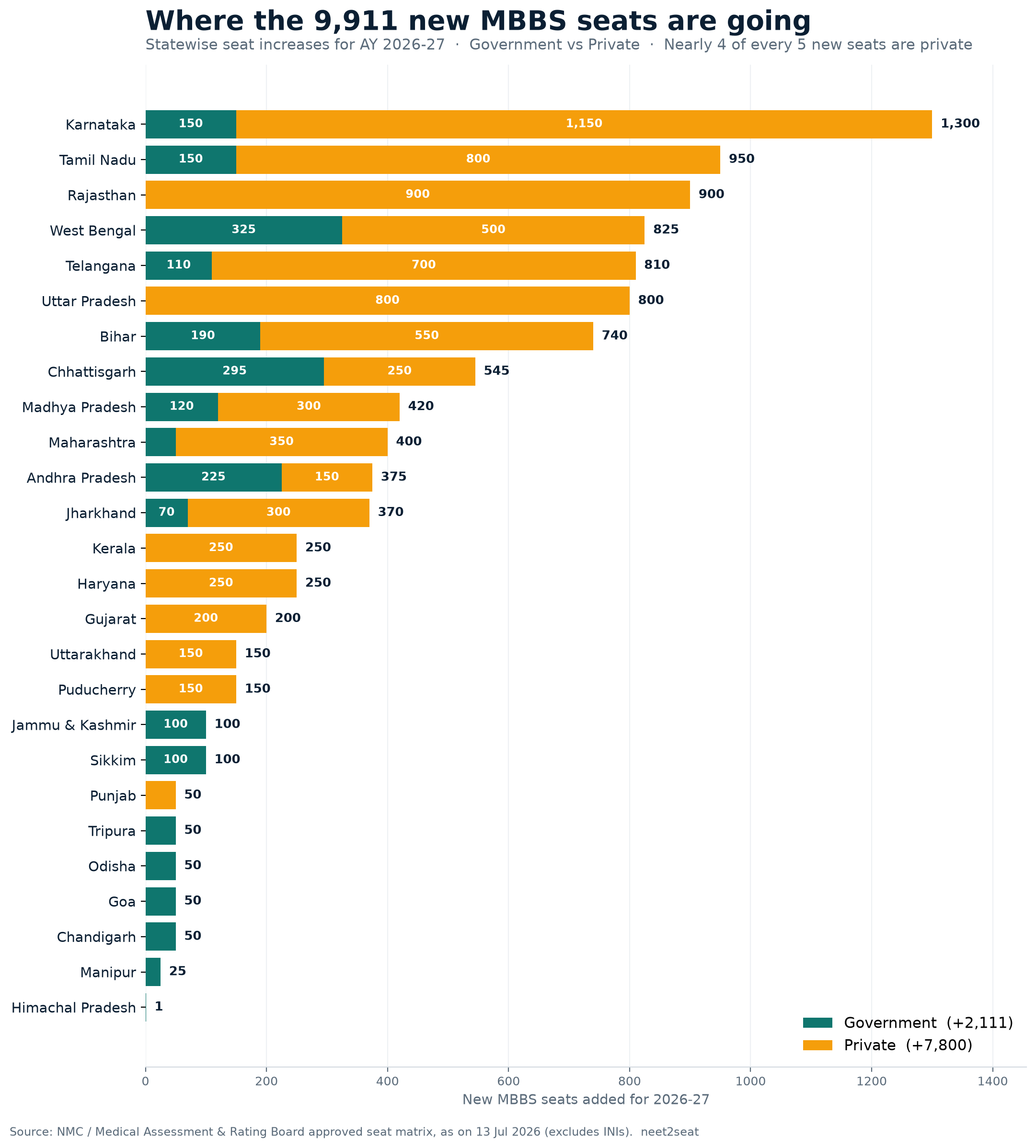
The gap widened almost entirely on the private side. Of the 9,911 seats added:
Private colleges took 7,800, about a 12% jump on their base
Government colleges added 2,111, about 3.4% on theirs
So the affordable government seat, the one most aspirants actually compete for, grew by roughly one in thirty. The overall count rose faster only because private capacity expanded.
Where the 9,911 new seats are going, by state and by management. Source: NMC / MARB seat matrix, as on 13 July 2026.
New colleges
Twenty-five colleges open for the first time in 2026-27, adding 2,400 seats: 2,000 across 18 private colleges and 400 across 7 government ones.
State ladder
Karnataka leads on seats with 15,395, its private capacity (10,995) more than double its government total. It also added the most seats of any state (1,300).
Uttar Pradesh has the most colleges (88) and 14,000 seats.
Tamil Nadu: 13,999. Maharashtra: 13,099. Telangana: 10,250.
The fine print that matters
The matrix is provisional. It can still change on decisions of the Appeal Committee or another competent authority, and the revised version is what the counselling committees must use.
Private colleges granted new seats or fresh approval must post an electronic bank guarantee within seven days; their Letter of Permission is issued only after that clears.
No counselling committee may admit beyond the approved number. A college crossing its cap faces regulatory and penal action under the NMC Act, 2019.
Not sure how the bigger seat pool changes your options? The AI counsellor and our counselling guides walk you through choice-filling and cutoffs step by step.
Source: National Medical Commission / Medical Assessment & Rating Board public notice dated 14 July 2026 (seat matrix as on 13 July 2026), File No. U-15029/09/2025-UGMEB.
Chhattisgarh will add 250 MBBS seats from the 2026-27 session after the National Medical Commission (NMC) cleared five new government medical colleges in the state. Each college gets 50 seats.
The five colleges are in Kabirdham (Kawardha), Janjgir-Champa, Manendragarh, Geedam in Dantewada, and Kunkuri in Jashpur. The clearance came from the NMC’s Medical Assessment and Rating Board (MARB) on 13 July 2026.
With these additions, the number of government medical colleges in Chhattisgarh rises from 10 to 15, and government MBBS seats go from 1,430 to 1,680. Chief Minister Vishnu Deo Sai said the colleges will widen access to medical education and improve healthcare in the state’s rural and remote districts.
Approved on the second attempt
The clearance follows an earlier setback. On 13 June 2026 the NMC had rejected all five applications, citing deficiencies in buildings and laboratories, shortage of teaching staff, missing affiliation from the state Health Sciences University, and administrative appointments that existed only on paper. The state government said it would fix the gaps and appeal. The July approval came after those deficiencies were addressed.
JNM Raipur also gets 20 more seats
Separately, the NMC’s rating board raised the MBBS intake at Pandit Jawaharlal Nehru Memorial (JNM) Medical College, Raipur, from 230 to 250 seats, also effective 2026-27. That is 20 seats on top of the 250 from the five new colleges.
What it means for NEET aspirants
More government seats give Chhattisgarh candidates additional lower-fee options in state counselling. These are new colleges in their first year, so their cutoffs cannot be compared with established institutions yet; first-year closing ranks usually settle over the opening rounds. You can track the state’s current government and private closing ranks on the Chhattisgarh NEET cutoffs page, and see where your score places you with the NEET rank predictor. neet2seat will publish college-wise cutoffs for these new seats once the 2026 Chhattisgarh counselling data is released.
Source: National Medical Commission approvals as reported on 13 July 2026 (Amar Ujala, APAC News Network, The Sootr), with the June 2026 rejection reported by Medical Dialogues. State seat totals as reported by Medical Dialogues.
The National Testing Agency (NTA) has put the scanned OMR answer sheets and recorded responses for NEET (UG) 2026 online, and opened a short window for candidates to challenge their recorded responses. The window runs from 13 July to 15 July 2026 and closes at 11:00 AM on 15 July. The scanned sheets and responses are available at neet.nta.nic.in.
This covers the NEET (UG) 2026 re-exam that NTA held on 21 June 2026, from 2:00 PM to 5:15 PM. A scanned copy of each candidate’s OMR answer sheet has also gone to the email address registered during the NEET 2026 application. We had flagged when these would appear in our earlier note on the Re-NEET 2026 OMR and response sheet.
What the OMR sheet is
OMR stands for Optical Mark Recognition. In NEET, you answer on a printed OMR sheet by darkening one bubble per question with a blue or black ballpoint pen. A scanning machine reads those darkened bubbles and turns them into your recorded responses, which is the answer set NTA evaluates against the answer key. The scanned image NTA has now displayed is a photograph of your own filled sheet, and the recorded responses are what the machine read from it. This challenge window lets you check that the two agree, because a faint, partial or stray mark can be read wrongly.
What you can challenge, and what you cannot
This window is only for the recorded responses, meaning the answers the scanning machine read from your OMR sheet. If a recorded option does not match what you actually darkened on the physical sheet, you can flag it. The same applies to a wrongly captured data field such as Roll Number, Booklet Number or Set Code.
The answer key challenge is a separate process, and NTA says it is already concluded. That window closed earlier, as we covered when the re-exam provisional answer key was released. No challenge to the answer keys will be accepted now.
Fee
The fee is ₹200 for each response you challenge. The notice’s annexure states this amount is refunded if your challenge is verified as correct, while the summary table describes it as non-refundable, so treat the fee as at risk until NTA clarifies. Payment is online only, through Net Banking, Debit or Credit Card, or UPI, and must reach NTA by 11:00 AM on 15 July 2026. A challenge without a completed payment will not be processed.
How to raise a challenge
Go to neet.nta.nic.in and log in with your Application Number and password.
Complete the two-factor authentication by entering the OTP sent to your registered mobile number and email.
Open “View/Challenge OMR Sheet & Recorded Responses” and compare your scanned sheet against the options the machine read, question by question.
Select each question where the recorded option is wrong and tick your claimed answer.
Pay ₹200 per challenge, submit, then download and print the acknowledgement page for your records.
Points to keep in mind
Only a circle fully darkened with a blue or black ballpoint pen counts as a valid response. A faint or partial mark can be read differently by the scanner.
Review the scanned image carefully before you pay, since the fee is charged per challenge.
Raising a challenge on a doctored or tampered scanned image is treated as Unfair Means, and can lead to debarment or legal action.
What comes next
Once the recorded responses are settled, the re-exam result is the next milestone; we track the likely timing in our note on the NEET UG 2026 result date. As soon as you have a score in hand, you can estimate your standing with the NEET rank predictor, look up last year’s closing ranks on the college cutoffs pages, and map out a plan with the AI counsellor.
For any clarification, NTA has listed 011-40759000 and 011-69227700, and the email neetug2026@nta.ac.in. Candidates should rely on neet.nta.nic.in and nta.ac.in for updates.
Source: NTA Public Notice dated 13 July 2026, “Display of Scanned Images of OMR Answer Sheet and Recorded Response for National Eligibility cum Entrance Test (UG)-2026”.
The Government of Punjab has notified the admission rules for MBBS and BDS seats in the state for 2026. The notification, issued by the Department of Medical Education and Research on 8 July 2026, covers government and private medical and dental colleges, including private universities and minority institutions, and it supersedes every earlier admission notification in the state.
Baba Farid University of Health Sciences (BFUHS), Faridkot, will run the centralised counselling. Every seat, whether government quota, management quota, NRI or minority, is filled on NEET merit.
How the seats are filled
In government colleges, 15% of MBBS and BDS seats go to the All India Quota, filled by the Medical Counselling Committee (MCC) of the DGHS. The remaining 85% form the state quota, filled by BFUHS on NEET merit. After the NEET result, candidates apply to BFUHS on its prescribed form for all seats except the All India Quota. Left-over seats are filled by the same admission committee on the same merit, so individual colleges cannot call for separate applications.
Who qualifies for the Punjab state quota
A candidate must be an Indian citizen and meet one of these conditions: passed Class 11 and 12 from Punjab, or was born in Punjab, or is a permanent resident of the state. Permanent residence covers, among others, those who studied five years in Punjab (or the two years just before the qualifying exam), and the children of Punjab government employees, pensioners and long-settled residents. Wards of defence personnel posted in Punjab, NRI candidates and minority-community candidates competing for minority seats are also eligible.
A ₹20 lakh service bond for government MBBS seats
Students admitted to MBBS in Punjab’s government medical colleges must sign a service bond of ₹20 lakh. It commits them to two years of government service for a state-quota seat and one year for an All India Quota seat. Anyone who does not complete the bonded service pays the ₹20 lakh, on top of any other recovery. The bonded posting, duties and location are decided by the state government.
Punjab MBBS and BDS fees 2026: government and private college fee structure
The notification fixes the annual tuition for every college type and quota. Government seats are the cheapest, while private management-quota and NRI seats cost the most. The table below lists the annual tuition, in rupees, for each seat type.
NRI seats are charged for the whole course rather than by year: US$1,10,000 for MBBS and US$44,000 for BDS. The minority colleges CMC and CDC, Ludhiana, charge ₹6.60 lakh a year for MBBS and ₹2.20 lakh a year for BDS, and SGRD University, Amritsar, charges ₹12,06,000 in the first MBBS year; all three raise fees 10% every year. Fees are payable every six months, and colleges cannot demand the full course fee in advance. Hostel charges are extra and are listed in the notification.
Reservation
Government colleges reserve 25% of state-quota seats for Scheduled Castes, 10% for Backward Classes, 10% for the Economically Weaker Section and 5% for persons with disability, along with smaller quotas for sports persons, wards of defence and Punjab Police personnel, descendants of freedom fighters, terrorist and riot-affected families, and border and backward-area candidates. Private colleges follow the same pattern and add a 1% quota for Jammu and Kashmir migrants. A reserved-category candidate who qualifies on general merit is counted against the general seats.
NRI seats
NRI seats cover 15% of the intake in every private college, at Guru Gobind Singh Medical College, Faridkot, and at the Dr B.R. Ambedkar State Institute of Medical Sciences (AIMS), Mohali. Government colleges set aside a smaller number: 13 seats each at the Patiala and Amritsar government medical colleges, and 3 and 4 seats at the Amritsar and Patiala government dental colleges. NRI counselling is held before the other categories, and any unfilled NRI seat moves to the general pool.
A single-state affidavit
Every candidate, with a parent or guardian, must file a sworn affidavit that they are claiming Punjab state-quota eligibility only and have not sought state-quota admission in any other state or union territory for the same year. A false declaration cancels the admission at any stage. A student already admitted elsewhere can join afresh through this year’s counselling with a no-objection certificate, but leaving a government MBBS or BDS seat before completing two years attracts the full course fee and penalties.
What aspirants should do next
Punjab candidates should watch the BFUHS website for the counselling schedule, seat matrix and category-wise merit lists, which the university must display at least seven days before counselling. To judge where you stand, our Punjab NEET cutoffs page lists last year’s college-wise closing ranks, and the NEET rank predictor estimates which Punjab colleges your score can reach. Read the full notification for the exact criteria that apply to your case.
Chennai, July 9, 2026. The Tamil Nadu government is preparing a Supreme Court challenge after three private medical colleges were granted deemed-to-be-university status. The change removes about 650 MBBS seats from the state’s admission pool just as the 2026 counselling season gets underway.
The three institutions are St Peter’s Medical College (about 250 seats), and Dhanalakshmi Srinivasan Institute of Medical Sciences together with Srinivasan Medical College (about 400 seats combined). A fourth, Karpaga Vinayaga Institute of Medical Sciences and Research Centre in Maduranthakam, has announced deemed status on its website, although NMC records still show it affiliated to the Tamil Nadu Dr MGR Medical University.
The immediate consequence: admissions to these colleges move out of the Tamil Nadu Selection Committee’s hands and into all-India counselling run by the Medical Counselling Committee (MCC). The state stands to lose about 350 government-quota seats right away, including seats reserved for government-school students under Tamil Nadu’s 7.5% quota. State Health Minister K.G. Arunraj has accused the colleges, some reportedly linked to leaders of major political parties, of exploiting legal loopholes. He said they approached central regulators directly and bypassed the state’s No Objection Certificate process. By his count, 462 government-quota MBBS seats plus 35 government-school-quota seats are at risk across four colleges.
The cost impact on students is steep. Government-quota students in these private colleges currently pay between ₹4.35 lakh and ₹5.4 lakh a year. As deemed universities, with no centrally fixed fee, the same colleges can charge between ₹20 lakh and ₹35 lakh annually. The opposition PMK, counting colleges already converted and three more in the pipeline, says the state could lose about 700 affordable MBBS seats. Its leader Anbumani Ramadoss has asked the government to offset the loss by adding 50 seats each in 16 government medical colleges.
State officials say the government will approach the Supreme Court early next week after consulting legal experts.
Seat figures vary across sources: 350 immediate government-quota seats per initial reports, 462 plus 35 per the state health minister, and about 700 per PMK’s projection that includes colleges still in the pipeline. Each figure above is attributed to who stated it.
The National Medical Commission has issued conditional seat-renewal letters to more than 800 medical colleges for their MBBS seats for the 2026-27 session, according to a report in Medical Dialogues (10 July 2026). Instead of running the usual pre-admission inspection at every college before clearing it to admit students, the Commission’s Medical Assessment and Rating Board (MARB), headed by Prof M.K. Ramesh, has let colleges proceed with admissions now and made the renewal conditional on later checks.
Colleges have 45 days to fix flagged deficiencies in infrastructure, faculty and clinical facilities. After that, MARB will run surprise physical, virtual or hybrid assessments rather than a scheduled annual inspection. The stated logic: a surprise visit shows whether a college meets standards year-round, not just on inspection day.
What this means if you are sitting NEET-UG 2026
Most years, a chunk of seats stays frozen going into counselling because a college’s renewal is stuck pending inspection. Those seats either arrive late or drop out of the matrix mid-cycle, which shrinks choice and pushes cutoffs up. By renewing conditionally up front, the NMC keeps far more colleges’ seats live for the 2026-27 counselling that follows the NEET-UG result.
In practical terms:
More seats on the table. A fuller matrix at the start of counselling means more options across rounds.
Slightly easier cutoffs. More available seats for the same candidate pool generally nudges closing ranks outward, so the rank needed to secure a given college tends to loosen a little.
A better overall chance of landing a seat, especially in the later rounds where late-added seats usually surface.
The catch — read before you lock a choice
The renewal is conditional, not final. If a college still has unresolved deficiencies when MARB shows up, the Commission can cut its intake, withdraw seats, or suspend admissions. That risk sits mainly with colleges carrying serious shortfalls, and action typically will not unseat students already admitted in a cycle. Still, before you commit a top preference to a lesser-known private college, check its current NMC status. We will track which colleges face intake action as MARB’s assessments come through.