- Karnataka uses 8 base categories plus a 6-suffix system (G, K, R, H, KH, RH), creating 75+ distinct category codes in allotment data.
- The HK region suffix (Article 371J) provides the largest advantage: up to 70% reservation at colleges within the Hyderabad-Karnataka region.
- Category 1 is exempt from creamy layer exclusion; Categories 2A through 3B require Non-Creamy Layer with income below Rs 8 lakh.
- Your Karnataka state category and central MCC category are independent classifications. Check both lists for your specific caste.
Karnataka’s category system has no equivalent at the central level
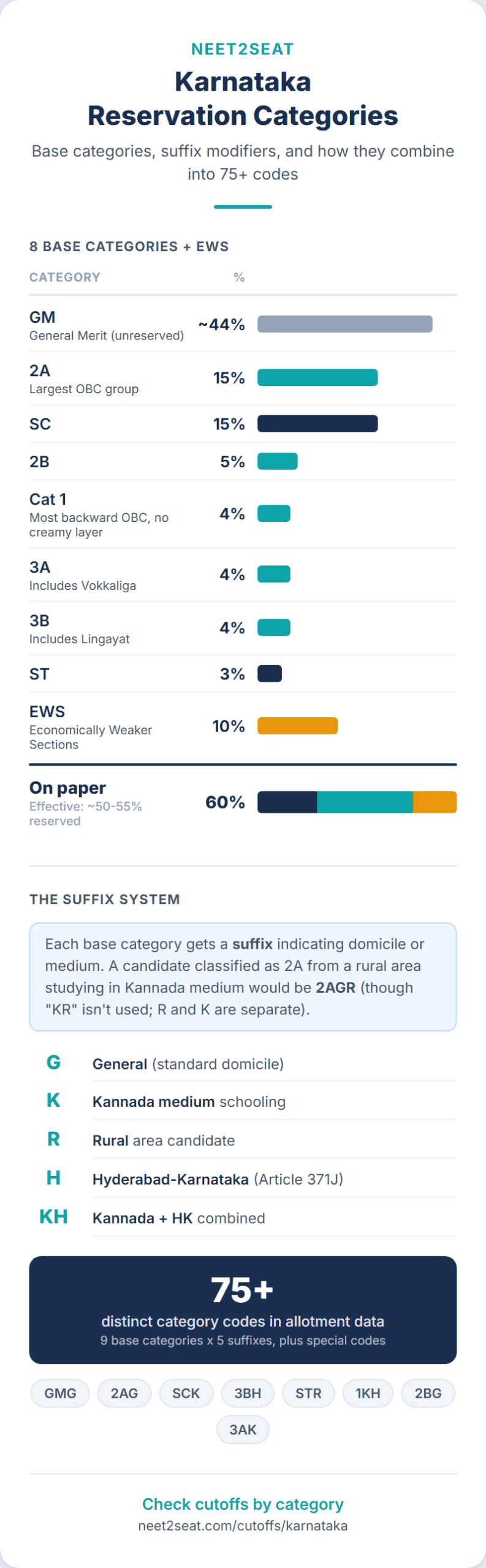
If you have seen only the MCC categories (SC, ST, OBC-NCL, EWS, General), Karnataka’s system will look unfamiliar. The state divides backward classes into five numbered groups (Category 1, 2A, 2B, 3A, 3B) instead of a single OBC label. It then layers a suffix system on top, creating separate sub-quotas for rural students, Kannada medium students, and Hyderabad-Karnataka region candidates. The result is over 75 distinct category codes in allotment data.
This guide covers every category used in Karnataka NEET UG state counselling, based on KEA’s counselling documentation and the Karnataka Backward Classes Commission’s classification system. If you are looking for Maharashtra categories, see our Maharashtra categories guide.
Base categories: the eight groups
Karnataka recognizes eight base reservation categories for medical admissions. The stated reservation percentages (Cat 1 at 4%, 2A at 15%, 2B at 5%, 3A at 4%, 3B at 4%, SC at 15%, ST at 3%, plus EWS at 10%) add up to 60% on paper. In practice, not all reservation seats are filled (some revert to GM if no eligible candidates remain), and the effective reservation is closer to 50-55% in a given year. Roughly 40-50% of state quota seats end up going to General Merit candidates.
GM (General Merit): unreserved
Open to all candidates irrespective of caste, religion, or community. Approximately 44% of state quota seats fall under GM after all reservations are applied. GM seats are filled strictly on NEET All India Rank merit. Any candidate, including those from reserved categories, can compete for GM seats. No caste certificate is required. GM is the most competitive category in Karnataka counselling.
In 2025, GM closing AIRs at the top government colleges ranged from 3,025 (Bangalore Medical College, Round 2) to approximately 23,700 (Gulbarga Institute of Medical Sciences, Round 2). At private colleges under government quota, GM cutoffs extended to much higher AIRs
Category 1: most backward OBC group (4%)
Category 1 is unique among Karnataka’s OBC groups: the creamy layer exclusion does not apply. High-income families in Category 1 retain reservation eligibility, whereas families in Categories 2A through 3B with annual income above Rs 8 lakh lose eligibility and must compete under GM. This makes Category 1 the only OBC group with no income ceiling.
Category 1 covers the most socially and educationally backward communities among the Other Backward Classes. It carries a 4% reservation. Candidates must submit a Caste/Income Certificate issued by the jurisdictional Tahasildar. Fee exemption may be available for candidates whose family income is below Rs 2.5 lakh per year.
Category 2A: largest OBC group (15%)
The largest reservation category in Karnataka with 15% of state quota seats. Category 2A covers communities classified as backward under Group 2A by the Karnataka State Commission for Backward Classes. Because of the large allocation and large candidate pool, 2A cutoffs at government colleges can be competitive; at less sought-after institutions, they sometimes approach GM cutoffs.
Non-Creamy Layer Certificate with an RD (Registration Department) number is required. Family annual income must not exceed Rs 8 lakh.
Category 2B: OBC Group B (5%)
A 5% reservation for communities classified under Group 2B. Smaller candidate pool than 2A, which means cutoff ranks for 2B tend to be higher (less competitive) than 2A at the same college. The same documentation applies: Caste Certificate specifying 2B subcategory from the Tahasildar, plus Non-Creamy Layer Certificate with RD number and income below Rs 8 lakh.
Category 3A: OBC Group A (4%)
A 4% reservation covering communities classified under OBC Group 3A. Includes the Vokkaliga community and related groups. Same Non-Creamy Layer documentation requirements as 2A and 2B. The smaller seat allocation means cutoffs vary significantly between colleges: at top government colleges, 3A cutoffs can be close to GM, while at private colleges the gap widens.
Category 3B: OBC Group B (4%)
A 4% reservation for communities classified under OBC Group 3B. Includes the Veerashaiva-Lingayat community and related groups. Cutoff patterns are comparable to 3A. Candidates from 3B communities who fall within the creamy layer (income above Rs 8 lakh) must compete under GM instead.
Note: In 2024, the Karnataka government scrapped a 4% Muslim quota that had previously existed within OBC and redistributed portions to Categories 3A and 3B. The exact impact on seat percentages for the 2025 medical counselling cycle should be confirmed against the current KEA bulletin, as some sources report updated percentages while others continue to show the older figures.
SC (Scheduled Castes): 15%
A 15% reservation covering all communities listed under the Constitution (Scheduled Castes) Order for Karnataka. No creamy layer criterion applies. In 2024, Karnataka internally restructured SC reservation into four sub-groups (SC Left, SC Right, Touchable, Others), though the total allocation and the counselling process remain functionally the same for most candidates.
Candidates need a Caste/Income Certificate from the Tahasildar. Fee exemption at government colleges may be available for SC candidates with family income below Rs 10 lakh. Vacant SC seats follow the state’s inter-se vacancy filling rules.
ST (Scheduled Tribes): 3%
A 3% reservation for communities listed under the Constitution (Scheduled Tribes) Order for Karnataka. This is the smallest base reservation category. Given the limited allocation, ST seats at popular government colleges fill quickly; candidates should carefully consider their preference order. Caste/Income Certificate from the Tahasildar is required. No creamy layer exclusion. Fee exemptions available as with SC.
EWS (Economically Weaker Sections): 10%
A 10% reservation for economically weaker candidates from the general (unreserved) category, introduced after the 103rd Constitutional Amendment. EWS candidates cannot belong to any of the above reservation categories. Family annual income must be below Rs 8 lakh, with restrictions on agricultural land and residential property ownership.
The EWS certificate follows the format prescribed by the state government, though Karnataka has largely adopted the central government format following Supreme Court guidance on uniform NEET admission standards.
The suffix system: sub-quotas within each category
Karnataka is unique among Indian states in using a suffix-based encoding for sub-quotas. Each of the eight base categories can carry one of six suffixes, and these suffixes determine additional eligibility criteria:
G (General sub-quota)
The default. No additional eligibility beyond the base category requirements. A candidate coded as “SCG” is an SC candidate with no Kannada medium, rural, or HK region advantage. This is the standard pathway.
K (Kannada medium)
Reserved for candidates who completed 10 years of schooling (Classes 1 through 10) in Kannada medium schools recognized by the Karnataka government. Approximately 5% of government seats are allocated for Kannada medium students within each category. A Kannada Medium Study Certificate is required.
A candidate coded as “2AK” is a Category 2A candidate who studied in Kannada medium. Their cutoff is typically different from “2AG” (Category 2A general), often reflecting the smaller competitive pool.
R (Rural)
Reserved for candidates who studied in schools located in rural areas of Karnataka. Approximately 5% of government seats are set aside for rural area students. A Rural Area Study Certificate is required.
H (Hyderabad-Karnataka region)
The HK reservation is one of the most impactful sub-quotas in Karnataka. Two layers apply: 8% of seats statewide across all government colleges, plus up to 70% of seats at colleges located within the HK region (Bidar, Kalaburagi, Raichur, Yadgir, Koppal, Ballari). A GM candidate from Kalaburagi with HK status (“GMH”) can secure a seat at a Bengaluru government college with a considerably higher AIR than “GMG” would require.
Reserved for candidates from the six districts of the Hyderabad-Karnataka (now Kalyana-Karnataka) region. This sub-quota operates under Article 371(J) of the Constitution. Article 371(J) Certificate or Hyderabad-Karnataka Domicile Certificate from the Tahasildar’s office is required.
KH (Kannada medium + Hyderabad-Karnataka)
Candidates must meet both criteria: Kannada medium schooling and HK region domicile. A candidate coded “SCKH” is SC, Kannada medium, and from the HK region. The competitive pool for combination suffixes is the smallest, and cutoffs can differ substantially from the base category.
RH (Rural + Hyderabad-Karnataka)
Candidates must qualify for both the rural area and HK region criteria. Same logic as KH but with rural schooling instead of Kannada medium.
How the suffix system creates 48+ codes
Eight base categories multiplied by six suffixes gives 48 regular category codes. In practice, not all combinations appear in every counselling round (some combinations have zero eligible candidates for specific colleges), but our database tracks 78 distinct category codes across Karnataka’s allotment data.
Beyond the 48 regular codes, KEA uses special category codes:
- GMP, GMPH: General Merit Private, GM Private + HK region. For private college seats specifically.
- OPN: Open (private college), similar to GMP.
- OTH: Others (miscellaneous seat categories).
- MA, MC, ME, MM, MU: Minority quotas. MA = Minority Arabic, MC = Minority Christian, ME = Minority English (often the Christian minority medium), MM = Minority Muslim, MU = Minority Urdu.
- RC1 through RC8: Religious Congregation seats at deemed universities, each numbered for a specific congregation or trust.
- NRI: Non-Resident Indian quota.
- PH, PHM: Persons with Disability. PHM is PWD within the Muslim minority sub-category.
- NCC, SPO: NCC (National Cadet Corps) and Sports quota candidates.
- XD, D: Defence quota variants.
- JK: Jammu & Kashmir migrant quota.
- S-G: Special Government seats.
In the Karnataka cutoff analyzer, you can filter by any of these codes to see closing ranks for specific sub-quotas at specific colleges. Start with your base category, add your suffix (e.g., “SCR” for SC Rural), and compare cutoffs across colleges to build your preference list.
Horizontal reservations: parallel to the base categories
Like Maharashtra’s specified reservations, Karnataka operates several horizontal reservations that run in parallel with the base category system:
Women: 30% of seats within each category are reserved for female candidates. A female SC candidate competes for the SC female sub-quota first; if all female SC seats are filled, she competes for general SC seats on merit.
PWD (Persons with Disability): 5% of seats, applied across all categories. Disability certificate from a designated medical board is required.
Rural: approximately 5% of government seats, encoded through the R suffix.
Kannada medium: approximately 5% of government seats, encoded through the K suffix.
Defence/Ex-servicemen: a small quota for children of defence personnel.
NCC and Sports: quotas for NCC cadets and state/national level sportspersons.
Documents needed for each category
| Category | Required documents |
|---|---|
| GM | No category-specific documents (standard NEET + academic documents only) |
| Category 1 | Caste/Income Certificate from Tahasildar |
| 2A, 2B, 3A, 3B | Caste Certificate from Tahasildar + Non-Creamy Layer Certificate with RD number (income below Rs 8 lakh) |
| SC, ST | Caste/Income Certificate from Tahasildar (no NCL required) |
| EWS | EWS certificate with income proof (below Rs 8 lakh) |
| K suffix | Kannada Medium Study Certificate (Classes 1-10) |
| R suffix | Rural Area Study Certificate |
| H/KH/RH suffix | Article 371(J) or HK Domicile Certificate from Tahasildar |
| PWD | Disability certificate from designated Disability Assessment Board |
All category claims must be made during KEA registration. You cannot add or change your category after the deadline. If documents are missing or invalid at verification, you are treated as GM. Start gathering certificates immediately after NEET results. NCL certificates from the Tahasildar can take weeks to process. See our documents guide for the full checklist.
Non-Creamy Layer: who needs it and who does not
NCL applies to OBC categories 2A, 2B, 3A, and 3B. It does not apply to Category 1, SC, or ST. The certificate must include an RD (Registration Department) number and confirm family annual income below Rs 8 lakh. An expired or improperly formatted NCL means your reservation claim is denied and you compete under GM for the entire counselling cycle. Apply for NCL as early as possible after receiving your NEET result.
The certificate is issued by the Tahasildar of your taluk. Processing time varies; apply early.
How Karnataka categories map to central government categories
Your category for MCC (All India Quota) counselling is determined by the central government list. Your category for KEA (state) counselling is determined by Karnataka’s list. These are independent classifications. A single candidate can hold different categories in each system.
| Karnataka category | Likely central government equivalent |
|---|---|
| GM | General/Unreserved |
| Category 1, 2A, 2B, 3A, 3B | OBC-NCL (if your caste is on the central OBC list) |
| SC | SC |
| ST | ST |
| EWS | EWS |
The mapping is not automatic. Some Karnataka OBC communities may not appear on the central OBC list, making you General/Unreserved for AIQ purposes. Check your specific caste against the central list independently. Your KEA category and MCC category can be different.
What our data shows about category cutoffs
Our database tracks 45,673 Karnataka allotment records across 2023, 2024, and 2025, with 78 distinct category codes. Some patterns from the data:
The gap between GM and reserved category closing AIRs at government colleges follows a consistent hierarchy. At Bangalore Medical College (Round 2, 2025), the GM closing AIR was 3,025. Category 2A, the largest OBC group, had noticeably higher (less competitive) closing AIRs, while SC and ST closings were higher still. This hierarchy holds across colleges, though the gap narrows at less competitive institutions.
HK region codes (H, KH, RH suffixes) consistently show the largest advantage over their non-HK equivalents at the same college. At colleges within the HK region (Gulbarga, Raichur), HK cutoffs can be multiple times higher than GM cutoffs because those institutions reserve 70% of seats for HK candidates under Article 371(J). Kannada medium (K) and Rural (R) cutoffs fall between the general suffix (G) and HK suffix (H).
Year-over-year, all categories have seen cutoffs tighten. Between 2023 and 2025, closing AIRs at top government colleges dropped by 25% to 63%, depending on the college and category. This trend reflects the growing number of NEET qualifiers competing for a seat pool that has not expanded at the same rate.
You can explore all category-level cutoff data using the Karnataka cutoff analyzer.
FAQ
I am OBC-NCL under the central government list. Which Karnataka category am I?
Karnataka’s five OBC groups (Category 1, 2A, 2B, 3A, 3B) are based on the Karnataka State Commission for Backward Classes classification, which is separate from the central OBC list. Your specific caste determines your Karnataka OBC sub-category. Check the state backward classes list for your community, or consult the Tahasildar’s office in your taluk.
Can I claim both a base category and a suffix simultaneously?
You always have exactly one code: a base category plus one suffix. If you are Category 2A, studied in Kannada medium, and are from the HK region, you would be “2AKH.” You cannot hold multiple suffix codes simultaneously. KEA assigns the most advantageous applicable code based on your documented eligibility.
If I am from the HK region but studying in Bengaluru, can I claim the H suffix?
HK eligibility is based on your residential origin in one of the six qualifying districts, not on where you attend school. If you are from Kalaburagi district but studied in Bengaluru, you can still claim the H suffix if you hold the Article 371(J) certificate. However, for the KH (Kannada medium + HK) or RH (Rural + HK) suffixes, your school must meet the respective medium or rural criteria.
Does the creamy layer apply to Category 1?
No. Category 1 is exempt from the creamy layer exclusion. This distinguishes it from Categories 2A, 2B, 3A, and 3B, where families with annual income above Rs 8 lakh lose reservation eligibility and must compete under GM.
What are the RC codes (RC1, RC2, etc.) in deemed university allotments?
RC stands for Religious Congregation. Deemed universities in Karnataka often have seats reserved for specific religious congregations or trusts that run the institution. RC1 through RC8 are numbered codes for these specific congregations. The eligibility criteria are set by each institution and involve membership in or affiliation with the specific religious congregation.
How do I know which category codes to filter for in the cutoff analyzer?
Start with your base category, then add your suffix. If you are SC from a rural area, filter for “SCR.” If you are GM with no special sub-quota, filter for “GM” (which includes GMG and all GM variants). The cutoff analyzer shows all available category codes in the filter dropdown for Karnataka.