Medical college fees under All India Quota: government, deemed, and central institutions
The fee difference between institution types in MCC NEET UG counselling is large enough to change the financial trajectory of a medical career. Government AIQ seats can cost under Rs 1 lakh for the entire MBBS programme in some states, while deemed university seats routinely exceed Rs 1 crore. This guide breaks down fees by institution type, compares costs across states, and covers what you actually pay beyond tuition.
Government college fees under AIQ
Government medical college fees are set by the respective state government or its fee regulatory authority. AIQ students pay the same fee as state quota students at the same institution. There is no out-of-state surcharge.
AIQ and state quota students at the same government college pay identical tuition. A Bihar student at a Tamil Nadu government college pays the same Rs 13,610 per year as a local student. There is no penalty for crossing state lines through AIQ.
The range across states (annual tuition, 2025-26 data where available):
| State | Approximate annual fee | Approximate 5-year total |
|---|---|---|
| Tamil Nadu | Rs 13,610 | ~Rs 70,000 |
| Andhra Pradesh | Rs 26,500 | ~Rs 1,35,000 |
| Kerala | Rs 33,500 – Rs 53,865 | ~Rs 1,70,000 – Rs 2,70,000 |
| Karnataka | Rs 36,070 | ~Rs 1,80,000 |
| Maharashtra | Rs 1,52,100 + Rs 5,000 dev fee | ~Rs 8,00,000 |
| Delhi (MAMC, LHMC, UCMS) | Rs 2,60,000 | ~Rs 13,00,000 |
These are tuition-only figures. Additional fees (hostel, library, gymkhana, examination) add Rs 5,000 to Rs 20,000 per year depending on the institution. Even with add-ons, the maximum five-year cost at a government college through AIQ is roughly Rs 15 lakh (Delhi), and it can be under Rs 1 lakh (Tamil Nadu).
The fee range across government colleges is itself wide: a Tamil Nadu government seat costs roughly Rs 70,000 total, while a Delhi government seat costs approximately Rs 15 lakh. Both are government MBBS degrees with identical recognition.
Note: Kerala charges different rates for AIQ and state quota at some government colleges (Rs 33,500 for AIQ versus Rs 53,865 for state quota), though this is an exception. In most states, the fee is identical.
Deemed university fees
Deemed university fees are set by a committee under Supreme Court guidelines and vary widely by institution. The 2025 MCC cycle had 88 deemed institutions with MBBS fees ranging from approximately Rs 10 lakh per year to Rs 30.5 lakh per year.
Some reference points from the 2025 cycle:
| Institution | Approximate annual fee | Approximate 5-year total |
|---|---|---|
| Symbiosis Medical College, Pune | ~Rs 10 lakh | ~Rs 50 lakh |
| Kasturba MC Manipal (MAHE) | ~Rs 14-15 lakh | ~Rs 70-75 lakh |
| SRM Medical College, Chennai | ~Rs 18-20 lakh | ~Rs 90 lakh – Rs 1 crore |
| DY Patil Medical College, Pune | ~Rs 16-18 lakh | ~Rs 80-90 lakh |
| Sree Balaji Medical College, Chennai | ~Rs 30.5 lakh | ~Rs 1.5 crore |
Over 32 deemed colleges in the 2025 cycle charged more than Rs 1 crore for the full MBBS course. In 2025, 36 deemed colleges raised their fees compared to the previous year.
NRI quota seats at deemed universities carry even higher fees, typically 2-3 times the General/Paid seat fee. Check the MCC seat matrix for institution-specific NRI fee details.
AIIMS and JIPMER fees
AIIMS and JIPMER are outliers on the low end. Annual fees at AIIMS campuses are minimal (historically under Rs 5,000 per year for tuition at AIIMS New Delhi, though newer campuses may differ). JIPMER Puducherry similarly charges very low fees. These are fully government-funded institutions.
The combination of extremely low fees and extremely high competition (AIIMS New Delhi closes at AIR 48 in OPEN) means these are accessible only to the very top ranks.
Central university fees
Delhi University medical colleges (MAMC, LHMC, UCMS) charge approximately Rs 2,60,000 per year, among the highest government college fees in the country. IMS-BHU, AMU-JNMC, and VMMC have their own fee structures, generally in the Rs 20,000 to Rs 50,000 per year range.
ESIC college fees
ESIC medical colleges charge fees comparable to government colleges. The exact amount varies by ESIC institution but is generally under Rs 50,000 per year. Children/Wards (CW) seat holders may have different fee structures.
What you actually pay: beyond tuition
The fee listed in the MCC seat matrix is typically the tuition fee. Additional costs include:
- Hostel and mess: Rs 20,000 to Rs 1,50,000 per year, depending on the institution. Some government colleges have subsidised hostels; deemed universities often charge market rates.
- Library, gymkhana, and examination fees: Rs 2,000 to Rs 20,000 per year.
- Textbooks and instruments: Rs 20,000 to Rs 50,000 in the first year, less in subsequent years.
- MCC security deposit: Rs 10,000 (government AIQ) or Rs 2,00,000 (deemed), refundable under certain conditions.
- College-level deposit: Some colleges charge a separate refundable deposit (caution money). Amounts vary.
For a government college, total first-year all-inclusive cost (tuition + hostel + books) typically ranges from Rs 30,000 to Rs 3,50,000. For a deemed university, it ranges from Rs 12 lakh to Rs 35 lakh.
Scholarships and financial aid
Several government schemes can offset costs:
- Central sector scheme of scholarship: For SC/ST/OBC-NCL students at government and private colleges.
- Post-matric scholarship: State-level schemes for reserved category students. Coverage and amounts vary by state.
- MAHADBT (Maharashtra): Post-matric scholarship and freeship for backward class candidates who qualify on merit.
- State-specific schemes: Several states offer fee waivers or scholarships for meritorious NEET qualifiers, especially at government colleges.
Deemed universities occasionally offer institution-level merit scholarships for top rankers, but these are not standardised and must be verified with each university.
Education loans for MBBS are available from nationalised banks (typically up to Rs 10-20 lakh without collateral, higher with collateral). For deemed university fees, a loan is often necessary. Interest rates and repayment terms vary; check with your bank before the counselling cycle starts so financing is ready when needed.
Get your education loan pre-approved before the counselling cycle begins. Loan processing takes 2-4 weeks, and the reporting window after allotment is only 7-9 days. Having financing ready prevents last-minute scrambles that could cost you a seat.
Fee as a factor in choice filling
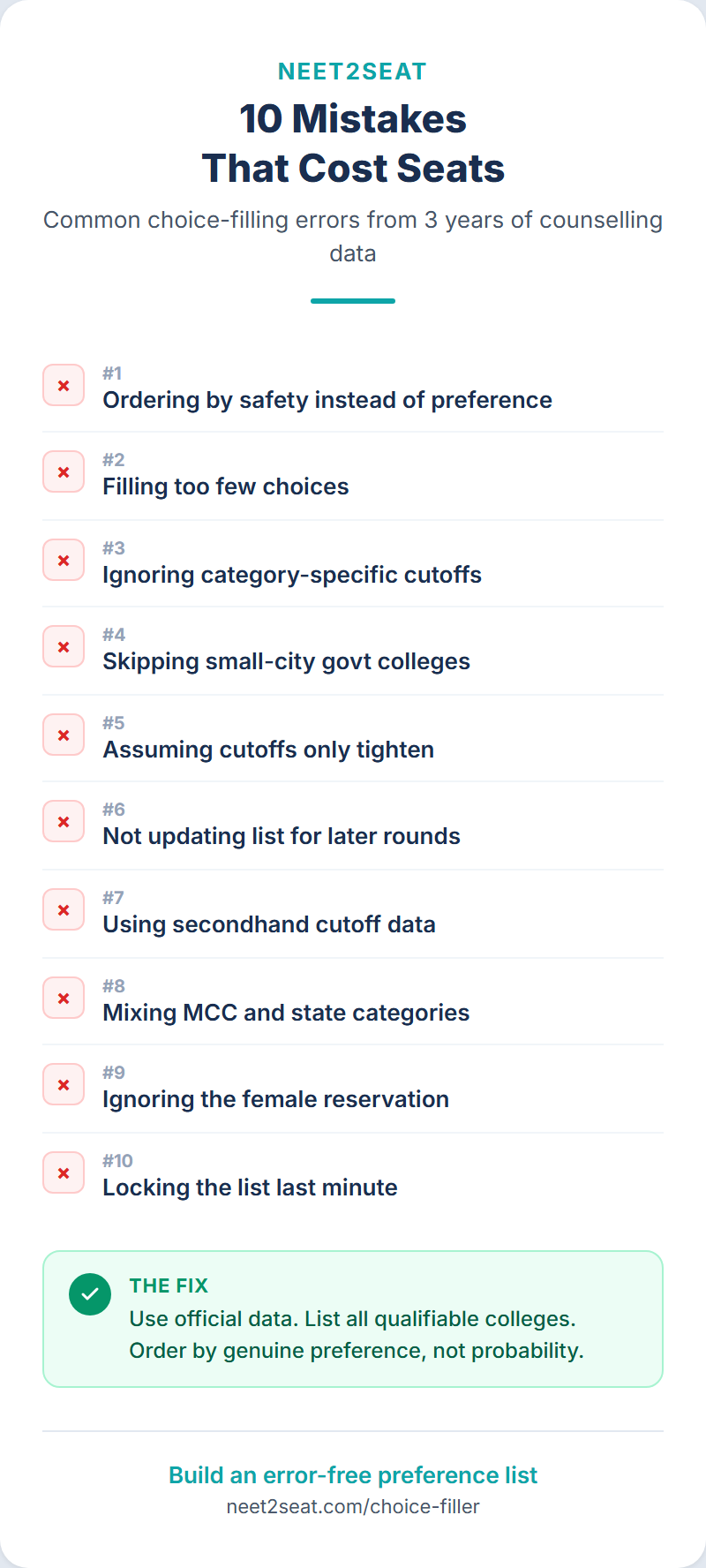
When building your MCC preference list, fee is a legitimate ordering criterion. A candidate who prefers government colleges over deemed universities (due to cost) should list all realistic government AIQ options above deemed options. The algorithm assigns the highest available preference, so placing low-fee government colleges higher ensures they are given priority.
However, do not make fee the only criterion. A deemed university with a 1,500-bed teaching hospital in a metro city may provide better clinical training than a newer government college with limited patient volume. Weigh fee against hospital quality, location, and institutional track record.
Build a personal fee-tolerance threshold before choice filling. List all government colleges you qualify for above that line, then add affordable deemed colleges below. Your preference order should reflect genuine willingness to attend at each college’s published fee.
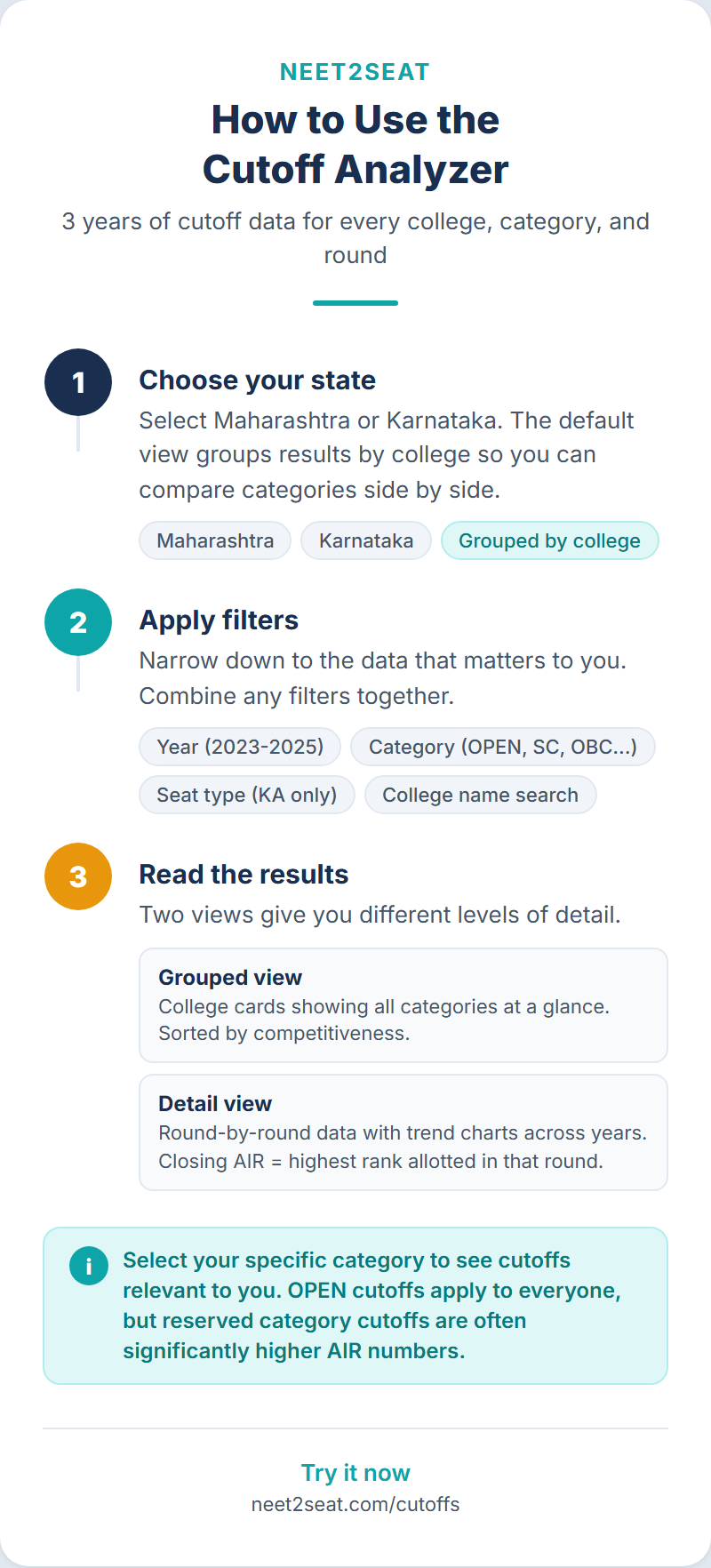
Use our cutoff analyzer to identify which government colleges are realistic for your rank, and our college predictor to quickly see safe and target options across all institution types.
FAQ
Do AIQ students at government colleges pay more than state quota students?
No. In most states, AIQ and state quota students at the same government college pay the same tuition fee. The fee is set by the state government and applies to all students regardless of their admission route. Minor exceptions exist (some Kerala colleges charge differently), but fee parity is the norm.
Can deemed university fees increase during my MBBS course?
Deemed university fees are typically fixed at the time of admission for the duration of the course, as per Supreme Court guidelines. However, some institutions have clauses for annual increases. Check the admission letter and fee structure document carefully before joining.
Is there a fee cap on deemed universities?
The Supreme Court-appointed committee and individual state fee regulatory bodies set guidelines for deemed university fees. There is no single nationwide cap, but the fee structure is supposed to be transparent and approved before the counselling cycle. MCC publishes the approved fee for each institution in the seat matrix.
What is the total cost difference between the cheapest and most expensive MBBS seat through MCC?
The cheapest route is a government college in Tamil Nadu (approximately Rs 70,000 for the full course) or an AIIMS campus (nominal fees). The most expensive is a deemed university NRI seat at a high-fee institution, which can exceed Rs 2 crore for the full course. The gap is over 200x between these extremes.
Should I take an education loan for a deemed university seat?
Education loans for MBBS are common and available from most nationalised banks. Consider the total repayment amount (principal + interest over the moratorium and repayment period) against your expected earnings as a doctor. An Rs 80 lakh loan at 8-10% interest over 7-10 years results in a total repayment of Rs 1.1-1.3 crore. Whether this is manageable depends on your specialisation plans (PG takes another 3 years with limited earning) and family financial situation. Get pre-approved before counselling starts.