- Choice 2 is risk-free: you either upgrade to a better college or keep your Round 1 seat with no penalty.
- The 2025 fee cap (Rs 12,001 advance) makes Choice 2 accessible to virtually all candidates regardless of the allotted college’s fees.
- Upgrade eligibility is limited to colleges ranked above your current allotment on your original preference list.
- Choice 3 (reject and re-enter) carries genuine risk of ending up with no seat; use it only when the allotted seat is genuinely unacceptable.
Choice 1 ends your counselling. Choice 2 keeps it alive. The wrong pick costs lakhs.
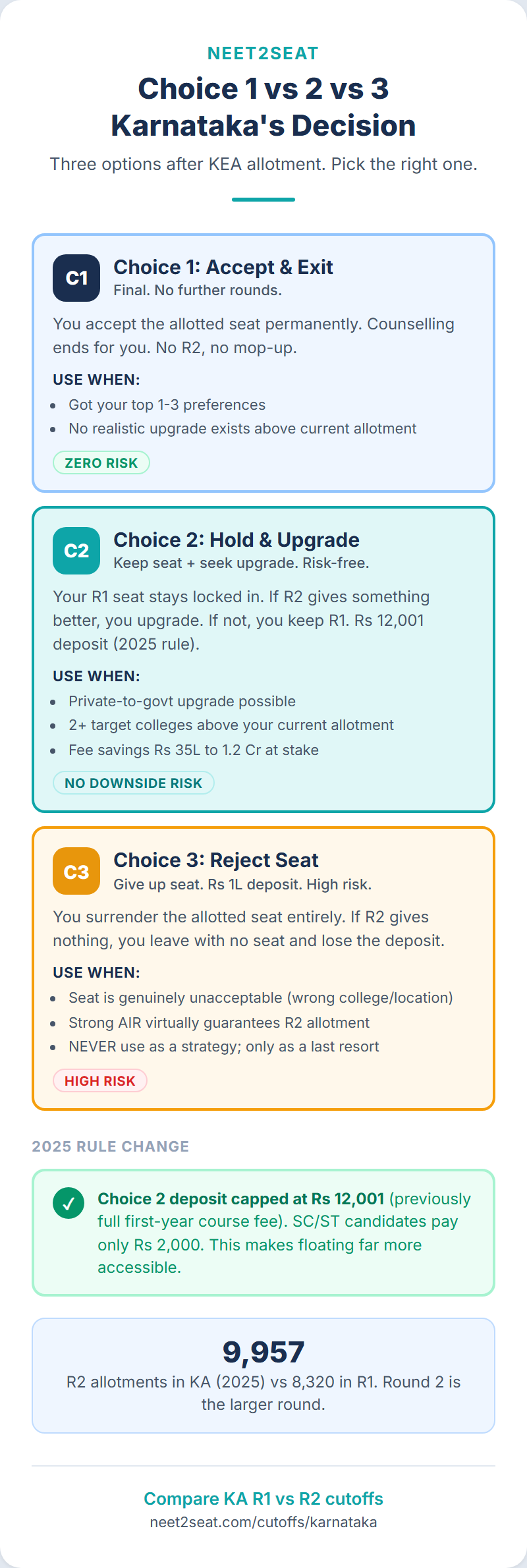
After Karnataka’s KEA publishes each round’s allotment, every allotted candidate selects one of three options: Choice 1 (accept and exit), Choice 2 (accept and seek upgrade), or Choice 3 (reject and re-enter). The decision between Choice 1 and Choice 2 is the Karnataka equivalent of “freeze vs float” in MCC terminology. Choice 3 is a separate, higher-risk path covered at the end of this guide.
This guide covers Karnataka-specific mechanics. For the general float-vs-freeze framework, see our float vs freeze pillar guide. For Maharashtra’s Status Retention system, see our Maharashtra Status Retention guide.
What each choice does, precisely
Choice 1: accept and exit
You take the allotted seat and leave the counselling process. Your preference list becomes irrelevant. You pay the full course fees and report to the college. This is final: you cannot re-enter counselling in later rounds (for the current year’s KEA process).
Choose Choice 1 when the allotted college is at or near the top of your preference list and no realistic upgrade exists.
Choice 2: accept and seek upgrade
You accept the allotted seat as your guaranteed minimum while the system checks for upgrades in the next round. In Round 2, the algorithm looks at your preference list for colleges ranked above your current allotment. If any of those colleges has a vacancy and your AIR qualifies, you are automatically upgraded. Your old seat is released for other candidates.
If no upgrade is available, you keep your Round 1 seat. Choice 2 is the no-risk path for upgrade-seeking candidates in Karnataka.
The 2025 advance fee change made Choice 2 significantly more accessible. Previously, candidates allotted seats with course fees above Rs 12 lakh had to pay the full fee upfront. The 2025 rule caps the advance at Rs 12,001. SC/ST/Category 1 candidates pay just Rs 2,000 as a caution deposit. A candidate allotted a private seat at Rs 20 lakh now pays Rs 12,001 to hold it, down from Rs 20 lakh previously.
Choice 3: reject and re-enter
You decline the allotted seat entirely. Your seat is released immediately. You re-enter the candidate pool for Round 2 with no guaranteed seat. The preferences above your rejected college are active for Round 2.
Choice 3 requires a caution deposit of Rs 1,00,000 (Rs 50,000 for SC/ST). If you are not allotted in Round 2, this deposit is forfeited. Choice 3 is the only option that carries genuine risk of ending up with no seat.
The preference list interaction that most candidates miss
In Karnataka, your initial preference list carries forward across rounds. When you select Choice 2, the upgrade algorithm checks only colleges ranked above your current allotment on that original list. If a college you now want was ranked below your allotment (say, at position 22 when you were allotted position 18), you cannot be upgraded to it. The algorithm only looks upward. This is why the initial preference order is the most critical decision in Karnataka counselling.
Example: you ranked 30 colleges. You were allotted college number 18 on your list. Choice 2 means the algorithm checks colleges 1 through 17 for vacancies in Round 2. If one of those colleges has an opening and your AIR qualifies, you are upgraded.
See our Karnataka choice filling guide for preference list construction.
When to choose Choice 1 (accept and exit)
Choice 1 is correct when:
You were allotted one of your top 3 preferences
If colleges ranked 1, 2, or 3 on your list have marginal differences (same city, same fee tier, similar reputation), and you got one of them, the upgrade potential is negligible. Accept and focus on starting MBBS.
Every college above your allotment is unrealistic
Check the Karnataka cutoff analyzer. Filter by Round 2, your category (including all suffix variants), and multiple years. If every college above your allotment closed at AIRs 5,000+ below your rank in Round 2 across all years, the upgrade is not happening. Round 2 easing of 10% to 20% will not bridge that gap.
You need to start clinical preparations
Choice 2 delays your final admission confirmation. If you need time-sensitive access to college facilities (hostel allocation, library access, bank loan processing that requires confirmed admission), the delay from Choice 2 may carry practical costs beyond the financial deposit.
When to choose Choice 2 (accept and seek upgrade)
Choice 2 is correct when:
The government-private gap applies
You were allotted a private college. Government colleges ranked higher on your list had tighter cutoffs in Round 1 than expected. Government fees in Karnataka are approximately Rs 50,000 per year versus Rs 8 lakh to Rs 25 lakh at private colleges. The five-year savings from upgrading to a government seat can exceed Rs 35 lakh to Rs 1.2 crore depending on the private college’s fee level.
With the 2025 fee cap, holding the private seat costs only Rs 12,001 (versus previously paying full fees upfront). The upgrade attempt now costs almost nothing financially.
Round 2 data supports the upgrade
Karnataka Round 2 is consistently the largest round. In 2025, Round 2 saw 9,957 allotments compared to 8,320 in Round 1. Seats vacated by Choice 1 and Choice 3 candidates create a substantial pool of opportunities. At mid-tier government colleges (ranked 10th to 24th), closing AIRs in Round 2 are typically 10% to 20% less competitive than Round 1.
Use the cutoff analyzer to compare your AIR against Round 2 closing AIRs for colleges above your allotment. If 2 or more colleges had Round 2 closings at or above your AIR in previous years, the upgrade probability is meaningful.
Your preference list has good colleges above your current allotment
This is where Karnataka’s carry-forward system matters. If you ranked 12 colleges above your current allotment and 5 of them are realistic targets based on historical data, the upgrade pool is large enough to justify Choice 2. If only 1 college is above your allotment and its closing AIR is far below your rank, Choice 2 adds time and paperwork with minimal payoff.
The 2025 advance fee rule change in detail
Before 2025, Choice 2 had a significant financial barrier. A candidate allotted a private college seat at Rs 15 lakh per year had to pay the full Rs 15 lakh upfront to hold the seat while seeking an upgrade. This effectively priced out many candidates from using Choice 2, forcing them into either Choice 1 (accept a seat they did not want) or Choice 3 (reject and risk everything).
The 2025 rule change:
- For seats with course fees exceeding Rs 12 lakh: advance payment capped at Rs 12,001
- For seats with course fees Rs 12 lakh or below: the full course fee is still required
- SC/ST/Category 1 candidates: caution deposit of Rs 2,000
The practical impact: a candidate allotted a private seat at Rs 20 lakh now pays Rs 12,001 to hold it while seeking a government upgrade (where fees are Rs 50,000 per year). Previously, they would have needed Rs 20 lakh in hand. This change significantly expanded access to the Choice 2 pathway for middle-income families.
If upgraded, the Rs 12,001 is refunded or adjusted against the new college’s fees. If not upgraded, the candidate pays the remaining balance at the original college.
Choice 3: when it makes sense and when it does not
Choice 3 (reject and re-enter) is the highest-risk option. You give up your Round 1 seat entirely. If Round 2 does not allot you a seat, you have no MBBS admission for the year and you forfeit Rs 1,00,000 (Rs 50,000 for SC/ST). For strategic upgrades, Choice 2 is almost always better. Reserve Choice 3 only for genuinely unacceptable seats.
When Choice 3 makes sense
- The allotted seat is genuinely unacceptable. The college is in a location you cannot physically reach (extreme distance, no transport), or the fees are completely unaffordable, or the seat type was not what you intended (NRI quota allotted when you wanted government quota).
- Your AIR strongly predicts a Round 2 allotment. If historical data across 2023 to 2025 shows that candidates with your AIR range were consistently allotted in Round 2 (not just occasionally, but in every year), the risk is lower.
When Choice 3 does not make sense
- You want an upgrade but have a decent current seat. Use Choice 2 instead. Choice 2 gives you the same upgrade opportunity without risking your current seat.
- Your AIR is borderline. If you are near the tail end of the allotment pool (close to the last person allotted), Round 2 is not guaranteed. Borderline candidates should never use Choice 3.
- You are using it as a negotiating tactic. Some candidates believe rejecting a seat signals to the system that they deserve better. The algorithm does not work this way. Your AIR determines your allotment, not your prior choices. Choice 3 carries real risk with no strategic advantage over Choice 2.
Choice 2 with suffix categories: a Karnataka-specific consideration
Karnataka’s suffix system (G, K, R, H, KH, RH) expands your effective upgrade pool. A college unreachable for your base category (2AG) might have a vacancy in a suffix variant (2AH) where competition is lower. When evaluating Choice 2, check cutoffs across all applicable suffix codes in the cutoff analyzer. Filter by each suffix variant separately to see the full picture.
When you select Choice 2, the upgrade algorithm checks all suffix variants you are eligible for at each college above your allotment. This expands the effective upgrade pool beyond what a simple base-category analysis would suggest.
Round 2 to Round 3: does the choice system repeat?
Yes. After Round 2 allotment, candidates again face the Choice 1/2/3 decision. The mechanics are the same. However, by Round 3 the seat pool is much smaller, and upgrade opportunities are limited. Most counselling advisors recommend choosing Choice 1 after Round 2 unless you have very strong data supporting a Round 3 upgrade at a specific college.
Round 3 in Karnataka is a smaller round. The allotment numbers drop significantly from Round 2. Candidates who still have not been allotted after Round 2 face a thin pool of remaining seats. At this stage, securing any medical seat matters more than optimizing for the perfect one.
Decision framework for Karnataka
Step-by-step: (1) Count colleges above your allotment on your preference list. (2) Check Round 2 closing AIRs in the cutoff analyzer for your category and all suffix variants. (3) Count realistic upgrades (Round 2 closings at or above your AIR). (4) If 3+ exist: Choice 2. (5) If 1-2 exist and fee savings exceed Rs 10 lakh: Choice 2. (6) If zero exist: Choice 1. (7) Choice 3 only if the seat is genuinely unacceptable AND your AIR strongly predicts a Round 2 allotment.
FAQ
If I choose Choice 2 and am not upgraded, do I lose anything?
No. You keep your Round 1 seat. You pay the remaining course fee balance at the original college. Choice 2 carries no penalty for non-upgrade. The only cost is time (waiting for Round 2 results) and the advance payment (which is adjusted against your final fees).
Can I modify my preference list after choosing Choice 2?
The general rule in Karnataka is that preferences carry forward. Some recent KEA cycles have allowed limited modification between rounds. Check the current year’s KEA notification. Even if modification is allowed, the structural constraint remains: upgrades can only happen to colleges above your current allotment on the (potentially modified) list.
What happens if I choose Choice 3 and am not allotted in Round 2?
You exit the KEA counselling process with no seat. Your caution deposit (Rs 1,00,000; Rs 50,000 for SC/ST) is forfeited. You can still participate in MCC mop-up rounds or management quota counselling if seats remain, but the KEA process is over for you.
Can I choose Choice 2 after Round 2 (for Round 3)?
Yes, the Choice 1/2/3 mechanism repeats after each round. However, the Round 3 seat pool is much smaller, and upgrade odds are reduced. Most candidates should choose Choice 1 after Round 2 unless specific data supports a Round 3 upgrade.
Does the Rs 12,001 fee cap apply to Choice 3 as well?
No. The Rs 12,001 cap applies specifically to Choice 2 (where you are holding a seat). Choice 3 rejects the seat entirely, so no course fees are involved. The Choice 3 caution deposit is a separate Rs 1,00,000 (Rs 50,000 SC/ST), unrelated to the course fee cap.
I am an out-of-state candidate. Do the same rules apply?
Yes, the Choice 1/2/3 mechanism applies to all candidates allotted through KEA. However, out-of-state candidates are only eligible for private college management/NRI/institutional quota seats. Your upgrade pool is limited to those seat types at colleges ranked above your current allotment.