- The allotment algorithm processes your list top to bottom; listing a competitive college higher never reduces your chances at colleges below it.
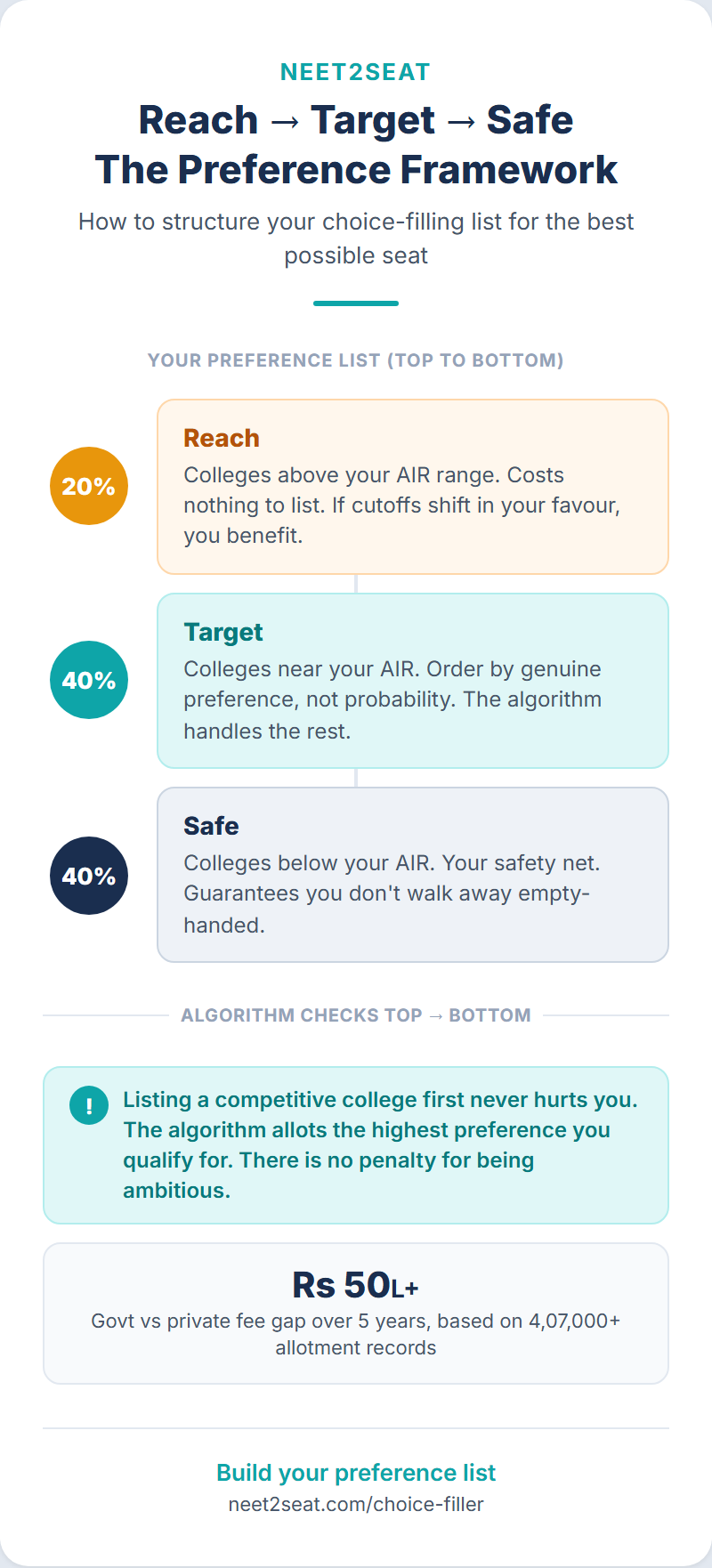
- Use the Reach-Target-Safe framework: top 20% aspirational, middle 40% realistic, bottom 40% safety net.
- Fill as many choices as possible. There is no penalty for additional entries, and every unfilled slot is a missed safety net.
- Round 1 exit is free in all counselling tracks, so list aggressively in the first round.
Choice filling is where most candidates lose seats they could have won
Your NEET choice filling strategy determines your outcome more than almost any other variable you control. The seat allotment algorithm is mechanical: it takes your NEET All India Rank, your locked preference list, the available seats, and your category eligibility, then assigns you the highest-ranked choice where your AIR meets the threshold. The algorithm does not know which college you “really” want. It only sees the order you gave it.
A badly ordered preference list can put you in a college you ranked 15th when your AIR qualifies for one you ranked 12th. It can cost you a government seat and land you in a private college that charges Rs 15 lakh more per year. Over five years of MBBS, a preference ordering mistake translates directly into lakhs of rupees and years of regret.
This guide covers the structural principles behind preference ordering: how the algorithm processes your list, what the common mistakes are, and how to build a list that maximizes your chances. For state-specific guidance, see our Maharashtra choice filling guide and our Karnataka choice filling guide.
How the allotment algorithm works
Both MCC and state counselling authorities use a variant of the Gale-Shapley algorithm (also called deferred acceptance). The properties that matter:
- Your list is processed top to bottom. The algorithm checks your first choice first. If your AIR qualifies and a seat is available, you get it. If not, it moves to your second choice. Then third. And so on until either you are allotted a seat or your entire list is exhausted.
- Higher-ranked candidates are processed first. A candidate with AIR 5,000 has their full preference list processed before a candidate with AIR 5,001. If both want the same seat, the higher-ranked candidate gets it.
- The order of your list cannot hurt you. Listing a more competitive college at position 1 does not reduce your chances at the college you listed at position 5. If you do not get choice 1, the algorithm simply moves to choice 2 as if choice 1 never existed. This is the most misunderstood property of the algorithm.
Because of property 3, there is no strategic reason to put a “safer” college higher in your list. You should always list colleges in your genuine order of preference, most desired first. The algorithm guarantees this is optimal.
The three-tier framework
Divide your list into three sections:
Top tier: Reach colleges (positions 1 through ~20%)
These are colleges where your AIR is above (worse than) the historical closing rank. You would not get in based on past data, but cutoffs shift every year. Listing them costs nothing. If cutoffs ease in your favour, you get a seat you would have missed entirely. If they do not, the algorithm moves down your list without penalty.
Use the college predictor to identify which colleges are classified as Reach for your AIR and category. Start your list with all Reach colleges, ordered by genuine preference.
Middle tier: Target colleges (positions ~20% through ~60%)
These are colleges where your AIR falls near the historical closing range. In some past years you would have made the cut; in others you would not. This is where ordering matters most: among colleges where your chances are uncertain, the one you want more should come first.
Within the Target tier, order by genuine preference: academic reputation, location, fees, infrastructure, or whatever factors matter to you. Do not order by “likelihood of getting in.” That calculation is already embedded in the algorithm; your job is to express preference, not predict probability.
Bottom tier: Safe colleges (positions ~60% through 100%)
These are colleges where your AIR has been comfortably within the closing rank in recent years. These are your safety net. You should list enough Safe colleges to ensure you get allotted something, even in a worst-case scenario where cutoffs tighten across the board.
Within the Safe tier, order by preference. Even though you are likely to get any of these, you want the algorithm to assign you the best one first.
How many choices to fill
More is better. There is no penalty for filling additional choices. If you qualify for 40 colleges, list all 40. If you qualify for 80, list all 80. Every unfilled choice is a missed opportunity if cutoffs shift unexpectedly.
Some candidates fill only 5 to 10 choices, reasoning that they only want those specific colleges. This works if their AIR comfortably clears all 10. It fails spectacularly if cutoffs tighten and none of the 10 are available. The candidate ends up with no allotment in that round.
The time cost of filling 50 choices vs 10 choices is about 20 extra minutes. The downside risk of having too few choices is potentially catastrophic. Fill more. For a detailed analysis of optimal list length, see our guide on how many choices to fill.
Government vs private: the fee multiplier
At government colleges in Maharashtra, MBBS costs approximately Rs 1.62 lakh per year (tuition plus development fee). At private colleges, it ranges from Rs 5 lakh to Rs 25 lakh per year. Over five years, the difference between a government seat and a mid-range private seat can exceed Rs 50 lakh.
A common mistake: candidates list a well-known private college above a mid-tier government college because the private college “feels” better. They get allotted the private seat, spend Rs 60 lakh more over five years, and end up with the same MBBS degree. Unless your family’s financial situation makes the fee difference irrelevant, government colleges should rank above private colleges of similar academic standing.
Location considerations
Location affects your medical education in ways beyond convenience. Colleges in metropolitan areas (Mumbai, Pune, Bengaluru) typically have higher patient volumes, more clinical exposure in specialized departments, and better access to research opportunities and postgraduate preparation resources. Colleges in smaller cities may have lower living costs and less competition for clinical rotations.
If you plan to practice in a specific region after MBBS, attending a college there builds local professional networks that matter for internship and residency placements. This is particularly relevant in Karnataka, where compulsory rural service after MBBS is mandated by state law.
Category-specific ordering
Your preference list should be built for your specific category, not the general pool. If you are an SC candidate in Maharashtra, the cutoffs relevant to you are SC cutoffs, not OPEN cutoffs. A college that is Reach for OPEN might be Safe for SC. Use the cutoff analyzer to check historical closing AIRs for your exact category at each college.
If you are eligible for multiple categories (for example, both OBC and OPEN in Maharashtra), model both scenarios using the cutoff analyzer. Some colleges may be reachable under your reserved category but not under OPEN.
Round-specific strategy
Round 1: fill aggressively
In both MCC and state counselling, Round 1 offers a free exit: if you receive an allotment you do not want, you simply do not report. Your deposit is refunded, and you remain eligible for Round 2. This means Round 1 carries no downside risk.
Fill your Round 1 list as ambitiously as possible. Include Reach colleges you would not normally bet on. The worst outcome is you get nothing and enter Round 2 in the same position. The best outcome is you lock a seat that opens up from an unexpected shift in preferences.
Round 2: adjust based on Round 1 data
After Round 1, you have concrete information: which colleges were allotted in Round 1, at what closing AIRs, and how many seats were vacated by candidates who took free exit. Use this data to refine your Round 2 preferences.
If a college’s Round 1 closing AIR was 20,000 and your AIR is 22,000, that college moves from Reach to Target for Round 2, because Round 2 closing AIRs are typically higher (less competitive) than Round 1 as more seats become available from exits and upgrades.
Round 3 and mop-up: take what you can get
By Round 3, the seat pool is small and the choices are limited. If you are still in the pool at this stage, your priority should be ensuring you get any medical seat rather than optimizing for the perfect one. Fill every available option.
Using our tools for preference ordering
The recommended workflow:
- Run the college predictor with your AIR, state, and category. This gives you the Safe/Target/Reach classification for every college.
- Check individual college cutoffs using the cutoff analyzer. For each Target college, look at the year-to-year variation in closing AIR. Colleges with volatile cutoffs are higher-risk (could swing either way). Colleges with stable cutoffs are more predictable.
- Build your preference list in the choice filling optimizer. Drag and drop colleges into your preferred order, using the Reach-Target-Safe framework. The optimizer shows historical cutoff data alongside each college to help you make informed ordering decisions.
What the data says about preference behaviour
From our analysis of 407,000+ allotment records across Maharashtra and Karnataka (2023-2025), several patterns emerge:
Government college cutoffs cluster tightly at the top. In Maharashtra 2025, the top 5 government colleges had OPEN closing AIRs between 2,571 and 11,360 (Round 2). That is a relatively narrow band for the most competitive seats in the state. A candidate with AIR 8,000 has a reasonable shot at multiple top-5 colleges, making preference order among them the deciding factor.
Private college cutoffs have a wider spread. The closing AIR range at private colleges extends from under 50,000 to over 5,00,000 depending on the institution and seat type. This means the Target zone for private colleges is broader, giving you more colleges to rank in your middle tier.
Cutoffs tighten year over year at top colleges. The top government colleges in both Maharashtra and Karnataka showed a 25% to 63% drop in closing AIRs from 2023 to 2025. If you are using last year’s cutoffs to judge your NEET 2026 chances, build in a safety margin: this year’s cutoffs may be tighter still.
FAQ
Does the order of my preference list affect my chances at any specific college?
No. Whether you list a college at position 1 or position 50, the algorithm checks whether your AIR qualifies for that college when it reaches that position on your list. Listing a college higher does not increase your chances of getting it. It only means the algorithm checks it earlier.
Should I list only colleges I would actually attend?
Yes and no. In Round 1, where exit is free, list broadly because there is no commitment. In later rounds where the allotment may be binding or involve deposit forfeiture, only list colleges you would genuinely attend. Getting allotted a college you do not want in Round 3 creates a painful choice between accepting an unwanted seat or forfeiting your deposit.
How do I handle colleges where I have no historical data?
New colleges or colleges with very recent NMC approval may not have historical cutoff data. Place them in the Target or Safe zone of your list based on their location, fee structure, and management type (government vs private). A new government college in a major city will likely have cutoffs in the same range as similarly positioned existing colleges.
What if I am participating in both MCC and state counselling?
Fill preference lists independently for each track. The colleges available, the category definitions, and the seat pools are different between MCC and state counselling. Your MCC list should reflect your AIQ options; your state list should reflect your state quota options. The two do not interact until you receive allotments from both and must choose one.
Can I change my preference list after locking?
In most counselling tracks, no. Once locked, the list is final for that round. If you forget to lock it manually, the system auto-locks the last saved version. Never rely on auto-lock: review your list carefully and lock it yourself well before the deadline.
What is the 80-20 rule in NEET choice filling?
The “80-20 rule” in NEET choice filling refers to a common guideline where candidates allocate roughly 80% of their preference list to colleges they can realistically get (Target and Safe zones) and 20% to aspirational Reach colleges. The idea is that your list should be dominated by practical options while still allowing for upside if cutoffs shift in your favour. Our framework (Reach at top 20%, Target at middle 40%, Safe at bottom 40%) follows a similar logic with more granularity.
How to do choice filling in NEET?
Choice filling is the process of creating your ranked preference list on the counselling portal (MCC, CET Cell, or KEA). You log in, see the available colleges and seat types, drag them into your preferred order, and lock the list before the deadline. The allotment algorithm processes your list top to bottom and assigns you the highest choice where your AIR qualifies. For a complete walkthrough, see our Maharashtra choice filling guide or our Karnataka guide.