Tag: pillar

  • Medical colleges under All India Quota: the complete picture

    Medical colleges under All India Quota: the complete picture

    The All India Quota (AIQ) route through MCC counselling gives NEET UG candidates access to medical colleges across India, regardless of domicile. This guide covers every type of institution that fills seats through MCC: government colleges contributing 15% AIQ seats, deemed universities, central universities, AIIMS campuses, JIPMER, and ESIC colleges. Use it as a starting point to understand the full landscape of medical colleges available through AIQ counselling, then explore specific categories through our detailed guides.

    Start with our college predictor to identify safe, target, and reach options for your rank. Then use the cutoff analyzer for detailed round-wise and year-wise closing rank analysis at specific colleges.

    How many colleges participate in AIQ

    In the 2025 counselling cycle, MCC filled approximately 26,515 seats (MBBS and BDS combined) across more than 400 institutions. Our database tracks 359 medical colleges under All India Quota with allotment data from 2023, 2024, and 2025. These 359 colleges span 267 cities across India.

    The breakdown by management type from our data: 112 government colleges, 239 private (including deemed universities that participate through MCC), and 8 classified as deemed. The “private” count is high because deemed universities, which are technically private institutions, form the single largest block of MCC seats.

    Government medical colleges (15% AIQ)

    Every government and corporation medical college in India surrenders 15% of its MBBS intake to the All India Quota. In 2025, this produced 8,159 MBBS seats and 492 BDS seats across government colleges in every state.

    These are the most sought-after AIQ seats because of their low tuition fees. Government college fees are set by the state government and typically range from Rs 13,610 per year (Tamil Nadu) to Rs 2,60,000 per year (Delhi). AIQ students at government colleges pay the same fees as state quota students at the same institution.

    Competition for government AIQ seats is intense. AIIMS New Delhi closed at AIR 48 (OPEN category, OS seat) in Round 1 of 2025. Even less competitive government colleges require ranks in the tens of thousands for OPEN category. For detailed closing ranks, use our AIQ cutoff analyzer.

    For a deeper look at government colleges under AIQ, see our government medical colleges in AIQ guide.

    Deemed universities

    Deemed universities account for 13,939 seats (10,649 MBBS + 3,290 BDS) across 88 institutions in the 2025 cycle. This is the single largest block of MCC seats. All deemed university seats are filled exclusively through MCC; there is no state counselling route.

    Key characteristics of deemed university seats:

    • No reservation. SC/ST/OBC-NCL/EWS/PwD reservation does not apply. Admission is on NEET merit, with separate NRI and minority quotas (Jain, Muslim) at select institutions.
    • Higher fees. Annual fees range from approximately Rs 10 lakh (Symbiosis, Pune) to Rs 30.5 lakh (Sree Balaji Medical College, Chennai). Over 32 deemed colleges charge more than Rs 1 crore for the full MBBS course.
    • Higher security deposit. MCC charges Rs 2,00,000 as a security deposit for deemed university registration, compared to Rs 10,000 for government AIQ.

    Deemed universities fill seats across multiple quota types: General/Paid (merit-based, open to all), NRI, Jain Minority (JMQ), and Muslim Minority (MMQ). Not all deemed institutions have minority quotas; it depends on the university’s status.

    Deemed university seats carry no SC/ST/OBC-NCL/EWS/PwD reservation. Your reserved category gives you no advantage at deemed institutions through MCC. All 13,939 seats are filled purely on NEET merit.

    For a full breakdown of fees, quotas, and strategy, see our deemed universities guide.

    AIIMS campuses

    All 17 AIIMS campuses contribute their entire intake to MCC counselling. The 2025 seat matrix had approximately 1,700 MBBS seats across AIIMS. The campuses, ordered by intake size:

    Campus MBBS seats
    AIIMS Jodhpur 150
    AIIMS New Delhi 125
    AIIMS Bhopal 125
    AIIMS Raipur 125
    AIIMS Rishikesh 125
    AIIMS Patna 125
    AIIMS Nagpur 125
    AIIMS Kalyani 125
    AIIMS Mangalagiri 125
    AIIMS Deogarh 125
    AIIMS Bathinda 100
    AIIMS Bilaspur (HP) 100
    AIIMS Jammu 100
    AIIMS Rai Bareli 100
    AIIMS Bibi Nagar (Hyderabad) 100
    AIIMS Rajkot 75
    AIIMS Madurai 50

    AIIMS New Delhi is the most competitive medical college in India. Its OPEN category (OS seat) closing AIR was 48 in Round 1 of 2025. Newer AIIMS campuses have considerably higher closing ranks; AIIMS Madurai and AIIMS Rajkot, opened in recent years, closed at ranks in the thousands.

    Central government reservation (SC 15%, ST 7.5%, OBC-NCL 27%, EWS 10%, PwD 5%) applies at all AIIMS campuses.

    The gap between AIIMS campuses is enormous. AIIMS New Delhi (OPEN/OS) closed at AIR 48 in 2025 Round 1, while newer campuses like AIIMS Madurai and AIIMS Rajkot close at ranks in the thousands. Do not treat all AIIMS as a single tier.

    JIPMER and IMS-BHU

    JIPMER Puducherry (134 MBBS seats) and JIPMER Karaikal (45 MBBS seats) participate fully in MCC counselling. IMS-BHU contributes 100 MBBS and 63 BDS seats. These institutions follow central government reservation.

    JIPMER Puducherry also has a Puducherry (PUD) quota for candidates domiciled in the Union Territory of Puducherry.

    Central universities

    Several Delhi-based and other central university medical colleges participate through MCC:

    • Maulana Azad Medical College (MAMC), Delhi: 207 MBBS seats. Splits between 85% Delhi quota and 15% AIQ.
    • Lady Hardinge Medical College (LHMC), Delhi: 189 MBBS seats. Same Delhi/AIQ split. Women-only institution.
    • University College of Medical Sciences (UCMS), Delhi: 144 MBBS seats. Delhi/AIQ split.
    • JNMC-AMU, Aligarh: 150 MBBS seats. Splits between AMU institutional quota and open seats.
    • VMMC (under IP University), Delhi: MBBS seats with IP University quota and AIQ split.

    Delhi University colleges are among the most competitive in AIQ. MAMC and LHMC typically close at ranks under 100 for OPEN/DU quota seats. Even the AIQ seats at these colleges require top ranks.

    ESIC medical colleges

    The Employees’ State Insurance Corporation (ESIC) runs 11 medical colleges, contributing 446 MBBS and 28 BDS seats to MCC counselling. ESIC colleges have additional seat types: CW (Children/Wards of ESIC employees) seats that are restricted to dependents of ESI insured persons. Open seats follow the standard AIQ allotment process.

    Filter the cutoff analyzer by both reservation category and seat type together. An OPEN/AI seat at a government college has very different closing ranks from an OPEN/OS seat at AIIMS or an NRI seat at a deemed university.

    How to explore these colleges on neet2seat

    Our platform tracks all 359 AIQ colleges with three years of allotment data:

    • AIQ colleges page: Browse all colleges by city, management type, or category. Each college page shows fees, intake, NMC status, and links to cutoff data.
    • AIQ cutoff analyzer: Filter closing ranks by college, category (OPEN, OBC, SC, ST, EWS + PwD variants), seat type (AI, OS, DU, AMU, ESI, NRI, JMQ, MMQ, etc.), round, and year.
    • College predictor: Enter your NEET rank and category to see safe, target, and reach colleges based on historical cutoff patterns.

    FAQ

    Can I get both state quota and AIQ seats at the same college?

    Not simultaneously. A government college has separate pools: 85% state quota and 15% AIQ. You can be allotted from either pool (through state counselling or MCC), but not both. If you receive allotments from both tracks at different colleges, you choose one.

    Are deemed university seats more expensive than government AIQ seats?

    Yes, significantly. Government AIQ fees range from Rs 13,610 to Rs 2,60,000 per year. Deemed university fees range from approximately Rs 10 lakh to Rs 30.5 lakh per year. The gap is substantial. See our AIQ fees guide for details.

    Which AIQ colleges are easiest to get into?

    Colleges with the highest closing AIR (i.e., seats available at lower ranks) tend to be newer government colleges in less populated areas, ESIC colleges, and some deemed universities. Our cutoff analyzer lets you sort by closing rank to identify these. In 2025, some AIQ government colleges closed above AIR 1,00,000 for OPEN category.

    Do all AIIMS campuses have the same closing rank?

    No. AIIMS New Delhi is far more competitive than newer campuses. In 2025 Round 1, AIIMS New Delhi (OPEN/OS) closed at AIR 48, while newer campuses like AIIMS Madurai and AIIMS Rajkot closed at ranks in the thousands. The gap between established and new AIIMS campuses is significant.

    How many medical colleges are there in India total?

    As of 2025-26, India has approximately 816 medical colleges with approximately 1,14,550 MBBS seats. Of these, about 26,515 seats across approximately 400 institutions are filled through MCC counselling. The remainder are filled through individual state counselling authorities.
  • NEET Counselling Process 2026 – Registration to Allotment

    • Two parallel tracks: MCC fills ~26,500 central seats (AIQ, deemed, AIIMS, ESIC); state authorities fill the 85% state quota
    • Register for both MCC and state counselling simultaneously; choose one if allotted in both
    • Round 1 is free exit in both tracks: fill preferences aggressively, no penalty for not reporting
    • 6-step process: register, fill choices, lock preferences, allotment, report to college, pay fees

    Two parallel tracks: central and state

    The NEET counselling process for 2026 runs on two separate tracks that operate simultaneously. The Medical Counselling Committee (MCC), under the Directorate General of Health Services (DGHS), handles central counselling. Each state has its own counselling authority for the remaining seats. Understanding this NEET UG counselling process is the first step toward converting your NEET rank into a medical seat.

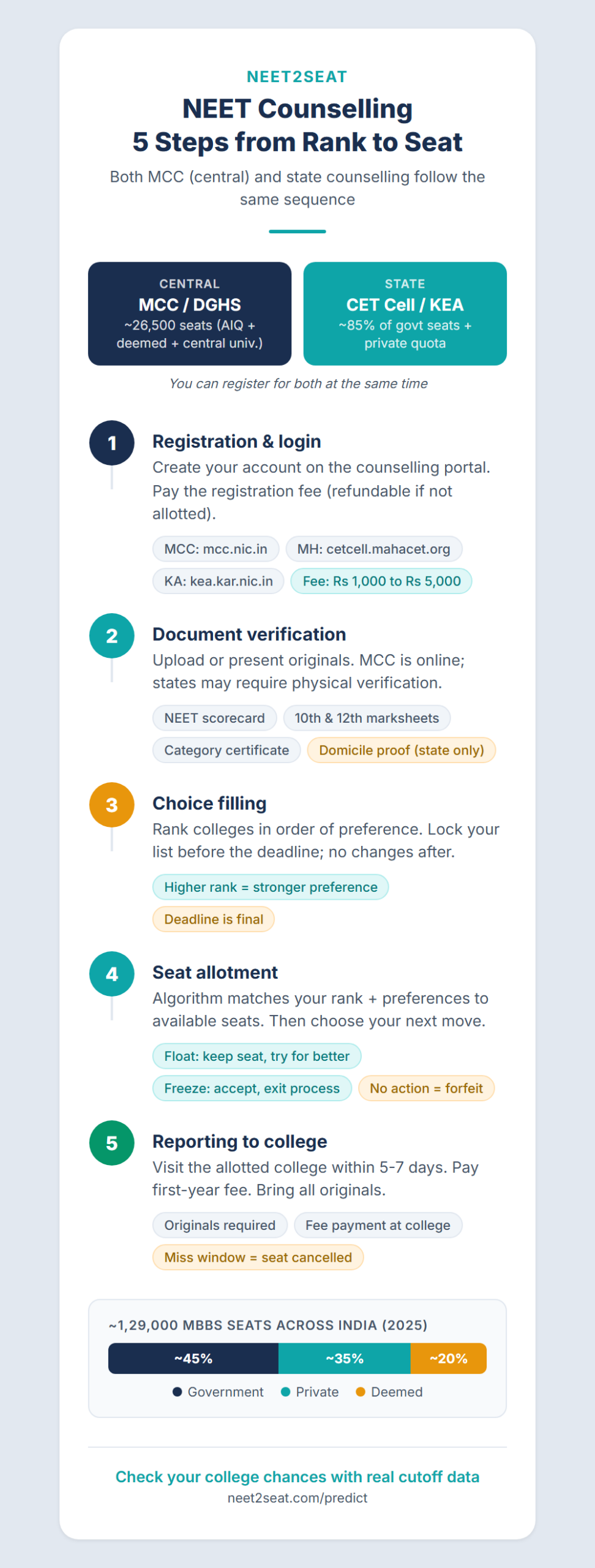
    Infographic showing the 5 steps of NEET counselling

    MCC fills roughly 26,500 seats across five categories:

    • 15% All India Quota (AIQ) seats in government medical and dental colleges
    • 100% of seats in deemed universities (88 institutions, about 13,900 seats in 2025)
    • 100% of seats in central universities (Delhi University, BHU, AMU, Jamia Millia Islamia, IP University)
    • All AIIMS and JIPMER campuses
    • ESIC medical colleges

    State counselling authorities fill the other 85% of government college seats, restricted to candidates with domicile in that state. States also handle private college admissions within their borders, though the exact seat split between state quota and management quota varies.

    A candidate can register for both MCC and state counselling at the same time. If allotted a seat in both, they must choose one and vacate the other within the reporting window.

    The numbers: how many seats, how many candidates

    In 2025, 12.36 lakh candidates qualified NEET UG, competing for approximately 1,29,000 MBBS seats. Karnataka and Maharashtra together account for over a fifth of India’s total MBBS capacity.

    In 2025, about 22.7 lakh students registered for NEET UG. Of these, 12,36,531 qualified (roughly 56% of those who appeared). They competed for approximately 1,16,000 MBBS seats available at the start of counselling, a number that grew to 1,29,026 by December 2025 as the National Medical Commission approved new colleges and seat increases through the year.

    The seat distribution across institution types looks like this:

    Institution typeApproximate MBBS seatsShare
    Government colleges55,000 to 58,000~45%
    Private colleges50,000 to 53,000~40%
    Deemed universities11,000 to 14,000~11%
    Central institutions (AIIMS, JIPMER, etc.)4,000 to 5,000~4%

    Karnataka had 13,944 MBBS seats in 2025-26, making it the state with the most seats in the country. Maharashtra had 12,824. Together, these two states account for over a fifth of India’s MBBS capacity.

    The six steps of counselling

    Whether you go through MCC or state counselling, the process follows the same sequence.

    1. Registration

    Register on the MCC portal (mcc.nic.in) or your state counselling portal. You enter personal details, your NEET roll number, and upload required documents. You also pay a registration fee and security deposit online.

    MCC registration fees for 2025 were Rs 1,000 for General/EWS candidates and Rs 500 for SC/ST/OBC/PwD candidates. Security deposits ranged from Rs 10,000 (government AIQ seats) to Rs 2,00,000 (private/deemed seats).

    2. Choice filling

    This is the most consequential step. You rank college-and-course combinations in order of preference. You can fill as many or as few choices as you want, and you can rearrange them until the locking deadline.

    The order matters: the allotment algorithm assigns you the highest-ranked choice where your AIR meets the cutoff. A poorly ordered preference list can land you in a less preferred college even if your rank qualifies for better options. Our choice filling optimizer helps you build a preference list using three years of actual cutoff data from Maharashtra and Karnataka.

    3. Choice locking

    Do not rely on auto-lock. Review your preference list carefully and lock it yourself before the deadline. Auto-lock saves the last version, which may not be your intended final order.

    Before the deadline, you lock your final preference list. If you forget to lock it manually, the system auto-locks the last saved version. Do not rely on auto-lock; review your list and lock it yourself.

    4. Seat allotment

    MCC runs the allotment algorithm considering your NEET AIR, your locked preference list, available seats, and your category eligibility. A provisional result is published first. After an objection window, the final result comes out.

    You can see what cutoffs looked like in previous years using our cutoff analyzer, which covers all rounds of Maharashtra and Karnataka state counselling from 2023 to 2025.

    5. Reporting to the allotted college

    You physically go to your allotted college within the reporting window and bring all original documents. The college verifies your documents, conducts a medical fitness check, and processes your admission. No proxy reporting: you must appear in person.

    6. Fee payment

    Tuition and other fees are paid at the college during reporting. Government college fees in Maharashtra and Karnataka typically range from Rs 10,000 to Rs 50,000 per year. Private colleges charge Rs 5 to 25 lakh per year depending on the institution.

    How many rounds, and what happens in each

    MCC ran four rounds plus a special stray round in 2025. Most state authorities follow a similar pattern.

    RoundWhat happensCan you exit freely?
    Round 1Fresh allotment based on your preference list and AIRYes. No penalty, full deposit refund.
    Round 2Fresh allotment + upgradation for Round 1 candidates. If you get a higher-preference seat, Round 1 seat is auto-cancelled.No. Security deposit forfeited if you exit.
    Round 3 (Mop-up)Remaining seats after Rounds 1 and 2No. Seat is binding after joining.
    Stray vacancyFinal vacancies. Joining is compulsory.No. Non-joining means deposit forfeiture and potential disqualification.

    Round 1 is your free option. If you receive an allotment you do not want, simply do not report. Your deposit is refunded and you remain eligible for Round 2. Fill choices aggressively in Round 1.

    The free exit in Round 1 is a safety valve. If you receive an allotment you don’t want, you simply don’t report. Your deposit is refunded and you remain eligible for Round 2. This means Round 1 carries almost no risk: fill choices aggressively and see what you get.

    The 15/85 seat split: AIQ vs. state quota

    In every government medical college, 15% of seats go to the All India Quota (open to candidates from any state, filled by MCC) and 85% stay with the state (restricted to domicile candidates, filled by the state authority).

    Private colleges follow different rules. The split varies by state. In many states, private colleges allocate around 50% to state quota, 35% to management quota, and 15% to NRI quota. All seats, including management and NRI quota, require NEET qualification.

    Deemed universities are entirely under MCC. No state quota applies to them.

    Unfilled AIQ seats after Round 2 historically revert to the respective state quotas, giving state authorities additional seats to fill. In 2025, the MCC information bulletin stated that unfilled AIQ seats revert to state authorities. Whether vacated seats (from resignations after joining) also revert or are filled within the AIQ pool depends on the timing and the specific MCC circular for that year. Check the current year’s MCC bulletin for the exact reversion rules, as they can change between counselling cycles.

    Open vs. closed states for private colleges

    When people talk about “open” and “closed” states, they mean private college state quota seats specifically. Government college state quota (85%) is always restricted to domicile candidates in every state.

    Maharashtra is a closed state: only Maharashtra domicile holders can apply for private medical college seats through the state counselling process. Karnataka is open: candidates from other states can apply for private college seats in Karnataka through KEA counselling.

    This distinction matters if you’re from one state but considering private colleges in another. If the target state is open, you can participate in their counselling. If closed, you cannot.

    Documents you’ll need

    Both MCC and state counselling require the same core documents during reporting:

    • NEET UG admit card and scorecard (originals)
    • Allotment letter from the counselling portal
    • Class 10 certificate and marksheet (for date of birth verification)
    • Class 12 certificate and marksheet
    • 8 passport-size photographs matching the NEET application photo
    • Government-issued ID (Aadhaar, PAN, or passport)
    • Category/caste certificate in the prescribed format (if applicable)
    • Domicile certificate (for state quota)
    • Disability certificate (for PwD candidates)
    • Gap year affidavit (if applicable)

    Get all documents ready before counselling registration opens. Domicile and caste certificates take weeks to obtain. Do not wait until after your first allotment.

    Missing even one document can delay or block your admission. Get them ready before counselling registration opens, not after. For Maharashtra-specific requirements, see our Maharashtra CET Cell counselling guide. For Karnataka, see our KEA counselling guide.

    What changed in 2025

    MCC tightened several rules for the 2025 counselling cycle compared to 2024:

    • Multiple registrations are now strictly prohibited. Registering more than once results in automatic cancellation and potential debarment.
    • MCC no longer edits or modifies personal information in registrations. All data is auto-fetched from the NTA database.
    • In-person reporting is mandatory. Proxy reporting (having someone else report on your behalf) is not allowed.
    • Resignation after Round 3 joining is no longer possible. Once you join after Round 3, the seat is binding.
    • Stray round joining is compulsory. Not joining after stray round allotment leads to deposit forfeiture and disqualification from the current year’s counselling.
    • OCI (Overseas Citizen of India) cardholders are now treated at par with Indian citizens for General/Unreserved seats, following a Supreme Court order.

    Maharashtra and Karnataka: what our data shows

    neet2seat tracks over 407,000 allotment records across Maharashtra (86 colleges) and Karnataka (74 colleges) from 2023 to 2025, covering every round of state counselling.

    neet2seat tracks cutoff and allotment data for Maharashtra (86 colleges) and Karnataka (74 colleges) across 2023, 2024, and 2025. Our database has over 407,000 individual allotment records.

    In Maharashtra, the state counselling covers government, private, and deemed colleges through the CET Cell. The process typically runs three rounds (Round 1, Round 2, Round 3) plus stray vacancy rounds. Closing AIRs ranged from as low as 10 (a top government college in an early round) to over 13 lakh (the last seats filled in later rounds) in 2025.

    In Karnataka, KEA conducts the state counselling. Karnataka had three counselling rounds in 2024 and 2025 (up from two rounds plus a mop-up in 2023). Closing AIRs showed a similar spread.

    You can explore this data directly: browse cutoffs by college, category, and round, or use the college predictor to see which colleges you’re likely to get based on your AIR.

    FAQ

    Can I participate in both MCC and state counselling simultaneously?

    Yes. You can register for and participate in both. If you receive allotments from both, you choose one and vacate the other within the specified reporting window.

    What if I don’t get any seat in Round 1?

    You automatically move to Round 2 with the same registration. No re-registration is needed. Round 2 includes seats vacated by Round 1 candidates who took free exit, plus any new seats added.

    Is the security deposit refundable?

    It depends on when you exit. In Round 1, you get a full refund if you choose not to report (free exit). After Round 2, the deposit is forfeited if you resign. If you’re never allotted a seat, the deposit is refunded regardless of round.

    Do I need a domicile certificate for AIQ seats?

    No. AIQ seats under MCC are open to candidates from any state. Domicile certificates are required only for state quota seats (the 85% filled by state counselling authorities).

    When should I start preparing documents?

    As soon as your NEET result is out. Domicile and caste certificates in particular can take weeks to obtain. Don’t wait until the registration window opens.

    What’s the difference between free exit and resignation?

    Free exit is available only in Round 1. You simply don’t report to the allotted college, and your deposit is refunded. Resignation is available in Round 2: you give up your seat, but your deposit is forfeited. After Round 3, neither option exists; the seat is binding.

    How many counselling rounds are there in NEET?

    MCC conducts 4 rounds for All India Quota: Round 1, Round 2, Round 3 (mop-up), and a stray vacancy round. State counselling authorities run 2 to 3 regular rounds plus their own mop-up rounds. Maharashtra runs 3 rounds plus a stray vacancy round. Karnataka runs 3 rounds. The total number depends on which tracks you participate in; candidates in both MCC and state counselling may go through 6 to 8 rounds across the full counselling cycle.

    How much does NEET counselling cost?

    MCC charges a registration fee of Rs 1,000 for General/EWS and Rs 500 for SC/ST/OBC/PwD candidates. A refundable security deposit of Rs 10,000 to Rs 2,00,000 is required depending on the college type. Maharashtra CET Cell charges a registration fee plus a security deposit as per the Information Brochure. Karnataka KEA charges a similar registration fee. The total upfront cost (registration + deposit) ranges from Rs 11,000 to Rs 2,00,000, most of which is refundable if you do not take a seat.

  • Medical colleges in Maharashtra: 86 colleges, 12,924 seats across government, private, and deemed

    86 medical colleges fill 12,924 MBBS seats through Maharashtra state-quota counselling (excludes AIQ government and deemed seats), with a fee range from Rs 1.62 lakh to Rs 25 lakh per year

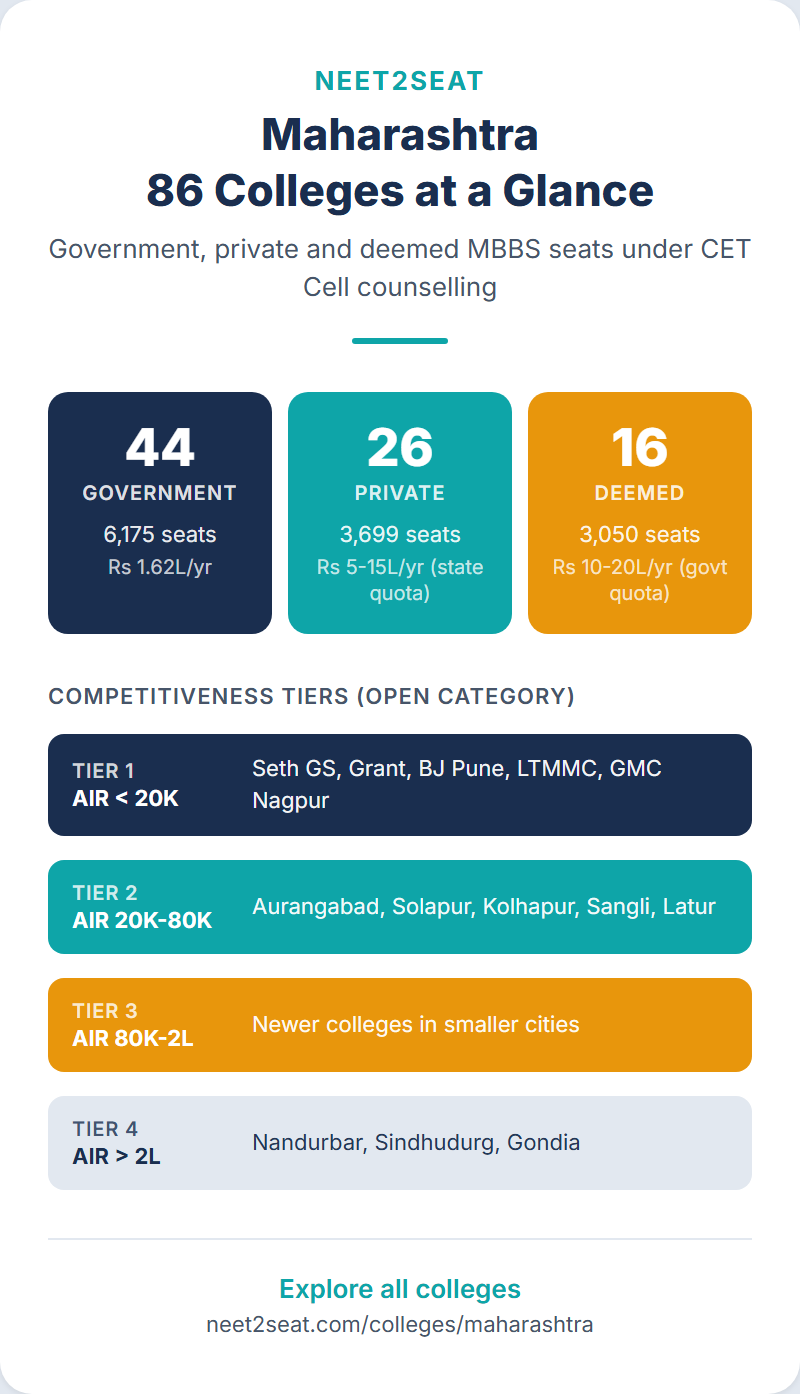
    Maharashtra has the second-largest medical education system in India. The 86 medical colleges in Maharashtra span 44 government colleges, 26 private colleges, and 16 deemed universities, with 12,924 MBBS seats filled through Maharashtra state-quota counselling (excludes AIQ and deemed seats). Understanding the full picture for NEET 2026 (who these colleges are, where they are, what they cost, and how competitive they are) is the first step toward building an informed preference list.

    Infographic overview of medical colleges in Maharashtra

    This guide maps all 86 colleges across the three categories. For individual college cutoffs, use the Maharashtra cutoff analyzer. For the complete college list with details, see the Maharashtra college directory.

    • 86 colleges: 44 government (Rs 1.62L/yr), 26 private (Rs 5-15L/yr), 16 deemed (Rs 10-25L/yr), totalling 12,924 MBBS seats
    • Government college closing AIRs range from 12,566 to above 9,71,403 — every AIR level has a government option
    • Mumbai + Navi Mumbai cluster has 16 colleges, the densest medical education ecosystem in any Indian metro
    • List all government colleges before private ones on your preference list to maximize fee savings

    Government medical colleges: 44 colleges, 6,175 seats

    Maharashtra’s 44 government medical colleges are spread across 36 cities. Nine are concentrated in Mumbai alone. Pune has 4 (including the Armed Forces Medical College, which has its own admission process). Nagpur has 2. The remaining colleges are distributed across district headquarters and smaller cities.

    Annual fees at all government colleges are approximately Rs 1.62 lakh per year. See our Maharashtra fees guide for the complete breakdown.

    The competitiveness spectrum

    Government colleges in Maharashtra span a wide competitiveness range. From our 2025 data (Round 2, OPEN category):

    The most competitive government colleges close at AIRs below 20,000. ESIC Medical College Andheri closed at AIR 12,566 (though ESIC colleges operate under central government and may have distinct dynamics). Grant Medical College (Mumbai), Seth GS Medical College (Mumbai), and BJ Medical College (Pune) are consistently among the most competitive, closing below AIR 15,000 in recent years.

    Mid-tier government colleges close between AIR 20,000 and 80,000. This band includes well-established colleges in cities like Aurangabad (Chhatrapati Sambhajinagar), Solapur, Kolhapur, Sangli, and Latur. These colleges offer solid clinical training with lower living costs than Mumbai or Pune.

    The least competitive government colleges close at AIRs above 80,000, extending to AIR 9,71,403 at the furthest end. Newer government colleges in Nandurbar, Sindhudurg, Gondia, and similar rural districts fill at higher ranks. Despite their lower competitiveness, they offer the same Rs 1.62 lakh/year fee structure and an equivalent MBBS degree.

    The 30x fee gap between government (Rs 1.62L/yr) and private (Rs 5-15L/yr) colleges makes every government seat worth listing, regardless of location. Even a Tier 4 government college saves Rs 20-65 lakh over five years compared to a private alternative.

    Mumbai’s government college cluster

    Mumbai has 9 government medical colleges, making it the single largest cluster in any Indian city. These include Seth GS Medical College (KEM Hospital), Grant Medical College (JJ Hospital), LTMMC (Sion Hospital), Topiwala National Medical College (Nair Hospital), ESIC Andheri, Gokuldas Tejpal, and others. With approximately 1,400 combined seats, Mumbai’s government cluster absorbs a significant portion of Maharashtra’s top-ranked candidates.

    For a detailed breakdown of Mumbai colleges, see our Mumbai medical colleges guide.

    The new-college expansion

    Maharashtra has been adding new government medical colleges in underserved districts. Colleges in Nandurbar, Alibaug (Raigad), Parbhani, Usmanabad, and similar locations were established in recent years. These newer colleges typically have smaller intakes (50 to 100 seats), less established infrastructure, and higher closing AIRs For candidates in the AIR 50,000 to 2,00,000 range, these colleges represent accessible government seats that many candidates overlook in favour of private colleges in larger cities.

    Newer government colleges in districts like Nandurbar and Sindhudurg are often overlooked. If your AIR is between 50,000 and 2,00,000, these colleges give you government fees and an identical MBBS degree. List them as safety options below your preferred choices.

    Private medical colleges: 26 colleges, 3,699 seats

    Maharashtra’s 26 private medical colleges are concentrated in a few urban corridors. Pune has 3, Nagpur has the NKP Salve Institute (250 seats), and Ahmednagar, Kolhapur, Nashik, Sangli, and other cities each have one or two.

    State quota fees range from Rs 5 lakh to Rs 15 lakh per year. Institutional quota (15% of seats) charges 2x to 3x the state quota fee. See the fees guide for details.

    The private college competitive range

    Private colleges in Maharashtra close at AIRs ranging from approximately 38,000 (top private colleges like KJ Somaiya in Mumbai) to above 5,00,000 (less established or newer institutions). The wide range means that candidates across a broad AIR spectrum (30,000 to 5,00,000+) will find private college options available to them.

    For candidates who exhaust their government college options on the preference list, private colleges provide essential backup. Even if the fee is Rs 10 lakh to Rs 15 lakh per year, having a private seat is better than no seat at all in Round 1 (where exit is free).

    Private college fees are 3x to 10x higher than government fees. Always exhaust your government college options on the preference list before adding private colleges. In Round 1, where exit is free, listing a private college as a backup costs nothing.

    Deemed universities: 16 colleges, 3,050 seats

    Maharashtra’s 16 deemed universities account for 3,050 MBBS seats. Five are concentrated in Navi Mumbai: DY Patil Medical College (3 separate campuses), MGM Medical College, and Terna Medical College. Others are in Pune (3), Wardha (2), and scattered across other cities.

    Deemed university government quota seats (approximately 25%) are filled through CET Cell counselling. The remaining seats go through MCC or the university’s own admission process. Fees range from Rs 10 lakh to Rs 25 lakh per year depending on seat type and institution.

    One detail worth watching: deemed universities in Maharashtra do not participate in state counselling for all their seats. The government quota portion (filled through CET Cell) has different cutoffs from the MCC portion. Check both tracks if you are considering a deemed university.

    Deemed university seats are split across CET Cell and MCC counselling. If targeting a deemed university, register for both counselling processes and compare government quota fees across the two tracks.

    Geographic distribution

    Maharashtra’s medical colleges span 45 cities. The concentration:

    • Mumbai + Navi Mumbai: 16 colleges (9 government, 2 private, 5 deemed). The largest cluster in any Indian metropolitan area for medical education.
    • Pune: 8 colleges (2 government including AFMC, 3 private, 3 deemed).
    • Nagpur: 3 colleges (2 government, 1 private).
    • Remaining cities: 1 to 2 colleges each, mostly government.

    For most candidates, the geographic decision is between pursuing a college in the Mumbai-Pune corridor (higher living costs, more clinical exposure, larger peer network) versus a college in a smaller city (lower costs, less competitive cutoffs, potentially more hands-on clinical rotations due to smaller batch sizes).

    See Mumbai colleges and Pune colleges for city-specific guides.

    How to use this information for preference ordering

    The 86 colleges fall into natural tiers for preference list construction:

    1. Top government colleges in metro areas (Seth GS, Grant, BJ Pune, LTMMC): positions 1 through 5 on most candidates’ lists.
    2. Remaining Mumbai and Pune government colleges: positions 6 through 15.
    3. Government colleges in mid-size cities (Nagpur, Aurangabad, Kolhapur, Solapur): positions 15 through 30.
    4. Government colleges in smaller cities and newer institutions: positions 30 through 44.
    5. Top private colleges (KJ Somaiya, DY Patil, etc.): positions 44 through 55.
    6. Remaining private and deemed university government quota: positions 55 through 86.

    This ordering puts all government colleges above all private colleges, reflecting the fee advantage. Adjust based on your specific location preferences and financial situation. Use the college predictor to classify each college as Safe, Target, or Reach for your AIR.

    Open the college predictor, enter your expected AIR and category, and classify each of Maharashtra’s 86 colleges as Safe, Target, or Reach. Then build your preference list following the tier order above, with all Safe and Target government colleges first.

    FAQ

    How many government colleges are in Maharashtra?

    44 government medical colleges with a combined intake of 6,175 MBBS seats, spread across 36 cities.

    Which Maharashtra medical college is the most competitive?

    Based on 2025 data, ESIC Medical College Andheri had the lowest OPEN closing AIR among government colleges. Among traditional government colleges, Grant Medical College and Seth GS Medical College in Mumbai are consistently the most competitive. Among private colleges, KJ Somaiya Medical College in Mumbai has the lowest closing AIR.

    Are deemed university seats worth considering?

    Yes, if you can afford the fees. Government quota seats at deemed universities (filled through CET Cell) have moderate fees and can be less competitive than equivalent-quality private colleges. Deemed universities often have well-equipped hospitals and research facilities. List them in the private/deemed tier of your preference list.

    Do all 86 colleges participate in CET Cell counselling?

    Most do, but AFMC Pune has its own admission process, and some deemed universities fill only a portion of their seats through CET Cell (the rest go through MCC or university-level admissions). Check the current year’s CET Cell seat matrix for the exact list of participating colleges and available seats.

    Can I get MBBS with 400 marks in NEET in Maharashtra?

    400 marks in NEET typically translates to an AIR in the range of 1,00,000 to 1,50,000 (the exact rank depends on the year’s difficulty and number of candidates). At this range in Maharashtra, government colleges in smaller cities (Tier 3 and Tier 4 in our ranking) and several private colleges are within reach for the OPEN category. Reserved category candidates at this mark range have access to a wider set of government colleges. Use the college predictor with your exact AIR to see your Safe, Target, and Reach options.

  • Medical colleges in Karnataka: 74 colleges, 14,094 seats across government, private, and deemed

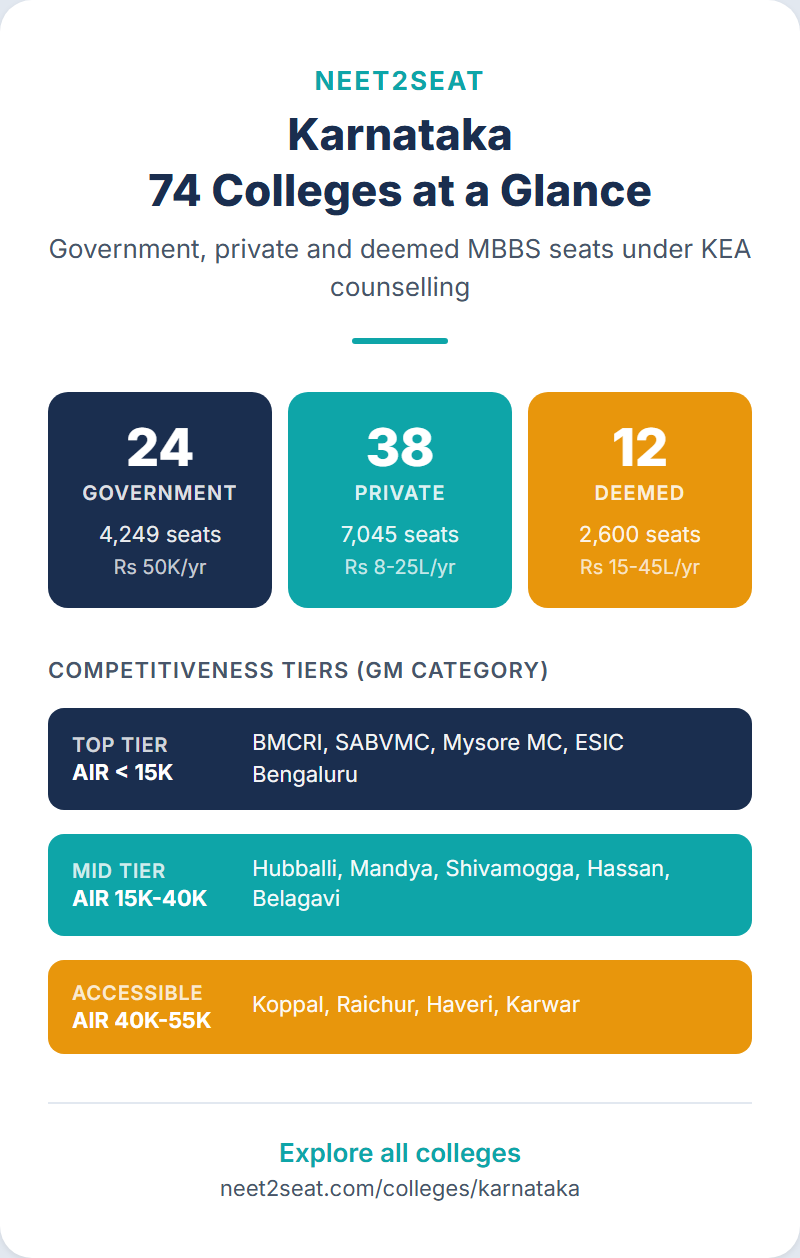
    74 medical colleges across 31 cities, with government seats at Rs 50,000 per year

    The 74 medical colleges in Karnataka span 24 government, 38 private, and 12 deemed universities, with a combined MBBS intake of 14,094 seats. Unlike many states where government colleges dominate, Karnataka’s private sector is larger (38 colleges, 7,045 seats) than the government sector (24 colleges, 4,249 seats), creating a two-track system where fee considerations heavily influence preference ordering. This guide ranks the top medical colleges in Karnataka by NEET 2026 cutoff competitiveness, using 2023-2025 historical data.

    Infographic overview of medical colleges in Karnataka

    This guide maps all 74 Karnataka medical colleges. For individual college cutoffs, use the Karnataka cutoff analyzer. For the complete college list with details, see the Karnataka college directory.

    • 74 colleges: 24 government (Rs 50K/yr), 38 private (Rs 8-25L/yr), 12 deemed (Rs 10-25L/yr), totalling 14,094 MBBS seats
    • Private sector is larger than government (38 vs 24 colleges) — fee decisions dominate preference ordering
    • Bengaluru has 20 colleges but only 3 government; AIR under ~13,000 needed for a government seat there
    • Karnataka’s suffix system (G, K, R, H, KH, RH) creates separate cutoff tracks — check all suffixes you qualify for

    Government medical colleges: 24 colleges, 4,249 seats

    Karnataka’s 24 government medical colleges charge a uniform Rs 50,000 per year. Over five years, total tuition is approximately Rs 2.5 lakh, among the lowest government medical college fees in India.

    The top tier (AIR under 15,000)

    Four government colleges consistently close at AIRs below 15,000 for the GM (General Merit) category:

    • Bangalore Medical College and Research Institute (BMCRI), Bengaluru: AIR 3,025 (2025 R2). The state’s most competitive medical college, affiliated with Victoria Hospital and Bowring Hospital. 250 seats.
    • Shri Atal Bihari Vajpayee Medical College, Bengaluru: AIR 7,669 (2025 R2). A newer government college in the state capital. The Bengaluru location drives demand.
    • Mysore Medical College, Mysuru: AIR 8,394 (2025 R2). One of the oldest medical colleges in South India, established in 1924. 250 seats.
    • ESIC Medical College, Bengaluru: AIR 12,937 (2025 R2). Central government institution with ESIC Hospital affiliation.

    The mid tier (AIR 13,000 to 40,000)

    Twelve government colleges close in the AIR 13,000 to 40,000 range for GM category. These include established institutions in Karnataka’s secondary cities:

    • Karnataka Medical College (KRIMS), Hubballi: AIR 13,488. The main government college in North Karnataka’s largest city.
    • Mandya Institute of Medical Sciences, Mandya: AIR 15,588. Close to Mysuru and Bengaluru, making it geographically accessible.
    • Shimoga Institute of Medical Sciences, Shivamogga: AIR 21,676.
    • Hassan Institute of Medical Sciences, Hassan: AIR 21,862.
    • Belagavi Institute of Medical Sciences, Belagavi: AIR 23,365. In the border district with significant clinical diversity.
    • Gulbarga Institute of Medical Sciences, Kalaburagi: AIR 23,671. In the Hyderabad-Karnataka region, which has its own reservation provisions.
    • Vijaynagar Institute of Medical Sciences, Ballari: AIR 23,690.
    • ESIC Medical College, Kalaburagi: AIR 28,962.

    And continuing through Chamarajanagar (31,696), Gadag (32,257), Bidar (37,203), and Kodagu (38,075).

    The accessible tier (AIR 38,000 to 55,000)

    Eight newer government colleges close at AIRs between 38,000 and 55,000. These include colleges in Chikkaballapura (38,361), Koppal (38,538), Raichur (39,240), Karwar (41,651), Chikkamagaluru (45,629), Haveri (49,827), Yadgiri (52,598), and Chitradurga (55,005).

    For candidates in the AIR 40,000 to 55,000 range, these colleges represent genuine government seat opportunities at Rs 50,000 per year. Many candidates in this range skip these colleges in favour of private colleges in Bengaluru, paying 20x to 50x more for a geographically preferred location. The financial case for listing these government colleges ahead of private options is compelling. See our Karnataka fees guide.

    A candidate choosing a Bengaluru private college (Rs 15L/yr) over a government college in Haveri or Chitradurga (Rs 50K/yr) pays Rs 72.5 lakh more over five years. The MBBS degree is identical. List accessible-tier government colleges before any private option unless your family can absorb that difference without financial strain.

    Private medical colleges: 38 colleges, 7,045 seats

    Karnataka’s private medical college sector is large and concentrated in a few urban centres. Bengaluru alone has 14 private medical colleges. Mangaluru has 5. Kalaburagi, Davangere, and Tumakuru have 2 each. The remaining colleges are scattered across 15+ cities.

    The most competitive private colleges

    From our 2025 data (R2, GM category), the most competitive private college government quota seats:

    • MS Ramaiah Medical College, Bengaluru: AIR 11,776. Consistently the most competitive private college in the state.
    • JSS Medical College, Mysuru: competitive government quota cutoffs comparable to mid-tier government colleges.
    • Kempegowda Institute of Medical Sciences, Bengaluru: strong Bengaluru location drives demand.

    Top private college government quota cutoffs in Karnataka overlap with mid-tier government college cutoffs. A candidate with AIR 12,000 faces a choice between a government college in Mandya (Rs 50,000/year) and MS Ramaiah in Bengaluru (Rs 15+ lakh/year). The fee multiplier is 30x for a Bengaluru address.

    Top private college cutoffs overlap with mid-tier government college cutoffs. Before choosing a private college for its city, check whether a government college at the same AIR level exists in another city. The fee difference over five years can exceed Rs 70 lakh.

    Bengaluru’s private college density

    With 14 private medical colleges, Bengaluru has the highest private medical college concentration in South India. GM government quota closing AIRs range from approximately 11,776 (MS Ramaiah) to 74,727 (East Point College). This means a candidate with AIR anywhere between 12,000 and 75,000 has a Bengaluru private college option available.

    See our Bengaluru medical colleges guide for the complete Bengaluru breakdown.

    Bengaluru’s 14 private colleges span AIR 12,000 to 75,000. If Bengaluru is your preferred city, use the cutoff analyzer to identify which private colleges are Safe, Target, and Reach for your specific AIR, then layer government colleges from other cities above them as lower-fee options.

    Government quota vs management quota at private colleges

    Private colleges in Karnataka allocate approximately 40% to 50% of seats as government quota (filled through KEA) and the remainder as management/institutional/NRI quota. Government quota fees range from Rs 8 lakh to Rs 25 lakh per year. Management quota fees range from Rs 25 lakh to Rs 45 lakh per year.

    The same college can have dramatically different cutoffs for government quota vs management quota seats. Government quota requires a lower (better) AIR; management quota accepts higher (worse) AIRs but at significantly higher fees. If your AIR does not qualify for government quota at a preferred private college, the management quota pathway exists, but at 2x to 4x the fee.

    Deemed universities: 12 colleges, 2,800 seats

    Karnataka’s 12 deemed universities include some nationally recognised institutions:

    • KMC Mangaluru (Manipal group): AIR 6,786 (2025 R2 GM). The most competitive deemed university seat in Karnataka. Government quota through KEA.
    • KMC Manipal (Manipal group): Primarily fills through MCC deemed pool. Not typically in KEA government quota data.
    • JSS Mysuru: Government quota seats through KEA with competitive cutoffs.
    • St. Johns Medical College, Bengaluru: Primarily MCC/university admission.

    Approximately 25% of deemed university seats are government quota (through KEA). The remainder go through MCC’s deemed university pool or the university’s own management/NRI admission process. If your target is a deemed university, check both KEA and MCC counselling tracks.

    Deemed universities like KMC Manipal and St. Johns fill most seats through MCC, not KEA. If targeting these institutions, register for MCC’s deemed university counselling in addition to KEA. Government quota cutoffs through KEA are often more competitive than MCC cutoffs for the same college.

    Nine deemed universities with no 2025 KEA data

    Nine deemed universities in our database do not have 2025 Round 2 GM allotment data through KEA. These include St. Johns, Rajarajeswari, Sri Siddhartha, KMC Manipal, and others. These colleges likely fill their government quota through MCC or have separate counselling processes. If you are targeting these institutions, check MCC’s deemed university schedule rather than KEA.

    Geographic distribution across 31 cities

    Karnataka’s 74 colleges span 31 cities:

    • Bengaluru: 20 colleges (3 government, 14 private, 3 deemed). By far the largest cluster.
    • Mangaluru: 8 colleges (5 private, 3 deemed). A medical education hub in coastal Karnataka.
    • Kalaburagi: 4 colleges (2 government, 2 private). The HK region centre.
    • Mysuru, Hubballi, Belagavi, Davangere: 2 to 3 colleges each.
    • Remaining 24 cities: 1 college each, mostly government.

    The state’s geographic spread means government colleges exist in both metro areas (Bengaluru: 3 government colleges) and remote districts (Yadgiri, Koppal, Chitradurga). For candidates willing to study outside Bengaluru, the accessible-tier government colleges offer extraordinary value: Rs 50,000/year in a location where living costs are also low.

    The suffix system and its impact on competitiveness

    Karnataka’s category system uses suffixes (G, K, R, H, KH, RH) that create separate cutoff tracks at each college. A college with a GM closing AIR of 23,000 might have a 2AH (2A + Hyderabad-Karnataka) closing AIR of 45,000 at the same institution. Candidates with suffix eligibility have access to less competitive cutoff tracks at every college on their list.

    When evaluating colleges, check cutoffs for all suffix variants you qualify for. The cutoff analyzer lets you filter by each category code independently. See our Karnataka categories guide for suffix details.

    Open the cutoff analyzer, select your category code including suffix (e.g., 2AH, 3BK, GMR), and check closing AIRs across all 74 colleges. Suffix-eligible candidates often qualify for colleges that appear out of reach under GM cutoffs alone.

    FAQ

    How many medical colleges are in Karnataka?

    74 colleges: 24 government (4,249 seats), 38 private (7,045 seats), 12 deemed universities (2,800 seats). Total: 14,094 MBBS seats.

    Which is the most competitive medical college in Karnataka?

    Bangalore Medical College and Research Institute (BMCRI) is the most competitive government college (AIR 3,025 for GM, 2025 R2). KMC Mangaluru is the most competitive deemed university (AIR 6,786). MS Ramaiah is the most competitive private college (AIR 11,776).

    Are all 24 government colleges in the KEA counselling?

    All 24 participate in KEA state quota counselling. ESIC colleges (Bengaluru and Kalaburagi) operate under central government but are included in KEA counselling for state quota seats. AIIMS-type central institutions, if any, have separate processes.

    Can out-of-state candidates get government college seats in Karnataka?

    Karnataka is an “open state” for NEET counselling, meaning candidates from any Indian state can participate in KEA counselling. However, state quota government college seats are restricted to Karnataka domicile candidates. Out-of-state candidates are eligible for private college management/NRI/institutional quota seats only.

    Which college has the lowest fees for MBBS in Karnataka?

    All 24 government medical colleges in Karnataka charge the same fee: approximately Rs 50,000 per year. Over five years, total government college tuition is roughly Rs 2.5 lakh. This is uniform across all government institutions, from Bangalore Medical College to the government college in Yadgiri. The cheapest route to an MBBS in Karnataka is any government college seat through KEA state quota counselling. See our Karnataka fees guide for the full breakdown.

  • Float vs freeze: when to hold your NEET seat and when to accept

    • Floating is a no-lose proposition: you either upgrade to a better college or keep your current seat.
    • The government-private fee gap (Rs 35 lakh to Rs 65 lakh over 5 years) makes floating almost always worthwhile when government colleges are on your upgrade path.
    • Use multi-year Round 2 closing AIR data to assess realistic upgrade targets; do not float for aspirational colleges far beyond your rank.
    • Terminology varies (MCC: Float/Freeze, Maharashtra: Status Retention, Karnataka: Choice 1/2/3) but the underlying decision is the same.

    The single decision that costs more candidates seats than any other

    The float vs freeze decision in NEET counselling is the single choice that costs more candidates seats than any other. After each round, allotted candidates face a binary choice: keep the seat and try for something better, or accept it and walk away. The terminology varies by counselling authority (MCC calls it “Float” and “Freeze”; Maharashtra calls it “Status Retention”; Karnataka calls it “Choice 1, Choice 2, Choice 3”), but the underlying decision is the same everywhere. Get it right, and you either upgrade to a better college or keep a solid backup. Get it wrong, and you either lose a seat you should have kept or stay locked into one you could have improved.

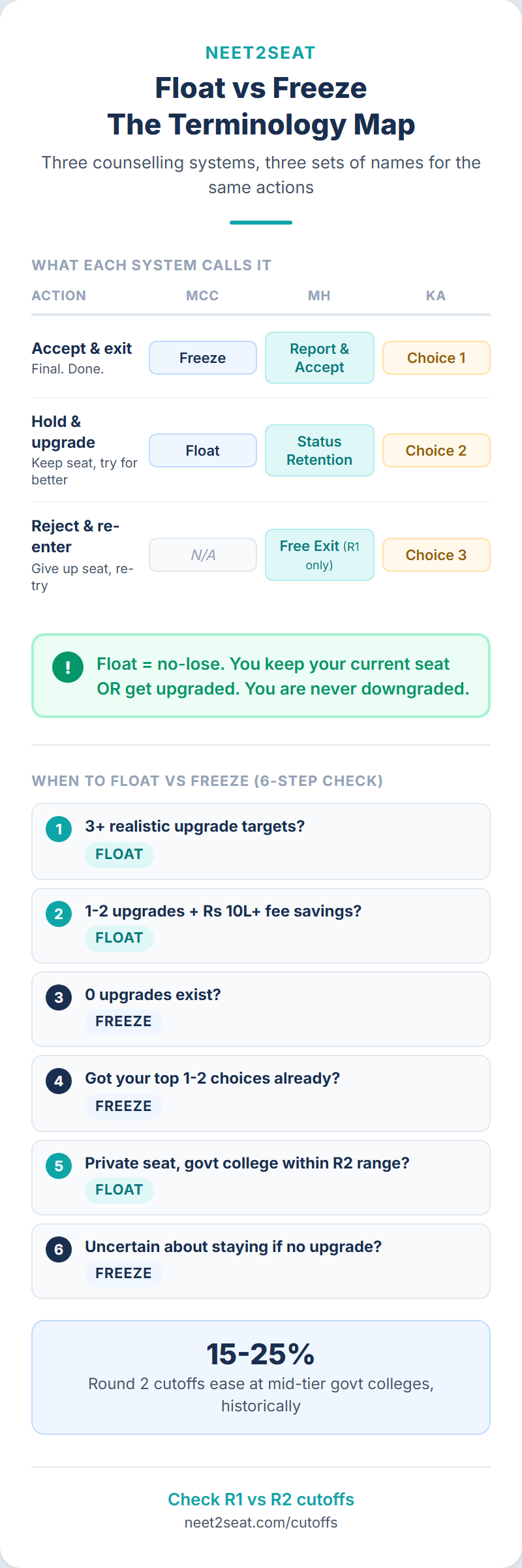
    Infographic explaining float vs freeze in NEET counselling

    This guide covers the general framework for making this decision in NEET 2026 counselling. For state-specific mechanics, see our Maharashtra Status Retention guide and our Karnataka Choice 1 vs Choice 2 guide.

    The terminology, mapped across systems

    Three counselling systems, three vocabularies, one underlying decision:

    ActionMCC termMaharashtra termKarnataka term
    Accept seat, exit counsellingFreezeDo not retain (report and accept)Choice 1
    Keep seat, seek upgrade in next roundFloatStatus RetentionChoice 2
    Reject seat, re-enter poolNot available (must float or freeze)Free Exit (Round 1 only)Choice 3

    MCC’s system is the simplest: two options, Float or Freeze. Maharashtra adds a free exit option in Round 1 and a binding Status Retention mechanism in Round 2. Karnataka adds a third path (Choice 3: reject and re-enter) that carries genuine risk of ending up with no seat at all.

    The rest of this guide uses “float” (lowercase) to mean “keep current seat while seeking upgrade” and “freeze” to mean “accept current seat and exit.” These are the most widely understood terms, even outside MCC counselling.

    How floating works at a mechanical level

    When you float (or declare Status Retention, or choose Choice 2), the system does three things:

    1. Your current seat is reserved for you. No other candidate can take it during the next round. It is held in your name until the round concludes.
    2. Your preference list is checked for upgrades. The algorithm looks at colleges ranked higher than your current allotment on your preference list. If any of those colleges has a vacancy and your AIR qualifies, you are upgraded.
    3. If upgraded, your old seat is released. It becomes available for other candidates in the current round. If not upgraded, you keep your original seat with no penalty.

    Floating is a no-lose proposition in most counselling systems. You either get something better or keep what you have. The only costs are financial (a deposit or partial fees to hold the seat) and logistical (waiting longer for a final answer). The algorithm cannot downgrade you to a college ranked lower on your preference list.

    When to freeze

    Freeze when any of these conditions is true:

    You got your first or second choice

    If the allotted college is at or near the top of your preference list, there is little room for upgrade. Floating would keep you in the system for another round with almost no chance of improvement. Freeze, report to the college, and start preparing for MBBS.

    The financial cost of floating is unacceptable

    In Karnataka, Choice 2 candidates with allotted seats having course fees above Rs 12 lakh previously had to pay the full fee upfront. The 2025 rule change capped this at Rs 12,001, making floating much more accessible. But in some counselling tracks, the deposit or advance fee required to hold a seat while floating can be substantial. If paying that amount creates financial strain with minimal upgrade probability, freezing is the safer financial decision.

    The college meets your minimum requirements

    If the allotted college is a government college with acceptable fees, reasonable location, and adequate infrastructure, and the only colleges ranked higher are marginal improvements (say, a government college in a slightly larger city), the risk-reward calculus favours freezing. A guaranteed seat at a good college is worth more than a slim chance at a marginally better one.

    You are in Round 3 or a mop-up round

    Late rounds have smaller seat pools and fewer upgrade opportunities. If you have a seat in Round 3, freeze it. The probability of meaningful improvement in subsequent rounds is low, and the risk of administrative complications increases.

    When to float

    Float when any of these conditions is true:

    Your current allotment is significantly below your preference list position

    If you listed 30 colleges and got allotted number 25, there are 24 colleges above your allotment that you prefer. Even if only 2 or 3 of those colleges have vacancies in the next round, your chances of an upgrade are real. The gap between your allotment and your top choices determines the upside of floating.

    The government-private gap applies

    You are allotted a private college at Rs 14 lakh per year but have government colleges ranked higher on your list. Government college fees in Maharashtra are approximately Rs 1.62 lakh per year; in Karnataka, approximately Rs 50,000 per year. The five-year savings from upgrading to a government seat range from Rs 35 lakh to Rs 65 lakh. Even if the upgrade probability is only 15%, the expected value (probability times savings) far exceeds the cost of holding the seat.

    You are in Round 1 or Round 2

    Early rounds have the largest seat pools and the most movement. In Karnataka, Round 2 had 9,957 allotments versus 8,320 in Round 1 in 2025, meaning significant seat turnover between rounds. In Maharashtra, Round 2 closes at higher (less competitive) AIRs than Round 1 at most colleges, creating upgrade opportunities that did not exist in Round 1.

    Historical data supports the upgrade

    Check the cutoff analyzer for the colleges above your allotment. Filter by Round 2, your category, and multiple years (2023-2025). If their Round 2 closing AIRs were at or above your AIR in at least 2 of 3 years, the upgrade is plausible. If they were well below your AIR in all years, the upgrade is not realistic regardless of floating.

    The data behind round-to-round movement

    From our database of 407,000+ allotment records across Maharashtra and Karnataka (2023 to 2025), several patterns affect the float-vs-freeze decision:

    Round 2 closing AIRs are consistently higher than Round 1

    At government colleges in Maharashtra, Round 2 closing AIRs for OPEN category averaged 15% to 25% higher (less competitive) than Round 1 across 2023 to 2025. At Karnataka government colleges, the shift was similar: Round 2 typically closed at 10% to 20% higher AIRs than Round 1.

    The easing pattern is not uniform. Top-5 government colleges show only 5% to 10% easing (their candidates freeze immediately). Mid-tier colleges (ranked 10th to 25th) show 15% to 25% easing: the sweet spot for upgrades. Lower-ranked colleges can ease by 30% to 40%.

    Top colleges show the smallest movement

    The most competitive government colleges (Seth GS Medical College in Mumbai, Bangalore Medical College in Karnataka) show minimal closing AIR movement between rounds. These colleges fill with top-ranked candidates who freeze immediately. If your upgrade target is a top-5 college, floating is less likely to help unless your AIR is very close to the Round 1 closing.

    Mid-tier colleges show the largest movement

    Government colleges ranked 10th to 25th in each state show the most Round 1 to Round 2 movement. These colleges experience the most seat turnover from candidates who were allotted there but chose to float (hoping for a top college) or who took free exit. If your upgrade targets are in this mid-tier range, floating has the highest probability of success.

    Private college movement is volatile

    Private college closing AIRs can shift by 30% to 50% between rounds, depending on fee changes, new seat additions, and candidate behaviour. If your backup is a private college and your upgrade targets are also private colleges, the outcome is harder to predict from historical data alone.

    The reject-and-re-enter option (Karnataka Choice 3)

    Karnataka’s Choice 3 is unique and high-risk: you reject the allotted seat entirely and re-enter the candidate pool for Round 2. Unlike floating, you have no safety net. If Round 2 does not produce an allotment, you are left with no seat and a forfeited caution deposit (Rs 1,00,000 general; Rs 50,000 SC/ST). For strategic upgrades, Choice 2 is almost always better because it preserves your Round 1 seat.

    The only scenario where Choice 3 makes strategic sense: your AIR is strong enough that historical data across multiple years confirms you would be allotted in Round 2, and the Rs 1,00,000 deposit is an acceptable cost if the prediction is wrong. Even then, Choice 2 achieves the same upgrade with zero risk.

    Financial analysis: when is floating worth the deposit?

    The financial question is straightforward: does the expected savings from an upgrade exceed the cost of holding the seat?

    Scenario 1: Private to government upgrade

    Current allotment: private college, Rs 14 lakh/year fees. Target upgrade: government college, Rs 50,000/year (Karnataka) or Rs 1.62 lakh/year (Maharashtra). Floating cost: Rs 12,001 (Karnataka 2025 rule) or deposit amount per Maharashtra rules.

    Five-year savings if upgraded: Rs 60 lakh to Rs 67.5 lakh. Even if the upgrade probability is only 15%, the expected value (probability times savings) is Rs 9 lakh to Rs 10 lakh. Against a floating cost of Rs 12,001, this is a clear float.

    Scenario 2: Government to better government upgrade

    Current allotment: government college in a smaller city. Target upgrade: government college in a metropolitan area. Fees are the same at both colleges. The financial savings are zero.

    The value here is non-financial: clinical exposure, research access, professional network, quality of life. If those factors are important enough to justify waiting another round, float. If the current college is acceptable, freeze and save the time.

    Scenario 3: Private to slightly cheaper private

    Current allotment: private college at Rs 18 lakh/year. Target upgrade: private college at Rs 12 lakh/year. Five-year savings if upgraded: Rs 30 lakh. If the upgrade probability is reasonable (check historical cutoffs), float. If the target college’s closing AIR is far below your AIR even in Round 2, the savings are theoretical and freezing is more practical.

    The psychological trap: anchoring to a specific college

    Many candidates float not because the math supports it, but because they are fixated on a specific college. “I want Seth GS” or “I only want Bangalore Medical College.” If your AIR is 20,000 and the target college closed at AIR 3,000, no amount of floating will get you there. The college’s Round 2 closing AIR might ease to 3,500 or 4,000, still far beyond your reach.

    Use the cutoff analyzer to check multi-year closing AIR ranges for your target colleges. If the best-case scenario across three years of data still does not reach your AIR, the upgrade is not realistic. Float for achievable upgrades, not aspirational ones.

    Decision framework

    Follow these steps: (1) Identify colleges above your allotment on your preference list. (2) Check Round 2 closing AIRs for those colleges in the cutoff analyzer, filtering by your category. (3) Count how many have closings at or above your AIR. (4) If 3+ colleges qualify, float. (5) If 1-2 qualify, float if the fee savings exceed Rs 10 lakh over five years. (6) If zero qualify, freeze.

    FAQ

    If I float and am not upgraded, do I lose my current seat?

    No. In all three counselling systems (MCC Float, Maharashtra Status Retention, Karnataka Choice 2), failing to upgrade means you keep your existing seat. The float mechanism is designed to be risk-free in terms of seat retention. The only costs are financial (deposit or advance fees) and time.

    Can I float in one counselling track and freeze in another?

    If you are participating in both MCC and state counselling simultaneously, each track’s decisions are independent until you receive a final allotment from both and must choose one. Floating in MCC does not affect your state counselling seat, and vice versa. However, the timelines may overlap, so track both deadlines carefully.

    What happens to my seat if I do not respond to the float/freeze deadline?

    Policies vary. In MCC, failure to exercise the option by the deadline typically results in seat cancellation. In Maharashtra, the default may be treated as free exit (Round 1) or seat cancellation (later rounds). In Karnataka, missed deadlines can result in forfeiture. Never rely on defaults; always submit your decision before the deadline.

    Is there a limit to how many times I can float?

    In MCC, you can float after each round until you either freeze or the final round concludes. In Maharashtra, Status Retention applies between specific rounds (Round 1 to Round 2 primarily). In Karnataka, the Choice 1/2/3 decision occurs after each round’s allotment. Check the current year’s counselling bulletin for exact rules on sequential floating.

    Does floating affect my deposit or fees?

    In MCC, the initial security deposit (typically Rs 25,000 for government quota; Rs 2,00,000 for deemed/private management quota) must remain deposited while floating. In Karnataka, the 2025 rule caps the advance fee at Rs 12,001 for seats above Rs 12 lakh. In Maharashtra, the deposit requirements for Status Retention are specified in the CET Cell information bulletin. The deposit is adjusted against the final college’s fees if you eventually freeze or are upgraded.

    What if I float and get upgraded to a college I like less than my current allotment?

    This cannot happen. The algorithm only upgrades you to colleges ranked higher (better) on your preference list than your current allotment. If you have College A at position 5 and College B (your current seat) at position 12, you can only be upgraded to colleges at positions 1 through 11. You will never be moved to a college ranked lower than your current seat.

    What is the difference between freeze and float in counselling?

    Float means you accept your current allotment but remain in the pool for an upgrade in the next round. If a better college (higher on your preference list) becomes available, you are automatically upgraded. If not, you keep your current seat. Freeze means you accept your current allotment and exit the counselling process entirely; you will not be considered for any further rounds. The terminology varies by state: Maharashtra calls it “Status Retention” (equivalent to float), and Karnataka uses “Choice 1” (freeze) and “Choice 2” (float).

  • NEET choice filling strategy: how to order your preference list

    • The allotment algorithm processes your list top to bottom; listing a competitive college higher never reduces your chances at colleges below it.
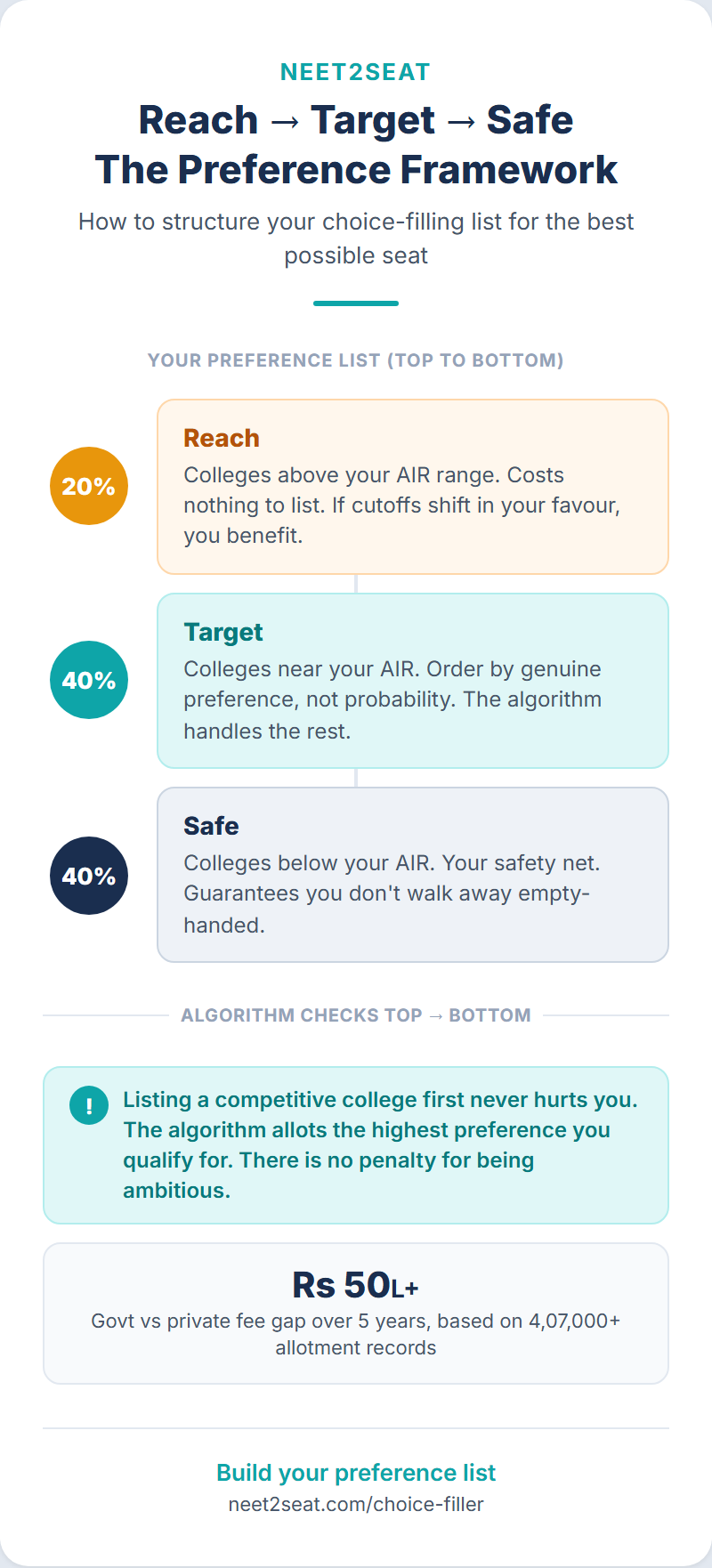
    • Use the Reach-Target-Safe framework: top 20% aspirational, middle 40% realistic, bottom 40% safety net.
    • Fill as many choices as possible. There is no penalty for additional entries, and every unfilled slot is a missed safety net.
    • Round 1 exit is free in all counselling tracks, so list aggressively in the first round.

    Choice filling is where most candidates lose seats they could have won

    Your NEET choice filling strategy determines your outcome more than almost any other variable you control. The seat allotment algorithm is mechanical: it takes your NEET All India Rank, your locked preference list, the available seats, and your category eligibility, then assigns you the highest-ranked choice where your AIR meets the threshold. The algorithm does not know which college you “really” want. It only sees the order you gave it.

    Infographic showing NEET choice filling strategy

    A badly ordered preference list can put you in a college you ranked 15th when your AIR qualifies for one you ranked 12th. It can cost you a government seat and land you in a private college that charges Rs 15 lakh more per year. Over five years of MBBS, a preference ordering mistake translates directly into lakhs of rupees and years of regret.

    This guide covers the structural principles behind preference ordering: how the algorithm processes your list, what the common mistakes are, and how to build a list that maximizes your chances. For state-specific guidance, see our Maharashtra choice filling guide and our Karnataka choice filling guide.

    How the allotment algorithm works

    Both MCC and state counselling authorities use a variant of the Gale-Shapley algorithm (also called deferred acceptance). The properties that matter:

    1. Your list is processed top to bottom. The algorithm checks your first choice first. If your AIR qualifies and a seat is available, you get it. If not, it moves to your second choice. Then third. And so on until either you are allotted a seat or your entire list is exhausted.
    2. Higher-ranked candidates are processed first. A candidate with AIR 5,000 has their full preference list processed before a candidate with AIR 5,001. If both want the same seat, the higher-ranked candidate gets it.
    3. The order of your list cannot hurt you. Listing a more competitive college at position 1 does not reduce your chances at the college you listed at position 5. If you do not get choice 1, the algorithm simply moves to choice 2 as if choice 1 never existed. This is the most misunderstood property of the algorithm.

    Because of property 3, there is no strategic reason to put a “safer” college higher in your list. You should always list colleges in your genuine order of preference, most desired first. The algorithm guarantees this is optimal.

    The three-tier framework

    Divide your list into three sections:

    Top tier: Reach colleges (positions 1 through ~20%)

    These are colleges where your AIR is above (worse than) the historical closing rank. You would not get in based on past data, but cutoffs shift every year. Listing them costs nothing. If cutoffs ease in your favour, you get a seat you would have missed entirely. If they do not, the algorithm moves down your list without penalty.

    Use the college predictor to identify which colleges are classified as Reach for your AIR and category. Start your list with all Reach colleges, ordered by genuine preference.

    Middle tier: Target colleges (positions ~20% through ~60%)

    These are colleges where your AIR falls near the historical closing range. In some past years you would have made the cut; in others you would not. This is where ordering matters most: among colleges where your chances are uncertain, the one you want more should come first.

    Within the Target tier, order by genuine preference: academic reputation, location, fees, infrastructure, or whatever factors matter to you. Do not order by “likelihood of getting in.” That calculation is already embedded in the algorithm; your job is to express preference, not predict probability.

    Bottom tier: Safe colleges (positions ~60% through 100%)

    These are colleges where your AIR has been comfortably within the closing rank in recent years. These are your safety net. You should list enough Safe colleges to ensure you get allotted something, even in a worst-case scenario where cutoffs tighten across the board.

    Within the Safe tier, order by preference. Even though you are likely to get any of these, you want the algorithm to assign you the best one first.

    How many choices to fill

    More is better. There is no penalty for filling additional choices. If you qualify for 40 colleges, list all 40. If you qualify for 80, list all 80. Every unfilled choice is a missed opportunity if cutoffs shift unexpectedly.

    Some candidates fill only 5 to 10 choices, reasoning that they only want those specific colleges. This works if their AIR comfortably clears all 10. It fails spectacularly if cutoffs tighten and none of the 10 are available. The candidate ends up with no allotment in that round.

    The time cost of filling 50 choices vs 10 choices is about 20 extra minutes. The downside risk of having too few choices is potentially catastrophic. Fill more. For a detailed analysis of optimal list length, see our guide on how many choices to fill.

    Government vs private: the fee multiplier

    At government colleges in Maharashtra, MBBS costs approximately Rs 1.62 lakh per year (tuition plus development fee). At private colleges, it ranges from Rs 5 lakh to Rs 25 lakh per year. Over five years, the difference between a government seat and a mid-range private seat can exceed Rs 50 lakh.

    A common mistake: candidates list a well-known private college above a mid-tier government college because the private college “feels” better. They get allotted the private seat, spend Rs 60 lakh more over five years, and end up with the same MBBS degree. Unless your family’s financial situation makes the fee difference irrelevant, government colleges should rank above private colleges of similar academic standing.

    Location considerations

    Location affects your medical education in ways beyond convenience. Colleges in metropolitan areas (Mumbai, Pune, Bengaluru) typically have higher patient volumes, more clinical exposure in specialized departments, and better access to research opportunities and postgraduate preparation resources. Colleges in smaller cities may have lower living costs and less competition for clinical rotations.

    If you plan to practice in a specific region after MBBS, attending a college there builds local professional networks that matter for internship and residency placements. This is particularly relevant in Karnataka, where compulsory rural service after MBBS is mandated by state law.

    Category-specific ordering

    Your preference list should be built for your specific category, not the general pool. If you are an SC candidate in Maharashtra, the cutoffs relevant to you are SC cutoffs, not OPEN cutoffs. A college that is Reach for OPEN might be Safe for SC. Use the cutoff analyzer to check historical closing AIRs for your exact category at each college.

    If you are eligible for multiple categories (for example, both OBC and OPEN in Maharashtra), model both scenarios using the cutoff analyzer. Some colleges may be reachable under your reserved category but not under OPEN.

    Round-specific strategy

    Round 1: fill aggressively

    In both MCC and state counselling, Round 1 offers a free exit: if you receive an allotment you do not want, you simply do not report. Your deposit is refunded, and you remain eligible for Round 2. This means Round 1 carries no downside risk.

    Fill your Round 1 list as ambitiously as possible. Include Reach colleges you would not normally bet on. The worst outcome is you get nothing and enter Round 2 in the same position. The best outcome is you lock a seat that opens up from an unexpected shift in preferences.

    Round 2: adjust based on Round 1 data

    After Round 1, you have concrete information: which colleges were allotted in Round 1, at what closing AIRs, and how many seats were vacated by candidates who took free exit. Use this data to refine your Round 2 preferences.

    If a college’s Round 1 closing AIR was 20,000 and your AIR is 22,000, that college moves from Reach to Target for Round 2, because Round 2 closing AIRs are typically higher (less competitive) than Round 1 as more seats become available from exits and upgrades.

    Round 3 and mop-up: take what you can get

    By Round 3, the seat pool is small and the choices are limited. If you are still in the pool at this stage, your priority should be ensuring you get any medical seat rather than optimizing for the perfect one. Fill every available option.

    Using our tools for preference ordering

    The recommended workflow:

    1. Run the college predictor with your AIR, state, and category. This gives you the Safe/Target/Reach classification for every college.
    2. Check individual college cutoffs using the cutoff analyzer. For each Target college, look at the year-to-year variation in closing AIR. Colleges with volatile cutoffs are higher-risk (could swing either way). Colleges with stable cutoffs are more predictable.
    3. Build your preference list in the choice filling optimizer. Drag and drop colleges into your preferred order, using the Reach-Target-Safe framework. The optimizer shows historical cutoff data alongside each college to help you make informed ordering decisions.

    What the data says about preference behaviour

    From our analysis of 407,000+ allotment records across Maharashtra and Karnataka (2023-2025), several patterns emerge:

    Government college cutoffs cluster tightly at the top. In Maharashtra 2025, the top 5 government colleges had OPEN closing AIRs between 2,571 and 11,360 (Round 2). That is a relatively narrow band for the most competitive seats in the state. A candidate with AIR 8,000 has a reasonable shot at multiple top-5 colleges, making preference order among them the deciding factor.

    Private college cutoffs have a wider spread. The closing AIR range at private colleges extends from under 50,000 to over 5,00,000 depending on the institution and seat type. This means the Target zone for private colleges is broader, giving you more colleges to rank in your middle tier.

    Cutoffs tighten year over year at top colleges. The top government colleges in both Maharashtra and Karnataka showed a 25% to 63% drop in closing AIRs from 2023 to 2025. If you are using last year’s cutoffs to judge your NEET 2026 chances, build in a safety margin: this year’s cutoffs may be tighter still.

    FAQ

    Does the order of my preference list affect my chances at any specific college?

    No. Whether you list a college at position 1 or position 50, the algorithm checks whether your AIR qualifies for that college when it reaches that position on your list. Listing a college higher does not increase your chances of getting it. It only means the algorithm checks it earlier.

    Should I list only colleges I would actually attend?

    Yes and no. In Round 1, where exit is free, list broadly because there is no commitment. In later rounds where the allotment may be binding or involve deposit forfeiture, only list colleges you would genuinely attend. Getting allotted a college you do not want in Round 3 creates a painful choice between accepting an unwanted seat or forfeiting your deposit.

    How do I handle colleges where I have no historical data?

    New colleges or colleges with very recent NMC approval may not have historical cutoff data. Place them in the Target or Safe zone of your list based on their location, fee structure, and management type (government vs private). A new government college in a major city will likely have cutoffs in the same range as similarly positioned existing colleges.

    What if I am participating in both MCC and state counselling?

    Fill preference lists independently for each track. The colleges available, the category definitions, and the seat pools are different between MCC and state counselling. Your MCC list should reflect your AIQ options; your state list should reflect your state quota options. The two do not interact until you receive allotments from both and must choose one.

    Can I change my preference list after locking?

    In most counselling tracks, no. Once locked, the list is final for that round. If you forget to lock it manually, the system auto-locks the last saved version. Never rely on auto-lock: review your list carefully and lock it yourself well before the deadline.

    What is the 80-20 rule in NEET choice filling?

    The “80-20 rule” in NEET choice filling refers to a common guideline where candidates allocate roughly 80% of their preference list to colleges they can realistically get (Target and Safe zones) and 20% to aspirational Reach colleges. The idea is that your list should be dominated by practical options while still allowing for upside if cutoffs shift in your favour. Our framework (Reach at top 20%, Target at middle 40%, Safe at bottom 40%) follows a similar logic with more granularity.

    How to do choice filling in NEET?

    Choice filling is the process of creating your ranked preference list on the counselling portal (MCC, CET Cell, or KEA). You log in, see the available colleges and seat types, drag them into your preferred order, and lock the list before the deadline. The allotment algorithm processes your list top to bottom and assigns you the highest choice where your AIR qualifies. For a complete walkthrough, see our Maharashtra choice filling guide or our Karnataka guide.