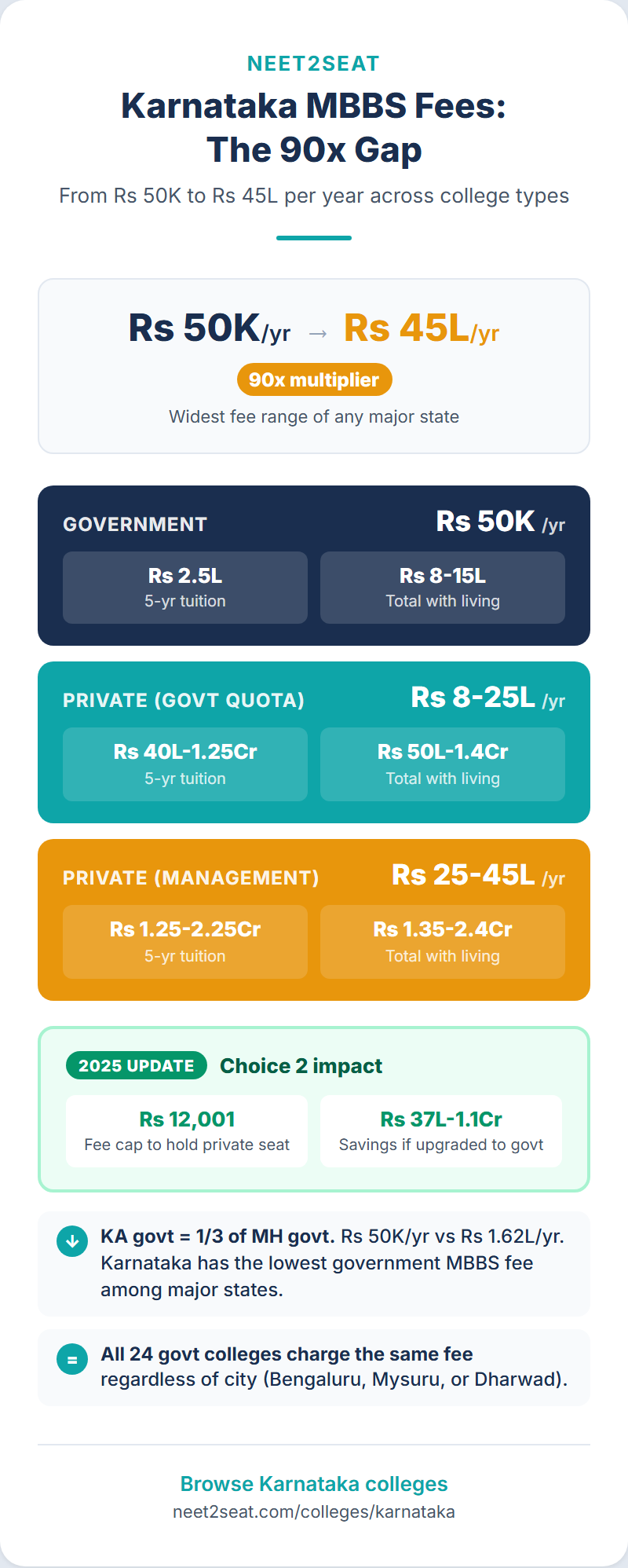
Karnataka’s fee structure has a 90x gap between the cheapest and most expensive medical seat
A government medical college seat in Karnataka costs approximately Rs 50,000 per year. A management quota seat at a top private college can exceed Rs 45 lakh per year. That is a 90x annual multiplier. Over five years, the total cost ranges from Rs 2.5 lakh (government seat, tuition only) to Rs 2.25 crore (private management quota with hostel and living expenses). This makes the seat type and college category the most consequential financial variables in the counselling process.
This guide covers fee structures for all three college types in Karnataka. For college-specific cutoff data, see the Karnataka cutoff analyzer. For a full list of colleges, see our Karnataka college directory.
- Government: Rs 50K/yr (total Rs 8-15L over 5 years) — among the lowest government medical college fees in India
- Private government quota: Rs 8-25L/yr; management quota: Rs 25-45L/yr — a 90x gap from cheapest to most expensive
- 2025 Choice 2 fee cap (Rs 12,001) removed the primary financial barrier to floating for government seat upgrades
- Rs 67.5L five-year savings from government vs mid-range private represents 7.5-11 years of a junior resident’s salary
Government medical colleges: Rs 50,000 per year
Karnataka has 24 government medical colleges with 4,249 MBBS seats. Government college fees are set by the state government and are uniform across all institutions. Bangalore Medical College, Mysore Medical College, and the government college in Yadgiri all charge the same tuition.
The annual tuition fee at Karnataka government medical colleges is approximately Rs 50,000. Over five years, tuition totals approximately Rs 2.5 lakh. Additional costs (hostel, mess, examination fees, books, equipment) bring the five-year total to roughly Rs 8 lakh to Rs 15 lakh, depending on the city and personal spending.
Karnataka’s government college fees are among the lowest in India. Maharashtra charges approximately Rs 1.62 lakh per year at government colleges; Karnataka charges roughly one-third of that. For a candidate eligible for both state’s counselling, this fee difference adds up to Rs 5.6 lakh over five years in tuition alone.
Fee concessions
SC, ST, Category 1, and other backward class students in Karnataka may be eligible for state government scholarship programmes that reimburse tuition fees. The Department of Social Welfare and Backward Classes Welfare Department operate separate schemes with different income ceilings. At Rs 50,000 per year, the tuition amount is modest enough that several scholarship programmes cover it fully.
At Rs 50,000/yr, Karnataka government college tuition is low enough that multiple state scholarship programmes cover it entirely. SC, ST, and Category 1 candidates should check the Social Welfare Department and Backward Classes Welfare Department websites for current eligibility and application deadlines.
Private medical colleges: Rs 8 lakh to Rs 25 lakh per year (government quota)
Karnataka has 38 private medical colleges with 7,045 MBBS seats. Private college fees in Karnataka are regulated by the Karnataka Private Medical Establishment Fee Committee. Fees vary significantly by institution.
Government quota seats (filled through KEA)
State counselling (KEA) fills government quota seats at private colleges. Approximately 40% to 50% of private college seats are government quota. The fees for these seats are regulated and range from approximately Rs 8 lakh to Rs 25 lakh per year, depending on the institution.
Top private colleges in Bengaluru (MS Ramaiah Medical College, St. Johns Medical College, JSS Medical College, Kempegowda Institute) tend to be at the higher end (Rs 15 lakh to Rs 25 lakh per year). Private colleges in smaller cities (Bagalkot, Davangere, Tumakuru) tend to be at the lower end (Rs 8 lakh to Rs 14 lakh per year).
Over five years, government quota at private colleges costs Rs 40 lakh to Rs 1.25 crore in tuition. With living expenses, the total ranges from Rs 50 lakh to Rs 1.4 crore.
Private/institutional quota seats
The remaining seats at private colleges are institutional or management quota. These seats carry higher fees, typically Rs 20 lakh to Rs 35 lakh per year. They are filled through a separate process (sometimes through KEA’s management quota round, sometimes through the college’s own admission office).
Management quota
Management quota fees at Karnataka private colleges range from Rs 25 lakh to Rs 45 lakh per year. These are the most expensive seats in the state. Over five years, management quota tuition alone can total Rs 1.25 crore to Rs 2.25 crore. Management quota seats are the last to be filled and are available to candidates who did not secure seats through any other pathway.
Management quota is the last resort, not a parallel option. Exhaust all KEA rounds (R1, R2, R3, mop-up) before considering management quota. The fee difference between government quota and management quota at the same private college can exceed Rs 1 crore over five years.
Deemed universities: Rs 10 lakh to Rs 30 lakh per year
Karnataka has 12 deemed universities with 2,800 MBBS seats. Deemed university fees are partially regulated but tend to be higher than private college government quota fees.
Government quota seats (filled through KEA)
Approximately 25% of deemed university seats are government quota, filled through KEA counselling alongside regular private college government quota seats. Fees for government quota at deemed universities range from Rs 10 lakh to Rs 20 lakh per year.
KMC Mangaluru (Manipal group) and JSS Mysuru are among the most competitive deemed university seats in Karnataka. Their government quota closing AIRs are comparable to top private colleges.
MCC and management quota seats
The remaining deemed university seats are filled through MCC counselling (for deemed university pool seats) or through the university’s own management/NRI quota process. These fees range from Rs 18 lakh to Rs 30 lakh per year. NRI quota fees at some institutions are denominated in USD and can exceed Rs 35 lakh per year equivalent.
The five-year cost comparison
| College type | Seat type | Annual fees (approx.) | 5-year tuition | 5-year total (with living) |
|---|---|---|---|---|
| Government | State quota | Rs 50,000 | Rs 2.5 lakh | Rs 8-15 lakh |
| Private | Government quota | Rs 8-25 lakh | Rs 40 lakh-1.25 cr | Rs 50 lakh-1.4 cr |
| Private | Management quota | Rs 25-45 lakh | Rs 1.25-2.25 cr | Rs 1.35-2.4 cr |
| Deemed | Government quota | Rs 10-20 lakh | Rs 50 lakh-1 cr | Rs 60 lakh-1.15 cr |
| Deemed | MCC/management quota | Rs 18-30 lakh | Rs 90 lakh-1.5 cr | Rs 1-1.65 cr |
The 2025 Choice 2 fee cap and its financial impact
Before 2025, a candidate allotted a private college seat at Rs 15 lakh per year through KEA had to pay the full Rs 15 lakh upfront to use Choice 2 (hold seat and seek upgrade). This meant that only candidates with Rs 15 lakh in liquid funds could float for a government upgrade.
The 2025 rule caps the Choice 2 advance payment at Rs 12,001 for seats with fees above Rs 12 lakh. SC/ST/Category 1 candidates pay Rs 2,000. This change removed the primary financial barrier to floating. A middle-income candidate allotted a private seat can now hold it for Rs 12,001 while attempting to upgrade to a government seat at Rs 50,000 per year, potentially saving Rs 37 lakh to Rs 1.1 crore over five years depending on the private college’s fees.
The 2025 Choice 2 fee cap is a game-changing rule. Previously, floating from a Rs 15L/yr private seat required Rs 15L upfront. Now it costs Rs 12,001. If you get a private seat in Round 1, always choose Choice 2 to attempt a government upgrade — the potential savings over five years can exceed Rs 1 crore.
For the full Choice 2 decision framework, see our Karnataka Choice 1 vs Choice 2 guide.
Why fee differences should dominate preference ordering
The gap between a government seat (Rs 50,000/year) and a mid-range private seat (Rs 14 lakh/year) totals Rs 67.5 lakh over five years. To put this in perspective:
- A junior resident in Karnataka earns approximately Rs 50,000 to Rs 75,000 per month. Rs 67.5 lakh represents 7.5 to 11 years of gross salary at that level.
- A postgraduate (MD/MS) seat at a government college costs approximately Rs 2 lakh to Rs 5 lakh per year. The savings from a government MBBS seat would fund the entire PG education.
- Education loan interest on Rs 67.5 lakh at 9.5% over 15 years adds approximately Rs 45 lakh in interest charges, making the effective cost difference over Rs 1.1 crore.
All 24 government colleges, even those in smaller cities (Yadgiri, Koppal, Haveri, Chitradurga), should appear above private colleges on your preference list unless private college fees are financially inconsequential for your family. The MBBS degree from every NMC-approved college qualifies you for PG entrance exams equally. See our choice filling guide for the complete preference ordering framework.
When building your KEA preference list, place all 24 government colleges (even in smaller cities) above all private colleges. The Rs 67.5L five-year savings from a government seat in Yadgiri vs a mid-range Bengaluru private college would fund your entire PG education and leave money to spare.
Compulsory rural service and its financial implications
Karnataka mandates compulsory rural service for government medical college graduates. The duration is typically one year (subject to state government orders). During rural service, the government pays a stipend. Failure to complete rural service can result in penalties, including being barred from PG admissions in the state.
Some candidates factor rural service into their cost-benefit analysis: “If I attend a private college, I avoid rural service.” This calculation is flawed for two reasons. First, the fee savings from a government seat (Rs 35 lakh to Rs 67 lakh) far exceed any income difference during the one-year service period. Second, rural service provides clinical experience in primary healthcare that is increasingly valued in PG selections and public health careers.
Do not choose a private college to avoid rural service. The one-year service period costs far less than the Rs 35-67L fee savings from a government seat. Rural postings also build primary care experience that strengthens PG applications in community medicine and public health tracks.
FAQ
Are government college fees the same across all 24 institutions?
Yes. The state government sets a uniform fee for all government medical colleges. Bangalore Medical College in the state capital and the government college in Yadgiri (a remote district) charge the same tuition.
Can private college fees increase during my five years?
Yes. Private college fees are approved by the Fee Regulatory Committee, and annual increments of 5% to 10% are common. Some colleges have a fixed fee structure for the entire five-year duration (locked at admission), while others apply annual increases. Check the specific college’s fee notification before admission.
What is the NRI quota fee at Karnataka deemed universities?
NRI quota fees vary significantly. At top deemed universities (Manipal group, JSS), NRI fees can range from Rs 30 lakh to Rs 50 lakh per year or more. Some institutions quote fees in USD. NRI quota is the most expensive pathway to an MBBS seat in Karnataka.
Is there a bond for government college graduates?
Karnataka government college graduates are subject to a service bond (compulsory rural service). The duration and terms are set by state government order and can change. Currently, the requirement is approximately one year of rural service. Non-compliance penalties include bond amount payment and potential restrictions on state PG admissions.
How do I find the exact fee for a specific college?
Fee details are published in the KEA information bulletin and on the Fee Regulatory Committee’s website. The Karnataka college directory on our platform shows fee ranges by college. For the exact current-year fee, refer to the official KEA notification for the counselling cycle.
What is the fees of MBBS in Bangalore?
MBBS fees in Bangalore depend entirely on the college type. The three government colleges (BMCRI, KIMS, ESIC) charge approximately Rs 50,000 per year. Private colleges in Bangalore range from Rs 8 lakh to Rs 25 lakh per year for government quota seats. Private management quota fees can reach Rs 45 lakh per year. Deemed universities (like MS Ramaiah) fall in the Rs 10 lakh to Rs 30 lakh per year range. The cheapest MBBS option in Bangalore is a government college seat at Rs 50,000/year; the most expensive exceeds Rs 2 crore over five years.