Closing ranks below are the OPEN / government headline (latest year, NEET All-India Rank). Full round-by-round history for 2023-2025 is on the Delhi cutoffs page.
College
MBBS seats
Counselled by
OPEN closing (AIR)
AIIMS New Delhi
132
MCC
~50
Maulana Azad Medical College (MAMC)
250
MCC (DU)
~100
VMMC & Safdarjung Hospital
170
MCC
~130
ABVIMS & Dr. RML Hospital
100
MCC
~215
University College of Medical Sciences (UCMS)
170
MCC (DU)
~560
Lady Hardinge Medical College (LHMC, women only)
240
MCC (DU)
~1,130
NDMC Medical College (Hindu Rao)
60
GGSIPU 85% / MCC 15%
~2,990
Dr. B.S.A. Medical College, Rohini
125
GGSIPU 85% / MCC 15%
~5,800
Army College of Medical Sciences (ACMS)
100
GGSIPU (army wards)
~28,700 (all-India pool)
Hamdard (HIMSR, deemed)
150
MCC (deemed)
~77,000
(Ranks rounded; they move year to year. Use the predictor for your own rank.)
The MCC colleges
AIIMS New Delhi — the toughest seat in the country; fills on All-India Rank, no state quota. ~132 MBBS seats.
Maulana Azad (MAMC), Lady Hardinge (LHMC), UCMS — the three University of Delhi colleges. Their 85% Delhi quota and 15% AIQ are both run by MCC. LHMC admits women only. MAMC is the largest Delhi government college at 250 seats and the most competitive of the DU three.
VMMC & Safdarjung and ABVIMS & Dr. RML Hospital — large central-government teaching hospitals; both quotas filled directly by MCC. Among the most sought-after after the DU colleges.
Hamdard (HIMSR) — a deemed university; fills its own deemed / management and minority seats through MCC, at deemed-college fees.
The GGSIPU 85% colleges
These three are where GGSIPU counsels the 85% Delhi quota itself (the 15% AIQ still goes through MCC):
Dr. B.S.A. Medical College, Rohini — 125 seats; the 85% Delhi seats close markedly later than the DU colleges, so it is the realistic Delhi-quota target for many mid-rank candidates.
NDMC Medical College (Hindu Rao) — 60 seats, the smallest Delhi government intake.
Army College of Medical Sciences (ACMS) — 100 seats, restricted to wards of Army personnel (see the categories guide). Its closing ranks reflect the army-wards pool, not the open Delhi field.
How to read Delhi cutoffs
A Delhi college shows up to three different closing ranks for the same seat — the 15% AIQ, the 85% Delhi quota, and (for BSA/NDMC/ACMS) the GGSIPU pools (HS / AI / OS). The Delhi cutoffs page separates them and shows 2023-2025 round by round. The headline figures above are the OPEN government line, the bar a general-merit candidate actually faces.
Medical college fees under All India Quota: government, deemed, and central institutions
The fee difference between institution types in MCC NEET UG counselling is large enough to change the financial trajectory of a medical career. Government AIQ seats can cost under Rs 1 lakh for the entire MBBS programme in some states, while deemed university seats routinely exceed Rs 1 crore. This guide breaks down fees by institution type, compares costs across states, and covers what you actually pay beyond tuition.
Government college fees under AIQ
Government medical college fees are set by the respective state government or its fee regulatory authority. AIQ students pay the same fee as state quota students at the same institution. There is no out-of-state surcharge.
AIQ and state quota students at the same government college pay identical tuition. A Bihar student at a Tamil Nadu government college pays the same Rs 13,610 per year as a local student. There is no penalty for crossing state lines through AIQ.
The range across states (annual tuition, 2025-26 data where available):
State
Approximate annual fee
Approximate 5-year total
Tamil Nadu
Rs 13,610
~Rs 70,000
Andhra Pradesh
Rs 26,500
~Rs 1,35,000
Kerala
Rs 33,500 – Rs 53,865
~Rs 1,70,000 – Rs 2,70,000
Karnataka
Rs 36,070
~Rs 1,80,000
Maharashtra
Rs 1,52,100 + Rs 5,000 dev fee
~Rs 8,00,000
Delhi (MAMC, LHMC, UCMS)
Rs 2,60,000
~Rs 13,00,000
These are tuition-only figures. Additional fees (hostel, library, gymkhana, examination) add Rs 5,000 to Rs 20,000 per year depending on the institution. Even with add-ons, the maximum five-year cost at a government college through AIQ is roughly Rs 15 lakh (Delhi), and it can be under Rs 1 lakh (Tamil Nadu).
The fee range across government colleges is itself wide: a Tamil Nadu government seat costs roughly Rs 70,000 total, while a Delhi government seat costs approximately Rs 15 lakh. Both are government MBBS degrees with identical recognition.
Note: Kerala charges different rates for AIQ and state quota at some government colleges (Rs 33,500 for AIQ versus Rs 53,865 for state quota), though this is an exception. In most states, the fee is identical.
Deemed university fees
Deemed university fees are set by a committee under Supreme Court guidelines and vary widely by institution. The 2025 MCC cycle had 88 deemed institutions with MBBS fees ranging from approximately Rs 10 lakh per year to Rs 30.5 lakh per year.
Some reference points from the 2025 cycle:
Institution
Approximate annual fee
Approximate 5-year total
Symbiosis Medical College, Pune
~Rs 10 lakh
~Rs 50 lakh
Kasturba MC Manipal (MAHE)
~Rs 14-15 lakh
~Rs 70-75 lakh
SRM Medical College, Chennai
~Rs 18-20 lakh
~Rs 90 lakh – Rs 1 crore
DY Patil Medical College, Pune
~Rs 16-18 lakh
~Rs 80-90 lakh
Sree Balaji Medical College, Chennai
~Rs 30.5 lakh
~Rs 1.5 crore
Over 32 deemed colleges in the 2025 cycle charged more than Rs 1 crore for the full MBBS course. In 2025, 36 deemed colleges raised their fees compared to the previous year.
NRI quota seats at deemed universities carry even higher fees, typically 2-3 times the General/Paid seat fee. Check the MCC seat matrix for institution-specific NRI fee details.
AIIMS and JIPMER fees
AIIMS and JIPMER are outliers on the low end. Annual fees at AIIMS campuses are minimal (historically under Rs 5,000 per year for tuition at AIIMS New Delhi, though newer campuses may differ). JIPMER Puducherry similarly charges very low fees. These are fully government-funded institutions.
The combination of extremely low fees and extremely high competition (AIIMS New Delhi closes at AIR 48 in OPEN) means these are accessible only to the very top ranks.
Central university fees
Delhi University medical colleges (MAMC, LHMC, UCMS) charge approximately Rs 2,60,000 per year, among the highest government college fees in the country. IMS-BHU, AMU-JNMC, and VMMC have their own fee structures, generally in the Rs 20,000 to Rs 50,000 per year range.
ESIC college fees
ESIC medical colleges charge fees comparable to government colleges. The exact amount varies by ESIC institution but is generally under Rs 50,000 per year. Children/Wards (CW) seat holders may have different fee structures.
What you actually pay: beyond tuition
The fee listed in the MCC seat matrix is typically the tuition fee. Additional costs include:
Hostel and mess: Rs 20,000 to Rs 1,50,000 per year, depending on the institution. Some government colleges have subsidised hostels; deemed universities often charge market rates.
Library, gymkhana, and examination fees: Rs 2,000 to Rs 20,000 per year.
Textbooks and instruments: Rs 20,000 to Rs 50,000 in the first year, less in subsequent years.
MCC security deposit: Rs 10,000 (government AIQ) or Rs 2,00,000 (deemed), refundable under certain conditions.
College-level deposit: Some colleges charge a separate refundable deposit (caution money). Amounts vary.
For a government college, total first-year all-inclusive cost (tuition + hostel + books) typically ranges from Rs 30,000 to Rs 3,50,000. For a deemed university, it ranges from Rs 12 lakh to Rs 35 lakh.
Scholarships and financial aid
Several government schemes can offset costs:
Central sector scheme of scholarship: For SC/ST/OBC-NCL students at government and private colleges.
Post-matric scholarship: State-level schemes for reserved category students. Coverage and amounts vary by state.
MAHADBT (Maharashtra): Post-matric scholarship and freeship for backward class candidates who qualify on merit.
State-specific schemes: Several states offer fee waivers or scholarships for meritorious NEET qualifiers, especially at government colleges.
Deemed universities occasionally offer institution-level merit scholarships for top rankers, but these are not standardised and must be verified with each university.
Education loans for MBBS are available from nationalised banks (typically up to Rs 10-20 lakh without collateral, higher with collateral). For deemed university fees, a loan is often necessary. Interest rates and repayment terms vary; check with your bank before the counselling cycle starts so financing is ready when needed.
Get your education loan pre-approved before the counselling cycle begins. Loan processing takes 2-4 weeks, and the reporting window after allotment is only 7-9 days. Having financing ready prevents last-minute scrambles that could cost you a seat.
Fee as a factor in choice filling
When building your MCC preference list, fee is a legitimate ordering criterion. A candidate who prefers government colleges over deemed universities (due to cost) should list all realistic government AIQ options above deemed options. The algorithm assigns the highest available preference, so placing low-fee government colleges higher ensures they are given priority.
However, do not make fee the only criterion. A deemed university with a 1,500-bed teaching hospital in a metro city may provide better clinical training than a newer government college with limited patient volume. Weigh fee against hospital quality, location, and institutional track record.
Build a personal fee-tolerance threshold before choice filling. List all government colleges you qualify for above that line, then add affordable deemed colleges below. Your preference order should reflect genuine willingness to attend at each college’s published fee.
Use our cutoff analyzer to identify which government colleges are realistic for your rank, and our college predictor to quickly see safe and target options across all institution types.
FAQ
Do AIQ students at government colleges pay more than state quota students?
No. In most states, AIQ and state quota students at the same government college pay the same tuition fee. The fee is set by the state government and applies to all students regardless of their admission route. Minor exceptions exist (some Kerala colleges charge differently), but fee parity is the norm.
Can deemed university fees increase during my MBBS course?
Deemed university fees are typically fixed at the time of admission for the duration of the course, as per Supreme Court guidelines. However, some institutions have clauses for annual increases. Check the admission letter and fee structure document carefully before joining.
Is there a fee cap on deemed universities?
The Supreme Court-appointed committee and individual state fee regulatory bodies set guidelines for deemed university fees. There is no single nationwide cap, but the fee structure is supposed to be transparent and approved before the counselling cycle. MCC publishes the approved fee for each institution in the seat matrix.
What is the total cost difference between the cheapest and most expensive MBBS seat through MCC?
The cheapest route is a government college in Tamil Nadu (approximately Rs 70,000 for the full course) or an AIIMS campus (nominal fees). The most expensive is a deemed university NRI seat at a high-fee institution, which can exceed Rs 2 crore for the full course. The gap is over 200x between these extremes.
Should I take an education loan for a deemed university seat?
Education loans for MBBS are common and available from most nationalised banks. Consider the total repayment amount (principal + interest over the moratorium and repayment period) against your expected earnings as a doctor. An Rs 80 lakh loan at 8-10% interest over 7-10 years results in a total repayment of Rs 1.1-1.3 crore. Whether this is manageable depends on your specialisation plans (PG takes another 3 years with limited earning) and family financial situation. Get pre-approved before counselling starts.
Medical colleges under All India Quota: the complete picture
The All India Quota (AIQ) route through MCC counselling gives NEET UG candidates access to medical colleges across India, regardless of domicile. This guide covers every type of institution that fills seats through MCC: government colleges contributing 15% AIQ seats, deemed universities, central universities, AIIMS campuses, JIPMER, and ESIC colleges. Use it as a starting point to understand the full landscape of medical colleges available through AIQ counselling, then explore specific categories through our detailed guides.
Start with our college predictor to identify safe, target, and reach options for your rank. Then use the cutoff analyzer for detailed round-wise and year-wise closing rank analysis at specific colleges.
How many colleges participate in AIQ
In the 2025 counselling cycle, MCC filled approximately 26,515 seats (MBBS and BDS combined) across more than 400 institutions. Our database tracks 359 medical colleges under All India Quota with allotment data from 2023, 2024, and 2025. These 359 colleges span 267 cities across India.
The breakdown by management type from our data: 112 government colleges, 239 private (including deemed universities that participate through MCC), and 8 classified as deemed. The “private” count is high because deemed universities, which are technically private institutions, form the single largest block of MCC seats.
Government medical colleges (15% AIQ)
Every government and corporation medical college in India surrenders 15% of its MBBS intake to the All India Quota. In 2025, this produced 8,159 MBBS seats and 492 BDS seats across government colleges in every state.
These are the most sought-after AIQ seats because of their low tuition fees. Government college fees are set by the state government and typically range from Rs 13,610 per year (Tamil Nadu) to Rs 2,60,000 per year (Delhi). AIQ students at government colleges pay the same fees as state quota students at the same institution.
Competition for government AIQ seats is intense. AIIMS New Delhi closed at AIR 48 (OPEN category, OS seat) in Round 1 of 2025. Even less competitive government colleges require ranks in the tens of thousands for OPEN category. For detailed closing ranks, use our AIQ cutoff analyzer.
Deemed universities account for 13,939 seats (10,649 MBBS + 3,290 BDS) across 88 institutions in the 2025 cycle. This is the single largest block of MCC seats. All deemed university seats are filled exclusively through MCC; there is no state counselling route.
Key characteristics of deemed university seats:
No reservation. SC/ST/OBC-NCL/EWS/PwD reservation does not apply. Admission is on NEET merit, with separate NRI and minority quotas (Jain, Muslim) at select institutions.
Higher fees. Annual fees range from approximately Rs 10 lakh (Symbiosis, Pune) to Rs 30.5 lakh (Sree Balaji Medical College, Chennai). Over 32 deemed colleges charge more than Rs 1 crore for the full MBBS course.
Higher security deposit. MCC charges Rs 2,00,000 as a security deposit for deemed university registration, compared to Rs 10,000 for government AIQ.
Deemed universities fill seats across multiple quota types: General/Paid (merit-based, open to all), NRI, Jain Minority (JMQ), and Muslim Minority (MMQ). Not all deemed institutions have minority quotas; it depends on the university’s status.
Deemed university seats carry no SC/ST/OBC-NCL/EWS/PwD reservation. Your reserved category gives you no advantage at deemed institutions through MCC. All 13,939 seats are filled purely on NEET merit.
All 17 AIIMS campuses contribute their entire intake to MCC counselling. The 2025 seat matrix had approximately 1,700 MBBS seats across AIIMS. The campuses, ordered by intake size:
Campus
MBBS seats
AIIMS Jodhpur
150
AIIMS New Delhi
125
AIIMS Bhopal
125
AIIMS Raipur
125
AIIMS Rishikesh
125
AIIMS Patna
125
AIIMS Nagpur
125
AIIMS Kalyani
125
AIIMS Mangalagiri
125
AIIMS Deogarh
125
AIIMS Bathinda
100
AIIMS Bilaspur (HP)
100
AIIMS Jammu
100
AIIMS Rai Bareli
100
AIIMS Bibi Nagar (Hyderabad)
100
AIIMS Rajkot
75
AIIMS Madurai
50
AIIMS New Delhi is the most competitive medical college in India. Its OPEN category (OS seat) closing AIR was 48 in Round 1 of 2025. Newer AIIMS campuses have considerably higher closing ranks; AIIMS Madurai and AIIMS Rajkot, opened in recent years, closed at ranks in the thousands.
Central government reservation (SC 15%, ST 7.5%, OBC-NCL 27%, EWS 10%, PwD 5%) applies at all AIIMS campuses.
The gap between AIIMS campuses is enormous. AIIMS New Delhi (OPEN/OS) closed at AIR 48 in 2025 Round 1, while newer campuses like AIIMS Madurai and AIIMS Rajkot close at ranks in the thousands. Do not treat all AIIMS as a single tier.
JIPMER and IMS-BHU
JIPMER Puducherry (134 MBBS seats) and JIPMER Karaikal (45 MBBS seats) participate fully in MCC counselling. IMS-BHU contributes 100 MBBS and 63 BDS seats. These institutions follow central government reservation.
JIPMER Puducherry also has a Puducherry (PUD) quota for candidates domiciled in the Union Territory of Puducherry.
Central universities
Several Delhi-based and other central university medical colleges participate through MCC:
Maulana Azad Medical College (MAMC), Delhi: 207 MBBS seats. Splits between 85% Delhi quota and 15% AIQ.
Lady Hardinge Medical College (LHMC), Delhi: 189 MBBS seats. Same Delhi/AIQ split. Women-only institution.
University College of Medical Sciences (UCMS), Delhi: 144 MBBS seats. Delhi/AIQ split.
JNMC-AMU, Aligarh: 150 MBBS seats. Splits between AMU institutional quota and open seats.
VMMC (under IP University), Delhi: MBBS seats with IP University quota and AIQ split.
Delhi University colleges are among the most competitive in AIQ. MAMC and LHMC typically close at ranks under 100 for OPEN/DU quota seats. Even the AIQ seats at these colleges require top ranks.
ESIC medical colleges
The Employees’ State Insurance Corporation (ESIC) runs 11 medical colleges, contributing 446 MBBS and 28 BDS seats to MCC counselling. ESIC colleges have additional seat types: CW (Children/Wards of ESIC employees) seats that are restricted to dependents of ESI insured persons. Open seats follow the standard AIQ allotment process.
Filter the cutoff analyzer by both reservation category and seat type together. An OPEN/AI seat at a government college has very different closing ranks from an OPEN/OS seat at AIIMS or an NRI seat at a deemed university.
How to explore these colleges on neet2seat
Our platform tracks all 359 AIQ colleges with three years of allotment data:
AIQ colleges page: Browse all colleges by city, management type, or category. Each college page shows fees, intake, NMC status, and links to cutoff data.
AIQ cutoff analyzer: Filter closing ranks by college, category (OPEN, OBC, SC, ST, EWS + PwD variants), seat type (AI, OS, DU, AMU, ESI, NRI, JMQ, MMQ, etc.), round, and year.
College predictor: Enter your NEET rank and category to see safe, target, and reach colleges based on historical cutoff patterns.
FAQ
Can I get both state quota and AIQ seats at the same college?
Not simultaneously. A government college has separate pools: 85% state quota and 15% AIQ. You can be allotted from either pool (through state counselling or MCC), but not both. If you receive allotments from both tracks at different colleges, you choose one.
Are deemed university seats more expensive than government AIQ seats?
Yes, significantly. Government AIQ fees range from Rs 13,610 to Rs 2,60,000 per year. Deemed university fees range from approximately Rs 10 lakh to Rs 30.5 lakh per year. The gap is substantial. See our AIQ fees guide for details.
Which AIQ colleges are easiest to get into?
Colleges with the highest closing AIR (i.e., seats available at lower ranks) tend to be newer government colleges in less populated areas, ESIC colleges, and some deemed universities. Our cutoff analyzer lets you sort by closing rank to identify these. In 2025, some AIQ government colleges closed above AIR 1,00,000 for OPEN category.
Do all AIIMS campuses have the same closing rank?
No. AIIMS New Delhi is far more competitive than newer campuses. In 2025 Round 1, AIIMS New Delhi (OPEN/OS) closed at AIR 48, while newer campuses like AIIMS Madurai and AIIMS Rajkot closed at ranks in the thousands. The gap between established and new AIIMS campuses is significant.
How many medical colleges are there in India total?
As of 2025-26, India has approximately 816 medical colleges with approximately 1,14,550 MBBS seats. Of these, about 26,515 seats across approximately 400 institutions are filled through MCC counselling. The remainder are filled through individual state counselling authorities.
The cutoff analyzer covers Maharashtra, Karnataka, and All India Quota with closing rank data from 2023 to 2025
Five filters (state, search, year, category, seat type) let you narrow results to specific colleges and categories
Selecting a category or seat type switches from a grouped college list to detailed per-category cards with trend data
College detail pages show closing rank trends across rounds and years as a line chart
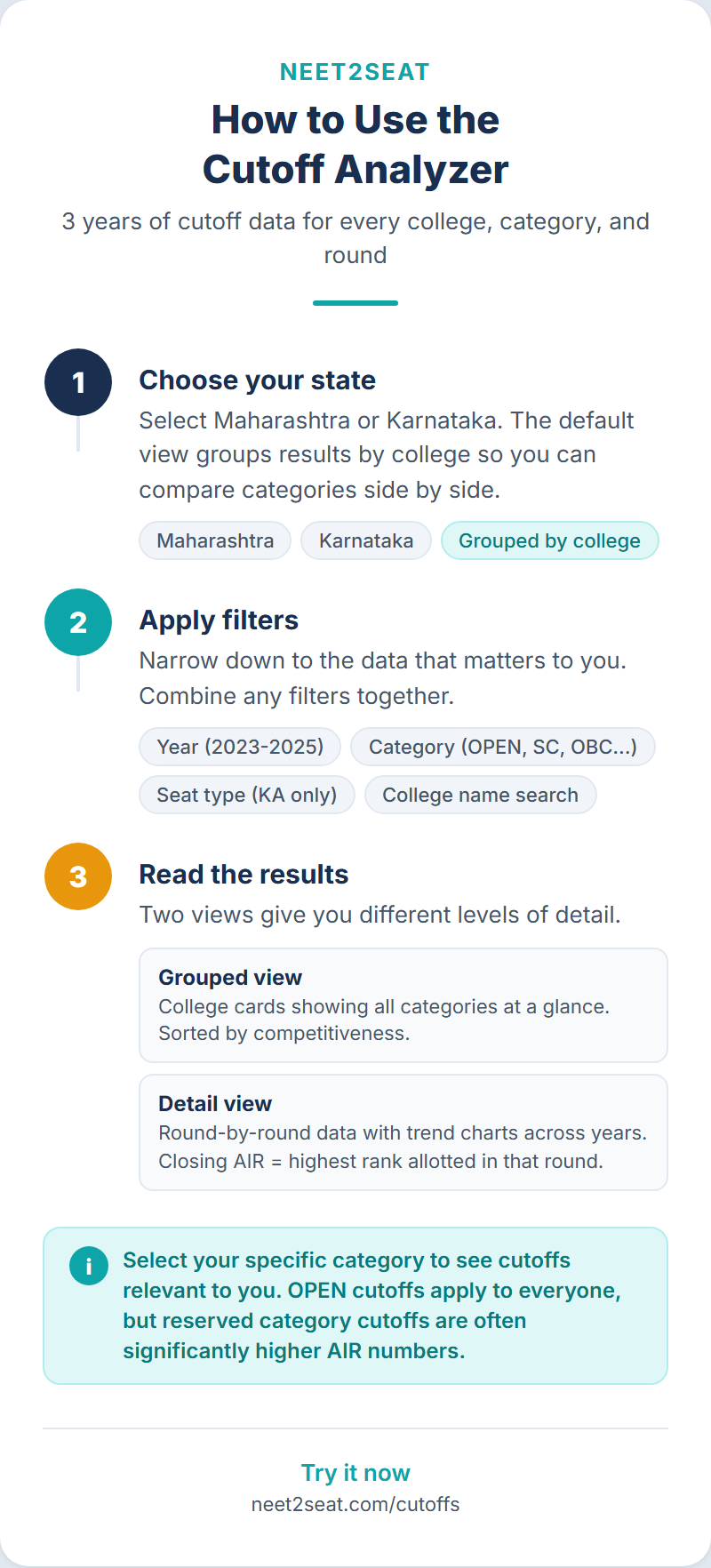
What the cutoff analyzer shows you
The cutoff analyzer contains NEET cutoff data from three years of counselling: 2023, 2024, and 2025. It covers three counselling tracks: Maharashtra (CET Cell), Karnataka (KEA), and All India Quota (MCC). The data comes from official allotment PDFs published after each counselling round.
You can filter by college name, year, reservation category, and seat type. The analyzer has two views depending on your filters: a grouped list of colleges (the default) and a detailed per-category view with trend analysis. Each college has its own detail page with a line chart showing how closing ranks changed across rounds and years.
Choosing your state
Start at neet2seat.com/cutoffs. Three cards link to state-specific analyzers: Maharashtra, Karnataka, and All India Quota. Click any card to load that state’s data.
Once inside a state analyzer, a toggle at the top of the filter panel lets you switch between states without going back to the hub page. The current state is highlighted.
The five filters
A filter panel on the left side of the page has five controls:
State toggle: Three buttons for Maharashtra, Karnataka, and All India Quota. Your current selection is highlighted. Clicking another state loads its data.
College search: A text box that searches college names as you type. Type the full name or a partial match and wait for the results to load.
Year: A dropdown defaulting to “All Years.” Options are 2023, 2024, and 2025. Selecting a single year filters results to show closing ranks from that year only.
Category: A dropdown defaulting to “All Categories.” Lists every reservation category available in the selected state. For Maharashtra, this includes OPEN, SC, ST, VJ, NT-B, NT-C, NT-D, OBC, SEBC, EWS, and their variants. For Karnataka, it includes GM, 1G, 2AG, 2BG, 3AG, 3BG, SCG, STG, and suffix variants (K, R, H, KH, RH). Selecting a category switches from grouped view to detailed view.
Seat type: A dropdown defaulting to “All Seat Types.” Options depend on the state (e.g., AID, MANUAL ROUND, AUTONOMOUS for Maharashtra). Selecting a seat type also switches to detailed view.
Start with “All Categories” to browse colleges in grouped view. Once you find colleges you are interested in, select your specific category to see per-category closing ranks and trend data.
Grouped view: the default
When no category and no seat type are selected, the analyzer shows a grouped college list. Each row represents one college and displays:
College name
Number of categories with cutoff data at that college
The full rank range across all categories and years (e.g., “Rank 450 to 85,000”)
Number of years of data available (1, 2, or 3)
A state badge (MH, KA, or AIQ)
Colleges are sorted by mean cutoff rank by default, with the most competitive colleges (lowest mean rank) at the top. Click any college row to go to its detail page.
Without a free account, only the first 5 colleges are visible. Remaining results appear blurred. Signing up (free, no payment required) gives you the full list with pagination.
Detailed view: when you select a category or seat type
Selecting a category from the dropdown (or a seat type) changes the display from grouped colleges to individual result cards. Each card shows one college-category combination:
College name, state badge, and seat type badge
Category badge and trend indicator (Improving, Declining, or Stable)
Mean cutoff: the average closing rank across all available rounds and years
Range: the lowest and highest closing ranks recorded
Latest round: the most recent year and round with its closing rank
Number of years of data available
Cards appear in a two-column grid on desktop and one column on mobile. Click any card to go to that college’s detail page, pre-filtered to the selected category.
You are an SC candidate in Maharashtra. Select “SC” from the category dropdown. The page switches to detailed view showing cards for every college with SC allotment data. Each card shows the mean closing rank, the best and worst ranks recorded, the trend direction, and the latest round’s rank. You can compare SC cutoffs across colleges at a glance.
College detail pages
Each college has a dedicated page accessible by clicking its name in any view. The page has four sections.
Category selector
A horizontal row of buttons, one per category with data at this college. Click a button to switch the page to that category’s data. For a Maharashtra government college, you might see buttons for OPEN, SC, ST, VJ, NT-B, NT-C, NT-D, OBC, SEBC, EWS, DEF, and their seat-type variants.
Trend chart
A line chart plots closing ranks across counselling rounds (R1, R2, R3, MOP on the x-axis) with one line per year. The y-axis shows closing rank with lower ranks (more competitive) at the top. Year colors: 2023 in gray, 2024 in blue, 2025 in teal. Hover over any data point to see the exact rank.
The chart makes it easy to see whether cutoffs at a college are tightening (lines shifting upward year over year, indicating lower closing ranks) or easing (lines shifting downward).
At most top government colleges in both Maharashtra and Karnataka, the 2025 line sits above the 2023 line on the chart (lower closing rank, meaning tighter competition). This pattern has held consistently across three years of data.
Statistics cards
Four cards below the chart show: Mean Cutoff (average closing rank), Min (the most competitive rank recorded), Max (the least competitive rank recorded), and Trend (Improving, Declining, or Stable, based on slope analysis of the data across years).
Round-by-round data
Below the statistics, each round is shown as a separate entry with the year, round name, and closing rank. Entries are sorted with the newest data first. Ranks appear in Indian numbering format (e.g., 1,23,456 instead of 123,456).
To compare your AIR against a college: go to the college detail page, select your category, and check the latest round’s closing rank. If your AIR is lower (better) than the closing rank in 2025, you would have been allotted that seat last year under the same conditions.
Category pages
Below the state heading on each state analyzer page, a row of links leads to category-specific pages. Clicking “OPEN” on the Maharashtra page, for instance, takes you to a page showing all Maharashtra colleges sorted by their OPEN category cutoffs.
Each category page includes:
A stats bar showing total colleges, best rank, highest rank, and year range
A collapsible definition explaining what the category means
A sortable table of colleges with columns for average rank, best rank, highest rank, and trend
Links to the same category in other states (e.g., from Maharashtra OPEN to Karnataka GM and AIQ OPEN)
These pages are useful when you want to compare cutoffs across all colleges within a single category without switching filters manually.
The quota suffix legend
Category codes often include suffixes that denote sub-quotas. Karnataka uses the most suffixes: G (general), K (Kannada medium), R (rural), H (Hyderabad-Karnataka), KH (Kannada medium + HK), RH (rural + HK). Maharashtra uses suffixes like -AI (All India Quota) and -PWD (persons with disability).
On each state analyzer page, a collapsible section titled “What do category suffixes mean?” lists every suffix code with its meaning. Expand it if you encounter a category code you do not recognize.
What requires a free account
The cutoff analyzer works for both anonymous and logged-in users, but some features require a free account:
Without an account: You see the first 5 results in any view, can access category pages, and can view college detail pages with 2025 data only. Trend charts appear blurred.
With a free account: Full results with pagination (20 per page), all three years of data on detail pages (2023, 2024, 2025), and full trend charts. There is no paid tier; the free account gives you full access.
FAQ
Where does the NEET cutoff data come from?
From official allotment PDFs published by the CET Cell (Maharashtra), KEA (Karnataka), and MCC (All India Quota) after each counselling round. We parse these PDFs and store every allotment record with college code, category, round, year, and closing rank. The database contains over 407,000 state counselling allotment records from Maharashtra and Karnataka, plus additional data from MCC All India Quota counselling.
How often is the NEET cutoff data updated?
After each counselling cycle ends. The current dataset covers 2023, 2024, and 2025. When 2026 counselling data becomes available, it will be added.
What is the difference between NEET cutoff marks and closing rank?
The cutoff analyzer shows closing All India Ranks (AIR), not marks. The NEET qualifying cutoff (minimum marks to be eligible for counselling) is set by NTA and applies uniformly. The closing rank at a specific college is the AIR of the last candidate allotted a seat there in a particular round. A closing rank of 15,000 means the candidate ranked 15,000th was the last one allotted; the corresponding marks depend on that year’s score distribution.
Why do some colleges show data for only one or two years?
New colleges or colleges that changed their counselling track may have data for fewer years. Some colleges also have very few allotments in certain categories, and the data reflects only rounds where at least one seat was filled in that category.
Can I compare NEET cutoffs across Maharashtra, Karnataka, and All India Quota?
Yes. Some colleges have seats in both state counselling and AIQ. Use the state toggle to switch between tracks, or visit the college detail page where cross-quota links appear if the college has data in multiple tracks. For a broader comparison of how AIQ and state quota counselling differ, see our AIQ vs state quota guide.
What should I do after checking cutoffs for my target colleges?
Use the college predictor to see which colleges you are likely to be allotted to based on your specific AIR and category. Then use the choice filler to build your preference list with those colleges in the right order.
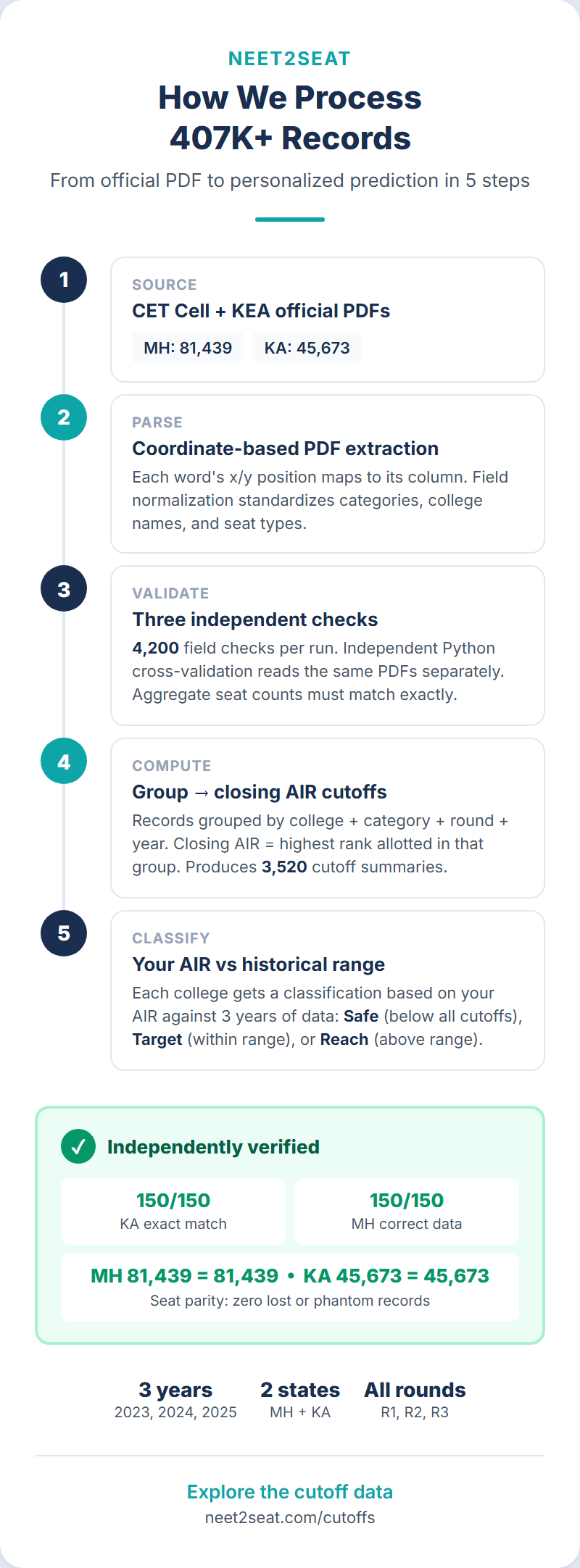
How neet2seat processes 407,000+ allotment records into actionable guidance
Every prediction, cutoff range, and college classification on neet2seat is derived from publicly available allotment data published by state counselling authorities. We do not survey students, scrape social media, or use self-reported data. The underlying dataset is deterministic: official PDF documents listing every candidate allotted in every round, at every college, in every category.
This guide explains exactly how we collect, parse, validate, and present that data, so you can evaluate the reliability of the information you are using to make counselling decisions.
All data comes from 407,658 official allotment records extracted from CET Cell (MH) and KEA (KA) PDFs
Three-layer verification: automated field checks (4,200 checks), independent PDF reader (300 rows cross-validated), aggregate seat parity
Closing AIR = the highest (worst) rank allotted at a college for a given category, round, and year
Data covers Maharashtra, Karnataka, and All India Quota for 2023, 2024, and 2025
Data sources
Our database covers two states:
Maharashtra: CET Cell publishes allotment lists for each counselling round as PDF documents. These list every allotted candidate with their NEET AIR, allotted college, category, seat type, and allotment status (joined, did not join, upgraded, etc.).
Karnataka: KEA publishes similar allotment lists for each round (R1, R2, R3) as PDF documents.
The data covers three academic years: 2023, 2024, and 2025. Across both states and all rounds, the database contains 407,658 individual allotment records.
Why PDFs and not APIs
Neither CET Cell nor KEA provides structured data feeds. Allotment results are published as PDF files on their official websites. These PDFs contain tabular data (rows and columns), but the format, layout, column positions, and even column names vary between states, between years, and sometimes between rounds within the same year.
This means every data point in our system was extracted from a PDF using custom parsers built specifically for each state’s format. The parsing process is the most technically challenging part of the pipeline, and getting it right determines the quality of everything downstream.
Our data source is deterministic: official government PDFs, not surveys, forums, or self-reported data. Every number on neet2seat can be traced back to a specific row in a specific PDF published by CET Cell or KEA. This is what makes the predictions reliable — they are based on what actually happened, not what someone remembered or estimated.
The parsing pipeline
Step 1: PDF extraction
Each PDF is processed using a coordinate-based extraction system. Rather than relying on text-flow order (which is unreliable in complex PDF tables), the parser identifies column boundaries by their x-coordinates on the page and assigns each text element to the correct column based on its position.
This approach handles the most common PDF parsing challenges: merged cells, misaligned columns, multi-line cell values, and rotated pages. Maharashtra’s 2023 and 2025 PDFs, for example, have pages rotated 90 degrees, requiring the parser to transform coordinates before column assignment.
Step 2: Field normalisation
Raw PDF text contains inconsistencies that need normalisation before the data is usable:
College names: The same college may appear with different spellings, abbreviations, or formatting across years. “Govt Medical College” vs “Government Medical College” vs “GMC” all refer to the same institution. Our pipeline maps these variants to a canonical name using a combination of college codes (which are consistent) and a name-cleaning pipeline.
Category codes: Maharashtra uses compound category codes (OPEN, OBC, SC, ST, VJA, NTB, NTC, NTD, SEBC, EWS, plus female suffixes like OPENW, SCW, and special quota suffixes like OPENDEF, OPENPH). Karnataka uses base categories with suffix codes (GM, 2AG, 2AK, 2AH, etc.). Each state’s category system is normalised to a consistent internal representation.
AIR values: Parsed as integers after stripping commas, periods, and whitespace.
Seat types: Mapped to consistent labels (state_quota, institutional_quota, management_quota, etc.).
Step 3: Validation
Parsed records go through multiple validation checks:
Range checks: AIR values must be positive integers within the expected range (1 to ~2,000,000). Category codes must match the known set for each state. College codes must exist in the colleges collection.
Cross-reference: College codes from allotment records are matched against the colleges database (sourced from NMC data). Records with unrecognised college codes are flagged for manual review.
Duplicate detection: The same candidate (identified by AIR + category + round) should not appear twice in the same round’s allotment.
Aggregate checks: Total seat counts from parsed data are compared against official seat matrix numbers published by the counselling authority. Maharashtra’s total matches at 81,439 records. Karnataka’s total matches at 45,673 records.
You can verify our data independently. Download any allotment PDF from the CET Cell or KEA website and compare specific entries against the cutoff analyzer. The numbers should match. If you find a discrepancy, contact us — data accuracy is the foundation everything else builds on.
Independent verification
We run three layers of verification to ensure data accuracy:
Layer 1: Pipeline consistency checks
An automated script (verify-data.ts) performs 4,200 field-level checks across 25 randomly selected colleges, comparing parsed values against manually read values from the source PDFs. Karnataka produces 0 mismatches. Maharashtra produces 22 mismatches, all traced to migration-era formatting differences (not incorrect data).
Layer 2: Independent PDF reader
A separate Python script (cross-validate.py) reads the same source PDFs using a completely different PDF parsing library (pdfplumber + PyMuPDF) and independently extracts data. We compare 300 rows across 6 PDFs (3 Maharashtra years + 3 Karnataka years). Karnataka: 150 out of 150 exact matches. Maharashtra: 150 out of 150 correct data values (21 cosmetic spacing differences, 0 actual errors).
The independent reader uses a different technology stack (Python vs TypeScript), different extraction logic, and different column detection methods. Agreement between two independent implementations provides strong evidence that the data is correct.
Layer 3: Aggregate seat parity
The total number of records in our database matches the total published by the counselling authorities. Maharashtra: 81,439 equals 81,439. Karnataka: 45,673 equals 45,673. No records were lost during parsing, and no phantom records were created.
How cutoff summaries are computed
The raw allotment data contains individual records (one per allotted candidate). Cutoff summaries aggregate these records to answer the question: “What was the closing AIR for [college] in [category] in [round] in [year]?”
The computation:
Group allotment records by college, category, round, and year.
Within each group, find the maximum AIR (the highest-numbered rank, i.e., the least competitive candidate who was allotted). This is the “closing AIR” or “last rank allotted.”
Also compute: the minimum AIR (most competitive allottee), the count of allotments, and the median AIR.
The closing AIR is the most useful number for counselling decisions because it answers: “What was the worst rank that still got a seat at this college in this category and round?” If your AIR is better (lower number) than the closing AIR, you would have been allotted. If worse, you would not have been.
How the college predictor works
The college predictor takes your AIR, state, and category, then classifies every college as Safe, Target, or Reach based on historical closing AIRs
The classification logic:
Safe: Your AIR is below (better than) the closing AIR at this college in your category across all recent years. You would have been allotted in every year we have data for.
Target: Your AIR is near the closing AIR. In some years you would have been allotted; in others you would not. The outcome depends on the specific year’s cutoff variation.
Reach: Your AIR is above (worse than) the closing AIR in all recent years. Based on historical data, you would not have been allotted. However, cutoffs can shift, and a Reach college is not impossible.
The boundaries between Safe, Target, and Reach are calculated using the range of closing AIRs across available years. Year-to-year variance at each college determines how wide the Target band is. Colleges with volatile cutoffs have wider Target bands; colleges with stable cutoffs have narrower ones.
What the data does not cover
Transparency about limitations is as important as the data itself:
MCC (All India Quota) data: Our current database covers state counselling only (CET Cell for Maharashtra, KEA for Karnataka). MCC AIQ allotments, deemed university central counselling, and AFMC are not included.
Management quota allotments: Private college management quota seats are filled through separate processes. Our data covers government quota and institutional quota seats filled through state counselling.
Individual preference lists: We know which candidates were allotted where, but not what preference lists they submitted. We cannot tell you how many candidates listed a specific college, only the closing rank of those who were allotted.
Post-allotment outcomes: We know whether a candidate was allotted and (in some rounds) whether they joined, upgraded, or exited. We do not have data on final graduation, NEET PG scores, or career outcomes.
The predictor covers state counselling data only. If you are also participating in MCC (All India Quota) or deemed university central counselling, those cutoffs are separate. Check MCC’s website for AIQ cutoff data alongside our state-level predictions.
Data freshness and updates
Allotment data is added after each counselling cycle completes. The current database includes:
Maharashtra: 2023, 2024, 2025 (all rounds)
Karnataka: 2023, 2024, 2025 (R1, R2, R3)
When new allotment PDFs are published (after the 2026 counselling cycle, for example), they will be parsed and added to the database. Cutoff summaries and predictor classifications update automatically when new data is loaded.
FAQ
Can I verify the data myself?
Yes. The source PDFs are publicly available on the CET Cell (cetcell.mahacet.org) and KEA (kea.kar.nic.in) websites. Download any round’s allotment list and compare specific entries against what our cutoff analyzer shows. The data should match.
Why do some colleges show “no data” for certain years or rounds?
If a college did not participate in state counselling in a specific year (new college not yet approved, or seats removed due to NMC compliance issues), no allotment data exists. Similarly, if a specific category had zero allotments at a college in a round (the seat went unfilled), no closing AIR can be computed.
How does the predictor handle colleges with only one or two years of data?
Colleges with limited historical data produce less reliable classifications. The predictor still computes Safe/Target/Reach based on available years, but the confidence is lower. A college with three years of data has a more stable cutoff range than one with only one year. The predictor does not explicitly display a confidence level, but you should treat single-year data with more caution than multi-year data.
Are the closing AIRs in the cutoff analyzer exact?
Yes, within the scope of the parsed data. The closing AIR shown for a given college-category-round-year is the maximum AIR from the allotment records in our database for that combination. It matches the source PDF. If the source PDF contains an error (misprint by the counselling authority), our data would reflect that error.
Why does the predictor sometimes show different results than what I calculate manually from cutoffs?
The predictor considers all available years and rounds when classifying a college. If you are looking at only one year’s data in the cutoff analyzer, you might see a college as “Safe” based on that year, while the predictor classifies it as “Target” because another year’s cutoff was tighter. The predictor is more conservative by design: it accounts for the full range of historical variation.
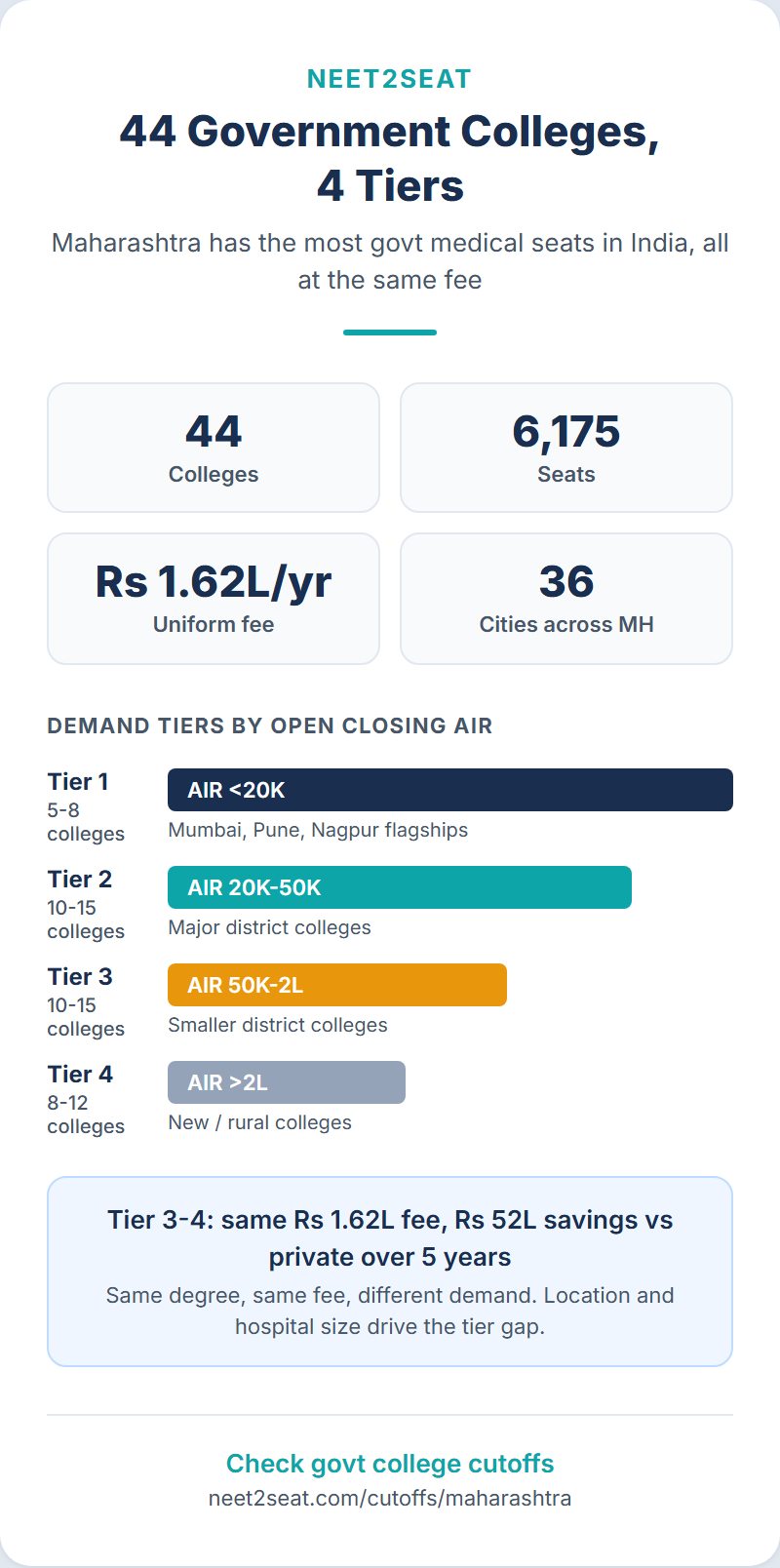
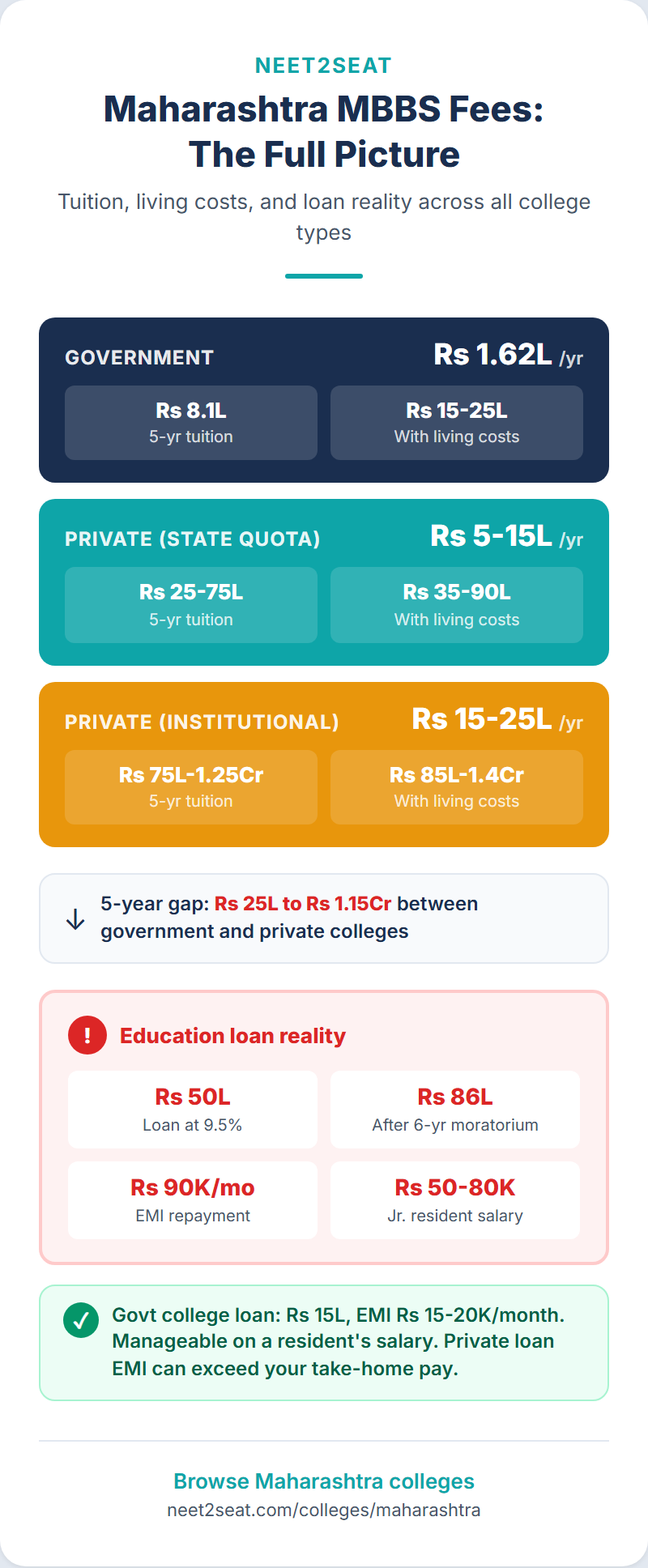
44 government colleges at Rs 1.62 lakh per year: the complete list and what each one offers
Maharashtra’s 44 government medical colleges share a uniform fee (approximately Rs 1.62 lakh per year) and grant the same MBBS degree. The differences are in clinical volume, hospital infrastructure, location, faculty, and the research environment. This guide ranks all 44 by competitiveness and maps what distinguishes the top tier from the rest.
For the full Maharashtra overview including private and deemed colleges, see our state overview. For individual college cutoffs, use the cutoff analyzer.
All 44 government colleges charge Rs 1.62L/yr and grant the same MBBS degree — the differences are in infrastructure and location
Tier 1 (AIR under 20,000): Mumbai and Pune flagships with 1,000+ bed teaching hospitals
Tier 3/4 colleges (AIR 50,000+) offer the same degree at 30-50% lower living costs than metro cities
List every government college where your AIR qualifies — extras are invisible safety nets that cost nothing
How we rank government colleges
We use the 2025 Round 2 OPEN closing AIR as the primary ranking metric. A lower closing AIR means the college fills with higher-ranked candidates, which correlates (imperfectly but consistently) with institutional reputation, hospital quality, and student demand. This is not a quality rating; it is a demand indicator.
Closing AIR measures demand, not quality. A Tier 4 college with higher closing AIRs may have modern buildings and equipment (from recent government investment) while a Tier 2 college with lower closing AIRs may have older infrastructure. Use closing AIR for competitiveness assessment, but verify infrastructure through college visits or NMC inspection reports.
Tier 1: OPEN closing AIR under 20,000 (approximately 5 to 8 colleges)
These are the most competitive government colleges in Maharashtra. They fill with candidates in the top 20,000 NEET ranks nationally.
ESIC Medical College Andheri (AIR 12,566 in 2025 R2) leads this tier, though with only 50 seats, its dynamics are distinct from larger institutions. The traditional Big Four of Maharashtra government medical education are Seth GS (KEM Hospital), Grant (JJ Hospital), BJ Medical College Pune (Sassoon Hospital), and LTMMC (Sion Hospital). GMC Nagpur, with 250 seats and a large hospital, also competes for Tier 1 positions in most years.
What distinguishes Tier 1: affiliated hospitals are large tertiary care centres (1,000+ beds), departments span all major specialities and super-specialities, research output is the highest among Maharashtra government colleges, and PG department reputations drive student demand.
Tier 2: OPEN closing AIR 20,000 to 50,000 (approximately 10 to 15 colleges)
Mid-tier government colleges in established cities: Aurangabad (Chhatrapati Sambhajinagar), Solapur, Kolhapur, Sangli, Miraj, Dhule, Akola, Amravati, and Jalgaon. These colleges have been operating for decades, have 200 to 250 seats each, and are affiliated with district-level hospitals that handle significant patient loads.
Clinical exposure at Tier 2 colleges is strong. District hospitals see a broad range of cases (general medicine, surgery, obstetrics, paediatrics, emergency medicine) because they are often the only tertiary referral point for a large geographic catchment. Students at GMC Aurangabad or GMC Kolhapur may get more hands-on procedural experience than peers at Mumbai colleges, where residents and PG students handle more cases.
Living costs in Tier 2 cities are 30% to 50% lower than Mumbai. Hostel availability is generally better (less demand, more space). The social and cultural environment is more limited than Mumbai or Pune, which matters to some candidates and is irrelevant to others.
Tier 2 colleges in district headquarters often provide more hands-on procedural experience than Tier 1 metro colleges, where PG residents handle many procedures. If clinical skill-building is your priority, Tier 2 colleges in Aurangabad, Kolhapur, or Solapur offer strong training at 30-50% lower living costs.
Tier 3: OPEN closing AIR 50,000 to 2,00,000 (approximately 10 to 15 colleges)
Colleges in smaller district headquarters and newer institutions. Cities include Nanded, Latur, Chandrapur, Yavatmal, Beed, Washim, and Osmanabad (Dharashiv). These colleges typically have 100 to 200 seats and were established in the last 10 to 20 years.
Infrastructure varies. Some Tier 3 colleges have modern buildings and equipment (recent government investments in medical education infrastructure). Others are still developing their clinical departments and hospital facilities. Patient volumes are lower than Tier 1 or 2 but sufficient for MBBS training requirements.
The value proposition of Tier 3 is straightforward: Rs 1.62 lakh/year for an MBBS degree that carries the same weight as a degree from Seth GS. If your AIR is 80,000 and the choice is between GMC Nanded at Rs 1.62 lakh/year and a private college in Pune at Rs 12 lakh/year, the five-year savings of Rs 52 lakh make the government option compelling even with a less preferred location.
A candidate with AIR 80,000 choosing between GMC Nanded (Rs 1.62L/yr) and a Pune private college (Rs 12L/yr): five-year tuition difference is Rs 52 lakh. Add lower living costs in Nanded (Rs 5K/month vs Rs 10K/month in Pune), and the total savings approach Rs 55 lakh. Both degrees carry identical weight for NEET PG eligibility.
Tier 4: OPEN closing AIR above 2,00,000 (approximately 8 to 12 colleges)
The newest government colleges in the most underserved areas: Nandurbar, Sindhudurg, Gondia, Alibaug (Raigad), and similar locations. Some of these colleges close at AIRs above 5,00,000, meaning candidates with relatively high (weak) ranks can still secure a government seat.
These colleges are sometimes dismissed as “not real options” by candidates focused on metropolitan colleges. This is a mistake for two reasons:
The degree is identical. NMC accreditation ensures that all government colleges meet minimum standards for faculty, equipment, and clinical training. The MBBS degree from GMC Nandurbar is legally and professionally identical to one from Seth GS.
The alternative may be no seat. A candidate with AIR 3,00,000 who lists only 10 colleges (all in Mumbai and Pune) may end up with no allotment. Adding Tier 4 government colleges at the bottom of the list provides a safety net at Rs 1.62 lakh/year.
Never dismiss Tier 4 government colleges. A candidate with AIR 3,00,000 who lists only metro colleges risks ending up with no allotment. Adding Nandurbar, Sindhudurg, or Gondia at the bottom of your list costs nothing and prevents the worst outcome: no medical seat at all at Rs 1.62L/yr.
The complete ranking: 2025 Round 2 OPEN closing AIRs
Use the cutoff analyzer to see the full ranked list with exact closing AIRs for any year, round, and category. Filter by state=Maharashtra, year=2025, category=OPEN, and sort by closing AIR to see every government college ranked from most to least competitive.
For Round 3 data (which shows slightly relaxed cutoffs at most colleges), add the Round 3 filter. Comparing R2 and R3 closing AIRs gives you the realistic range for each college.
City cluster analysis
Mumbai (9 colleges): Widest range of Tier 1 options. See Mumbai guide.
Pune (2 colleges + AFMC): BJM is Tier 1; AFMC is separate admission. See Pune guide.
Nagpur (2 colleges): GMC Nagpur is Tier 1/2. Indira Gandhi GMC is Tier 2/3.
Marathwada region (Aurangabad, Latur, Nanded, Ambejogai, Osmanabad): Multiple Tier 2/3 options. Historically underserved in medical education; new colleges are expanding access.
Vidarbha region (Nagpur, Chandrapur, Yavatmal, Akola, Amravati, Gondia): Tier 2/3/4 spread. Strong clinical diversity due to tribal and rural populations.
Western Maharashtra (Kolhapur, Sangli, Miraj, Satara, Ratnagiri): Established Tier 2 colleges with stable demand.
Open the cutoff analyzer, set state=Maharashtra, year=2025, category=OPEN, and sort by closing AIR. Identify every government college where your AIR falls within the closing range, then list all of them on your preference list. The algorithm gives you the best match; unlisted colleges cannot help you.
FAQ
Are all 44 government colleges in CET Cell counselling?
Most are. AFMC Pune has a separate admission process. ESIC colleges are included in CET Cell counselling for state quota. Check the current year’s seat matrix for the exact participating list.
Do government college closing AIRs tighten every year?
Generally yes, especially at Tier 1 and 2 colleges, due to increasing NEET registrations and overall score inflation. Tier 3 and 4 colleges show more stability because demand is less concentrated. Plan with a 10% to 15% buffer when using historical data.
Should I list all 44 government colleges?
List every government college where your AIR qualifies and you would accept the seat if allotted. For most candidates, that means 20 to 35 government colleges. Even if you list 40+ options, the algorithm gives you the highest-ranked one you qualify for. The extras are invisible safety nets.
What about the quality difference between Tier 1 and Tier 4?
Tier 1 colleges have larger hospitals, more specialities, more research, and a stronger alumni network. Tier 4 colleges are newer and still building these features. The MBBS curriculum and degree are the same. The practical training experience differs in volume and variety, not in kind. For PG entrance, what matters is your exam score, not which government college you attended.
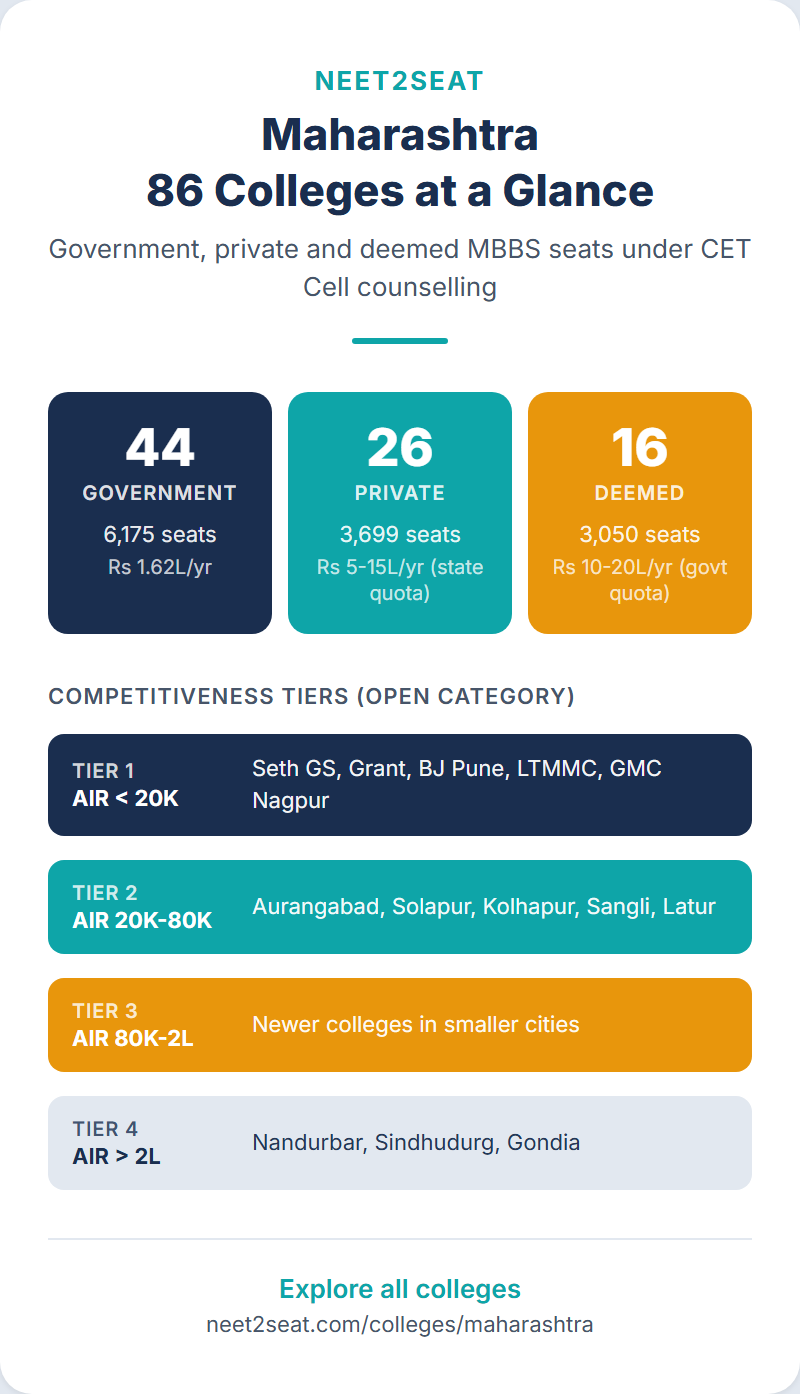
86 medical colleges fill 12,924 MBBS seats through Maharashtra state-quota counselling (excludes AIQ government and deemed seats), with a fee range from Rs 1.62 lakh to Rs 25 lakh per year
Maharashtra has the second-largest medical education system in India. The 86 medical colleges in Maharashtra span 44 government colleges, 26 private colleges, and 16 deemed universities, with 12,924 MBBS seats filled through Maharashtra state-quota counselling (excludes AIQ and deemed seats). Understanding the full picture for NEET 2026 (who these colleges are, where they are, what they cost, and how competitive they are) is the first step toward building an informed preference list.
Government college closing AIRs range from 12,566 to above 9,71,403 — every AIR level has a government option
Mumbai + Navi Mumbai cluster has 16 colleges, the densest medical education ecosystem in any Indian metro
List all government colleges before private ones on your preference list to maximize fee savings
Government medical colleges: 44 colleges, 6,175 seats
Maharashtra’s 44 government medical colleges are spread across 36 cities. Nine are concentrated in Mumbai alone. Pune has 4 (including the Armed Forces Medical College, which has its own admission process). Nagpur has 2. The remaining colleges are distributed across district headquarters and smaller cities.
Annual fees at all government colleges are approximately Rs 1.62 lakh per year. See our Maharashtra fees guide for the complete breakdown.
The competitiveness spectrum
Government colleges in Maharashtra span a wide competitiveness range. From our 2025 data (Round 2, OPEN category):
The most competitive government colleges close at AIRs below 20,000. ESIC Medical College Andheri closed at AIR 12,566 (though ESIC colleges operate under central government and may have distinct dynamics). Grant Medical College (Mumbai), Seth GS Medical College (Mumbai), and BJ Medical College (Pune) are consistently among the most competitive, closing below AIR 15,000 in recent years.
Mid-tier government colleges close between AIR 20,000 and 80,000. This band includes well-established colleges in cities like Aurangabad (Chhatrapati Sambhajinagar), Solapur, Kolhapur, Sangli, and Latur. These colleges offer solid clinical training with lower living costs than Mumbai or Pune.
The least competitive government colleges close at AIRs above 80,000, extending to AIR 9,71,403 at the furthest end. Newer government colleges in Nandurbar, Sindhudurg, Gondia, and similar rural districts fill at higher ranks. Despite their lower competitiveness, they offer the same Rs 1.62 lakh/year fee structure and an equivalent MBBS degree.
The 30x fee gap between government (Rs 1.62L/yr) and private (Rs 5-15L/yr) colleges makes every government seat worth listing, regardless of location. Even a Tier 4 government college saves Rs 20-65 lakh over five years compared to a private alternative.
Mumbai’s government college cluster
Mumbai has 9 government medical colleges, making it the single largest cluster in any Indian city. These include Seth GS Medical College (KEM Hospital), Grant Medical College (JJ Hospital), LTMMC (Sion Hospital), Topiwala National Medical College (Nair Hospital), ESIC Andheri, Gokuldas Tejpal, and others. With approximately 1,400 combined seats, Mumbai’s government cluster absorbs a significant portion of Maharashtra’s top-ranked candidates.
Maharashtra has been adding new government medical colleges in underserved districts. Colleges in Nandurbar, Alibaug (Raigad), Parbhani, Usmanabad, and similar locations were established in recent years. These newer colleges typically have smaller intakes (50 to 100 seats), less established infrastructure, and higher closing AIRs For candidates in the AIR 50,000 to 2,00,000 range, these colleges represent accessible government seats that many candidates overlook in favour of private colleges in larger cities.
Newer government colleges in districts like Nandurbar and Sindhudurg are often overlooked. If your AIR is between 50,000 and 2,00,000, these colleges give you government fees and an identical MBBS degree. List them as safety options below your preferred choices.
Private medical colleges: 26 colleges, 3,699 seats
Maharashtra’s 26 private medical colleges are concentrated in a few urban corridors. Pune has 3, Nagpur has the NKP Salve Institute (250 seats), and Ahmednagar, Kolhapur, Nashik, Sangli, and other cities each have one or two.
State quota fees range from Rs 5 lakh to Rs 15 lakh per year. Institutional quota (15% of seats) charges 2x to 3x the state quota fee. See the fees guide for details.
The private college competitive range
Private colleges in Maharashtra close at AIRs ranging from approximately 38,000 (top private colleges like KJ Somaiya in Mumbai) to above 5,00,000 (less established or newer institutions). The wide range means that candidates across a broad AIR spectrum (30,000 to 5,00,000+) will find private college options available to them.
For candidates who exhaust their government college options on the preference list, private colleges provide essential backup. Even if the fee is Rs 10 lakh to Rs 15 lakh per year, having a private seat is better than no seat at all in Round 1 (where exit is free).
Private college fees are 3x to 10x higher than government fees. Always exhaust your government college options on the preference list before adding private colleges. In Round 1, where exit is free, listing a private college as a backup costs nothing.
Deemed universities: 16 colleges, 3,050 seats
Maharashtra’s 16 deemed universities account for 3,050 MBBS seats. Five are concentrated in Navi Mumbai: DY Patil Medical College (3 separate campuses), MGM Medical College, and Terna Medical College. Others are in Pune (3), Wardha (2), and scattered across other cities.
Deemed university government quota seats (approximately 25%) are filled through CET Cell counselling. The remaining seats go through MCC or the university’s own admission process. Fees range from Rs 10 lakh to Rs 25 lakh per year depending on seat type and institution.
One detail worth watching: deemed universities in Maharashtra do not participate in state counselling for all their seats. The government quota portion (filled through CET Cell) has different cutoffs from the MCC portion. Check both tracks if you are considering a deemed university.
Deemed university seats are split across CET Cell and MCC counselling. If targeting a deemed university, register for both counselling processes and compare government quota fees across the two tracks.
Geographic distribution
Maharashtra’s medical colleges span 45 cities. The concentration:
Mumbai + Navi Mumbai: 16 colleges (9 government, 2 private, 5 deemed). The largest cluster in any Indian metropolitan area for medical education.
Pune: 8 colleges (2 government including AFMC, 3 private, 3 deemed).
Nagpur: 3 colleges (2 government, 1 private).
Remaining cities: 1 to 2 colleges each, mostly government.
For most candidates, the geographic decision is between pursuing a college in the Mumbai-Pune corridor (higher living costs, more clinical exposure, larger peer network) versus a college in a smaller city (lower costs, less competitive cutoffs, potentially more hands-on clinical rotations due to smaller batch sizes).
How to use this information for preference ordering
The 86 colleges fall into natural tiers for preference list construction:
Top government colleges in metro areas (Seth GS, Grant, BJ Pune, LTMMC): positions 1 through 5 on most candidates’ lists.
Remaining Mumbai and Pune government colleges: positions 6 through 15.
Government colleges in mid-size cities (Nagpur, Aurangabad, Kolhapur, Solapur): positions 15 through 30.
Government colleges in smaller cities and newer institutions: positions 30 through 44.
Top private colleges (KJ Somaiya, DY Patil, etc.): positions 44 through 55.
Remaining private and deemed university government quota: positions 55 through 86.
This ordering puts all government colleges above all private colleges, reflecting the fee advantage. Adjust based on your specific location preferences and financial situation. Use the college predictor to classify each college as Safe, Target, or Reach for your AIR.
Open the college predictor, enter your expected AIR and category, and classify each of Maharashtra’s 86 colleges as Safe, Target, or Reach. Then build your preference list following the tier order above, with all Safe and Target government colleges first.
FAQ
How many government colleges are in Maharashtra?
44 government medical colleges with a combined intake of 6,175 MBBS seats, spread across 36 cities.
Which Maharashtra medical college is the most competitive?
Based on 2025 data, ESIC Medical College Andheri had the lowest OPEN closing AIR among government colleges. Among traditional government colleges, Grant Medical College and Seth GS Medical College in Mumbai are consistently the most competitive. Among private colleges, KJ Somaiya Medical College in Mumbai has the lowest closing AIR.
Are deemed university seats worth considering?
Yes, if you can afford the fees. Government quota seats at deemed universities (filled through CET Cell) have moderate fees and can be less competitive than equivalent-quality private colleges. Deemed universities often have well-equipped hospitals and research facilities. List them in the private/deemed tier of your preference list.
Do all 86 colleges participate in CET Cell counselling?
Most do, but AFMC Pune has its own admission process, and some deemed universities fill only a portion of their seats through CET Cell (the rest go through MCC or university-level admissions). Check the current year’s CET Cell seat matrix for the exact list of participating colleges and available seats.
Can I get MBBS with 400 marks in NEET in Maharashtra?
400 marks in NEET typically translates to an AIR in the range of 1,00,000 to 1,50,000 (the exact rank depends on the year’s difficulty and number of candidates). At this range in Maharashtra, government colleges in smaller cities (Tier 3 and Tier 4 in our ranking) and several private colleges are within reach for the OPEN category. Reserved category candidates at this mark range have access to a wider set of government colleges. Use the college predictor with your exact AIR to see your Safe, Target, and Reach options.
74 medical colleges across 31 cities, with government seats at Rs 50,000 per year
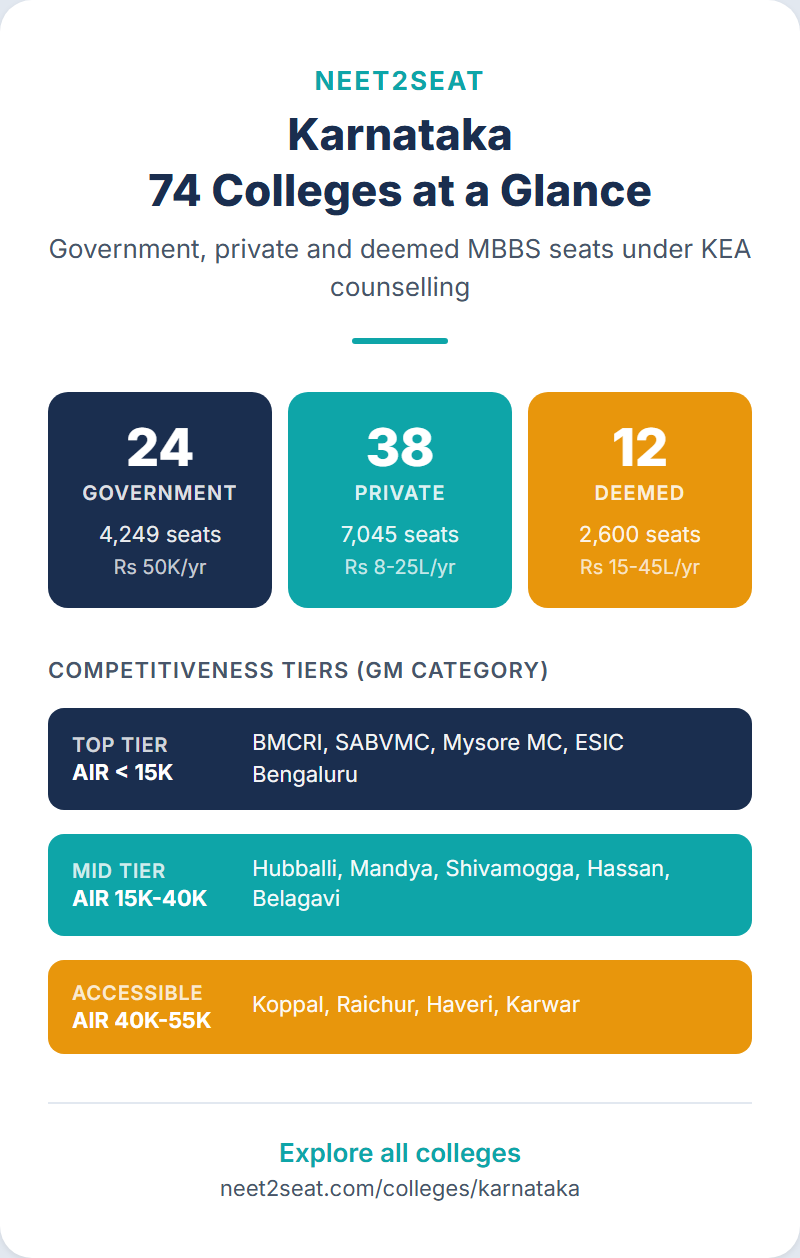
The 74 medical colleges in Karnataka span 24 government, 38 private, and 12 deemed universities, with a combined MBBS intake of 14,094 seats. Unlike many states where government colleges dominate, Karnataka’s private sector is larger (38 colleges, 7,045 seats) than the government sector (24 colleges, 4,249 seats), creating a two-track system where fee considerations heavily influence preference ordering. This guide ranks the top medical colleges in Karnataka by NEET 2026 cutoff competitiveness, using 2023-2025 historical data.
Private sector is larger than government (38 vs 24 colleges) — fee decisions dominate preference ordering
Bengaluru has 20 colleges but only 3 government; AIR under ~13,000 needed for a government seat there
Karnataka’s suffix system (G, K, R, H, KH, RH) creates separate cutoff tracks — check all suffixes you qualify for
Government medical colleges: 24 colleges, 4,249 seats
Karnataka’s 24 government medical colleges charge a uniform Rs 50,000 per year. Over five years, total tuition is approximately Rs 2.5 lakh, among the lowest government medical college fees in India.
The top tier (AIR under 15,000)
Four government colleges consistently close at AIRs below 15,000 for the GM (General Merit) category:
Bangalore Medical College and Research Institute (BMCRI), Bengaluru: AIR 3,025 (2025 R2). The state’s most competitive medical college, affiliated with Victoria Hospital and Bowring Hospital. 250 seats.
Shri Atal Bihari Vajpayee Medical College, Bengaluru: AIR 7,669 (2025 R2). A newer government college in the state capital. The Bengaluru location drives demand.
Mysore Medical College, Mysuru: AIR 8,394 (2025 R2). One of the oldest medical colleges in South India, established in 1924. 250 seats.
ESIC Medical College, Bengaluru: AIR 12,937 (2025 R2). Central government institution with ESIC Hospital affiliation.
The mid tier (AIR 13,000 to 40,000)
Twelve government colleges close in the AIR 13,000 to 40,000 range for GM category. These include established institutions in Karnataka’s secondary cities:
Karnataka Medical College (KRIMS), Hubballi: AIR 13,488. The main government college in North Karnataka’s largest city.
Mandya Institute of Medical Sciences, Mandya: AIR 15,588. Close to Mysuru and Bengaluru, making it geographically accessible.
Shimoga Institute of Medical Sciences, Shivamogga: AIR 21,676.
Hassan Institute of Medical Sciences, Hassan: AIR 21,862.
Belagavi Institute of Medical Sciences, Belagavi: AIR 23,365. In the border district with significant clinical diversity.
Gulbarga Institute of Medical Sciences, Kalaburagi: AIR 23,671. In the Hyderabad-Karnataka region, which has its own reservation provisions.
Vijaynagar Institute of Medical Sciences, Ballari: AIR 23,690.
ESIC Medical College, Kalaburagi: AIR 28,962.
And continuing through Chamarajanagar (31,696), Gadag (32,257), Bidar (37,203), and Kodagu (38,075).
The accessible tier (AIR 38,000 to 55,000)
Eight newer government colleges close at AIRs between 38,000 and 55,000. These include colleges in Chikkaballapura (38,361), Koppal (38,538), Raichur (39,240), Karwar (41,651), Chikkamagaluru (45,629), Haveri (49,827), Yadgiri (52,598), and Chitradurga (55,005).
For candidates in the AIR 40,000 to 55,000 range, these colleges represent genuine government seat opportunities at Rs 50,000 per year. Many candidates in this range skip these colleges in favour of private colleges in Bengaluru, paying 20x to 50x more for a geographically preferred location. The financial case for listing these government colleges ahead of private options is compelling. See our Karnataka fees guide.
A candidate choosing a Bengaluru private college (Rs 15L/yr) over a government college in Haveri or Chitradurga (Rs 50K/yr) pays Rs 72.5 lakh more over five years. The MBBS degree is identical. List accessible-tier government colleges before any private option unless your family can absorb that difference without financial strain.
Private medical colleges: 38 colleges, 7,045 seats
Karnataka’s private medical college sector is large and concentrated in a few urban centres. Bengaluru alone has 14 private medical colleges. Mangaluru has 5. Kalaburagi, Davangere, and Tumakuru have 2 each. The remaining colleges are scattered across 15+ cities.
The most competitive private colleges
From our 2025 data (R2, GM category), the most competitive private college government quota seats:
MS Ramaiah Medical College, Bengaluru: AIR 11,776. Consistently the most competitive private college in the state.
JSS Medical College, Mysuru: competitive government quota cutoffs comparable to mid-tier government colleges.
Kempegowda Institute of Medical Sciences, Bengaluru: strong Bengaluru location drives demand.
Top private college government quota cutoffs in Karnataka overlap with mid-tier government college cutoffs. A candidate with AIR 12,000 faces a choice between a government college in Mandya (Rs 50,000/year) and MS Ramaiah in Bengaluru (Rs 15+ lakh/year). The fee multiplier is 30x for a Bengaluru address.
Top private college cutoffs overlap with mid-tier government college cutoffs. Before choosing a private college for its city, check whether a government college at the same AIR level exists in another city. The fee difference over five years can exceed Rs 70 lakh.
Bengaluru’s private college density
With 14 private medical colleges, Bengaluru has the highest private medical college concentration in South India. GM government quota closing AIRs range from approximately 11,776 (MS Ramaiah) to 74,727 (East Point College). This means a candidate with AIR anywhere between 12,000 and 75,000 has a Bengaluru private college option available.
Bengaluru’s 14 private colleges span AIR 12,000 to 75,000. If Bengaluru is your preferred city, use the cutoff analyzer to identify which private colleges are Safe, Target, and Reach for your specific AIR, then layer government colleges from other cities above them as lower-fee options.
Government quota vs management quota at private colleges
Private colleges in Karnataka allocate approximately 40% to 50% of seats as government quota (filled through KEA) and the remainder as management/institutional/NRI quota. Government quota fees range from Rs 8 lakh to Rs 25 lakh per year. Management quota fees range from Rs 25 lakh to Rs 45 lakh per year.
The same college can have dramatically different cutoffs for government quota vs management quota seats. Government quota requires a lower (better) AIR; management quota accepts higher (worse) AIRs but at significantly higher fees. If your AIR does not qualify for government quota at a preferred private college, the management quota pathway exists, but at 2x to 4x the fee.
Deemed universities: 12 colleges, 2,800 seats
Karnataka’s 12 deemed universities include some nationally recognised institutions:
KMC Mangaluru (Manipal group): AIR 6,786 (2025 R2 GM). The most competitive deemed university seat in Karnataka. Government quota through KEA.
KMC Manipal (Manipal group): Primarily fills through MCC deemed pool. Not typically in KEA government quota data.
JSS Mysuru: Government quota seats through KEA with competitive cutoffs.
St. Johns Medical College, Bengaluru: Primarily MCC/university admission.
Approximately 25% of deemed university seats are government quota (through KEA). The remainder go through MCC’s deemed university pool or the university’s own management/NRI admission process. If your target is a deemed university, check both KEA and MCC counselling tracks.
Deemed universities like KMC Manipal and St. Johns fill most seats through MCC, not KEA. If targeting these institutions, register for MCC’s deemed university counselling in addition to KEA. Government quota cutoffs through KEA are often more competitive than MCC cutoffs for the same college.
Nine deemed universities with no 2025 KEA data
Nine deemed universities in our database do not have 2025 Round 2 GM allotment data through KEA. These include St. Johns, Rajarajeswari, Sri Siddhartha, KMC Manipal, and others. These colleges likely fill their government quota through MCC or have separate counselling processes. If you are targeting these institutions, check MCC’s deemed university schedule rather than KEA.
Geographic distribution across 31 cities
Karnataka’s 74 colleges span 31 cities:
Bengaluru: 20 colleges (3 government, 14 private, 3 deemed). By far the largest cluster.
Mangaluru: 8 colleges (5 private, 3 deemed). A medical education hub in coastal Karnataka.
Kalaburagi: 4 colleges (2 government, 2 private). The HK region centre.
Mysuru, Hubballi, Belagavi, Davangere: 2 to 3 colleges each.
Remaining 24 cities: 1 college each, mostly government.
The state’s geographic spread means government colleges exist in both metro areas (Bengaluru: 3 government colleges) and remote districts (Yadgiri, Koppal, Chitradurga). For candidates willing to study outside Bengaluru, the accessible-tier government colleges offer extraordinary value: Rs 50,000/year in a location where living costs are also low.
The suffix system and its impact on competitiveness
Karnataka’s category system uses suffixes (G, K, R, H, KH, RH) that create separate cutoff tracks at each college. A college with a GM closing AIR of 23,000 might have a 2AH (2A + Hyderabad-Karnataka) closing AIR of 45,000 at the same institution. Candidates with suffix eligibility have access to less competitive cutoff tracks at every college on their list.
When evaluating colleges, check cutoffs for all suffix variants you qualify for. The cutoff analyzer lets you filter by each category code independently. See our Karnataka categories guide for suffix details.
Open the cutoff analyzer, select your category code including suffix (e.g., 2AH, 3BK, GMR), and check closing AIRs across all 74 colleges. Suffix-eligible candidates often qualify for colleges that appear out of reach under GM cutoffs alone.
Which is the most competitive medical college in Karnataka?
Bangalore Medical College and Research Institute (BMCRI) is the most competitive government college (AIR 3,025 for GM, 2025 R2). KMC Mangaluru is the most competitive deemed university (AIR 6,786). MS Ramaiah is the most competitive private college (AIR 11,776).
Are all 24 government colleges in the KEA counselling?
All 24 participate in KEA state quota counselling. ESIC colleges (Bengaluru and Kalaburagi) operate under central government but are included in KEA counselling for state quota seats. AIIMS-type central institutions, if any, have separate processes.
Can out-of-state candidates get government college seats in Karnataka?
Karnataka is an “open state” for NEET counselling, meaning candidates from any Indian state can participate in KEA counselling. However, state quota government college seats are restricted to Karnataka domicile candidates. Out-of-state candidates are eligible for private college management/NRI/institutional quota seats only.
Which college has the lowest fees for MBBS in Karnataka?
All 24 government medical colleges in Karnataka charge the same fee: approximately Rs 50,000 per year. Over five years, total government college tuition is roughly Rs 2.5 lakh. This is uniform across all government institutions, from Bangalore Medical College to the government college in Yadgiri. The cheapest route to an MBBS in Karnataka is any government college seat through KEA state quota counselling. See our Karnataka fees guide for the full breakdown.
20 medical colleges, 3 government options, and a private sector that spans AIR 12,000 to 75,000
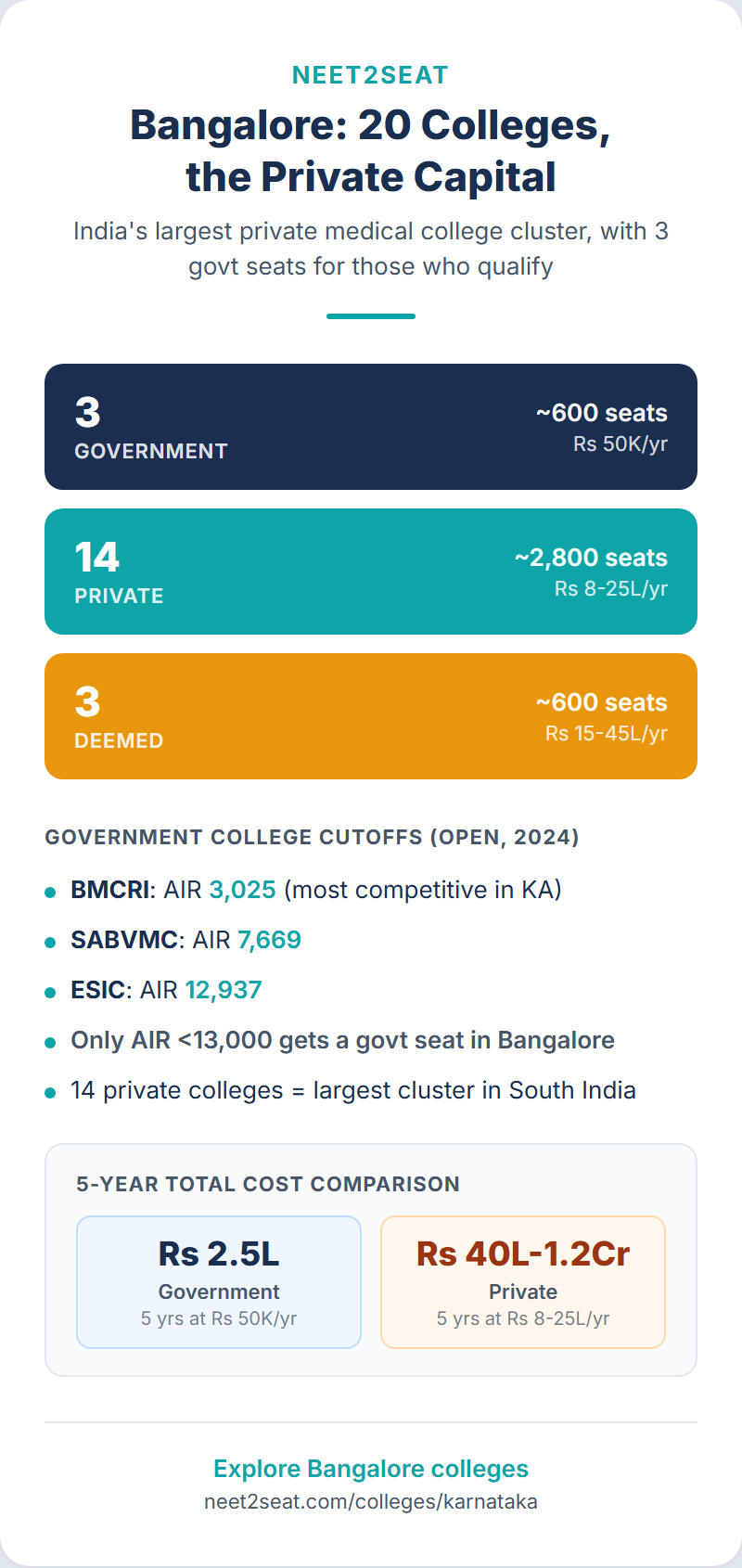
Bangalore has 20 medical colleges: 3 government (including ESIC), 14 private, and 3 deemed universities. The best medical colleges in Bangalore are dominated by its private sector, the largest private medical college cluster in South India. This guide covers NEET cutoff data, fees, and what distinguishes each Bangalore institution. For candidates targeting the city, the critical decision is whether Bangalore’s advantages justify private college fees that are 20x to 50x higher than government college fees in other Karnataka cities.
20 colleges (3 government, 14 private, 3 deemed) — the private sector dominates Bengaluru’s medical education
Only AIR under ~13,000 qualifies for a government seat in Bengaluru (BMCRI, SABVMC, ESIC)
Private colleges span AIR 12,000 to 75,000, with fees 20x-50x higher than government colleges in other cities
The Bengaluru premium is worth paying only if your family can absorb the fee difference without financial strain
Government medical colleges in Bengaluru
Bengaluru has 3 government medical colleges, far fewer than Mumbai’s 9. Competition for government seats in Bengaluru is correspondingly intense.
Bangalore Medical College and Research Institute (BMCRI)
The most competitive medical college in Karnataka. GM closing AIR in 2025 Round 2: 3,025. BMCRI is affiliated with Victoria Hospital (1,500+ beds) and Bowring Hospital. Established in 1955, it is the state’s premier government medical institution. 250 seats.
Getting into BMCRI requires an AIR in the top 3,000 to 4,000 nationally. For context, that puts BMCRI’s competitiveness on par with top government colleges in Mumbai and Delhi. Candidates with AIR above 5,000 should treat BMCRI as a Reach.
Shri Atal Bihari Vajpayee Medical College (SABVMC)
A newer government medical college in Bengaluru. GM closing AIR in 2025 R2: 7,669. The Bengaluru location drives its competitiveness higher than its institutional age would suggest. SABVMC fills a capacity gap: BMCRI’s 250 seats were insufficient for a city of 12 million, and SABVMC added another government option.
ESIC Medical College, Bengaluru
Operated under the central government’s ESIC scheme. GM closing AIR in 2025 R2: 12,937. ESIC colleges have a distinct character: they are affiliated with ESIC hospitals that primarily serve insured workers. Clinical exposure skews toward occupational health and primary care, though the hospitals also handle general secondary and tertiary cases.
The government bottleneck
Three government colleges with approximately 600 combined seats for a metropolitan area of 12 million people. The math is stark: only candidates with AIR below approximately 13,000 can realistically get a government seat in Bengaluru. The remaining 7,400+ government college seats in Karnataka are distributed across 21 other cities, many with AIR thresholds between 15,000 and 55,000.
For candidates with AIR 15,000 to 55,000, the choice is: a government seat in Mysuru, Hubballi, Mandya, or another city at Rs 50,000/year, or a private seat in Bengaluru at Rs 8 lakh to Rs 25 lakh/year. The fee difference over five years ranges from Rs 37.5 lakh to Rs 1.2 crore.
600 government seats for 12 million people: Bengaluru’s government-to-population ratio is among the lowest in India for major cities. Candidates with AIR 15,000-55,000 face a binary choice between an affordable government seat in another city and an expensive private seat in Bengaluru. The five-year fee difference can exceed Rs 1 crore.
Private medical colleges in Bengaluru: 14 institutions
Bengaluru’s 14 private medical colleges are the largest such cluster in Karnataka. They span a wide competitiveness range.
The top tier (GM closing AIR under 25,000)
MS Ramaiah Medical College: AIR 11,776 (2025 R2 GM). Consistently Karnataka’s most competitive private college. Ramaiah Hospital is a 1,300-bed facility with strong clinical infrastructure. Government quota fees are in the Rs 15 lakh to Rs 20 lakh/year range.
Kempegowda Institute of Medical Sciences (KIMS): Competitive government quota cutoffs in the top private tier. Established institution with a well-known teaching hospital.
These top-tier private colleges have cutoffs that overlap with mid-tier government colleges in other cities. A candidate choosing MS Ramaiah over a government college in Hassan or Mandya is paying approximately Rs 70 lakh more over five years for a Bengaluru address and Ramaiah’s infrastructure.
MS Ramaiah’s cutoff (AIR 11,776) overlaps with government colleges in Mandya (AIR 15,588) and Shivamogga (AIR 21,676). The five-year fee difference is approximately Rs 70 lakh to Rs 1 crore. Make this a conscious financial decision, not a default assumption that private-in-Bengaluru is always better than government-elsewhere.
The mid tier (GM closing AIR 25,000 to 50,000)
Several private colleges in this range offer solid medical education with moderate (by private college standards) fee levels. Institutions in this tier include colleges in both central Bengaluru and the city’s expanding periphery.
The accessible tier (GM closing AIR 50,000 to 75,000)
Newer or less established private colleges in Bengaluru close at higher AIRs, making them accessible to candidates with AIR 50,000 to 75,000. East Point College, for example, closed at AIR 74,727 in 2025 R2. These colleges offer a Bengaluru location at the cost of higher fees and potentially developing infrastructure.
If your AIR is between 50,000 and 75,000 and Bengaluru is non-negotiable, accessible-tier private colleges are your realistic options. But also list government colleges in Haveri, Chitradurga, and Yadgiri (all under AIR 55,000) as Rs 50K/yr alternatives. The algorithm gives you the highest-ranked option you qualify for.
Deemed universities in Bengaluru
Bengaluru has 3 deemed universities offering MBBS. St. Johns Medical College is the most notable, known for its clinical training and community health programmes. However, St. Johns primarily fills through MCC or its own admission process rather than KEA counselling.
Government quota seats at Bengaluru deemed universities (through KEA) are limited. Check both KEA and MCC tracks if targeting deemed universities in the city.
Living costs in Bengaluru
Bengaluru is a Tier 1 city with corresponding living costs, though cheaper than Mumbai:
Hostel/PG: Rs 6,000 to Rs 15,000 per month (varies by area; colleges in the periphery are cheaper).
Food: Rs 3,000 to Rs 5,000 per month.
Transport: Bengaluru’s traffic is notorious. Colleges closer to your accommodation save significant commute time. Metro connectivity is improving but does not yet cover all medical college locations.
Total monthly: Rs 10,000 to Rs 20,000 per month, or Rs 6 lakh to Rs 12 lakh over five years.
The Bengaluru premium: when it is worth paying
Bengaluru’s private colleges command a premium because the city offers:
High clinical diversity: Teaching hospitals in Bengaluru see patients from across Karnataka and neighbouring states, providing exposure to a wide range of conditions.
Research opportunities: Proximity to IISc, NIMHANS, and multiple biotech companies creates research avenues not available in smaller cities.
Professional network: Bengaluru’s medical community is large and well-connected. Relationships formed during MBBS can help with PG placements and early career opportunities.
Lifestyle: A cosmopolitan city with good food, entertainment, and social infrastructure.
The premium is worth paying if: (a) your family can absorb the fee difference without financial strain, and (b) you value the city-specific advantages enough to prioritise them over the financial savings of a government seat elsewhere.
The premium is not worth paying if: (a) private college fees would require a large education loan that burdens your first 10+ years of practice, or (b) you are indifferent to city-specific factors and primarily want a medical degree at the lowest cost.
Calculate the total five-year cost for your target Bengaluru private college (tuition + living) and compare it with a government college in another city. If the difference exceeds what your family can pay without a large loan, the government college is the financially sound choice. The MBBS degree is identical for PG entrance eligibility.
What AIR do I need for a government seat in Bengaluru?
Based on 2025 data, approximately AIR 13,000 or below for GM category. BMCRI closes at approximately 3,000, SABVMC at approximately 7,700, and ESIC at approximately 13,000.
Is MS Ramaiah worth the fee over a government college in another city?
MS Ramaiah is a well-respected institution with strong infrastructure. The five-year fee difference versus a government college is approximately Rs 70 lakh to Rs 1 crore. For families where this amount is manageable, Ramaiah offers a Bengaluru medical education at a competitive private college. For families where this would mean a large loan, the government college is the better financial choice. The medical degree is equivalent.
Can I get a Bengaluru private college seat with AIR 50,000?
Yes. Multiple Bengaluru private colleges have GM government quota closing AIRs between 50,000 and 75,000. You would have several options in the mid-to-accessible tier. Use the college predictor with your exact AIR to see which ones are Safe, Target, and Reach.
Maharashtra medical college fees range from Rs 1.62 lakh to Rs 25 lakh per year, depending on three variables
The cost of an MBBS degree in Maharashtra depends on three factors: whether the college is government, private, or deemed; which seat type you hold (state quota, institutional quota, or management quota); and whether your category qualifies for fee concessions. Over a five-year MBBS programme, these variables create a total cost range from under Rs 10 lakh to over Rs 1.25 crore.
This guide breaks down the fee structures across all three college types in Maharashtra, using current fee data. For college-specific cutoff data, see the Maharashtra cutoff analyzer. For a full list of colleges, see our Maharashtra college directory.
Government: Rs 1.62L/yr (total Rs 15-25L over 5 years including living expenses)
Private state quota: Rs 5-15L/yr; institutional quota: 2-3x state quota; management quota: Rs 20-25L+/yr
The 5-year total cost gap spans Rs 10L (government) to Rs 1.25 crore (private management quota) — an 8x spread
A Rs 50L education loan at 9.5% with moratorium accumulates Rs 36L in interest before the first EMI
Government medical colleges: Rs 1.62 lakh per year
Maharashtra has 44 government medical colleges with a combined intake of 6,175 MBBS seats. Government college fees are set by the state government and are uniform across all 44 institutions. Whether you attend Seth GS Medical College in Mumbai or the government medical college in Nandurbar, the tuition fees are the same.
The current annual fee at Maharashtra government medical colleges is approximately Rs 1.52 lakh for tuition, plus a development fee of approximately Rs 10,000, bringing the total to roughly Rs 1.62 lakh per year. Over five years, total tuition costs come to approximately Rs 8.1 lakh.
Additional costs beyond tuition include hostel fees (Rs 10,000 to Rs 30,000 per year depending on the institution), mess charges (Rs 30,000 to Rs 60,000 per year), and examination fees. Total out-of-pocket cost for five years at a Maharashtra government college, including living expenses in a mid-range city, typically falls between Rs 15 lakh and Rs 25 lakh.
Fee concessions for reserved categories
SC, ST, VJ/NT, and OBC candidates in Maharashtra may be eligible for government fee reimbursement schemes. Several state scholarship programmes cover tuition fees partially or fully for economically weaker reserved category students. The exact reimbursement depends on family income thresholds set by the Social Justice Department or Tribal Development Department. Check the current year’s eligibility criteria; the schemes are revised periodically.
If you belong to SC, ST, VJ/NT, or OBC categories, check your eligibility for state fee reimbursement schemes before assuming you need to pay full tuition. At Rs 1.62L/yr, government college fees are often covered entirely by state scholarships for eligible candidates.
The hidden cost advantage of government colleges
Government college fees are indexed to government pay commissions and rarely increase by more than 5% to 10% per year. Private college fees, by contrast, are subject to fee regulatory committee approvals and can increase by 10% to 15% annually. A government college seat that costs Rs 1.62 lakh per year in Year 1 might cost Rs 1.80 lakh by Year 5. A private college seat at Rs 15 lakh in Year 1 could be Rs 20 lakh by Year 5, depending on the approved escalation clause.
Fee escalation compounds the gap over five years. Government fees increase 0-5% annually; private fees increase 10-15%. A private college starting at Rs 15L/yr can reach Rs 20L/yr by Year 5, while a government college stays near Rs 1.62L/yr. The cumulative difference exceeds the Year 1 gap by 20-30%.
Private medical colleges: Rs 5 lakh to Rs 25 lakh per year
Maharashtra has 26 private medical colleges with 3,699 MBBS seats. Private college fees are set by the state Fee Regulatory Authority (FRA), which approves fee structures based on the college’s infrastructure, faculty, and operational costs.
State quota seats
85% of private college seats fall under state quota, filled through CET Cell counselling. State quota fees at private colleges range from approximately Rs 5 lakh to Rs 15 lakh per year. The exact amount varies by institution. Well-established private colleges with good infrastructure and hospital facilities tend to be at the higher end; newer or less established institutions charge less.
Over five years, state quota fees at private colleges total Rs 25 lakh to Rs 75 lakh, excluding living expenses. Adding hostel, mess, and other charges, the total cost ranges from Rs 35 lakh to Rs 90 lakh.
Institutional quota seats
15% of private college seats are institutional quota, also filled through CET Cell but with different fee structures. Institutional quota fees are typically 2x to 3x the state quota fees at the same college. A college charging Rs 10 lakh per year for state quota might charge Rs 20 lakh to Rs 25 lakh per year for institutional quota.
Institutional quota seats are open to NRI, OCI, and out-of-state candidates in addition to Maharashtra domicile candidates. The higher fees reflect the broader eligibility pool and the college’s discretion in setting institutional quota pricing (within FRA limits).
Management quota
Private colleges also have management quota seats, which are filled through a separate process (not through CET Cell counselling). Management quota fees are the highest, often Rs 20 lakh to Rs 25 lakh per year or more. These seats are typically filled last and may be available to candidates who did not secure seats through regular counselling.
Deemed universities: Rs 10 lakh to Rs 25 lakh per year
Maharashtra has 16 deemed universities with 3,050 MBBS seats. Deemed university fee structures are more complex because they have multiple seat types with different fee levels.
Government quota seats (through state counselling)
Approximately 25% of deemed university seats are government quota, filled through CET Cell counselling in Maharashtra. Government quota fees at deemed universities are typically lower than the institution’s private fees but higher than state government college fees. Expect Rs 10 lakh to Rs 18 lakh per year for government quota at most deemed universities.
Private/management quota seats (through university or MCC)
The remaining seats are filled through MCC counselling or the university’s own admission process. Fees for these seats range from Rs 15 lakh to Rs 25 lakh per year, depending on the institution’s reputation and location.
Five deemed universities are concentrated in Navi Mumbai. Others are located across Pune, Wardha, and other cities. The geographic concentration in the Mumbai-Pune corridor means these colleges cater to urban candidates willing to pay premium fees for metro-area clinical exposure.
The five-year cost comparison
College type
Seat type
Annual fees (approx.)
5-year tuition
5-year total (with living)
Government
State quota
Rs 1.62 lakh
Rs 8.1 lakh
Rs 15-25 lakh
Private
State quota
Rs 5-15 lakh
Rs 25-75 lakh
Rs 35-90 lakh
Private
Institutional quota
Rs 15-25 lakh
Rs 75 lakh-1.25 cr
Rs 85 lakh-1.4 cr
Deemed
Government quota
Rs 10-18 lakh
Rs 50-90 lakh
Rs 60 lakh-1.05 cr
Deemed
Private quota
Rs 15-25 lakh
Rs 75 lakh-1.25 cr
Rs 85 lakh-1.4 cr
The gap between government (Rs 15-25L total) and private management quota (Rs 1.25 crore+ total) is 5x to 8x. This difference affects student loan burdens, early-career financial flexibility, and even specialisation choices. Factor the full five-year cost, not just annual tuition, into your preference ordering.
The gap between the cheapest option (government state quota at Rs 15-25 lakh total) and the most expensive (deemed/private management quota at Rs 1.25 crore+ total) is roughly 5x to 8x. Over a doctor’s career, this fee difference affects student loan burdens, early-career financial flexibility, and specialization choices (candidates with large education debts may prioritize high-paying specializations over research or public health).
How fees affect preference ordering
For most candidates, the fee structure should be a primary factor in preference list ordering. A government medical college in Latur at Rs 1.62 lakh per year provides the same MBBS degree as a private college in Mumbai at Rs 15 lakh per year. The five-year savings of Rs 65 lakh or more can fund an entire postgraduate education, clear a family’s other financial obligations, or provide a financial cushion during residency.
When building your preference list on the choice filling optimizer, order all government colleges (even in less preferred cities) above private colleges, unless your family can comfortably absorb the fee difference. The optimizer shows fee tiers alongside cutoff data to help you make this trade-off explicitly rather than by default.
Open the choice filling optimizer and sort your preference list with all government colleges (positions 1-44) above all private colleges. The optimizer shows fee tiers alongside cutoff data so you can see the cost impact of each ordering decision. Adjust only if your family can comfortably absorb the fee difference.
Education loans and financial planning
Most nationalised banks offer education loans for MBBS at recognised institutions. What to know:
Collateral: Loans above Rs 7.5 lakh typically require collateral (property, fixed deposits). Government college costs often fall below this threshold; private college costs almost always exceed it.
Interest rates: Education loan interest rates from public sector banks range from 8% to 10.5% per annum. The interest compounds during the moratorium period (study years + 1 year post-graduation). A Rs 50 lakh loan at 9.5% interest with a 6-year moratorium accumulates approximately Rs 36 lakh in compound interest before the first EMI payment, bringing the outstanding balance to roughly Rs 86 lakh.
Repayment burden: A doctor’s starting salary as a junior resident is Rs 50,000 to Rs 80,000 per month in most states. Monthly EMI on the capitalized Rs 86 lakh balance (15-year tenure at 9.5%) is approximately Rs 90,000. Even calculated on the original Rs 50 lakh principal alone, the EMI would be Rs 52,000. Either way, repayment consumes most or all of a junior doctor’s income for years.
Run the loan math before committing to a private college. Rs 50L at 9.5% with a 6-year moratorium becomes Rs 86L by repayment start. The monthly EMI (Rs 90,000) exceeds most junior residents’ salaries. A government college loan of Rs 10-15L produces EMIs of Rs 15-20K/month — a manageable burden.
These numbers reinforce the financial case for prioritising government college seats. The total loan required for a government MBBS (if any) is under Rs 15 lakh, resulting in manageable EMIs of Rs 15,000 to Rs 20,000 per month.
FAQ
Do government college fees increase during the five years?
Government fees may have annual increments, but they are modest (typically 0% to 5%). The fee structure is set by state government order and revised infrequently. Your Year 1 fee is a reasonable estimate for all five years.
Can I negotiate private college fees?
No. Private college state quota and institutional quota fees are regulated by the Fee Regulatory Authority. The approved fee is the fee you pay. Management quota fees may have some flexibility in specific cases, but this varies by institution and is not guaranteed.
Are NRI quota fees different?
Yes. NRI quota fees are significantly higher, typically Rs 25 lakh to Rs 40 lakh per year or more, depending on the institution. NRI fees are set by the institution (with regulatory oversight) and are denominated in USD at some deemed universities.
Do I need to pay the full five-year fee upfront?
No. Fees are paid annually (or sometimes semester-wise). At the time of admission, you pay the first year’s tuition, development fees, and any required security deposit. Subsequent years are billed at the start of each academic year.
What happens to my fees if I upgrade through Status Retention?
If you are upgraded from a private college to a government college (or to a cheaper private college), the fee deposit paid at the original college is adjusted or refunded per CET Cell rules. You then pay the new college’s fee structure. Check the information bulletin for exact refund timelines and any processing deductions.
How much fees for MBBS in private college in Maharashtra?
Private medical college MBBS fees in Maharashtra range from approximately Rs 5 lakh to Rs 15 lakh per year for state quota seats (85% of intake), Rs 15 lakh to Rs 25 lakh per year for institutional quota seats (15% of intake), and Rs 20 lakh to Rs 25 lakh per year for management quota seats. Over five years, the total tuition at a private college ranges from Rs 25 lakh (state quota, lower-end) to Rs 1.25 crore (management quota, higher-end). Fees are set by the Fee Regulatory Authority and vary by institution.