44 government colleges at Rs 1.62 lakh per year: the complete list and what each one offers
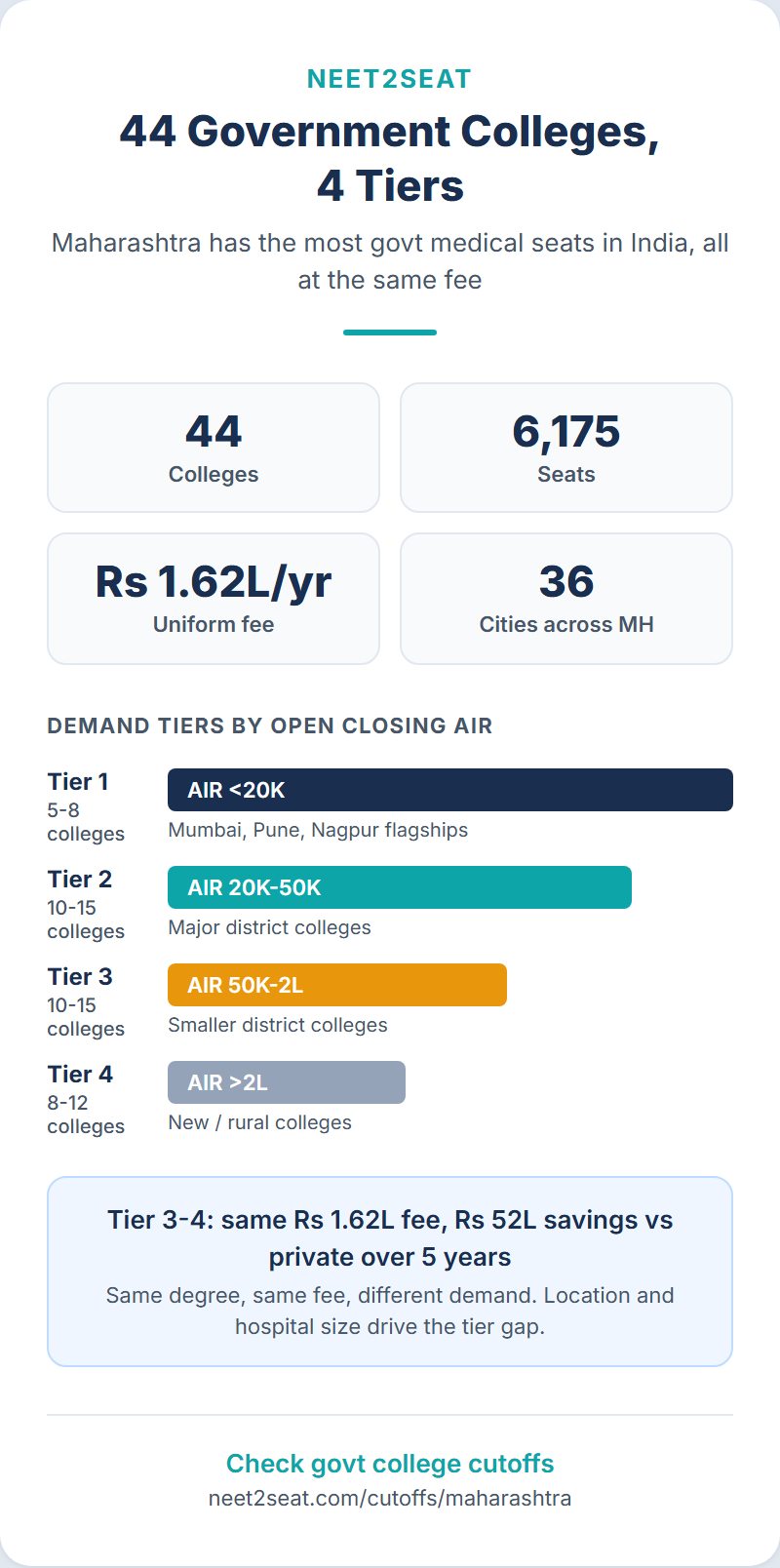
Maharashtra’s 44 government medical colleges share a uniform fee (approximately Rs 1.62 lakh per year) and grant the same MBBS degree. The differences are in clinical volume, hospital infrastructure, location, faculty, and the research environment. This guide ranks all 44 by competitiveness and maps what distinguishes the top tier from the rest.
For the full Maharashtra overview including private and deemed colleges, see our state overview. For individual college cutoffs, use the cutoff analyzer.
- All 44 government colleges charge Rs 1.62L/yr and grant the same MBBS degree — the differences are in infrastructure and location
- Tier 1 (AIR under 20,000): Mumbai and Pune flagships with 1,000+ bed teaching hospitals
- Tier 3/4 colleges (AIR 50,000+) offer the same degree at 30-50% lower living costs than metro cities
- List every government college where your AIR qualifies — extras are invisible safety nets that cost nothing
How we rank government colleges
We use the 2025 Round 2 OPEN closing AIR as the primary ranking metric. A lower closing AIR means the college fills with higher-ranked candidates, which correlates (imperfectly but consistently) with institutional reputation, hospital quality, and student demand. This is not a quality rating; it is a demand indicator.
Closing AIR measures demand, not quality. A Tier 4 college with higher closing AIRs may have modern buildings and equipment (from recent government investment) while a Tier 2 college with lower closing AIRs may have older infrastructure. Use closing AIR for competitiveness assessment, but verify infrastructure through college visits or NMC inspection reports.
Tier 1: OPEN closing AIR under 20,000 (approximately 5 to 8 colleges)
These are the most competitive government colleges in Maharashtra. They fill with candidates in the top 20,000 NEET ranks nationally.
ESIC Medical College Andheri (AIR 12,566 in 2025 R2) leads this tier, though with only 50 seats, its dynamics are distinct from larger institutions. The traditional Big Four of Maharashtra government medical education are Seth GS (KEM Hospital), Grant (JJ Hospital), BJ Medical College Pune (Sassoon Hospital), and LTMMC (Sion Hospital). GMC Nagpur, with 250 seats and a large hospital, also competes for Tier 1 positions in most years.
What distinguishes Tier 1: affiliated hospitals are large tertiary care centres (1,000+ beds), departments span all major specialities and super-specialities, research output is the highest among Maharashtra government colleges, and PG department reputations drive student demand.
For Tier 1 details by city, see Mumbai colleges and Pune colleges.
Tier 2: OPEN closing AIR 20,000 to 50,000 (approximately 10 to 15 colleges)
Mid-tier government colleges in established cities: Aurangabad (Chhatrapati Sambhajinagar), Solapur, Kolhapur, Sangli, Miraj, Dhule, Akola, Amravati, and Jalgaon. These colleges have been operating for decades, have 200 to 250 seats each, and are affiliated with district-level hospitals that handle significant patient loads.
Clinical exposure at Tier 2 colleges is strong. District hospitals see a broad range of cases (general medicine, surgery, obstetrics, paediatrics, emergency medicine) because they are often the only tertiary referral point for a large geographic catchment. Students at GMC Aurangabad or GMC Kolhapur may get more hands-on procedural experience than peers at Mumbai colleges, where residents and PG students handle more cases.
Living costs in Tier 2 cities are 30% to 50% lower than Mumbai. Hostel availability is generally better (less demand, more space). The social and cultural environment is more limited than Mumbai or Pune, which matters to some candidates and is irrelevant to others.
Tier 2 colleges in district headquarters often provide more hands-on procedural experience than Tier 1 metro colleges, where PG residents handle many procedures. If clinical skill-building is your priority, Tier 2 colleges in Aurangabad, Kolhapur, or Solapur offer strong training at 30-50% lower living costs.
Tier 3: OPEN closing AIR 50,000 to 2,00,000 (approximately 10 to 15 colleges)
Colleges in smaller district headquarters and newer institutions. Cities include Nanded, Latur, Chandrapur, Yavatmal, Beed, Washim, and Osmanabad (Dharashiv). These colleges typically have 100 to 200 seats and were established in the last 10 to 20 years.
Infrastructure varies. Some Tier 3 colleges have modern buildings and equipment (recent government investments in medical education infrastructure). Others are still developing their clinical departments and hospital facilities. Patient volumes are lower than Tier 1 or 2 but sufficient for MBBS training requirements.
The value proposition of Tier 3 is straightforward: Rs 1.62 lakh/year for an MBBS degree that carries the same weight as a degree from Seth GS. If your AIR is 80,000 and the choice is between GMC Nanded at Rs 1.62 lakh/year and a private college in Pune at Rs 12 lakh/year, the five-year savings of Rs 52 lakh make the government option compelling even with a less preferred location.
A candidate with AIR 80,000 choosing between GMC Nanded (Rs 1.62L/yr) and a Pune private college (Rs 12L/yr): five-year tuition difference is Rs 52 lakh. Add lower living costs in Nanded (Rs 5K/month vs Rs 10K/month in Pune), and the total savings approach Rs 55 lakh. Both degrees carry identical weight for NEET PG eligibility.
Tier 4: OPEN closing AIR above 2,00,000 (approximately 8 to 12 colleges)
The newest government colleges in the most underserved areas: Nandurbar, Sindhudurg, Gondia, Alibaug (Raigad), and similar locations. Some of these colleges close at AIRs above 5,00,000, meaning candidates with relatively high (weak) ranks can still secure a government seat.
These colleges are sometimes dismissed as “not real options” by candidates focused on metropolitan colleges. This is a mistake for two reasons:
- The degree is identical. NMC accreditation ensures that all government colleges meet minimum standards for faculty, equipment, and clinical training. The MBBS degree from GMC Nandurbar is legally and professionally identical to one from Seth GS.
- The alternative may be no seat. A candidate with AIR 3,00,000 who lists only 10 colleges (all in Mumbai and Pune) may end up with no allotment. Adding Tier 4 government colleges at the bottom of the list provides a safety net at Rs 1.62 lakh/year.
Never dismiss Tier 4 government colleges. A candidate with AIR 3,00,000 who lists only metro colleges risks ending up with no allotment. Adding Nandurbar, Sindhudurg, or Gondia at the bottom of your list costs nothing and prevents the worst outcome: no medical seat at all at Rs 1.62L/yr.
The complete ranking: 2025 Round 2 OPEN closing AIRs
Use the cutoff analyzer to see the full ranked list with exact closing AIRs for any year, round, and category. Filter by state=Maharashtra, year=2025, category=OPEN, and sort by closing AIR to see every government college ranked from most to least competitive.
For Round 3 data (which shows slightly relaxed cutoffs at most colleges), add the Round 3 filter. Comparing R2 and R3 closing AIRs gives you the realistic range for each college.
City cluster analysis
- Mumbai (9 colleges): Widest range of Tier 1 options. See Mumbai guide.
- Pune (2 colleges + AFMC): BJM is Tier 1; AFMC is separate admission. See Pune guide.
- Nagpur (2 colleges): GMC Nagpur is Tier 1/2. Indira Gandhi GMC is Tier 2/3.
- Marathwada region (Aurangabad, Latur, Nanded, Ambejogai, Osmanabad): Multiple Tier 2/3 options. Historically underserved in medical education; new colleges are expanding access.
- Vidarbha region (Nagpur, Chandrapur, Yavatmal, Akola, Amravati, Gondia): Tier 2/3/4 spread. Strong clinical diversity due to tribal and rural populations.
- Western Maharashtra (Kolhapur, Sangli, Miraj, Satara, Ratnagiri): Established Tier 2 colleges with stable demand.
Open the cutoff analyzer, set state=Maharashtra, year=2025, category=OPEN, and sort by closing AIR. Identify every government college where your AIR falls within the closing range, then list all of them on your preference list. The algorithm gives you the best match; unlisted colleges cannot help you.
FAQ
Are all 44 government colleges in CET Cell counselling?
Most are. AFMC Pune has a separate admission process. ESIC colleges are included in CET Cell counselling for state quota. Check the current year’s seat matrix for the exact participating list.
Do government college closing AIRs tighten every year?
Generally yes, especially at Tier 1 and 2 colleges, due to increasing NEET registrations and overall score inflation. Tier 3 and 4 colleges show more stability because demand is less concentrated. Plan with a 10% to 15% buffer when using historical data.
Should I list all 44 government colleges?
List every government college where your AIR qualifies and you would accept the seat if allotted. For most candidates, that means 20 to 35 government colleges. Even if you list 40+ options, the algorithm gives you the highest-ranked one you qualify for. The extras are invisible safety nets.
What about the quality difference between Tier 1 and Tier 4?
Tier 1 colleges have larger hospitals, more specialities, more research, and a stronger alumni network. Tier 4 colleges are newer and still building these features. The MBBS curriculum and degree are the same. The practical training experience differs in volume and variety, not in kind. For PG entrance, what matters is your exam score, not which government college you attended.