- There is no penalty for listing additional choices. More is always better.
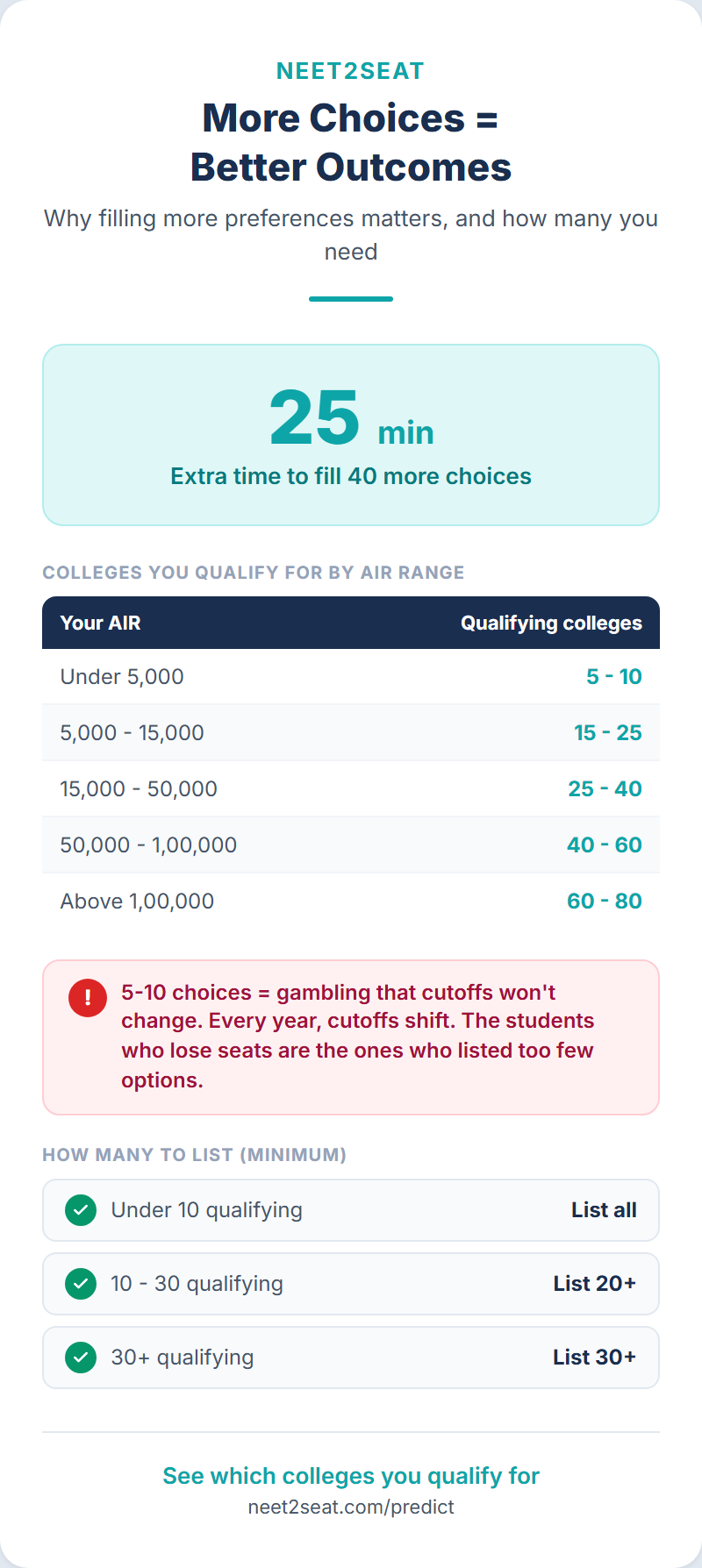
- The time investment for 50 choices vs 10 is about 25 extra minutes: one of the highest-value uses of time in the entire process.
- In Round 1, exit is free. You cannot get “stuck” at an unwanted college.
- Use the college predictor to identify your Safe, Target, and Reach zones, then list all of them.
The short answer: as many as you can
Fill every college where you would accept a seat if offered. There is no penalty for listing additional choices. The allotment algorithm processes your list top to bottom and assigns you the highest-ranked choice where your AIR qualifies. Choices below your allotted position are never seen by anyone. They sit unused, invisible, and cost you nothing.
The real question is not “how many” but “what is the risk of listing too few?” That risk is concrete: you end up with no allotment in a round where you could have had one.
What happens when you list too few choices
Consider a candidate with AIR 35,000 in Maharashtra who lists 8 colleges, all in Mumbai. The cutoffs at those 8 colleges in 2025 Round 1 ranged from 2,571 to 50,000 for OPEN category. In a normal year, this candidate gets one of the less competitive options. But in 2025, cutoffs tightened across the board. All 8 colleges had closing AIRs below 35,000. The candidate gets no allotment. If they had listed 25 colleges including government colleges in smaller cities and a few private colleges, they would have had a seat.
This scenario plays out every year. It is not hypothetical.
The numbers: how list length affects outcomes
We do not have access to individual candidates’ preference lists (those are confidential). But we can model outcomes using our cutoff data. What the data shows about how many colleges each AIR range qualifies for:
Maharashtra, OPEN category, 2025 (all rounds combined)
| Your AIR range | Approximate colleges with closing AIR >= your AIR |
|---|---|
| Under 5,000 | 5-10 (all top government colleges) |
| 5,000 to 15,000 | 15-25 (most government colleges) |
| 15,000 to 50,000 | 25-40 (all government + some private) |
| 50,000 to 1,00,000 | 40-60 (including many private colleges) |
| Above 1,00,000 | 60-80 (primarily private colleges) |
If you have AIR 30,000 and list only 10 colleges, you are covering less than half your options. If cutoffs tighten by 10% to 15% (which has happened between consecutive years), 3 or 4 of your listed colleges may become unavailable. Your effective list shrinks from 10 to 6 or 7. With 30 colleges listed, the same tightening still leaves you 25 options.
The time investment
Filling 10 choices takes about 15 minutes. Filling 50 choices takes about 40 minutes. The additional 25 minutes buying you 40 more options is one of the highest-value uses of time in the entire counselling process.
The bottleneck is research time, not filling time. Use the choice filling optimizer and college predictor to collapse hours of research into a 5-minute interaction. Then transferring your list to the counselling portal takes minutes.
Common objections
“I only want government colleges”
Fine. List all the government colleges you qualify for, in your preferred order. Maharashtra has 44 government medical colleges; Karnataka has 24. If you are listing fewer than 20 government colleges when your AIR qualifies for that many, you are leaving options on the table.
After your government colleges, add private colleges at the bottom of your list as a safety net. In Round 1, where exit is free, being allotted a private college you do not want costs nothing. You do not report, your deposit is refunded, and you enter Round 2. But if your entire list of government colleges is exhausted and you have no private colleges listed, you get no allotment at all.
“I want to exclude colleges in certain cities”
If a specific location is genuinely unacceptable, do not list it. But be honest about whether the objection is a firm constraint or a soft preference. If you are choosing between “no seat at all” and “a seat in Latur,” most candidates would take the seat. Better to have it as option 45 on your list than to end up with nothing.
“Listing too many colleges means I might get stuck somewhere I hate”
In Round 1, you cannot get “stuck.” Exit is free. In later rounds, it is true that accepting an allotment becomes more binding. But even then, having more choices does not increase your risk. The algorithm gives you the highest choice on your list where you qualify. If your top 20 choices are all colleges you genuinely want, positions 21 through 50 only activate if none of your top 20 are available. At that point, the alternative is no seat at all.
“The counselling portal is slow and times out”
Prepare your list in advance using offline tools. Enter it on the portal when traffic is lighter (early morning or late night). Do not wait until the last few hours before the deadline. Portal crashes during peak periods have caused candidates to miss deadlines entirely.
A framework for minimum list length
As a rough guideline:
- If your AIR qualifies for 10 or fewer colleges: list all of them. You are at the top of the merit spectrum, and every option matters.
- If your AIR qualifies for 10 to 30 colleges: list at least 20. Leave a buffer of 5 to 10 colleges beyond what you think you need.
- If your AIR qualifies for 30 or more colleges: list at least 30. Include all government colleges plus a selection of acceptable private colleges.
The college predictor tells you how many colleges fall into your Safe, Target, and Reach zones. Use that as the baseline for list length: list all Safe and Target colleges at minimum, plus as many Reach colleges as you can identify.
Round 1 vs later rounds
The argument for long lists is strongest in Round 1 because of the free exit provision. In later rounds, where the allotment may be binding:
Round 2: still list broadly. In Maharashtra, Round 2 allows fresh preference filling. In Karnataka, the Choice 2/Choice 3 mechanism adds complexity (see our Karnataka choice filling guide), but the principle holds: more options are better than fewer.
Round 3 (mop-up): the seat pool is small. List whatever is available. This is not the round for selectivity; it is the round for ensuring you have a medical seat.
FAQ
Is there a maximum number of choices I can fill?
MCC and state counselling authorities set technical limits, but they are high enough that most candidates will not hit them. Maharashtra’s CET Cell does not impose a hard limit on the number of preferences. Karnataka KEA also allows unlimited options. MCC allows up to the total number of available college-course combinations.
Does listing 50 choices take longer to process than listing 10?
Not for you. The algorithm is automated and processes all candidates’ lists simultaneously. Whether your list has 10 or 100 entries, your allotment is determined in the same batch run. The processing time is the same.
If I list a college I do not want and get allotted there, what happens?
In Round 1 (free exit), nothing. You do not report, and your deposit is refunded. In later rounds, the consequences depend on the specific counselling track’s rules. In MCC Round 2, your deposit may be forfeited. In Round 3, the seat may be binding. Only list colleges you would not attend in rounds where exit carries penalties.
Should I list the same colleges in both MCC and state counselling?
The college lists are different between MCC and state counselling (MCC includes deemed universities and AIQ seats; state counselling includes state quota seats). Some colleges appear in both tracks but with different seat pools. List independently based on what is available in each track.