MCC choice filling for NEET UG: how to fill preferences on the AIQ portal
Choice filling on the MCC portal is where your counselling outcome is decided. You build an ordered preference list of college-course combinations, and the allotment algorithm processes candidates by NEET rank, assigning each person the highest preference with a vacant seat. Getting this right matters more than most candidates realize. This guide covers how MCC choice filling works, what the portal looks like, common mistakes, and a practical strategy for ordering your list.
When and where choice filling happens
Choice filling opens on mcc.admissions.nic.in after registration closes for each round. In the 2025 cycle, Round 1 choice filling ran from 22 July to 7 August (about two weeks). Round 2 ran from 5-15 September. Round 3 ran from 30 September to 9 October.
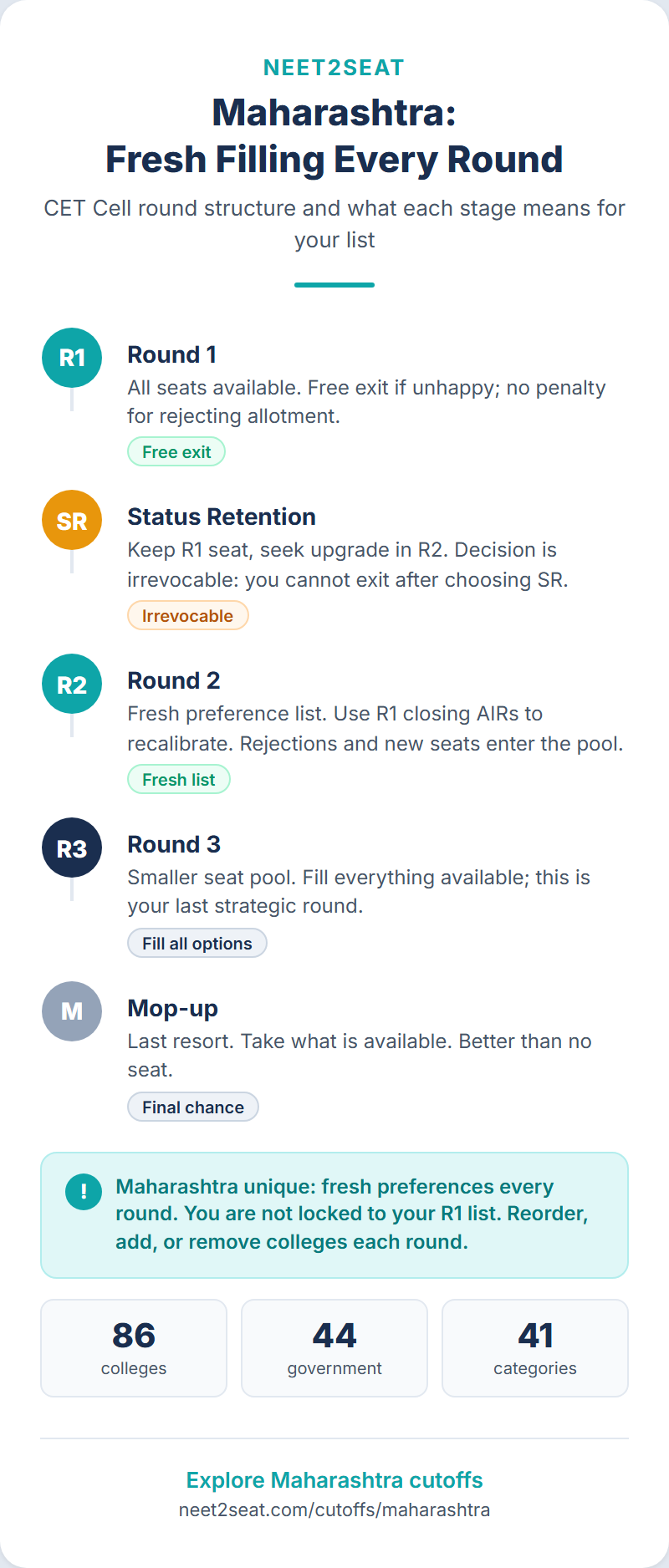
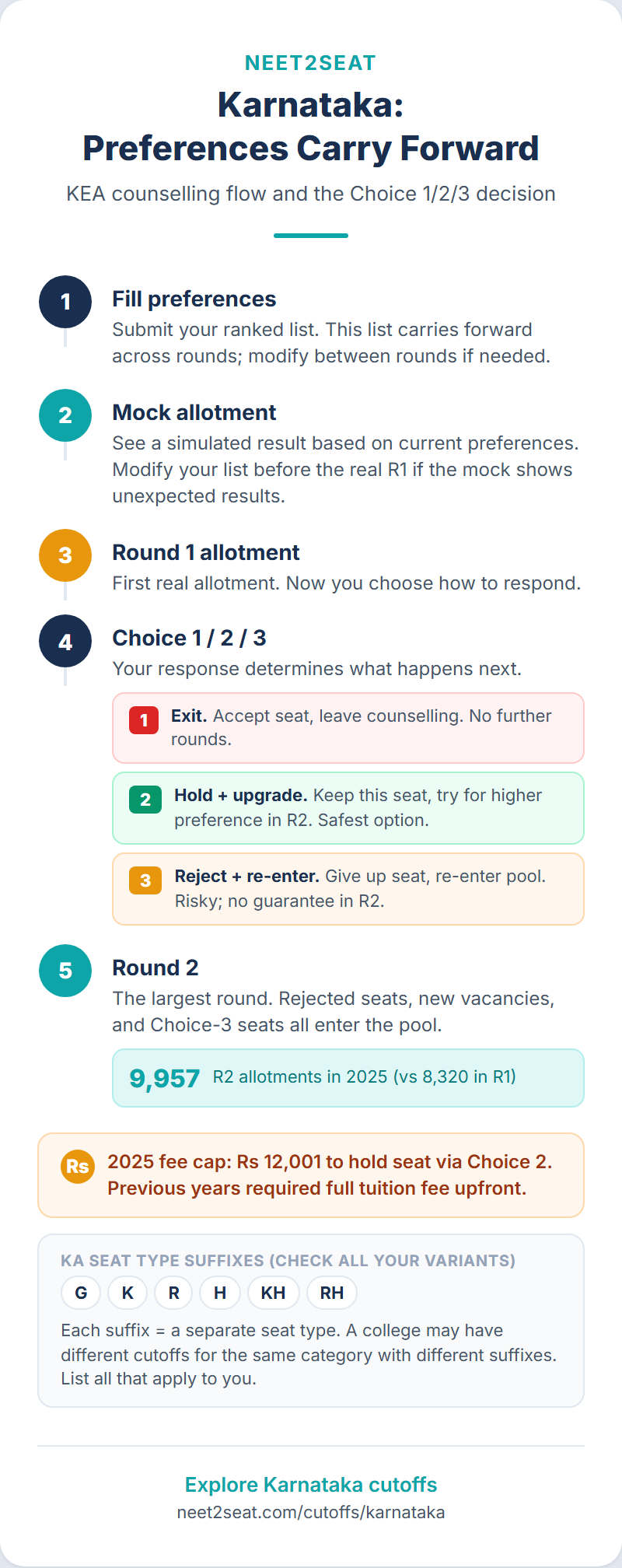
You must fill fresh choices for each round. Your Round 1 preference list does not carry forward to Round 2. This is a common point of confusion; treat each round as an independent exercise.
Your Round 1 preference list is completely voided before Round 2. You must fill fresh choices every round. Previous lists do not carry forward.
No limit on number of choices
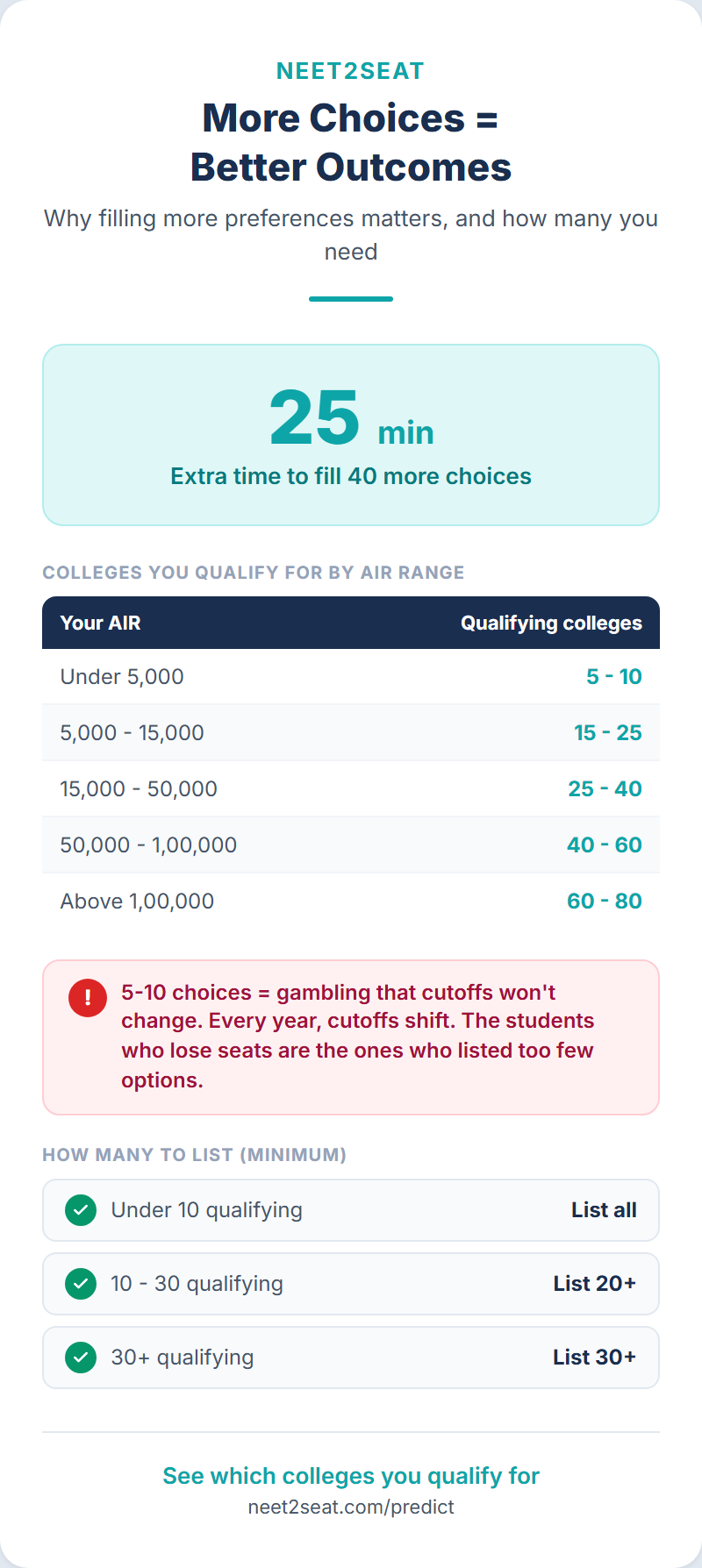
MCC does not cap the number of college-course combinations you can add. If there are 359 AIQ colleges in the system (which our database tracks), you could theoretically list every one of them. In practice, you should list every college-course combination you are genuinely willing to attend. More choices give you a higher probability of allotment, because the algorithm stops at the first vacant match as it scans down your list.
Listing a college does not commit you to joining it. If you are allotted a seat you listed but no longer want, you can exit (in Round 1, this is free; in later rounds, there are deposit consequences).
How to fill choices on the portal
The MCC portal presents available colleges and courses based on your registered seat types and category. The process:
- Search and add: Search by college name, state, city, or institution type. Add college-course combinations to your list one at a time.
- Reorder: Drag and drop (or use move buttons) to arrange choices in your true preference order. Your first choice should be the college you want most, second choice the next best, and so on.
- Save regularly: The portal has a save button. Save your list after every batch of changes. Unsaved changes can be lost if your session times out.
- Lock: Near the end of the choice-filling window, a separate locking period opens (typically the last few hours). Once you lock, your list is final. If you do not lock manually, the system auto-locks your last saved list at the deadline.
You can add, remove, and reorder choices as many times as you want during the filling window. The system records only your final locked list for allotment processing.
The allotment algorithm
MCC uses a merit-based single-round allocation. It processes candidates in descending order of NEET All India Rank (AIR 1 first, then AIR 2, and so on). For each candidate, the system scans their preference list from top to bottom and assigns the first choice where:
- The college has a vacant seat in the candidate’s eligible category
- The candidate meets any institution-specific eligibility (domicile for DU colleges, ESIC employee wards for CW seats, etc.)
If no choice has a vacant seat, the candidate gets no allotment in that round. The key implication: your preference order determines which seat you get among those available at your rank, but it cannot get you a seat that candidates with better ranks have already taken.
Strategy: how to order your choices
A few principles that consistently produce better outcomes:
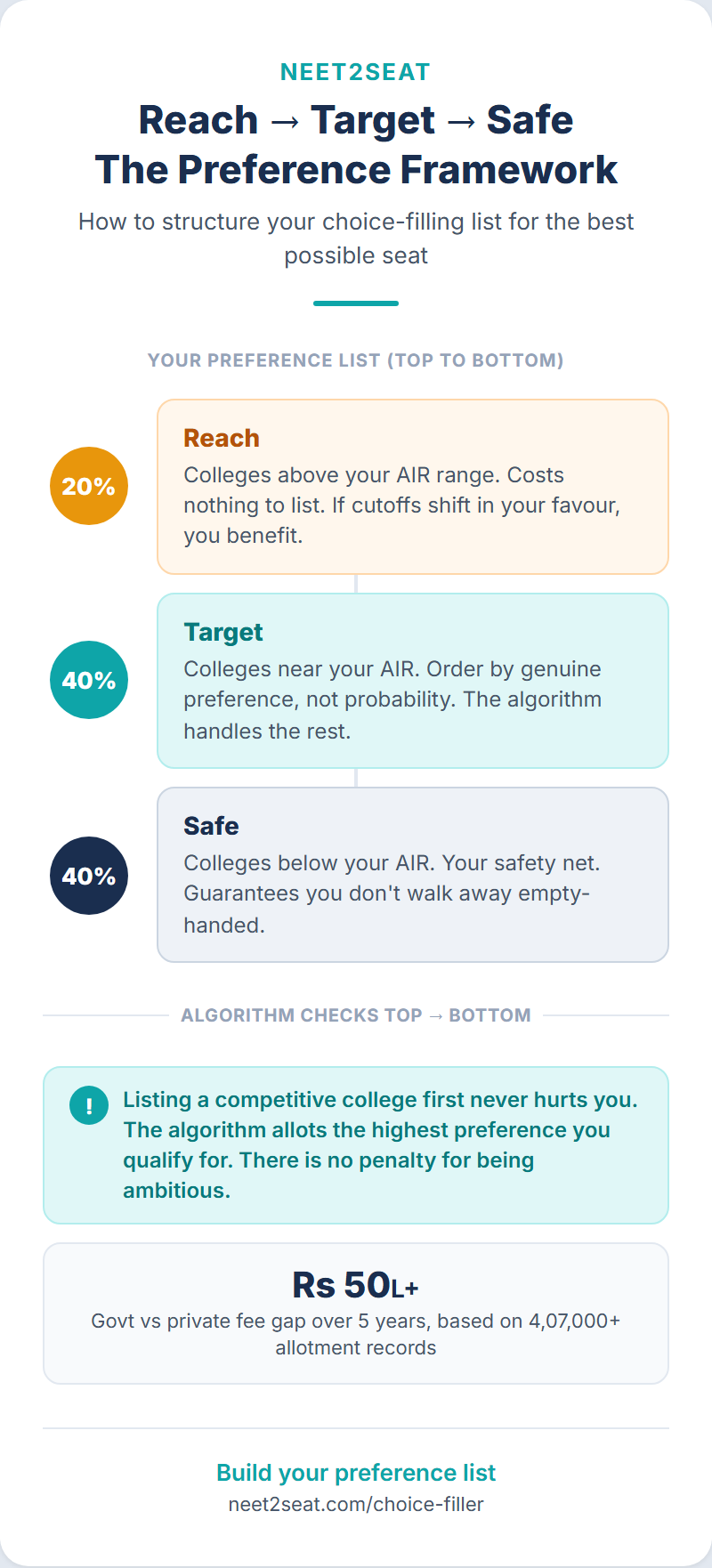
Put your true first choice first. There is no tactical reason to list a “safe” college first. The algorithm checks your list from top to bottom, so listing your dream college first costs you nothing. If it is available at your rank, you get it. If not, the algorithm moves to your second choice. You never lose a safer option by listing an ambitious choice above it.
There is zero downside to listing your dream college first. The algorithm checks your list top-to-bottom; an ambitious first choice cannot cost you a safer option placed lower on the list.
Fill more choices than you think you need. In 2025, MCC processed candidates across 359 colleges with 16 different seat types and 10 categories. The combinations are large. If you list 30 colleges but the 31st would have been your allotment, you get nothing. List everything you would accept.
Use our cutoff data for calibration. Our AIQ cutoff analyzer shows closing AIR by college, category, seat type, and year for 2023-2025. Use these to identify three zones:
- Reach colleges: Where last year’s closing rank was better than yours by a margin. Low probability but worth listing (put them at the top).
- Target colleges: Where your rank falls within the recent range of closing ranks. Reasonable probability.
- Safe colleges: Where your rank comfortably beats recent closing ranks. High probability (put them lower in the list, as backups).
Our college predictor automates this classification for your specific rank and category.
Don’t leave gaps in your list. If you would attend College A and College C but not College B, skip College B. But do not leave a gap between your last realistic choice and the end of your list. Add safe options all the way down. The cost of having one extra college on your list is zero; the cost of missing an allotment because you ran out of choices is an entire year.
List every college-course combination you would genuinely attend. With 359 colleges in the system, aim for 50+ choices if your rank range spans many colleges. Use our college predictor to identify your safe, target, and reach options.
Choice locking: do not skip it
The choice locking window opens in the last few hours of the choice-filling period. During this window, you explicitly lock your list, making it final and uneditable.
If you forget to lock, the system auto-locks your last saved list. This means whatever you last clicked “Save” on becomes your final list. If you were in the middle of reordering and saved a partially reorganized list, that is what gets locked. Always do a final review and manual lock before the deadline.
Auto-lock saves your last saved list, not your intended list. If your last save was mid-reorder, that partially reorganised list becomes final. Always do a deliberate final review and manually lock your choices.
Round-by-round choice filling differences
| Round | Fresh choices required? | Available seats | Key difference |
|---|---|---|---|
| Round 1 | Yes (first round) | All MCC seats | Largest pool; fill aggressively |
| Round 2 | Yes (Round 1 list voided) | R1 leftover + vacated + upgraded seats | Smaller pool but less competition from R1 acceptors |
| Round 3 (Mop-up) | Yes (fresh registration too) | R2 leftover + vacated seats | Even smaller pool; joining is compulsory |
| Stray vacancy | Yes | R3 leftover (mainly deemed/central) | Freeze only, no float option |
The pool of available seats shrinks with each round, but so does the number of competing candidates (since many have already accepted seats). Round 2 can sometimes produce surprises where seats at popular colleges open up because their Round 1 holders were upgraded to even more popular colleges.
The competition shrinks with each round as candidates accept seats and leave the pool. Round 2 upgrades can free seats at popular colleges that were fully filled in Round 1, creating opportunities that did not exist earlier.
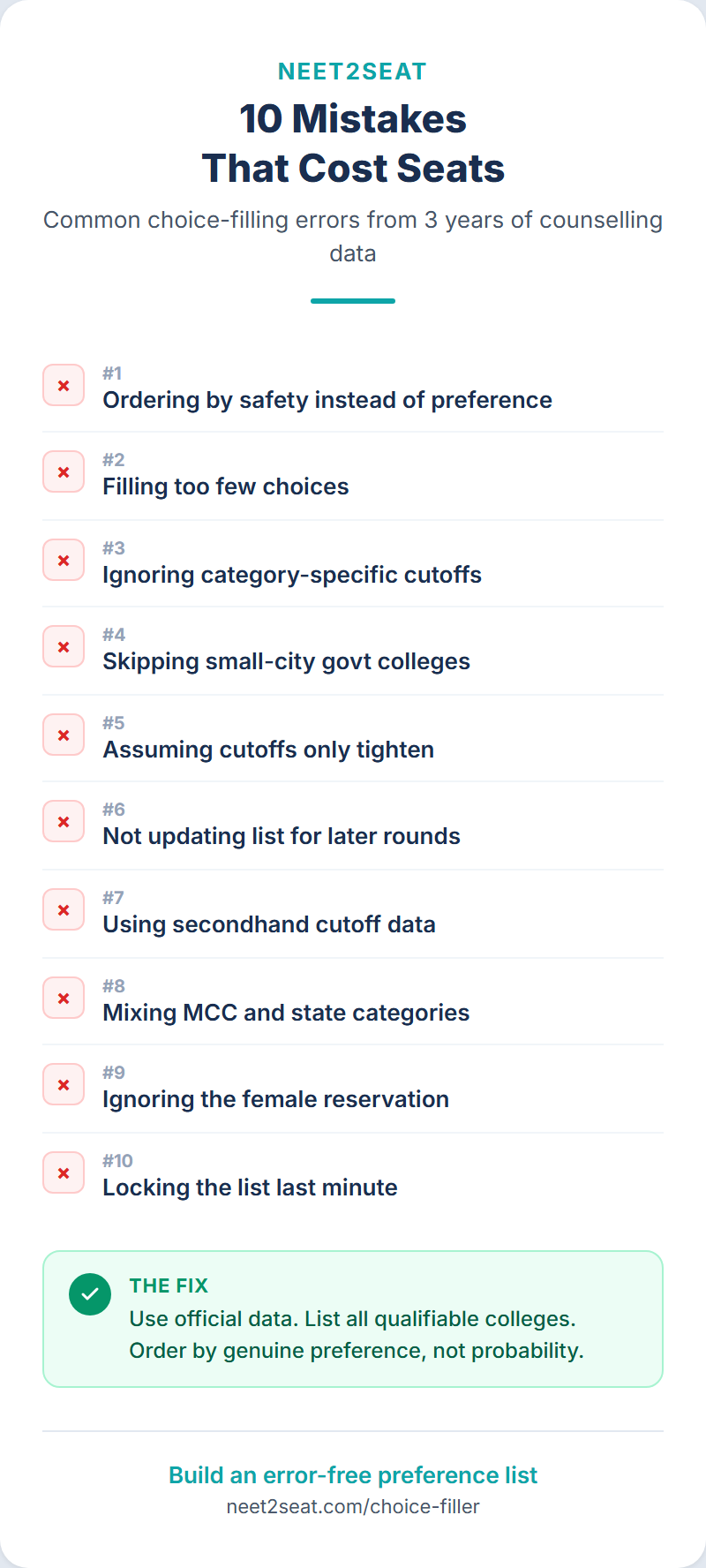
Common choice-filling mistakes
Listing too few choices. Candidates who list only 10-15 colleges and miss allotment have no one to blame but the length of their list. With 359 colleges in the system, listing 50+ is reasonable for most rank ranges.
Ordering by fee instead of preference. Some candidates push low-fee government colleges to the top and high-fee deemed colleges to the bottom. This is fine if it reflects genuine preference. But if you would genuinely prefer a particular deemed college (better clinical exposure, location, or speciality reputation) over a remote government college, order accordingly. The algorithm respects your list; make the list reflect what you actually want.
Not checking seat type eligibility. Some seats have additional eligibility requirements (Delhi domicile for DU quota, ESIC employee relationship for CW seats). If you list a seat you are not eligible for, it is simply skipped by the algorithm (no penalty), but it does not count as a valid choice. Make sure your realistic choices are ones you actually qualify for.
Forgetting to lock. Auto-lock saves you from a blank list, but it locks whatever you last saved. If your last save was an incomplete reorder, that is your final list.
FAQ
Can I change my choices after locking?
No. Once locked (manually or auto-locked at the deadline), your list is final for that round. You will fill fresh choices in the next round if you participate.
Do my Round 1 choices carry forward to Round 2?
No. Each round requires a completely new preference list. Your Round 1 list is voided before Round 2 choice filling opens.
What happens if I list a college I am not eligible for?
The allotment system skips it and moves to your next choice. There is no penalty for listing an ineligible college; it simply does not count. However, do not rely on ineligible choices as padding.
Should I list BDS colleges if I only want MBBS?
Only if you would genuinely attend a BDS programme. Listing a BDS college as a placeholder is risky: if you get allotted there, you either join a programme you did not want or exit with potential deposit forfeiture (in later rounds). Only list what you would accept.
How do I find the best colleges for my rank?
Use our college predictor to see safe, target, and reach colleges for your NEET rank and category. Then explore detailed cutoff trends on our AIQ cutoff analyzer. These tools cover 359 AIQ colleges across three years of data.