- Your Karnataka preference list carries forward across rounds, so the initial ordering is critical.
- Use the mock allotment as a free trial run to refine your list before the final lock.
- Choice 2 (Accept and Seek Upgrade) preserves your seat with no penalty if not upgraded.
- Check cutoffs for all suffix variants you qualify for (G, K, R, H, KH, RH) to find additional options.
Karnataka’s Choice 1/2/3 system changes how you think about preferences
In Karnataka, the preference list you submit before Round 1 carries forward. Unlike Maharashtra, where you file a completely new list each round, Karnataka’s KEA counselling requires you to enter your preferences once, and those preferences shape outcomes across all rounds. The Choice 1/Choice 2/Choice 3 decision after allotment then determines whether you accept, seek an upgrade, or re-enter the pool.
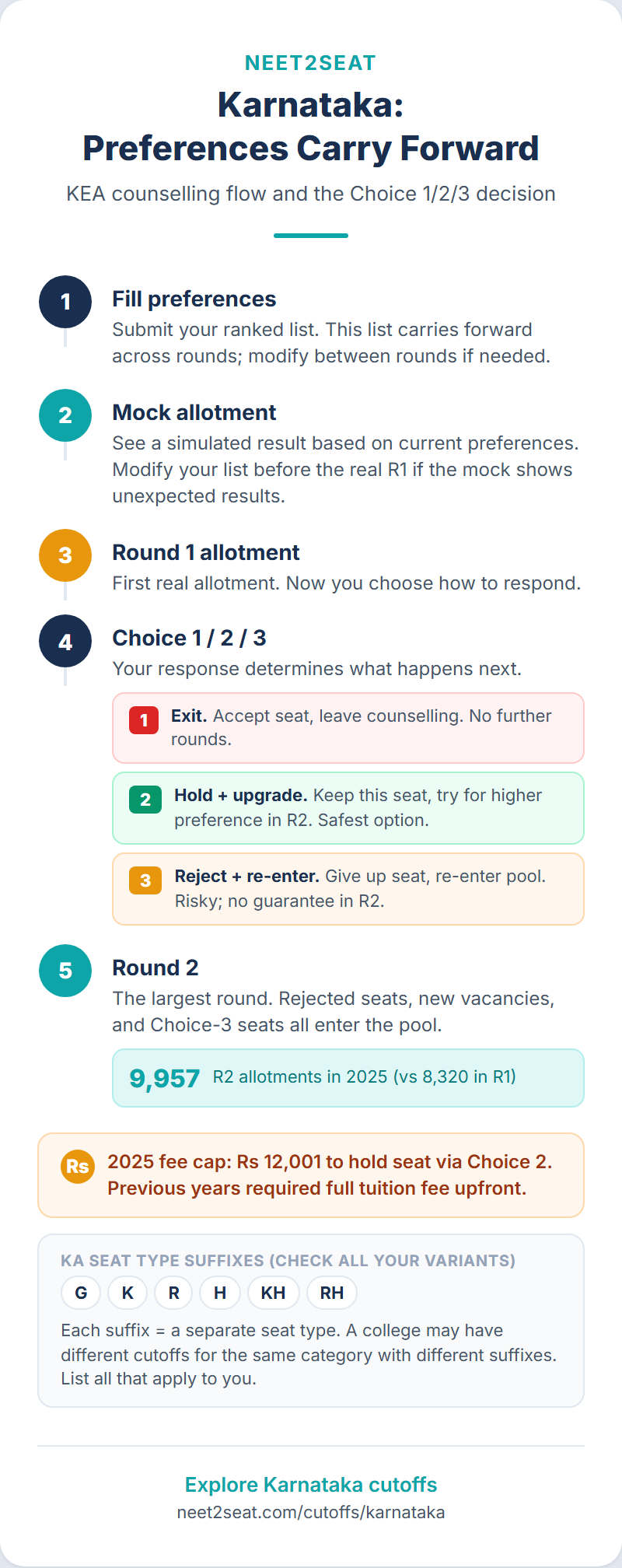
Your initial preference list matters more in Karnataka than in Maharashtra. A poorly ordered list stays with you across all rounds. In Maharashtra, you get a fresh start each round. In Karnataka, you do not.
This guide covers Karnataka-specific choice filling. For the general framework, see our choice filling strategy guide. For Maharashtra, see our Maharashtra choice filling guide.
The mock allotment advantage
KEA publishes a mock allotment before the final Round 1 allotment. This is a preview of where you would be allotted based on current preferences and the seat matrix. After seeing the mock results, you can modify, add, delete, or reorder your choices before the final lock.
Treat the mock allotment as a free trial run. After seeing the results, rearrange your list if needed. Move colleges that are clearly out of reach to the bottom (they will not hurt you there, but a cleaner list is easier to review). Promote colleges that are borderline if they match your genuine preferences.
The mock allotment shows you:
- Which college and category you would be allotted under current preferences
- Whether your top choices are realistic or unreachable
- Where you stand relative to closing thresholds at specific colleges
How the Choice 1/2/3 decision interacts with your preference list
After each round’s final allotment, you select one of three options:
Choice 1 (Accept and Exit): you take the allotted seat and leave counselling. Your preference list is no longer relevant. This is final.
Choice 2 (Accept and Seek Upgrade): you accept the allotted seat but want to try for a better seat in Round 2. Your existing preference list is carried forward. In Round 2, the algorithm checks your preferences above your current allotment: if any of those higher-ranked colleges now has a vacancy and your AIR qualifies, you are upgraded. Your old seat is released automatically.
Choice 3 (Decline and Re-enter): you reject the seat entirely and re-enter the pool. Your preferences above the rejected college are active for Round 2. This is the highest-risk option: there is no guarantee you will get any seat in Round 2.
Choice 2 upgrade eligibility is determined by what is above your current allotment on your preference list. If the college you actually want is below your current allotment (because you ranked it lower), you cannot be upgraded to it. This is why getting the initial preference order right is the single most important step in Karnataka counselling.
Building the initial preference list
Since your list carries forward, it needs to be right the first time. The principles:
List every college you would attend, not just your ideal ones
Karnataka has 74 medical colleges in our database: 24 government, 38 private, 12 deemed. Your preference list should cover enough of these to guarantee an allotment in at least one round. If you qualify for 40 colleges but list only 15, and those 15 fill before your rank, you exit Round 1 with nothing.
Separate government and private tiers
Government college fees in Karnataka are approximately Rs 50,000 per year. Private college government quota fees average Rs 14 lakh per year. Management quota fees average Rs 36 lakh per year. The fee multiplier between government and private is 28x to 72x. For most candidates, all government colleges (even in less preferred locations) should come before private colleges.
Account for the suffix system
Karnataka’s categories use suffixes: G (general), K (Kannada medium), R (Rural), H (Hyderabad-Karnataka), KH, RH. If you qualify for multiple suffix codes (say, you are a 2A candidate from a rural school in the HK region, making you eligible for 2AG, 2AR, 2AH, and 2ARH), the algorithm checks your eligibility across applicable codes.
When using the cutoff analyzer to research your options, check cutoffs for all suffix variants you qualify for. A college might be Reach for 2AG but Safe for 2AH, meaning the HK reservation gives you additional options you would otherwise miss.
Include deemed university government quota seats
Approximately 25% of deemed university seats are government quota, filled through KEA. These seats often have different cutoffs from the private and management quota at the same institution. If a deemed university appears in the KEA counselling, check the government quota closing AIR specifically; it may be more accessible than you expect.
Round 2: what changes
In Round 2, the seat pool shifts:
- Choice 1 candidates from Round 1 are gone; their seats are not available (they accepted).
- Choice 2 candidates retain their Round 1 seats while seeking upgrades. If upgraded, their old seats become available for others.
- Choice 3 candidates re-enter the pool. Their vacated Round 1 seats become available.
- New seats may be added if the NMC approved additional seats after Round 1.
Round 2 is consistently the largest round in Karnataka. In 2025, Round 2 had 9,957 allotments versus 8,320 in Round 1. Seats freed by Choice 1 and Choice 3 candidates create a large pool of vacancies. Closing AIRs at the most competitive government colleges tend to be slightly less competitive (higher numbers) than Round 1.
The Choice 2 advance fee change in 2025
A significant 2025 rule change: for Choice 2 candidates with allotted seats having course fees exceeding Rs 12 lakh, only Rs 12,001 needs to be paid upfront (previously the full course fee was required). SC/ST/Category 1 candidates pay Rs 2,000 as a caution deposit.
This lowers the financial barrier for Choice 2. Previously, a candidate allotted a private college seat at Rs 15 lakh had to pay the full Rs 15 lakh to keep the seat while seeking an upgrade. Now they pay Rs 12,001. This makes Choice 2 more accessible for candidates who want to hold a private seat while hoping for a government upgrade.
When to choose Choice 3 (decline and re-enter)
Choice 3 is the highest-risk option. Use it only when: (1) the allotted seat is genuinely unacceptable, (2) your AIR is strong enough that historical data strongly suggests a better allotment in Round 2, and (3) you are willing to risk the Rs 1,00,000 caution deposit (Rs 50,000 for SC/ST). If you are on the margin, Choice 2 is almost always better: it preserves your Round 1 seat while giving you a shot at an upgrade.
FAQ
Can I modify my preference list between Round 1 and Round 2?
The general rule is that preferences carry forward from Round 1. Some recent KEA cycles have allowed limited modification. Check the current year’s KEA notification for the exact policy. Even if modification is allowed, the core order established in Round 1 shapes your outcomes.
If I choose Choice 2 and am not upgraded, what happens?
You keep your Round 1 seat. You pay the remaining course fee balance and report to the original college. Choice 2 carries no penalty for non-upgrade.
Does my out-of-state status affect preference filling?
If you are a non-Karnataka candidate, you can only be allotted private college private/management/NRI quota seats through KEA. Your preference list should include only those seat types. Government college state quota seats and government quota at private colleges are restricted to Karnataka domicile candidates.
How do deemed university seats appear in the preference list?
Deemed university government quota seats (filled through KEA) appear alongside other college options. They are treated like any other college in the preference list. Management and NRI quota at deemed universities go through MCC, not KEA, and do not appear in the KEA preference list.
What if I got admission through MCC and also have a KEA allotment?
You can cancel your KEA seat before Round 2 results if you chose Choice 2, without forfeiting fees. If you chose Choice 1 and already reported, the cancellation and refund rules depend on the timing relative to KEA’s cancellation deadline. Check both the MCC and KEA bulletins for exact cross-counselling rules for the current year.