- Maharashtra allows fresh preference filling every round: you can rebuild your entire list after each result.
- Use Round 1 closing AIRs to reclassify colleges from Reach to Target or Safe for Round 2.
- Status Retention is irrevocable. Once declared, you cannot withdraw even if no upgrade comes.
- Government fees (~Rs 1.62 lakh/year) vs private fees (Rs 5-25 lakh/year) should heavily influence your ordering.
Maharashtra allows fresh preference filling every round
Maharashtra’s CET Cell counselling process gives you a structural advantage that candidates in many other states do not have: you can submit an entirely new preference list in each round. Round 1, Round 2, and Round 3 each open fresh choice-filling windows. You are not locked into your Round 1 preferences for the rest of the process.
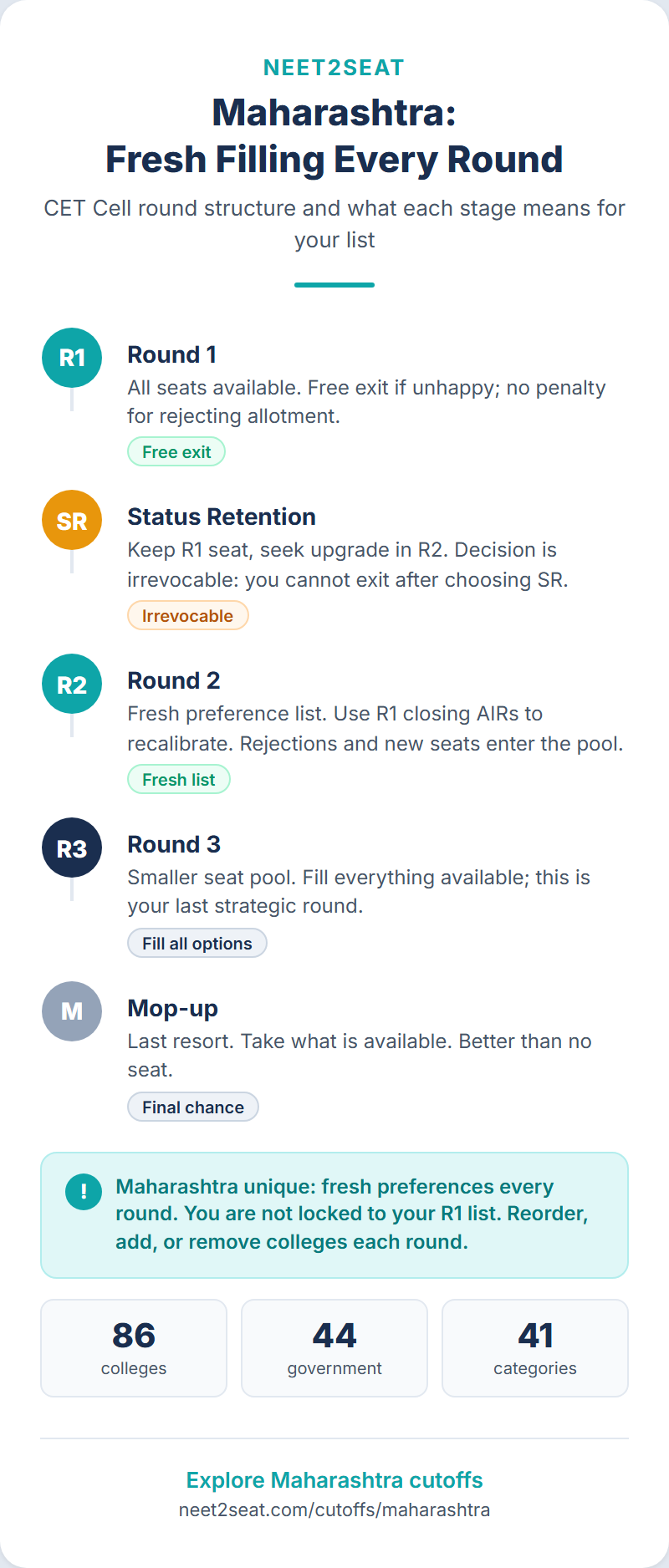
This matters because the seat pool changes between rounds. Seats vacated by candidates who took free exit in Round 1 become available in Round 2. Round 3 adds stray vacancy seats. Each round’s closing AIRs provide concrete information that did not exist when you filled your Round 1 list. Fresh filling lets you incorporate that information.
This guide covers Maharashtra-specific preference filing details. For the general framework (algorithm mechanics, Reach-Target-Safe ordering), see our choice filling strategy guide. For Karnataka, see our Karnataka choice filling guide.
The round structure and what changes between rounds
Round 1
All seats are available: 85% state quota at government and private colleges, institutional quota seats at private colleges. You fill preferences based on historical data and your AIR. Exit is free; if allotted, you can simply not report and your deposit is refunded.
After Round 1 results, CET Cell publishes the allotment list showing which colleges were allotted at which closing AIRs by category. This data becomes your strongest input for Round 2.
Between Round 1 and Round 2: Status Retention
Status Retention is irrevocable. Once you declare Status Retention on a seat, you cannot withdraw from it, even if you do not get upgraded in Round 2. If you are not upgraded, you continue with the Round 1 seat. Think of it as Maharashtra’s equivalent of “Float” in other states. Only declare Status Retention if you are genuinely willing to keep your Round 1 seat as a floor.
If you were allotted a seat in Round 1 and want to keep it while seeking an upgrade, you file a Status Retention declaration. See our Status Retention guide for the full mechanics and when to use it.
Candidates who did not receive an allotment in Round 1, or who took free exit, enter Round 2 with a clean slate.
Round 2
Fresh preference filling opens. The seat pool now includes seats vacated by Round 1 exits plus any new seats added. Closing AIRs in Round 2 are typically higher (less competitive) than Round 1 for most colleges because the candidate pool has shrunk (those who accepted Round 1 seats and declared Status Retention are no longer competing for new seats; they only compete for upgrades within their retained category).
Use Round 1 closing AIR data to recalibrate your list. A college that was Reach in Round 1 might now be Target or even Safe based on observed data.
Round 3
The final regular round. The seat pool is smaller. Many top colleges have already filled their seats. Fresh preference filling still applies. This is the round where candidates who have been waiting for a specific college should reconsider their position: if that college is fully filled, listing alternatives becomes more urgent.
Maharashtra-specific preference considerations
86 colleges across three types
CET Cell handles admissions for 44 government colleges, 26 private colleges, and 16 deemed universities. Your preference list can include any combination of these, though deemed university seats going through state counselling are limited to the government quota portion.
Government fees are roughly Rs 1.62 lakh per year (tuition plus development fee). Private college fees range from Rs 5 lakh to Rs 25 lakh depending on the institution. This fee gap means that for most candidates, government colleges should dominate the upper portion of the preference list.
The 41 category codes
Maharashtra’s parallel reservation system creates compound categories. OPENW (Open + Female), SCW (SC + Female), OPENDEF (Open + Defence), OPENDEFPH (Open + Defence + PWD), and so on. Your preference list applies to your specific category combination.
If you are a female candidate in a constitutional category (say, SC), you may be eligible for both SC and SCW seats. Use the cutoff analyzer to check closing AIRs for both category codes at each college. Understanding which compound code applies to you determines which cutoffs are relevant. See our Maharashtra categories guide for a full breakdown.
Government colleges are concentrated in a few cities
Mumbai alone has 8 to 10 government medical colleges (depending on how the GMC/Cama Hospital new institutions are counted). Pune has 4. Nagpur has 2. Aurangabad (Chhatrapati Sambhajinagar), Kolhapur, Solapur, Latur, Dhule, Akola, and others each have one.
If you are a candidate from Mumbai, your natural tendency is to list Mumbai colleges first. That is reasonable if you genuinely prefer Mumbai. But if your AIR puts you in the Target zone for Mumbai colleges and the Safe zone for colleges in Nagpur or Aurangabad, listing only Mumbai colleges is risky. Add government colleges in other cities as safety options.
Inter-se for unfilled reserved seats
Maharashtra operates a three-group inter-se mechanism. Unfilled SC/ST seats go to the other group within Group I. Unfilled VJ/NT-B seats go within Group II. Unfilled NT-C/NT-D/OBC seats go within Group III. If still unfilled, seats go to combined merit of all reserved categories, then to common merit. Colleges with historically unfilled reserved seats in your group may offer additional opportunities in later rounds.
Using Round 1 data to build your Round 2 list
After Round 1 results, follow these steps: (1) Go to the Maharashtra cutoff analyzer and filter for your category. (2) Note Round 1 closing AIRs for each college. (3) Compare to your AIR. (4) Move newly realistic colleges higher, push colleges that filled at much lower AIRs to the bottom. (5) Add colleges that did not fill in Round 1.
Institutional quota seats
Private colleges in Maharashtra allocate 15% of seats as institutional quota, filled on an all-India basis through CET Cell’s counselling process. These seats are open to NRI, OCI, and out-of-state candidates, and they carry higher fees than state quota seats.
If your AIR qualifies for institutional quota at a private college but not for state quota, listing the institutional quota option as a backup gives you an additional pathway. The fees are higher (typically 2x to 3x state quota), but it is better to have the option than to miss out entirely.
FAQ
Can I add colleges in Round 2 that I did not list in Round 1?
Yes. Maharashtra allows fresh preference filling in each round. Your Round 2 list is completely independent of your Round 1 list. You can add new colleges, remove old ones, and reorder everything.
If I declared Status Retention, does my preference list in Round 2 matter?
Yes. Your Round 2 preferences determine which college you might be upgraded to. If you listed College A (better than your Round 1 seat) at position 1 and your AIR qualifies, you get upgraded. If not, you keep your Round 1 seat. Status Retention candidates compete for upgrades alongside fresh Round 2 candidates.
Should I fill institutional quota seats?
Only if the higher fees are acceptable to you. Institutional quota fees at private colleges are typically 2x to 3x the state quota fees. If you can afford it and the alternative is no seat, list them at the bottom of your preference list as a safety net.
What happens if I do not fill any preferences in Round 2?
If you were not allotted in Round 1, you are automatically eligible for Round 2 but must fill preferences to participate. If you do not file a preference list, you receive no allotment in Round 2. There is no carryover from Round 1.
How do I know which seats are available in Round 2?
CET Cell publishes an updated seat matrix before each round’s choice-filling window opens. This shows remaining seats by college, category, and seat type. Cross-reference it with your eligibility to identify options.