- The counselling algorithm processes your list top to bottom; putting a safe college at position 1 means you get allotted there and the algorithm never checks your preferred colleges below it
- Round 1 exits are free or low-cost in all three tracks (MCC, CET Cell, KEA); fill aggressively and narrow down later
- Your category differs between AIQ and state counselling: being OBC-NCL for MCC does not mean you are OBC in your state
- Closing ranks shift between rounds; using only Round 1 data to build your Round 2 list ignores seats freed by upgrades and exits
How choice filling works
NEET choice filling is the step where you rank colleges in order of preference on your counselling portal. The counselling authority’s algorithm then processes all candidates by AIR, assigning each person to the highest-preference college where their rank qualifies and a seat remains available. This process, based on the Gale-Shapley algorithm, is deterministic: your outcome depends on your AIR, your category, and the order of your preference list.
The mistakes below come from patterns visible in three years of allotment data across Maharashtra, Karnataka, and All India Quota counselling.
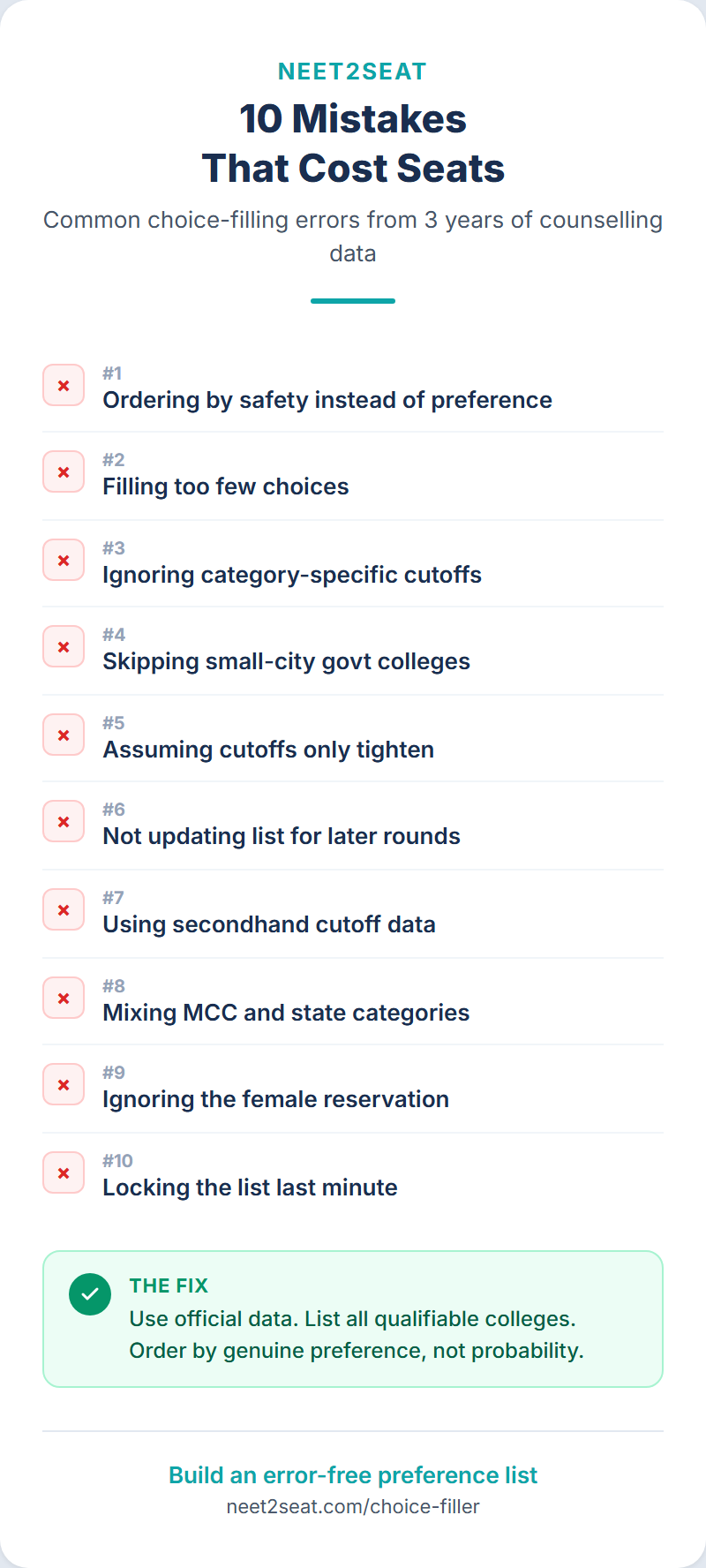
1. Filling fewer than 15 choices
Some candidates list only 5 or 8 colleges, reasoning that they do not want to attend anything below their top picks. This logic backfires. Listing a college does not obligate you to attend it; it only means the algorithm considers it as a fallback if nothing higher on your list is available. If your list runs out before the algorithm finds a match, you receive no allotment in that round.
In Karnataka 2025, the mop-up round filled only 967 seats across all colleges. Candidates who reached Round 3 with no allotment because their short preference lists produced no match in earlier rounds had to pay Rs 1,00,000 (Rs 50,000 for SC/ST) just to remain eligible for mop-up.
List every college you would consider attending, even reluctantly. There is no penalty for listing 30 or 50 colleges. There is a real cost to listing too few.
2. Ordering safe colleges above reach colleges
This is the most consequential ordering mistake. The algorithm processes your list from position 1 downward. If college A is at position 1 and your AIR qualifies, you are allotted college A. The algorithm stops. It never checks position 2, 3, or any college below.
If you put a “safe” college (where your rank comfortably qualifies) at position 1 and a “reach” college (where your rank barely qualifies) at position 5, you get the safe college. The reach college never gets evaluated, even though you would have been allotted there if you had ranked it higher.
The correct order: colleges you most want to attend go first, regardless of how competitive they are. If you do not qualify at position 1, the algorithm moves to position 2 automatically. Listing a competitive college first carries zero risk; the algorithm simply skips it if your rank does not qualify.
The Gale-Shapley algorithm cannot penalize you for listing a competitive college first. If your rank does not qualify, it moves to the next choice. Put your most preferred college at position 1, always.
3. Not registering for both MCC and state counselling
MCC (All India Quota) and state counselling (CET Cell in Maharashtra, KEA in Karnataka) run in parallel. They fill different seat pools using the same NEET rank. Registering for one does not disqualify you from the other.
MCC filled roughly 26,500 seats in 2025: 15% of government college seats nationwide plus all deemed university, central university, AIIMS, and ESIC seats. Your state counselling fills the remaining 85% of government seats plus private college allocations. A candidate who registers for only one track halves their options.
Registration for both tracks is free (MCC) or costs a nominal fee (Karnataka: Rs 2,500 for general category, Rs 500 for SC/ST). The time investment is a few hours. The cost of skipping one track is an entire pool of colleges you could have been allotted to.
4. Being conservative in Round 1
Round 1 exits are cheap or free across all three tracks. In MCC Round 1, you can withdraw without financial penalty beyond the initial security deposit. In Maharashtra, candidates can file a Status Retention declaration to seek an upgrade in Round 2 without losing their Round 1 seat. In Karnataka, Choice 2 (accept and seek upgrade) carries no penalty if you are not upgraded; you keep your Round 1 seat.
Yet candidates often play Round 1 conservatively: listing only “realistic” colleges, skipping reach options, or avoiding unfamiliar cities. The rational approach is the opposite. Round 1 has the widest seat pool and the lowest exit cost. Fill it aggressively with every college you would consider.
In Round 1, include every college you would consider attending. You can decline, seek an upgrade, or adjust your list in Round 2. You cannot recover a seat you missed because you did not list the college.
5. Ignoring government colleges in smaller cities
Candidates from Mumbai, Pune, and Bangalore tend to list only colleges in their home city or other metros. Government colleges in smaller cities get left off their lists entirely.
The fee difference alone makes this worth reconsidering. Government MBBS tuition in Maharashtra is Rs 1,52,100 plus Rs 5,000 development fee per year. Government fees in Karnataka start at Rs 50,000 per year. Private college fees in the same states range from Rs 8 lakh to Rs 25 lakh per year for government-quota seats, and up to Rs 45 lakh for management quota at deemed universities. Over 4.5 years, the total cost difference between a government seat and a private management seat can exceed Rs 1 crore.
A government seat in Miraj, Latur, or Aurangabad follows the same NMC curriculum and awards the same MBBS degree as one in Mumbai. If a government seat in a smaller city is available at your rank and you did not list it, you cannot go back and add it after allotment.
6. Not checking your category across counselling tracks
Your AIQ category (under the central government list) and your state counselling category are independent. A candidate who is OBC-NCL for MCC might be NT-C, VJ, or SEBC in Maharashtra, or Category 2A, 3A, or 3B in Karnataka. These are determined by different lists maintained by different authorities.
Candidates who assume their category is the same across tracks sometimes file preferences for the wrong category, or do not claim a category they are entitled to in one of the tracks.
Maharashtra has categories with no central government equivalent: VJ (Vimukta Jati), NT-B, NT-C, NT-D, and SEBC. If your caste falls under one of these, you have reservation in state counselling that does not exist in MCC. Conversely, if your caste is on the central OBC list but not a state-specific category, your reservation advantage may be stronger in MCC.
Maharashtra recognizes VJ, NT-B, NT-C, NT-D, and SEBC as separate reservation categories with no equivalent in MCC’s central list. A candidate eligible for NT-D reservation in Maharashtra competes as either OBC-NCL or General in MCC, depending on whether their caste appears on the central OBC list.
7. Ignoring how cutoffs change between rounds
Closing ranks in Round 2 are not the same as Round 1. After Round 1, some candidates freeze their seats and exit. Others seek upgrades. New seats open as candidates vacate positions. The pool of available seats changes entirely.
In Karnataka 2025, Round 2 filled 9,957 seats compared to Round 1’s 8,320 because exits and additional seats expanded the pool. At mid-tier colleges, Round 2 closing ranks can differ from Round 1 by 20% to 40%. Using your Round 1 preference list unchanged for Round 2 means you are making decisions based on outdated data.
Check closing ranks from the previous round before building your next preference list. If Round 1 closed at rank 15,000 for a college and your AIR is 16,500, that college is a reach in Round 1. But if historical data shows Round 2 closing ranks at the same college averaged 18,000 over the past three years, it becomes a realistic target. You can check this in the cutoff analyzer, which shows closing ranks for every round and year.
8. Not locking preferences before the deadline
Both MCC and state counselling portals have a hard deadline for locking your preference list. If you edit your list but do not click the final “Lock” button before the deadline, your changes may not be saved. In some portals, an unlocked preference list is treated as “no preference submitted,” which means no allotment for that round.
KEA’s Karnataka counselling has a separate verification step: candidates receive a secret key during document verification, and this key is required to activate the counselling account and submit preferences. Losing or forgetting this key before the deadline means you cannot participate.
Lock your preference list well before the official deadline. Portal traffic spikes in the final hours, and server slowdowns have caused candidates to miss deadlines in previous cycles.
9. Ignoring fee differences when ordering preferences
Two colleges may look similar in cutoff rank but differ in annual fees by Rs 10 to 20 lakh. If you place a management-quota private college above a government college in your preference list, and your AIR qualifies at both, you get the private college. The total cost difference over 4.5 years can be enormous.
In Karnataka 2025, government college fees averaged around Rs 1,07,000 per year. Private government-quota seats averaged Rs 14,17,000. Management quota seats averaged Rs 35,88,000. A candidate who listed a private management seat at position 3 and a government seat at position 8 would pay roughly Rs 1.5 crore more over the full course if their rank qualified at both.
This does not mean you should always prefer the cheaper college. If you genuinely want a specific private college for its location or clinical training, list it higher. But make that decision consciously, knowing the financial difference. Do not place an expensive college higher by accident or because a coaching centre’s sample list put it there.
10. Copying someone else’s preference list
Preference lists circulate among coaching centres, WhatsApp groups, and family networks. Candidates copy “recommended” lists from peers, seniors, or online forums. This fails for three reasons.
First, the correct ordering depends on your AIR and category. A list designed for AIR 5,000 SC is wrong for AIR 12,000 OPEN. The set of colleges where you qualify is different; the risk profile is different.
Second, shared lists tend to overweight metro colleges and ignore smaller-city government colleges. A generic list from a Mumbai coaching centre will not include Gulbarga Institute of Medical Sciences or Hassan Institute of Medical Sciences, both of which might be realistic targets at your rank with fees far lower than any private college in Bangalore.
Third, if many candidates copy the same list, they all compete for the same seats in the same order. This artificially inflates cutoffs at the listed colleges and leaves unlisted colleges with vacant seats that any of those candidates could have secured.
Build your preference list from your own AIR, category, and fee budget. The neet2seat choice filler generates a personalized list based on your specific rank and classifies each college as Safe, Target, or Reach using three years of historical data.
FAQ
How do I do NEET choice filling?
After registering on your counselling portal (mcc.nic.in for MCC, mahacet.org for Maharashtra, cetonline.karnataka.gov.in for Karnataka), log in during the preference-filling window and rank colleges in your order of preference. The algorithm processes all candidates by AIR, allotting each person to their highest-ranked college where a seat is available. Lock your list before the deadline.
What is choice filling and locking in NEET?
Choice filling is the process of ordering colleges in your preference list. Locking is the final confirmation step that submits your list to the algorithm. You can edit your preference list any number of times during the window, but only the locked version is processed for allotment. An unlocked list may not be considered.
How many choices should I fill in NEET counselling?
As many as possible. There is no penalty for listing colleges you are unlikely to be allotted to. If you list 40 colleges and qualify at only 3, you get allotted to the one highest on your list among those 3. If you had listed only your top 10 and none of those 3 were in it, you get no allotment. The only cost of a long list is the time spent ordering it.
Does the order of my NEET choice filling list matter?
Yes. It is the single most consequential variable you control after your NEET score. The algorithm checks your list from position 1 downward and stops at the first college where your rank qualifies and a seat is available. Two candidates with identical AIR and category can get different allotments entirely because of how they ordered their lists.