Maharashtra medical college fees range from Rs 1.62 lakh to Rs 25 lakh per year, depending on three variables
The cost of an MBBS degree in Maharashtra depends on three factors: whether the college is government, private, or deemed; which seat type you hold (state quota, institutional quota, or management quota); and whether your category qualifies for fee concessions. Over a five-year MBBS programme, these variables create a total cost range from under Rs 10 lakh to over Rs 1.25 crore.
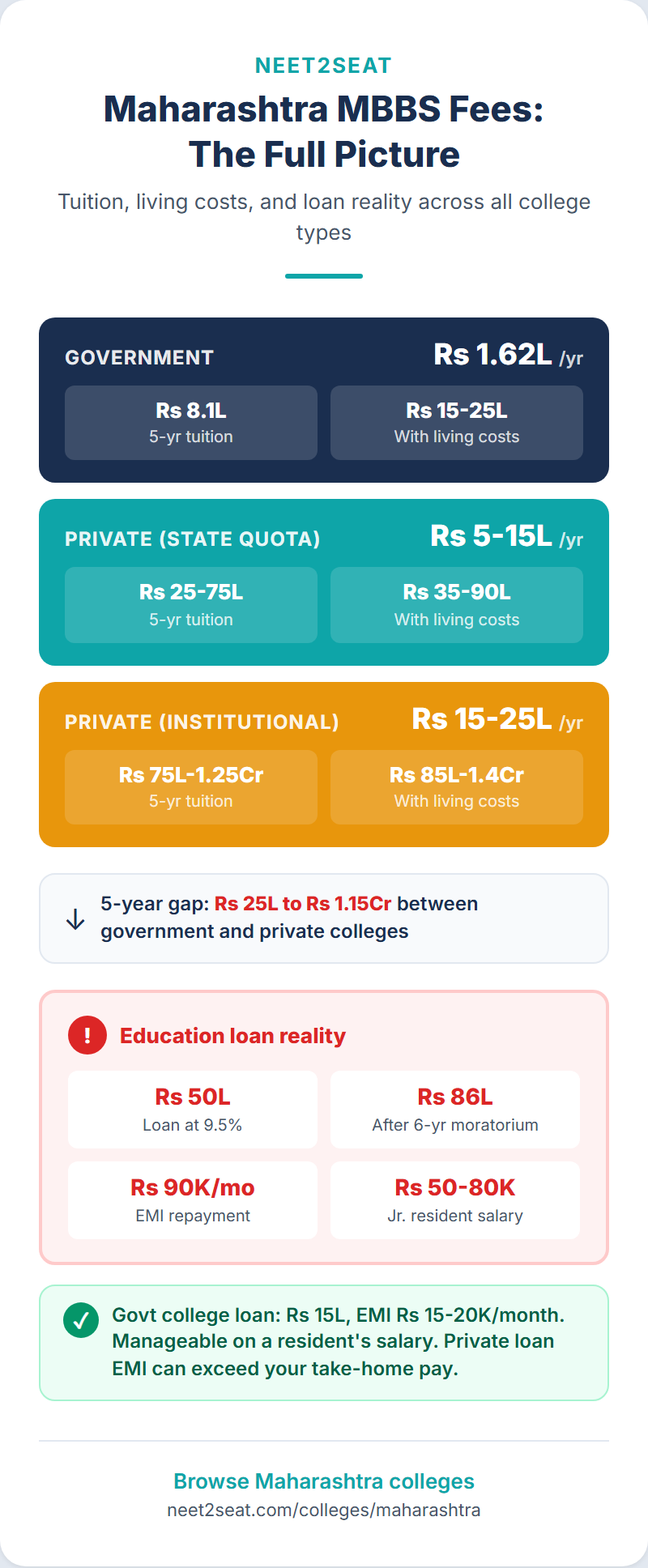
This guide breaks down the fee structures across all three college types in Maharashtra, using current fee data. For college-specific cutoff data, see the Maharashtra cutoff analyzer. For a full list of colleges, see our Maharashtra college directory.
- Government: Rs 1.62L/yr (total Rs 15-25L over 5 years including living expenses)
- Private state quota: Rs 5-15L/yr; institutional quota: 2-3x state quota; management quota: Rs 20-25L+/yr
- The 5-year total cost gap spans Rs 10L (government) to Rs 1.25 crore (private management quota) — an 8x spread
- A Rs 50L education loan at 9.5% with moratorium accumulates Rs 36L in interest before the first EMI
Government medical colleges: Rs 1.62 lakh per year
Maharashtra has 44 government medical colleges with a combined intake of 6,175 MBBS seats. Government college fees are set by the state government and are uniform across all 44 institutions. Whether you attend Seth GS Medical College in Mumbai or the government medical college in Nandurbar, the tuition fees are the same.
The current annual fee at Maharashtra government medical colleges is approximately Rs 1.52 lakh for tuition, plus a development fee of approximately Rs 10,000, bringing the total to roughly Rs 1.62 lakh per year. Over five years, total tuition costs come to approximately Rs 8.1 lakh.
Additional costs beyond tuition include hostel fees (Rs 10,000 to Rs 30,000 per year depending on the institution), mess charges (Rs 30,000 to Rs 60,000 per year), and examination fees. Total out-of-pocket cost for five years at a Maharashtra government college, including living expenses in a mid-range city, typically falls between Rs 15 lakh and Rs 25 lakh.
Fee concessions for reserved categories
SC, ST, VJ/NT, and OBC candidates in Maharashtra may be eligible for government fee reimbursement schemes. Several state scholarship programmes cover tuition fees partially or fully for economically weaker reserved category students. The exact reimbursement depends on family income thresholds set by the Social Justice Department or Tribal Development Department. Check the current year’s eligibility criteria; the schemes are revised periodically.
If you belong to SC, ST, VJ/NT, or OBC categories, check your eligibility for state fee reimbursement schemes before assuming you need to pay full tuition. At Rs 1.62L/yr, government college fees are often covered entirely by state scholarships for eligible candidates.
The hidden cost advantage of government colleges
Government college fees are indexed to government pay commissions and rarely increase by more than 5% to 10% per year. Private college fees, by contrast, are subject to fee regulatory committee approvals and can increase by 10% to 15% annually. A government college seat that costs Rs 1.62 lakh per year in Year 1 might cost Rs 1.80 lakh by Year 5. A private college seat at Rs 15 lakh in Year 1 could be Rs 20 lakh by Year 5, depending on the approved escalation clause.
Fee escalation compounds the gap over five years. Government fees increase 0-5% annually; private fees increase 10-15%. A private college starting at Rs 15L/yr can reach Rs 20L/yr by Year 5, while a government college stays near Rs 1.62L/yr. The cumulative difference exceeds the Year 1 gap by 20-30%.
Private medical colleges: Rs 5 lakh to Rs 25 lakh per year
Maharashtra has 26 private medical colleges with 3,699 MBBS seats. Private college fees are set by the state Fee Regulatory Authority (FRA), which approves fee structures based on the college’s infrastructure, faculty, and operational costs.
State quota seats
85% of private college seats fall under state quota, filled through CET Cell counselling. State quota fees at private colleges range from approximately Rs 5 lakh to Rs 15 lakh per year. The exact amount varies by institution. Well-established private colleges with good infrastructure and hospital facilities tend to be at the higher end; newer or less established institutions charge less.
Over five years, state quota fees at private colleges total Rs 25 lakh to Rs 75 lakh, excluding living expenses. Adding hostel, mess, and other charges, the total cost ranges from Rs 35 lakh to Rs 90 lakh.
Institutional quota seats
15% of private college seats are institutional quota, also filled through CET Cell but with different fee structures. Institutional quota fees are typically 2x to 3x the state quota fees at the same college. A college charging Rs 10 lakh per year for state quota might charge Rs 20 lakh to Rs 25 lakh per year for institutional quota.
Institutional quota seats are open to NRI, OCI, and out-of-state candidates in addition to Maharashtra domicile candidates. The higher fees reflect the broader eligibility pool and the college’s discretion in setting institutional quota pricing (within FRA limits).
Management quota
Private colleges also have management quota seats, which are filled through a separate process (not through CET Cell counselling). Management quota fees are the highest, often Rs 20 lakh to Rs 25 lakh per year or more. These seats are typically filled last and may be available to candidates who did not secure seats through regular counselling.
Deemed universities: Rs 10 lakh to Rs 25 lakh per year
Maharashtra has 16 deemed universities with 3,050 MBBS seats. Deemed university fee structures are more complex because they have multiple seat types with different fee levels.
Government quota seats (through state counselling)
Approximately 25% of deemed university seats are government quota, filled through CET Cell counselling in Maharashtra. Government quota fees at deemed universities are typically lower than the institution’s private fees but higher than state government college fees. Expect Rs 10 lakh to Rs 18 lakh per year for government quota at most deemed universities.
Private/management quota seats (through university or MCC)
The remaining seats are filled through MCC counselling or the university’s own admission process. Fees for these seats range from Rs 15 lakh to Rs 25 lakh per year, depending on the institution’s reputation and location.
Five deemed universities are concentrated in Navi Mumbai. Others are located across Pune, Wardha, and other cities. The geographic concentration in the Mumbai-Pune corridor means these colleges cater to urban candidates willing to pay premium fees for metro-area clinical exposure.
The five-year cost comparison
| College type | Seat type | Annual fees (approx.) | 5-year tuition | 5-year total (with living) |
|---|---|---|---|---|
| Government | State quota | Rs 1.62 lakh | Rs 8.1 lakh | Rs 15-25 lakh |
| Private | State quota | Rs 5-15 lakh | Rs 25-75 lakh | Rs 35-90 lakh |
| Private | Institutional quota | Rs 15-25 lakh | Rs 75 lakh-1.25 cr | Rs 85 lakh-1.4 cr |
| Deemed | Government quota | Rs 10-18 lakh | Rs 50-90 lakh | Rs 60 lakh-1.05 cr |
| Deemed | Private quota | Rs 15-25 lakh | Rs 75 lakh-1.25 cr | Rs 85 lakh-1.4 cr |
The gap between government (Rs 15-25L total) and private management quota (Rs 1.25 crore+ total) is 5x to 8x. This difference affects student loan burdens, early-career financial flexibility, and even specialisation choices. Factor the full five-year cost, not just annual tuition, into your preference ordering.
The gap between the cheapest option (government state quota at Rs 15-25 lakh total) and the most expensive (deemed/private management quota at Rs 1.25 crore+ total) is roughly 5x to 8x. Over a doctor’s career, this fee difference affects student loan burdens, early-career financial flexibility, and specialization choices (candidates with large education debts may prioritize high-paying specializations over research or public health).
How fees affect preference ordering
For most candidates, the fee structure should be a primary factor in preference list ordering. A government medical college in Latur at Rs 1.62 lakh per year provides the same MBBS degree as a private college in Mumbai at Rs 15 lakh per year. The five-year savings of Rs 65 lakh or more can fund an entire postgraduate education, clear a family’s other financial obligations, or provide a financial cushion during residency.
When building your preference list on the choice filling optimizer, order all government colleges (even in less preferred cities) above private colleges, unless your family can comfortably absorb the fee difference. The optimizer shows fee tiers alongside cutoff data to help you make this trade-off explicitly rather than by default.
For a detailed framework on preference ordering, see our choice filling strategy guide.
Open the choice filling optimizer and sort your preference list with all government colleges (positions 1-44) above all private colleges. The optimizer shows fee tiers alongside cutoff data so you can see the cost impact of each ordering decision. Adjust only if your family can comfortably absorb the fee difference.
Education loans and financial planning
Most nationalised banks offer education loans for MBBS at recognised institutions. What to know:
- Collateral: Loans above Rs 7.5 lakh typically require collateral (property, fixed deposits). Government college costs often fall below this threshold; private college costs almost always exceed it.
- Interest rates: Education loan interest rates from public sector banks range from 8% to 10.5% per annum. The interest compounds during the moratorium period (study years + 1 year post-graduation). A Rs 50 lakh loan at 9.5% interest with a 6-year moratorium accumulates approximately Rs 36 lakh in compound interest before the first EMI payment, bringing the outstanding balance to roughly Rs 86 lakh.
- Repayment burden: A doctor’s starting salary as a junior resident is Rs 50,000 to Rs 80,000 per month in most states. Monthly EMI on the capitalized Rs 86 lakh balance (15-year tenure at 9.5%) is approximately Rs 90,000. Even calculated on the original Rs 50 lakh principal alone, the EMI would be Rs 52,000. Either way, repayment consumes most or all of a junior doctor’s income for years.
Run the loan math before committing to a private college. Rs 50L at 9.5% with a 6-year moratorium becomes Rs 86L by repayment start. The monthly EMI (Rs 90,000) exceeds most junior residents’ salaries. A government college loan of Rs 10-15L produces EMIs of Rs 15-20K/month — a manageable burden.
These numbers reinforce the financial case for prioritising government college seats. The total loan required for a government MBBS (if any) is under Rs 15 lakh, resulting in manageable EMIs of Rs 15,000 to Rs 20,000 per month.
FAQ
Do government college fees increase during the five years?
Government fees may have annual increments, but they are modest (typically 0% to 5%). The fee structure is set by state government order and revised infrequently. Your Year 1 fee is a reasonable estimate for all five years.
Can I negotiate private college fees?
No. Private college state quota and institutional quota fees are regulated by the Fee Regulatory Authority. The approved fee is the fee you pay. Management quota fees may have some flexibility in specific cases, but this varies by institution and is not guaranteed.
Are NRI quota fees different?
Yes. NRI quota fees are significantly higher, typically Rs 25 lakh to Rs 40 lakh per year or more, depending on the institution. NRI fees are set by the institution (with regulatory oversight) and are denominated in USD at some deemed universities.
Do I need to pay the full five-year fee upfront?
No. Fees are paid annually (or sometimes semester-wise). At the time of admission, you pay the first year’s tuition, development fees, and any required security deposit. Subsequent years are billed at the start of each academic year.
What happens to my fees if I upgrade through Status Retention?
If you are upgraded from a private college to a government college (or to a cheaper private college), the fee deposit paid at the original college is adjusted or refunded per CET Cell rules. You then pay the new college’s fee structure. Check the information bulletin for exact refund timelines and any processing deductions.
How much fees for MBBS in private college in Maharashtra?
Private medical college MBBS fees in Maharashtra range from approximately Rs 5 lakh to Rs 15 lakh per year for state quota seats (85% of intake), Rs 15 lakh to Rs 25 lakh per year for institutional quota seats (15% of intake), and Rs 20 lakh to Rs 25 lakh per year for management quota seats. Over five years, the total tuition at a private college ranges from Rs 25 lakh (state quota, lower-end) to Rs 1.25 crore (management quota, higher-end). Fees are set by the Fee Regulatory Authority and vary by institution.