86 medical colleges fill 12,924 MBBS seats through Maharashtra state-quota counselling (excludes AIQ government and deemed seats), with a fee range from Rs 1.62 lakh to Rs 25 lakh per year
Maharashtra has the second-largest medical education system in India. The 86 medical colleges in Maharashtra span 44 government colleges, 26 private colleges, and 16 deemed universities, with 12,924 MBBS seats filled through Maharashtra state-quota counselling (excludes AIQ and deemed seats). Understanding the full picture for NEET 2026 (who these colleges are, where they are, what they cost, and how competitive they are) is the first step toward building an informed preference list.
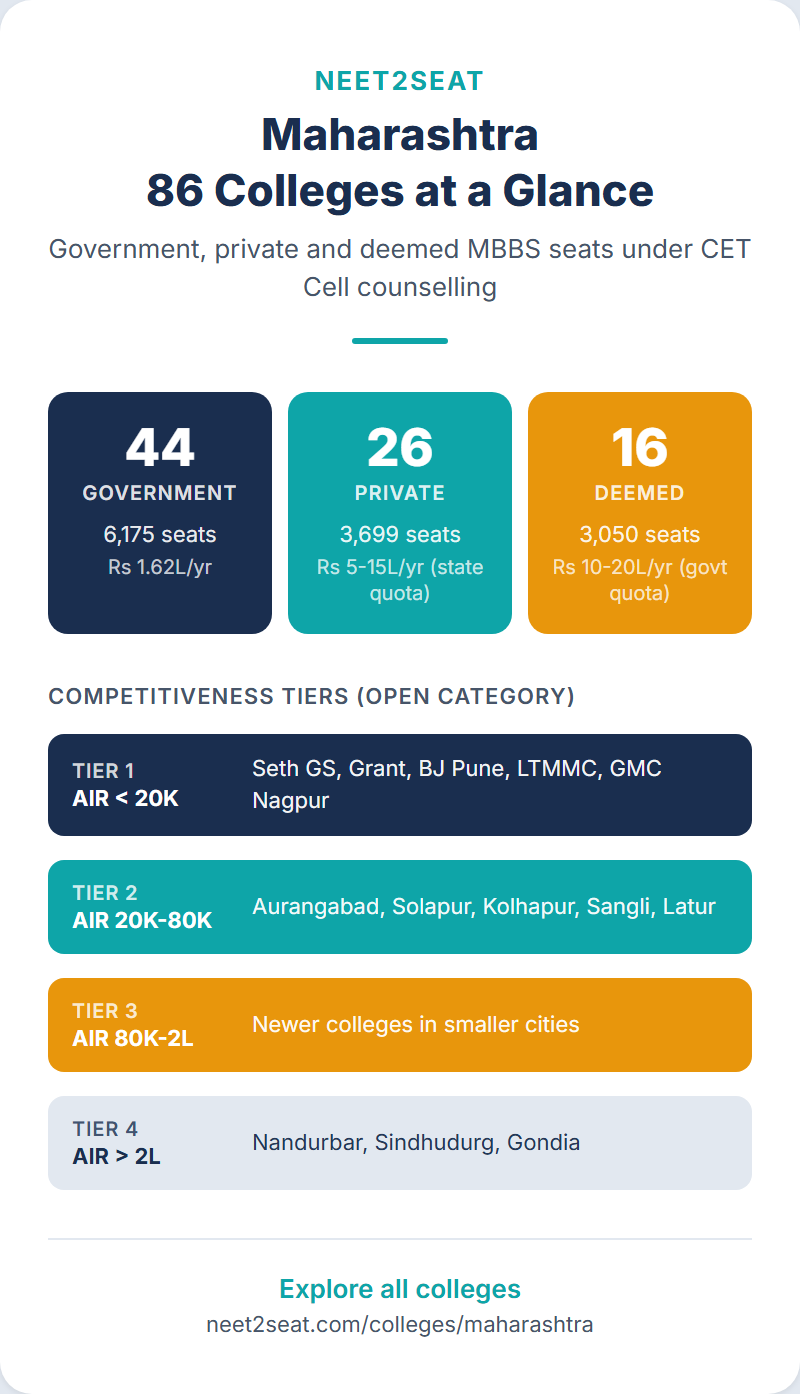
This guide maps all 86 colleges across the three categories. For individual college cutoffs, use the Maharashtra cutoff analyzer. For the complete college list with details, see the Maharashtra college directory.
- 86 colleges: 44 government (Rs 1.62L/yr), 26 private (Rs 5-15L/yr), 16 deemed (Rs 10-25L/yr), totalling 12,924 MBBS seats
- Government college closing AIRs range from 12,566 to above 9,71,403 — every AIR level has a government option
- Mumbai + Navi Mumbai cluster has 16 colleges, the densest medical education ecosystem in any Indian metro
- List all government colleges before private ones on your preference list to maximize fee savings
Government medical colleges: 44 colleges, 6,175 seats
Maharashtra’s 44 government medical colleges are spread across 36 cities. Nine are concentrated in Mumbai alone. Pune has 4 (including the Armed Forces Medical College, which has its own admission process). Nagpur has 2. The remaining colleges are distributed across district headquarters and smaller cities.
Annual fees at all government colleges are approximately Rs 1.62 lakh per year. See our Maharashtra fees guide for the complete breakdown.
The competitiveness spectrum
Government colleges in Maharashtra span a wide competitiveness range. From our 2025 data (Round 2, OPEN category):
The most competitive government colleges close at AIRs below 20,000. ESIC Medical College Andheri closed at AIR 12,566 (though ESIC colleges operate under central government and may have distinct dynamics). Grant Medical College (Mumbai), Seth GS Medical College (Mumbai), and BJ Medical College (Pune) are consistently among the most competitive, closing below AIR 15,000 in recent years.
Mid-tier government colleges close between AIR 20,000 and 80,000. This band includes well-established colleges in cities like Aurangabad (Chhatrapati Sambhajinagar), Solapur, Kolhapur, Sangli, and Latur. These colleges offer solid clinical training with lower living costs than Mumbai or Pune.
The least competitive government colleges close at AIRs above 80,000, extending to AIR 9,71,403 at the furthest end. Newer government colleges in Nandurbar, Sindhudurg, Gondia, and similar rural districts fill at higher ranks. Despite their lower competitiveness, they offer the same Rs 1.62 lakh/year fee structure and an equivalent MBBS degree.
The 30x fee gap between government (Rs 1.62L/yr) and private (Rs 5-15L/yr) colleges makes every government seat worth listing, regardless of location. Even a Tier 4 government college saves Rs 20-65 lakh over five years compared to a private alternative.
Mumbai’s government college cluster
Mumbai has 9 government medical colleges, making it the single largest cluster in any Indian city. These include Seth GS Medical College (KEM Hospital), Grant Medical College (JJ Hospital), LTMMC (Sion Hospital), Topiwala National Medical College (Nair Hospital), ESIC Andheri, Gokuldas Tejpal, and others. With approximately 1,400 combined seats, Mumbai’s government cluster absorbs a significant portion of Maharashtra’s top-ranked candidates.
For a detailed breakdown of Mumbai colleges, see our Mumbai medical colleges guide.
The new-college expansion
Maharashtra has been adding new government medical colleges in underserved districts. Colleges in Nandurbar, Alibaug (Raigad), Parbhani, Usmanabad, and similar locations were established in recent years. These newer colleges typically have smaller intakes (50 to 100 seats), less established infrastructure, and higher closing AIRs For candidates in the AIR 50,000 to 2,00,000 range, these colleges represent accessible government seats that many candidates overlook in favour of private colleges in larger cities.
Newer government colleges in districts like Nandurbar and Sindhudurg are often overlooked. If your AIR is between 50,000 and 2,00,000, these colleges give you government fees and an identical MBBS degree. List them as safety options below your preferred choices.
Private medical colleges: 26 colleges, 3,699 seats
Maharashtra’s 26 private medical colleges are concentrated in a few urban corridors. Pune has 3, Nagpur has the NKP Salve Institute (250 seats), and Ahmednagar, Kolhapur, Nashik, Sangli, and other cities each have one or two.
State quota fees range from Rs 5 lakh to Rs 15 lakh per year. Institutional quota (15% of seats) charges 2x to 3x the state quota fee. See the fees guide for details.
The private college competitive range
Private colleges in Maharashtra close at AIRs ranging from approximately 38,000 (top private colleges like KJ Somaiya in Mumbai) to above 5,00,000 (less established or newer institutions). The wide range means that candidates across a broad AIR spectrum (30,000 to 5,00,000+) will find private college options available to them.
For candidates who exhaust their government college options on the preference list, private colleges provide essential backup. Even if the fee is Rs 10 lakh to Rs 15 lakh per year, having a private seat is better than no seat at all in Round 1 (where exit is free).
Private college fees are 3x to 10x higher than government fees. Always exhaust your government college options on the preference list before adding private colleges. In Round 1, where exit is free, listing a private college as a backup costs nothing.
Deemed universities: 16 colleges, 3,050 seats
Maharashtra’s 16 deemed universities account for 3,050 MBBS seats. Five are concentrated in Navi Mumbai: DY Patil Medical College (3 separate campuses), MGM Medical College, and Terna Medical College. Others are in Pune (3), Wardha (2), and scattered across other cities.
Deemed university government quota seats (approximately 25%) are filled through CET Cell counselling. The remaining seats go through MCC or the university’s own admission process. Fees range from Rs 10 lakh to Rs 25 lakh per year depending on seat type and institution.
One detail worth watching: deemed universities in Maharashtra do not participate in state counselling for all their seats. The government quota portion (filled through CET Cell) has different cutoffs from the MCC portion. Check both tracks if you are considering a deemed university.
Deemed university seats are split across CET Cell and MCC counselling. If targeting a deemed university, register for both counselling processes and compare government quota fees across the two tracks.
Geographic distribution
Maharashtra’s medical colleges span 45 cities. The concentration:
- Mumbai + Navi Mumbai: 16 colleges (9 government, 2 private, 5 deemed). The largest cluster in any Indian metropolitan area for medical education.
- Pune: 8 colleges (2 government including AFMC, 3 private, 3 deemed).
- Nagpur: 3 colleges (2 government, 1 private).
- Remaining cities: 1 to 2 colleges each, mostly government.
For most candidates, the geographic decision is between pursuing a college in the Mumbai-Pune corridor (higher living costs, more clinical exposure, larger peer network) versus a college in a smaller city (lower costs, less competitive cutoffs, potentially more hands-on clinical rotations due to smaller batch sizes).
See Mumbai colleges and Pune colleges for city-specific guides.
How to use this information for preference ordering
The 86 colleges fall into natural tiers for preference list construction:
- Top government colleges in metro areas (Seth GS, Grant, BJ Pune, LTMMC): positions 1 through 5 on most candidates’ lists.
- Remaining Mumbai and Pune government colleges: positions 6 through 15.
- Government colleges in mid-size cities (Nagpur, Aurangabad, Kolhapur, Solapur): positions 15 through 30.
- Government colleges in smaller cities and newer institutions: positions 30 through 44.
- Top private colleges (KJ Somaiya, DY Patil, etc.): positions 44 through 55.
- Remaining private and deemed university government quota: positions 55 through 86.
This ordering puts all government colleges above all private colleges, reflecting the fee advantage. Adjust based on your specific location preferences and financial situation. Use the college predictor to classify each college as Safe, Target, or Reach for your AIR.
Open the college predictor, enter your expected AIR and category, and classify each of Maharashtra’s 86 colleges as Safe, Target, or Reach. Then build your preference list following the tier order above, with all Safe and Target government colleges first.
FAQ
How many government colleges are in Maharashtra?
44 government medical colleges with a combined intake of 6,175 MBBS seats, spread across 36 cities.
Which Maharashtra medical college is the most competitive?
Based on 2025 data, ESIC Medical College Andheri had the lowest OPEN closing AIR among government colleges. Among traditional government colleges, Grant Medical College and Seth GS Medical College in Mumbai are consistently the most competitive. Among private colleges, KJ Somaiya Medical College in Mumbai has the lowest closing AIR.
Are deemed university seats worth considering?
Yes, if you can afford the fees. Government quota seats at deemed universities (filled through CET Cell) have moderate fees and can be less competitive than equivalent-quality private colleges. Deemed universities often have well-equipped hospitals and research facilities. List them in the private/deemed tier of your preference list.
Do all 86 colleges participate in CET Cell counselling?
Most do, but AFMC Pune has its own admission process, and some deemed universities fill only a portion of their seats through CET Cell (the rest go through MCC or university-level admissions). Check the current year’s CET Cell seat matrix for the exact list of participating colleges and available seats.
Can I get MBBS with 400 marks in NEET in Maharashtra?
400 marks in NEET typically translates to an AIR in the range of 1,00,000 to 1,50,000 (the exact rank depends on the year’s difficulty and number of candidates). At this range in Maharashtra, government colleges in smaller cities (Tier 3 and Tier 4 in our ranking) and several private colleges are within reach for the OPEN category. Reserved category candidates at this mark range have access to a wider set of government colleges. Use the college predictor with your exact AIR to see your Safe, Target, and Reach options.