Answers to the 25 questions candidates ask most about NEET counselling
This NEET counselling FAQ collects the 25 most frequently asked questions about NEET-UG medical college counselling in Maharashtra and Karnataka. Each answer is sourced from official counselling processes and our analysis of 407,000+ allotment records across 2023-2025. For detailed coverage of any topic, follow the linked guides.
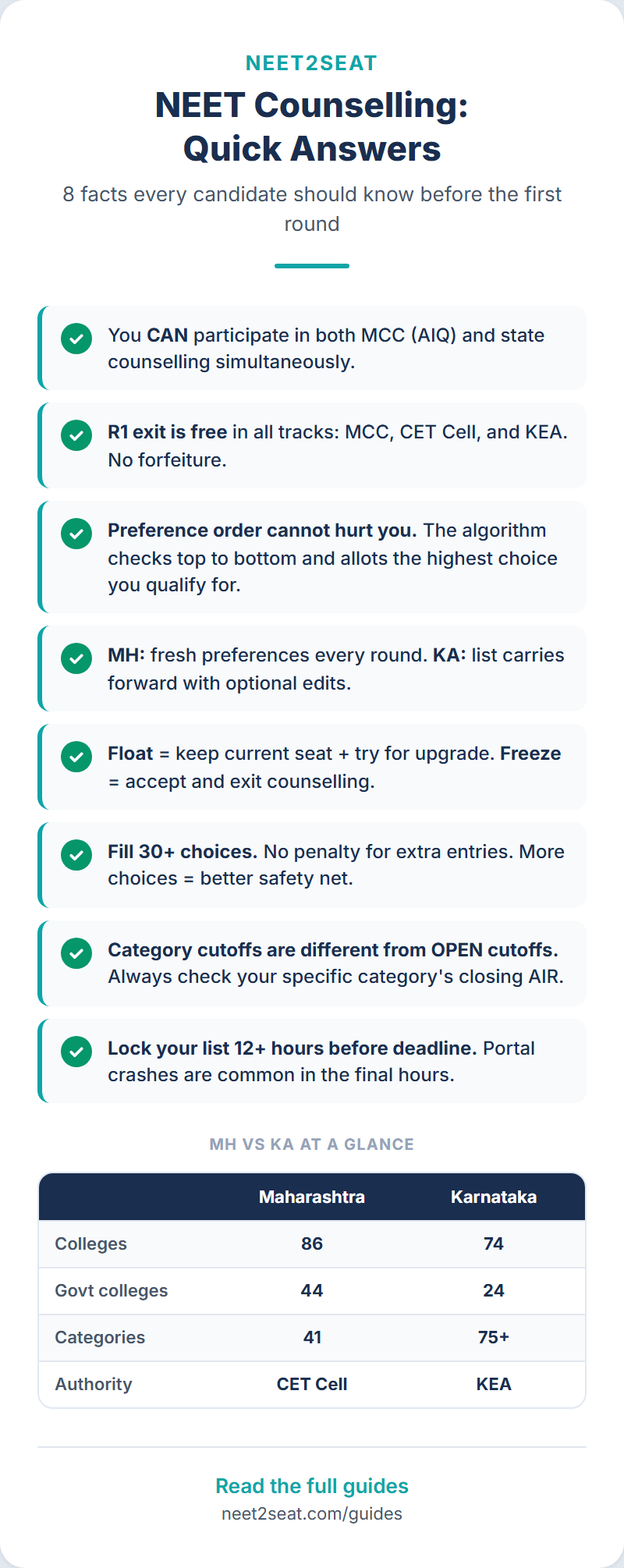
- Participate in both MCC and state counselling simultaneously; choose one seat at the deadline
- List as many preferences as possible — there is no penalty, and extras are invisible safety nets
- Round 1 exit is free in both states; only list colleges you would attend in later binding rounds
- Government colleges (any city) should rank above private colleges unless fees are financially immaterial
General counselling questions
What is the difference between AIQ (All India Quota) and state quota?
15% of government medical college MBBS seats across India are pooled into the All India Quota, managed by MCC (Medical Counselling Committee). The remaining 85% are filled through state counselling authorities. In Maharashtra, CET Cell manages state quota. In Karnataka, KEA manages state quota. You can participate in both AIQ and state counselling simultaneously, but you must eventually hold only one seat. See our AIQ vs state quota guide for the full comparison.
Can I participate in both MCC and state counselling?
Yes. Registration and choice filling for MCC and state counselling are separate processes. You can fill preferences in both tracks. If allotted in both, you must choose one and surrender the other before the specified deadline. Holding two seats simultaneously beyond the deadline is not permitted and can result in cancellation of both seats.
What documents do I need for counselling?
The standard set includes: NEET-UG admit card and scorecard, Class 10 and 12 mark sheets and certificates, domicile certificate (for state quota eligibility), category/caste certificate (if applicable), income certificate (for fee concessions), transfer certificate, passport-size photographs, Aadhaar card, and medical fitness certificate. Maharashtra and Karnataka each have specific additional requirements. See our documents guide for the complete list by state.
What happens if I miss the choice-filling deadline?
If you do not submit and lock your preference list before the deadline, the system may auto-lock the last saved version (in some counselling tracks) or you may be treated as having not participated in that round. Neither outcome is desirable. Always lock your preferences manually well before the deadline. Do not rely on auto-lock.
Never rely on auto-lock. Lock your preference list manually at least 2-3 hours before the deadline. State counselling portals experience heavy traffic in the final hours, and a technical issue during auto-lock could leave your list in an unintended state.
Is the counselling portal available 24/7 during the choice-filling window?
Technically yes, but state counselling portals (both CET Cell and KEA) have experienced performance issues during peak hours, especially in the final 24 hours before deadlines. Access the portal during off-peak hours (early morning or late night) for a smoother experience. Prepare your preference list offline first, then enter it on the portal.
Preference filling questions
Does listing a less competitive college first reduce my chances at a better college?
No. The allotment algorithm processes your list from top to bottom and assigns you the highest-ranked choice where your AIR qualifies. If you list College A (less competitive) at position 1 and College B (more competitive) at position 2, the algorithm checks College A first. If your AIR qualifies for College A and a seat is available, you get it. But if College B had a vacancy and your AIR also qualified, you would have gotten College B if you had ranked it higher. The algorithm never penalises you for what is listed below your allotment. See our choice filling strategy guide.
The algorithm processes your list top to bottom and stops at the first match. It never penalises you for what is listed below your allotment. This means listing extra colleges at the bottom can only help (as safety nets), never hurt. The only ordering that matters is: put more-preferred colleges higher.
How many preferences should I fill?
As many as possible. There is no penalty for filling additional choices. If you qualify for 40 colleges, list all 40. The downside risk of too few choices (no allotment in a round) far outweighs the time cost of filling more choices (approximately 20 extra minutes for 40 additional entries). See our guide on how many choices to fill.
Spend the extra 20 minutes to list every college where your AIR qualifies. The worst outcome of listing too many is nothing (the extras are never reached). The worst outcome of listing too few is no allotment at all. The asymmetry makes maximal listing a clear win.
Should I list colleges I do not want to attend?
In Round 1, where exit is free, yes. Listing a college does not commit you to attending it. If allotted a college you do not want in Round 1, simply do not report, and your deposit is refunded. In later rounds where allotments may be binding, only list colleges you would genuinely attend.
Can I change my preference list after locking it?
No. Once locked, the list is final for that round. In Maharashtra, you get a fresh preference-filling window in each round, so Round 2 preferences are independent of Round 1. In Karnataka, the list carries forward (with limited modification in some years). Always review your list carefully before locking.
Should I list government colleges in small cities above private colleges in Mumbai or Bengaluru?
For most candidates, yes. Government college fees (Rs 50,000/year in Karnataka; Rs 1.62 lakh/year in Maharashtra) are a fraction of private college fees (Rs 8 lakh to Rs 25 lakh/year). Over five years, the savings can exceed Rs 50 lakh. The MBBS degree is equivalent regardless of college location. Unless private college fees are financially immaterial to your family, government colleges should come first on your list. See Maharashtra fees and Karnataka fees guides.
Order your preference list with all government colleges (any city) above all private colleges. The fee savings over five years can exceed Rs 50 lakh, and the MBBS degree is equivalent for PG entrance eligibility regardless of college location or tier.
Round and allotment questions
What is “free exit” and when is it available?
Free exit means you can decline a Round 1 allotment without financial penalty. Your counselling deposit is refunded, and you re-enter Round 2 as a fresh candidate. Free exit is available in Round 1 of both MCC and state counselling. Later rounds may have financial penalties for non-reporting or cancellation.
What is the difference between float and freeze?
Float (MCC terminology) means you keep your current seat while seeking an upgrade in the next round. Freeze means you accept the seat and exit counselling. Maharashtra calls floating “Status Retention.” Karnataka calls it “Choice 2.” The mechanics differ slightly by state, but the core concept is the same: float to try for better, freeze to accept what you have. See our float vs freeze guide.
Do Round 2 cutoffs always ease compared to Round 1?
In most cases, yes. Round 2 closing AIRs are typically 15% to 25% higher (less competitive) than Round 1 at mid-tier government colleges, due to the candidate pool shrinking and seats being freed up. However, 5% to 10% of colleges may see tighter Round 2 cutoffs due to seat additions, cross-counselling timing, or other structural factors. See our Round 2 cutoff changes guide.
What happens if I am not allotted in any round?
If regular rounds (1, 2, 3) do not produce an allotment, you can participate in the mop-up/stray vacancy round. If the mop-up round also does not yield a seat, your remaining options are management quota at private colleges (expensive), NRI quota (if eligible), or preparing for the next year’s NEET. See our mop-up round guide.
Maharashtra-specific questions
What is Status Retention in Maharashtra?
Status Retention is Maharashtra’s mechanism for keeping your Round 1 seat while seeking a Round 2 upgrade. It is irrevocable: once declared, you cannot withdraw from the retained seat. If upgraded in Round 2, you move to the new college. If not upgraded, you must report to the original college. See our Status Retention guide.
How many categories does Maharashtra have?
Maharashtra uses 41 distinct category codes in its counselling process. These are compound categories combining constitutional reservations (OPEN, OBC, SC, ST, VJ, NTB, NTC, NTD, SEBC, EWS) with horizontal reservations (Female W, Defence DEF, PWD PH, Minority MN, Orphan ORP). For example, OPENW is Open + Female; SCDEF is SC + Defence. See our Maharashtra categories guide.
Can I fill a completely new preference list in Round 2?
Yes. Maharashtra allows fresh preference filling in every round. Your Round 2 list is completely independent of Round 1. You can add new colleges, remove old ones, and reorder everything based on Round 1 closing AIR data. See our Maharashtra choice filling guide.
Karnataka-specific questions
What are Choice 1, Choice 2, and Choice 3 in Karnataka?
After each round’s allotment, Karnataka candidates choose: Choice 1 (accept seat, exit counselling), Choice 2 (accept seat, seek upgrade in next round), or Choice 3 (reject seat, re-enter pool with no guarantee). Choice 2 is the safe upgrade path. Choice 3 risks ending up with no seat. See our Choice 1 vs Choice 2 guide.
Does my preference list carry forward in Karnataka?
Yes. Unlike Maharashtra (where you fill fresh preferences each round), Karnataka’s KEA carries your initial preference list forward across rounds. If you choose Choice 2, the algorithm checks colleges ranked above your current allotment on that original list. This makes getting the initial order right more critical in Karnataka. See our Karnataka choice filling guide.
What is the suffix system in Karnataka categories?
Karnataka adds suffixes to base categories: G (general merit), K (Kannada medium schooling), R (Rural), H (Hyderabad-Karnataka region). Combinations include KH and RH. A candidate might qualify for 2AG, 2AK, 2AR, and 2AH depending on their schooling, location, and region. Each suffix has separate cutoffs at each college. See our Karnataka categories guide.
What is the mock allotment in Karnataka?
KEA publishes a mock allotment before the final Round 1 allotment. This preview shows where you would be allotted based on current preferences and the seat matrix. After seeing the mock results, you can modify your preference list before the final lock. This is a significant advantage: it lets you test your preferences against real data before the results are binding. See our KEA counselling guide.
Using neet2seat questions
What data does neet2seat use?
All predictions and cutoff data come from official allotment PDFs published by CET Cell (Maharashtra) and KEA (Karnataka). The database contains 407,658 records across 2023, 2024, and 2025 for both states. We do not use self-reported data, surveys, or social media sources. See our methodology guide.
How do I use the cutoff analyzer?
Go to the cutoff analyzer. Select your state, then filter by year, round, category, and optionally by college name. The results show closing AIRs (the last rank allotted) for each college-category combination. You can view results grouped by college to see multi-year trends at a glance. See our cutoff analyzer tutorial.
How does the college predictor classify colleges as Safe, Target, or Reach?
The college predictor compares your AIR against historical closing AIRs at each college for your category. Safe means your AIR has been below (better than) the closing AIR in all recent years. Target means your AIR falls near the historical range (sometimes in, sometimes out). Reach means your AIR has been above (worse than) the closing AIR in all years. See our predictor tutorial.
Can I build my preference list on neet2seat?
Yes. The choice filling optimizer lets you build and order your preference list using drag-and-drop. It shows historical cutoff data alongside each college to help you make informed ordering decisions. You can export the final list and enter it on the official counselling portal.
Is 550 a good score in NEET for OBC?
550 marks in NEET typically corresponds to an AIR in the 30,000 to 60,000 range (depending on the year). For OBC candidates in Maharashtra, this AIR range puts multiple government colleges in the Target zone; in Karnataka, OBC (Category 2A/2B/3A/3B) candidates at this range have even more government options available because reserved category cutoffs are less competitive. Use the college predictor with your exact AIR, state, and category to see your specific Safe, Target, and Reach colleges.
What NEET cutoff is required for OBC category?
The NEET qualifying cutoff (minimum marks to be eligible for counselling) is set by NTA and varies by year; for OBC-NCL candidates, it has historically been around the 40th percentile (approximately 115-120 marks out of 720). But qualifying is not the same as getting a seat. For an actual government college MBBS seat, OBC candidates in Maharashtra typically need AIRs below 2,00,000 (marks above 350-400). In Karnataka, OBC categories like 2A can access government colleges at even higher AIRs Check the cutoff analyzer filtered by your category for specific college-level data.