- Mop-up seats are disproportionately at private colleges and in reserved categories; top government colleges rarely have vacancies.
- Do not extrapolate regular round cutoffs to mop-up; the dynamics are fundamentally different with small, unpredictable seat pools.
- The mop-up round is not the time for selectivity. List every available college in order of preference.
- Reporting deadlines are tight (2-3 days) and allotments are typically binding with no free exit.
The mop-up round is not a second chance. It is a last resort with different rules.
After Rounds 1, 2, and 3 of regular counselling, some medical college seats remain unfilled. The mop-up round (sometimes called the stray vacancy round) exists to fill these leftover seats. Candidates still without an MBBS admission, or those willing to give up an existing seat for a potentially better one, can participate.
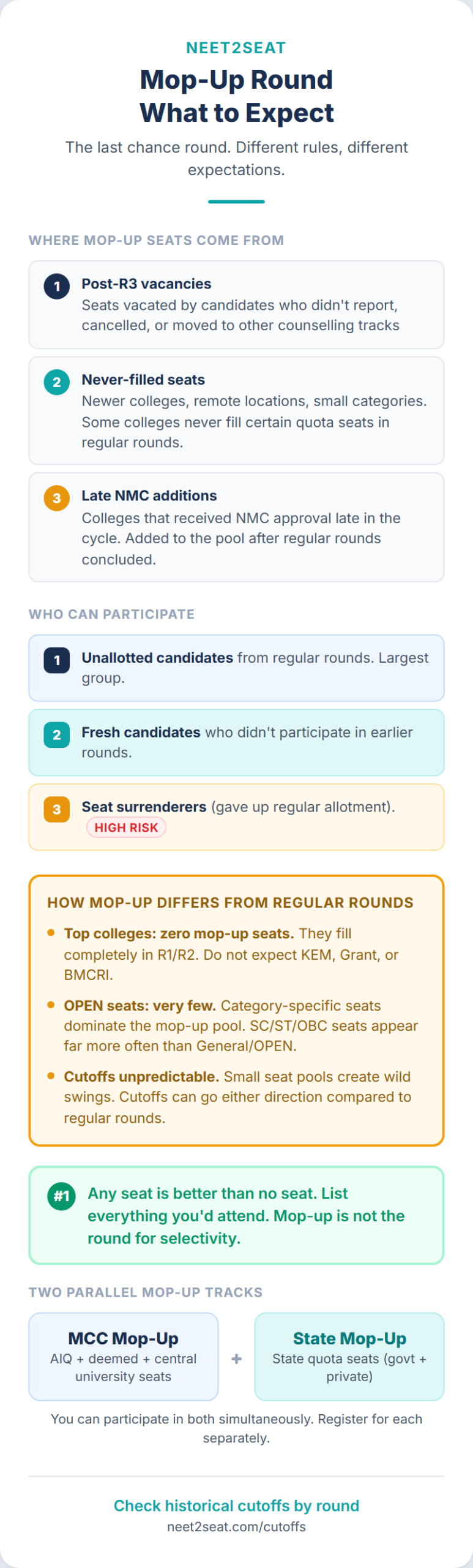
The mop-up round operates under a different set of rules than regular rounds. The seat pool is small and unpredictable. The candidate pool is a mix of newcomers, previous round rejects, and strategic upgraders. Cutoff behaviour deviates from what historical data would suggest for regular rounds. Approach it as a last resort, not a planned strategy.
This guide covers what the mop-up round actually looks like and how to approach it. For the regular round structure, see our counselling process overview. For round-to-round cutoff shifts, see our Round 2 cutoff changes guide.
What seats are available in the mop-up round
Mop-up seats come from three sources:
Seats vacated after Round 3
Candidates who were allotted in Round 2 or 3 but did not report, or who cancelled their admission before the mop-up deadline, leave behind vacant seats. These cancellations happen for various reasons: the candidate secured a better seat in another counselling track (MCC, deemed university management quota), decided against MBBS entirely, or could not arrange finances for the allotted college’s fees.
Seats that were never filled
Some seats go unfilled through all three regular rounds. This typically happens at newer colleges in remote locations, colleges with recent NMC compliance issues, or specific category-seat type combinations where the eligible candidate pool is smaller than the seat count. Private colleges in non-metropolitan areas and deemed university government quota seats are the most common unfilled categories.
Late additions
Seats approved by NMC after the regular counselling cycle began, or seats from colleges that received late recognition, may appear for the first time in the mop-up round.
Who participates in the mop-up round
Unallotted candidates from regular rounds
Candidates who participated in Rounds 1 through 3 but were not allotted anywhere. This includes candidates whose AIR was not competitive enough for any college on their preference list in any round. These candidates have the most to gain from the mop-up round: any seat is better than no seat.
Fresh candidates who did not participate earlier
Some candidates skip regular rounds (for various reasons: documentation issues, waiting for other entrance exam results, personal circumstances) and enter at the mop-up stage. They bring a fresh set of AIRs into the pool, which can shift cutoffs unpredictably.
Candidates who forfeited earlier seats
In Karnataka, Choice 3 candidates who rejected Round 1 seats and were not allotted in Round 2 may be eligible for the mop-up round (depending on KEA’s rules for that year). These candidates have known AIRs and a history of participation.
Candidates surrendering current seats for upgrades
In some counselling tracks, candidates with existing seats can surrender them and participate in the mop-up round, hoping for a better allotment. This is high-risk: surrendering a guaranteed seat for a thin, unpredictable mop-up pool is rarely advisable unless the current seat is genuinely unacceptable.
How mop-up cutoffs differ from regular rounds
Wider spread, less predictability
In regular rounds, cutoffs follow a roughly predictable gradient: top colleges have the lowest (most competitive) closing AIRs, mid-tier colleges cluster in the middle, and less competitive colleges close at higher AIRs The gradient is consistent year over year.
In the mop-up round, this gradient breaks down. The seat pool is small (sometimes only 5 to 20 seats at a given college, compared to hundreds in Round 1), and the candidate pool is mixed. A college that closed at AIR 40,000 in Round 2 might have mop-up seats closing at AIR 80,000 or at AIR 25,000, depending on who shows up. Historical mop-up data is more useful than regular round data for predicting outcomes.
Some colleges have no mop-up seats
The top government colleges in both Maharashtra and Karnataka typically fill all their seats in Rounds 1 and 2. By the mop-up stage, Seth GS Medical College (Mumbai), Bangalore Medical College, Grant Medical College (Mumbai), and similar institutions have zero vacancies. If your strategy depends on getting a top government seat, the mop-up round will not help.
Category seats dominate the mop-up pool
OPEN seats at desirable colleges fill early. What remains in mop-up is disproportionately composed of reserved category seats (especially smaller categories like ST, EWS, or suffix categories in Karnataka) and private college institutional quota seats. If you are in the OPEN category, your mop-up options are more limited than the total seat count suggests.
MCC mop-up vs state counselling mop-up
MCC and state counselling authorities run separate mop-up processes:
MCC mop-up/stray vacancy
MCC runs a mop-up round for AIQ (All India Quota) seats at government colleges, and for deemed university seats. The MCC mop-up typically happens after all regular MCC rounds are complete. Candidates who did not secure a seat through MCC regular rounds can participate. The seat pool is from all participating states, making it geographically diverse but unpredictable.
Maharashtra CET Cell mop-up
CET Cell conducts its own mop-up/stray vacancy round for state quota seats. The timeline follows the completion of regular state counselling rounds. Maharashtra’s mop-up seats tend to be at private colleges and newer government colleges. The process follows CET Cell’s standard choice-filling mechanism (fresh preference filing).
Karnataka KEA mop-up
KEA manages the mop-up for Karnataka state quota seats. The format may differ from regular rounds: some years KEA has conducted spot-round physical counselling (candidates physically present at a venue) rather than online choice filling. Check the current year’s KEA notification for the exact format and arrange travel to the venue in advance if needed.
You can participate in both MCC and state counselling mop-up rounds if you are eligible for both. The timelines may overlap, so track both schedules.
Strategy for the mop-up round
Treat it as “take what is available”
The mop-up round is not the time for selectivity. If you have reached this stage without a seat, your goal is to secure any MBBS admission. The difference between colleges matters far less than the difference between having a seat and not having one. List every college with available seats, in order of your genuine preference, but include all of them.
Research the seat matrix before the deadline
Counselling authorities publish the mop-up seat matrix before the choice-filling window opens. Study it the moment it is released. The matrix tells you exactly what is available, not what you hope might be available. If your target college has zero seats in the mop-up matrix, it is not an option. Cross-reference with your category eligibility to identify every viable option.
Do not extrapolate from regular round cutoffs
A college that closed at AIR 50,000 in Round 2 might have mop-up seats closing at AIR 30,000 (because only a few seats are available and strong candidates are competing for them) or at AIR 1,00,000 (because the candidate pool is thinner). Historical mop-up data, if available, is more useful than regular round data for predicting mop-up cutoffs.
Our cutoff analyzer includes round-level data where available. If the database contains mop-up or Round 3 records for a college, those are your best reference points.
Be prepared for physical counselling
Some state authorities (including KEA in some years) conduct mop-up as a physical spot round rather than online. This requires you to be physically present at the designated venue (typically in the state capital) on the specified date. Travel and accommodation need to be arranged in advance. Missing the spot round means missing the opportunity entirely.
Watch for timing conflicts between MCC and state mop-up
MCC and state mop-up rounds sometimes overlap in their schedules. If you are participating in both, ensure you can meet deadlines for both tracks. Accepting a seat in one track’s mop-up may require cancelling participation in the other. Understand the cancellation rules and financial implications before committing.
Financial considerations in the mop-up round
Mop-up seats are disproportionately at private colleges. A five-year commitment at Rs 15 lakh to Rs 25 lakh per year totals Rs 75 lakh to Rs 1.25 crore. Assess whether you can afford private college fees before filling preferences. Government college seats in the mop-up round are rare but possible, especially at newer or smaller-city institutions. If any government seats appear in the matrix, they should top your list regardless of location.
Deemed university government quota seats (filled through KEA in Karnataka or through MCC nationally) sometimes appear in mop-up. These can have fees intermediate between government and private levels. Check the exact fee structure for each deemed university in the information bulletin.
After the mop-up round
If you secure a seat in the mop-up round, report immediately. Mop-up reporting deadlines are tight, often 2 to 3 days from the allotment announcement. Missing the reporting deadline forfeits the seat.
If the mop-up round does not produce an allotment, your options narrow significantly:
- Management quota: Private colleges and deemed universities fill management quota seats through their own admission processes, separate from government counselling. These seats are expensive (Rs 25 lakh to Rs 50 lakh per year) but may still be available after all counselling rounds are complete.
- NRI quota: NRI seats at some colleges remain unfilled and are converted or offered to other candidates. Availability varies by institution and year.
- Drop year: If no acceptable seat is available, some candidates choose to prepare for the next year’s NEET exam. This is a significant decision that should account for the opportunity cost of a year, the likelihood of score improvement, and the psychological factors involved.
FAQ
Can I participate in the mop-up round if I already have a seat from Rounds 1-3?
Rules vary by counselling authority and year. In some tracks, you can surrender your current seat and participate in mop-up. In others, current seat holders are not eligible. Check the specific rules for MCC, CET Cell, or KEA for the current year. Surrendering a seat to enter mop-up is high-risk; only consider it if your current seat is genuinely unacceptable.
Are mop-up round seats binding?
Generally yes. Mop-up allotments are typically final. There is no free exit after the mop-up round. If allotted, you are expected to report and pay fees. Non-reporting may result in deposit forfeiture and disqualification from future rounds.
How many seats are typically available in the mop-up round?
This varies significantly by year. In Maharashtra, mop-up seats can number in the hundreds (predominantly at private colleges). In Karnataka, the mop-up pool depends on how many candidates chose Choice 3 without receiving Round 2 allotments and how many seats were added late. Exact numbers are published in the seat matrix before the mop-up window opens.
Is the mop-up round worth waiting for?
If you already have a seat from regular rounds that you can live with, do not give it up for mop-up hopes. If you have no seat, the mop-up round is your last opportunity through government counselling. It is absolutely worth participating in if you are otherwise unallotted. The question is not whether to participate but whether to expect a good outcome: expectations should be modest, but any seat is better than none.
Do I need to register separately for the mop-up round?
Some counselling tracks require separate registration or renewal. MCC mop-up may require a fresh choice-filling submission. State counselling authorities may require re-registration or a declaration of intent to participate. Check the notification for your specific track; do not assume that regular round registration carries over to mop-up.