- Two parallel tracks: MCC fills ~26,500 central seats (AIQ, deemed, AIIMS, ESIC); state authorities fill the 85% state quota
- Register for both MCC and state counselling simultaneously; choose one if allotted in both
- Round 1 is free exit in both tracks: fill preferences aggressively, no penalty for not reporting
- 6-step process: register, fill choices, lock preferences, allotment, report to college, pay fees
Two parallel tracks: central and state
The NEET counselling process for 2026 runs on two separate tracks that operate simultaneously. The Medical Counselling Committee (MCC), under the Directorate General of Health Services (DGHS), handles central counselling. Each state has its own counselling authority for the remaining seats. Understanding this NEET UG counselling process is the first step toward converting your NEET rank into a medical seat.
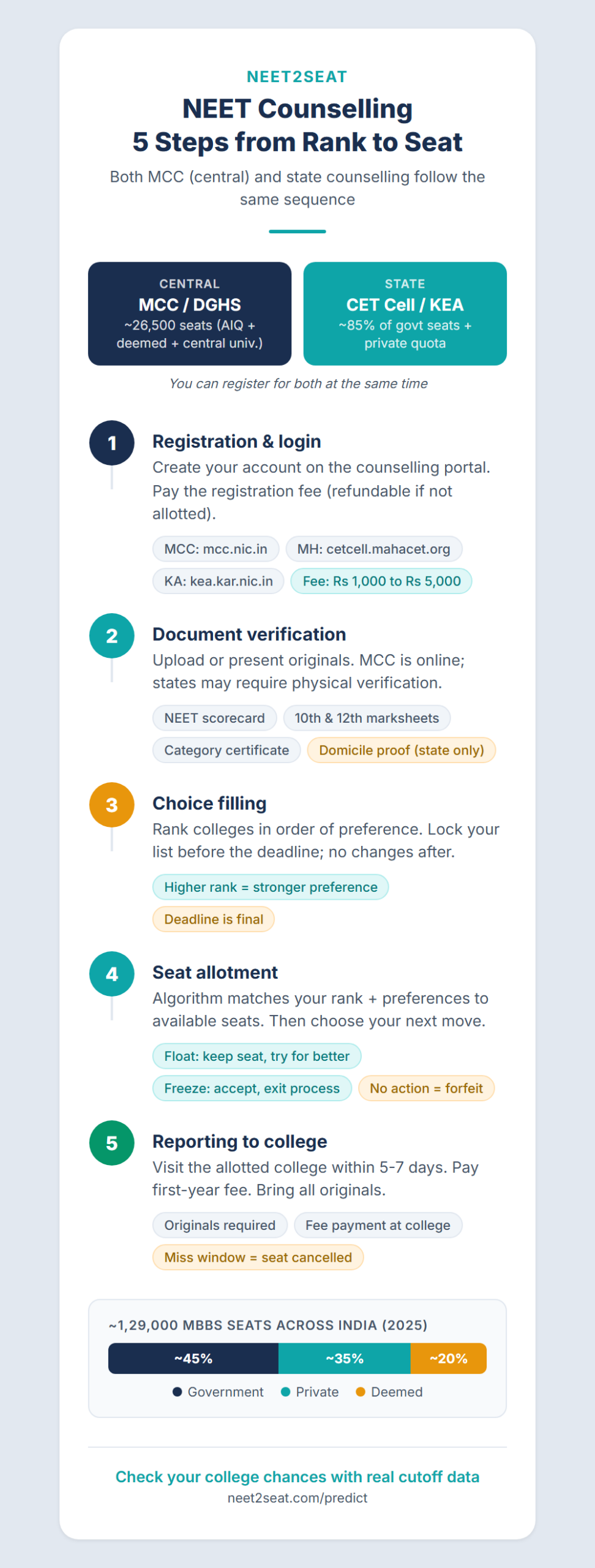
MCC fills roughly 26,500 seats across five categories:
- 15% All India Quota (AIQ) seats in government medical and dental colleges
- 100% of seats in deemed universities (88 institutions, about 13,900 seats in 2025)
- 100% of seats in central universities (Delhi University, BHU, AMU, Jamia Millia Islamia, IP University)
- All AIIMS and JIPMER campuses
- ESIC medical colleges
State counselling authorities fill the other 85% of government college seats, restricted to candidates with domicile in that state. States also handle private college admissions within their borders, though the exact seat split between state quota and management quota varies.
A candidate can register for both MCC and state counselling at the same time. If allotted a seat in both, they must choose one and vacate the other within the reporting window.
The numbers: how many seats, how many candidates
In 2025, 12.36 lakh candidates qualified NEET UG, competing for approximately 1,29,000 MBBS seats. Karnataka and Maharashtra together account for over a fifth of India’s total MBBS capacity.
In 2025, about 22.7 lakh students registered for NEET UG. Of these, 12,36,531 qualified (roughly 56% of those who appeared). They competed for approximately 1,16,000 MBBS seats available at the start of counselling, a number that grew to 1,29,026 by December 2025 as the National Medical Commission approved new colleges and seat increases through the year.
The seat distribution across institution types looks like this:
| Institution type | Approximate MBBS seats | Share |
|---|---|---|
| Government colleges | 55,000 to 58,000 | ~45% |
| Private colleges | 50,000 to 53,000 | ~40% |
| Deemed universities | 11,000 to 14,000 | ~11% |
| Central institutions (AIIMS, JIPMER, etc.) | 4,000 to 5,000 | ~4% |
Karnataka had 13,944 MBBS seats in 2025-26, making it the state with the most seats in the country. Maharashtra had 12,824. Together, these two states account for over a fifth of India’s MBBS capacity.
The six steps of counselling
Whether you go through MCC or state counselling, the process follows the same sequence.
1. Registration
Register on the MCC portal (mcc.nic.in) or your state counselling portal. You enter personal details, your NEET roll number, and upload required documents. You also pay a registration fee and security deposit online.
MCC registration fees for 2025 were Rs 1,000 for General/EWS candidates and Rs 500 for SC/ST/OBC/PwD candidates. Security deposits ranged from Rs 10,000 (government AIQ seats) to Rs 2,00,000 (private/deemed seats).
2. Choice filling
This is the most consequential step. You rank college-and-course combinations in order of preference. You can fill as many or as few choices as you want, and you can rearrange them until the locking deadline.
The order matters: the allotment algorithm assigns you the highest-ranked choice where your AIR meets the cutoff. A poorly ordered preference list can land you in a less preferred college even if your rank qualifies for better options. Our choice filling optimizer helps you build a preference list using three years of actual cutoff data from Maharashtra and Karnataka.
3. Choice locking
Do not rely on auto-lock. Review your preference list carefully and lock it yourself before the deadline. Auto-lock saves the last version, which may not be your intended final order.
Before the deadline, you lock your final preference list. If you forget to lock it manually, the system auto-locks the last saved version. Do not rely on auto-lock; review your list and lock it yourself.
4. Seat allotment
MCC runs the allotment algorithm considering your NEET AIR, your locked preference list, available seats, and your category eligibility. A provisional result is published first. After an objection window, the final result comes out.
You can see what cutoffs looked like in previous years using our cutoff analyzer, which covers all rounds of Maharashtra and Karnataka state counselling from 2023 to 2025.
5. Reporting to the allotted college
You physically go to your allotted college within the reporting window and bring all original documents. The college verifies your documents, conducts a medical fitness check, and processes your admission. No proxy reporting: you must appear in person.
6. Fee payment
Tuition and other fees are paid at the college during reporting. Government college fees in Maharashtra and Karnataka typically range from Rs 10,000 to Rs 50,000 per year. Private colleges charge Rs 5 to 25 lakh per year depending on the institution.
How many rounds, and what happens in each
MCC ran four rounds plus a special stray round in 2025. Most state authorities follow a similar pattern.
| Round | What happens | Can you exit freely? |
|---|---|---|
| Round 1 | Fresh allotment based on your preference list and AIR | Yes. No penalty, full deposit refund. |
| Round 2 | Fresh allotment + upgradation for Round 1 candidates. If you get a higher-preference seat, Round 1 seat is auto-cancelled. | No. Security deposit forfeited if you exit. |
| Round 3 (Mop-up) | Remaining seats after Rounds 1 and 2 | No. Seat is binding after joining. |
| Stray vacancy | Final vacancies. Joining is compulsory. | No. Non-joining means deposit forfeiture and potential disqualification. |
Round 1 is your free option. If you receive an allotment you do not want, simply do not report. Your deposit is refunded and you remain eligible for Round 2. Fill choices aggressively in Round 1.
The free exit in Round 1 is a safety valve. If you receive an allotment you don’t want, you simply don’t report. Your deposit is refunded and you remain eligible for Round 2. This means Round 1 carries almost no risk: fill choices aggressively and see what you get.
The 15/85 seat split: AIQ vs. state quota
In every government medical college, 15% of seats go to the All India Quota (open to candidates from any state, filled by MCC) and 85% stay with the state (restricted to domicile candidates, filled by the state authority).
Private colleges follow different rules. The split varies by state. In many states, private colleges allocate around 50% to state quota, 35% to management quota, and 15% to NRI quota. All seats, including management and NRI quota, require NEET qualification.
Deemed universities are entirely under MCC. No state quota applies to them.
Unfilled AIQ seats after Round 2 historically revert to the respective state quotas, giving state authorities additional seats to fill. In 2025, the MCC information bulletin stated that unfilled AIQ seats revert to state authorities. Whether vacated seats (from resignations after joining) also revert or are filled within the AIQ pool depends on the timing and the specific MCC circular for that year. Check the current year’s MCC bulletin for the exact reversion rules, as they can change between counselling cycles.
Open vs. closed states for private colleges
When people talk about “open” and “closed” states, they mean private college state quota seats specifically. Government college state quota (85%) is always restricted to domicile candidates in every state.
Maharashtra is a closed state: only Maharashtra domicile holders can apply for private medical college seats through the state counselling process. Karnataka is open: candidates from other states can apply for private college seats in Karnataka through KEA counselling.
This distinction matters if you’re from one state but considering private colleges in another. If the target state is open, you can participate in their counselling. If closed, you cannot.
Documents you’ll need
Both MCC and state counselling require the same core documents during reporting:
- NEET UG admit card and scorecard (originals)
- Allotment letter from the counselling portal
- Class 10 certificate and marksheet (for date of birth verification)
- Class 12 certificate and marksheet
- 8 passport-size photographs matching the NEET application photo
- Government-issued ID (Aadhaar, PAN, or passport)
- Category/caste certificate in the prescribed format (if applicable)
- Domicile certificate (for state quota)
- Disability certificate (for PwD candidates)
- Gap year affidavit (if applicable)
Get all documents ready before counselling registration opens. Domicile and caste certificates take weeks to obtain. Do not wait until after your first allotment.
Missing even one document can delay or block your admission. Get them ready before counselling registration opens, not after. For Maharashtra-specific requirements, see our Maharashtra CET Cell counselling guide. For Karnataka, see our KEA counselling guide.
What changed in 2025
MCC tightened several rules for the 2025 counselling cycle compared to 2024:
- Multiple registrations are now strictly prohibited. Registering more than once results in automatic cancellation and potential debarment.
- MCC no longer edits or modifies personal information in registrations. All data is auto-fetched from the NTA database.
- In-person reporting is mandatory. Proxy reporting (having someone else report on your behalf) is not allowed.
- Resignation after Round 3 joining is no longer possible. Once you join after Round 3, the seat is binding.
- Stray round joining is compulsory. Not joining after stray round allotment leads to deposit forfeiture and disqualification from the current year’s counselling.
- OCI (Overseas Citizen of India) cardholders are now treated at par with Indian citizens for General/Unreserved seats, following a Supreme Court order.
Maharashtra and Karnataka: what our data shows
neet2seat tracks over 407,000 allotment records across Maharashtra (86 colleges) and Karnataka (74 colleges) from 2023 to 2025, covering every round of state counselling.
neet2seat tracks cutoff and allotment data for Maharashtra (86 colleges) and Karnataka (74 colleges) across 2023, 2024, and 2025. Our database has over 407,000 individual allotment records.
In Maharashtra, the state counselling covers government, private, and deemed colleges through the CET Cell. The process typically runs three rounds (Round 1, Round 2, Round 3) plus stray vacancy rounds. Closing AIRs ranged from as low as 10 (a top government college in an early round) to over 13 lakh (the last seats filled in later rounds) in 2025.
In Karnataka, KEA conducts the state counselling. Karnataka had three counselling rounds in 2024 and 2025 (up from two rounds plus a mop-up in 2023). Closing AIRs showed a similar spread.
You can explore this data directly: browse cutoffs by college, category, and round, or use the college predictor to see which colleges you’re likely to get based on your AIR.
FAQ
Can I participate in both MCC and state counselling simultaneously?
Yes. You can register for and participate in both. If you receive allotments from both, you choose one and vacate the other within the specified reporting window.
What if I don’t get any seat in Round 1?
You automatically move to Round 2 with the same registration. No re-registration is needed. Round 2 includes seats vacated by Round 1 candidates who took free exit, plus any new seats added.
Is the security deposit refundable?
It depends on when you exit. In Round 1, you get a full refund if you choose not to report (free exit). After Round 2, the deposit is forfeited if you resign. If you’re never allotted a seat, the deposit is refunded regardless of round.
Do I need a domicile certificate for AIQ seats?
No. AIQ seats under MCC are open to candidates from any state. Domicile certificates are required only for state quota seats (the 85% filled by state counselling authorities).
When should I start preparing documents?
As soon as your NEET result is out. Domicile and caste certificates in particular can take weeks to obtain. Don’t wait until the registration window opens.
What’s the difference between free exit and resignation?
Free exit is available only in Round 1. You simply don’t report to the allotted college, and your deposit is refunded. Resignation is available in Round 2: you give up your seat, but your deposit is forfeited. After Round 3, neither option exists; the seat is binding.
How many counselling rounds are there in NEET?
MCC conducts 4 rounds for All India Quota: Round 1, Round 2, Round 3 (mop-up), and a stray vacancy round. State counselling authorities run 2 to 3 regular rounds plus their own mop-up rounds. Maharashtra runs 3 rounds plus a stray vacancy round. Karnataka runs 3 rounds. The total number depends on which tracks you participate in; candidates in both MCC and state counselling may go through 6 to 8 rounds across the full counselling cycle.
How much does NEET counselling cost?
MCC charges a registration fee of Rs 1,000 for General/EWS and Rs 500 for SC/ST/OBC/PwD candidates. A refundable security deposit of Rs 10,000 to Rs 2,00,000 is required depending on the college type. Maharashtra CET Cell charges a registration fee plus a security deposit as per the Information Brochure. Karnataka KEA charges a similar registration fee. The total upfront cost (registration + deposit) ranges from Rs 11,000 to Rs 2,00,000, most of which is refundable if you do not take a seat.