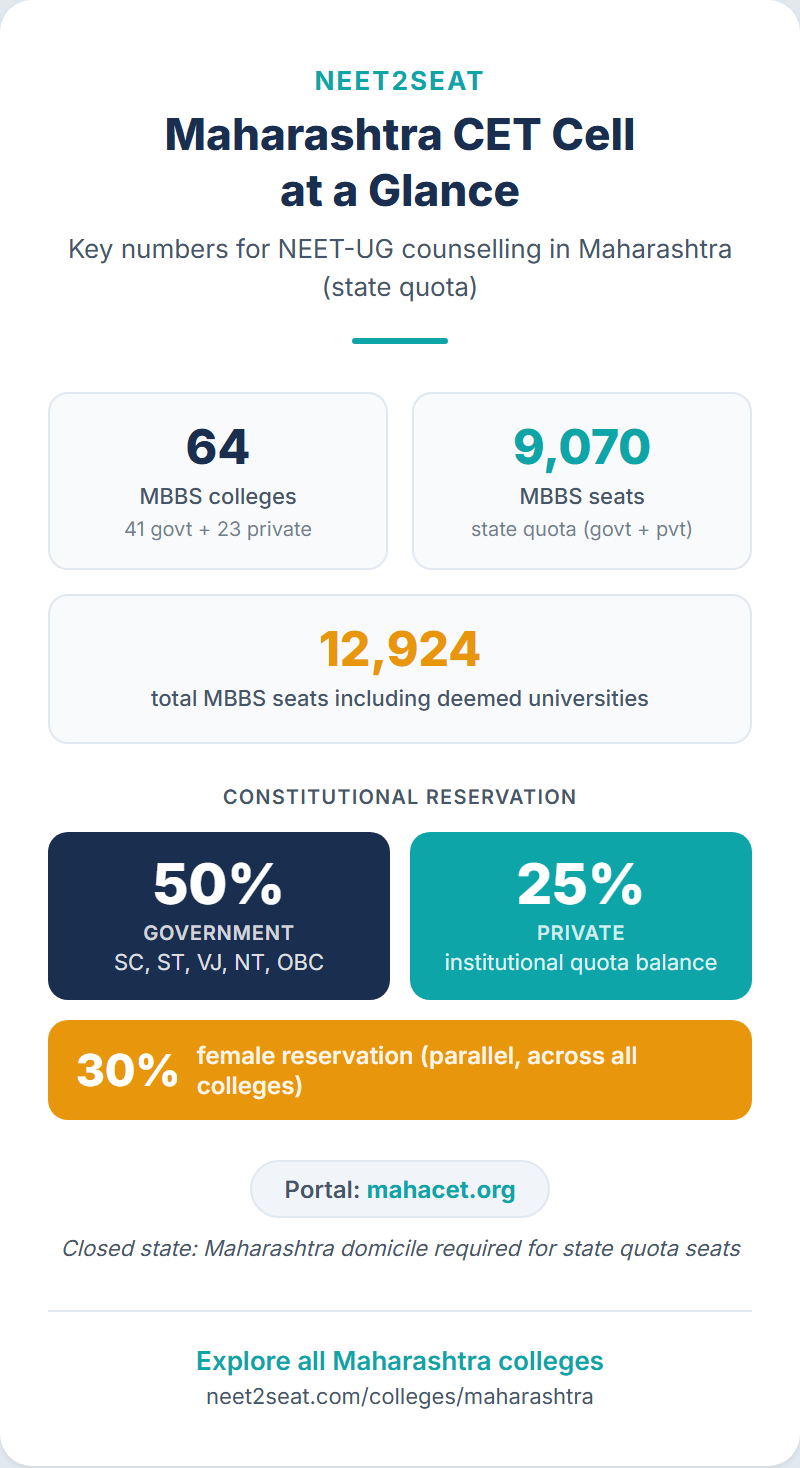
- CET Cell runs counselling for 64 colleges (9,070 seats) through mahacet.org; 16 more deemed universities fill seats through MCC
- Closed state: only Maharashtra domicile holders qualify for state quota. Non-domicile candidates are limited to the 15% institutional quota at private colleges
- Fresh preferences every round: Round 1 choices do not carry forward to Round 2
- Status Retention is irrevocable: once submitted, you exit all future rounds permanently
Who runs Maharashtra medical counselling
Maharashtra NEET counselling 2026 is conducted by the Office of the Commissioner, State Common Entrance Test Cell (CET Cell) in Mumbai. The CET Cell process runs under the authority of the Medical Education and Drugs Department, Government of Maharashtra, and follows rules published in the NEET UG Information Brochure issued each year. For the 2025-26 cycle, the brochure was approved on 22 July 2025 and runs to 337 pages of rules, annexures, college lists, and seat matrices.
Everything happens on one portal: mahacet.org. Registration, document uploading, preference filling, allotment results, status retention, and stray vacancy rounds all run through this single website. There is no offline preference form.
Maharashtra is a closed state for private college admissions. Only candidates with Maharashtra domicile (or those exempted under specific rules for children of government employees posted outside the state) can apply for state quota seats. Candidates from other states cannot participate in Maharashtra state counselling, except for the 15% institutional quota at private colleges, which is open on an all-India basis.
How many colleges and seats
According to the 2025 Information Brochure (college list dated 23 July 2025), Maharashtra has 64 MBBS colleges with a combined intake of 9,070 seats. Of these, 41 are government or corporation colleges (5,850 seats) and 23 are private unaided colleges (3,220 seats).
Including deemed universities, Maharashtra has 86 medical colleges with a combined capacity of 12,924 MBBS seats across all admission pathways. The 16 deemed universities fill seats through MCC, not CET Cell.
The state also has 16 deemed universities with MBBS programmes, but these fill seats through MCC (central counselling), not the CET Cell. Including deemed universities, our database tracks 86 medical colleges in Maharashtra with a combined capacity of 12,924 MBBS seats across all admission pathways.
The four largest government colleges each have 250 seats: Grant Government Medical College Mumbai, Seth GS Medical College and KEM Hospital Mumbai, BJ Government Medical College Pune, and Government Medical College Nagpur. The smallest government colleges (GMC GT and Cama Hospital Mumbai, GMC Parbhani) have 50 seats each.
How seats are distributed
Maharashtra splits its seats across three tracks:
All India Quota (AIQ): 15% of seats in government and corporation MBBS and BDS colleges go to the All India Quota, filled by MCC through central counselling. These are open to candidates from any state. Per the 2025 brochure, AIQ seats from government and corporation medical and dental colleges do not revert back to the state if unfilled.
State quota: 85% of government college seats and 85% of private college seats are filled by the CET Cell from the state merit list. Constitutional reservation, specified reservation, and female reservation all apply to state quota seats.
Institutional quota: 15% of seats in private unaided colleges are institutional quota seats. The CET Cell fills these through CAP rounds on an all-India basis, open to NRI, OCI, and out-of-Maharashtra (OMS) candidates. This is the only route for non-domicile candidates to get a private college seat in Maharashtra through state counselling.
Maharashtra’s reservation structure
Maharashtra has one of the most layered reservation systems in Indian medical admissions. The categories here differ from most other states, so pay close attention if you are comparing across states.
Constitutional reservation (government colleges): 50% of state quota
| Category | Reservation |
|---|---|
| Scheduled Castes and SC converts to Buddhism (SC) | 13% |
| Scheduled Tribes (ST) | 7% |
| Vimukta Jati / DT-A (VJ) | 3% |
| Nomadic Tribes B (NT-B) | 2.5% |
| Nomadic Tribes C (NT-C) | 3.5% |
| Nomadic Tribes D (NT-D) | 2% |
| Other Backward Classes including SBC (OBC) | 19% |
| Total | 50% |
Constitutional reservation (private unaided colleges): 25% of total intake
Private colleges carry exactly half the government percentages: SC 6.5%, ST 3.5%, VJ 1.5%, NT-B 1.25%, NT-C 1.75%, NT-D 1%, OBC 9.5%. This comes from the Maharashtra Act No. XXX of 2006.
Additional reservations (parallel/specified)
These operate in parallel with constitutional reservation, meaning a candidate can hold both a constitutional category seat and a specified quota seat simultaneously:
- SEBC (Socially and Educationally Backward Classes): 10% of available state quota seats, in government and private colleges (excluding minority institutions). This reservation is subject to the outcome of W.P. No. 3468/2024 in the Bombay High Court.
- EWS (Economically Weaker Section): 10% of available state quota seats, same scope as SEBC.
- Defence (DEF): 5% of intake, maximum 5 seats per government/corporation/government-aided college. Three sub-categories: DEF-1 (ex-service, MH domicile), DEF-2 (active, MH domicile), DEF-3 (active, transferred to MH).
- PWD (Persons with Disability): 5% of annual sanctioned intake, per the Rights of Persons with Disabilities Act 2016. Constitutional reservation applies within PWD quota seats.
- Hilly Area (HA): 3% at government/corporation medical colleges, MBBS only.
- Orphan: 1% of available seats. Constitutional reservation applies within orphan quota.
- Female: 30% reservation at all colleges under CAP, across all categories. Female candidates fill female quota seats first; after those are exhausted, they compete for general seats on merit.
Specified reservations (DEF, PWD, HA, MKB, Orphan, Female) are allotted before general seats in each round. If specified quota seats go unfilled, they revert to the respective category in the state quota.
Inter-se for unfilled reserved seats
When reserved category seats remain vacant after allotment, Maharashtra uses a three-group inter-se mechanism. Unfilled seats first go to candidates from the same group:
- Group I: SC and ST (share unfilled seats between these two)
- Group II: VJ and NT-B
- Group III: NT-C, NT-D, and OBC (including SBC)
If seats remain vacant after group inter-se, they go to the combined merit list of all reserved categories. If still vacant, they go to the common (open) merit list. SEBC and EWS unfilled seats skip this cascade entirely and revert directly to general category.
Ear-marking
When a reserved category candidate qualifies on open merit, they can choose to take either the open seat or their category seat. If they choose their category seat, one open seat at that college is “ear-marked” for the next eligible candidate from that reserved category. This mechanism prevents reserved category candidates from inadvertently blocking seats for their own community. Ear-marking does not apply to specified reservations.
The round structure
Maharashtra runs three regular CAP (Centralized Admission Process) rounds plus stray vacancy rounds. The structure differs from MCC counselling in one critical way: you fill fresh preferences for every round. Choices from one round do not carry forward to the next (except stray vacancy round choices, which carry forward to subsequent stray rounds).
Unlike MCC, Maharashtra requires fresh preferences for each round. Your Round 1 choices are completely voided before Round 2. Do not assume your earlier preferences carry forward.
Round 1
All registered candidates fill preferences and the software allots seats based on NEET AIR and preference order. If you are allotted a seat, you must report to the college and complete admission formalities (document verification, fee payment, original document submission) within the prescribed window.
If you do not report, your selection stands cancelled and the seat becomes vacant for Round 2. You remain eligible for Round 2 without re-registration. This is effectively a free exit: no penalty, no lost deposit, no consequences beyond losing that particular seat.
Round 1 carries zero risk. Not reporting after allotment is a free exit with no penalty or deposit forfeiture. Fill as many preferences as you are willing to consider.
If you join and are satisfied, you fill the Status Retention Form (more on this below). If you join but want to try for a better seat, you skip Status Retention and fill fresh choices for Round 2.
Status Retention
This is Maharashtra’s equivalent of “freezing” your seat. After joining your Round 1 college, you submit the Status Retention Form (Annexure J in the Information Brochure) to the Dean or Principal of your allotted college within the prescribed window. The form is a physical document, signed by you, your parent or guardian, and the Dean or Principal.
Two rules make Status Retention consequential. First, it is irrevocable and irreversible. Once submitted, you cannot withdraw it under any circumstances. Second, after submitting it, you are removed from consideration for all subsequent rounds of the 2025-26 admission process. Your seat is locked; you are done.
Status Retention is irrevocable. Once submitted, you cannot withdraw it and you are removed from all subsequent rounds. If there is any chance you want a better seat in Round 2, do not submit this form.
There is one exception: a candidate who has submitted Status Retention can still resign from the allotted seat before the prescribed date and become eligible for Round 2. But this effectively means giving up a confirmed seat to re-enter the pool with no guarantee of getting anything better.
If you have been allotted a seat in Round 1, our Status Retention guide for Maharashtra walks through the decision in detail.
Round 2
Available seats include everything left from Round 1: unallotted seats, seats vacated by candidates who did not join, and seats freed by candidates who joined Round 1 but got upgraded in Round 2.
Candidates who joined during Round 1 and did not fill Status Retention are automatically considered for upgradation. If upgraded, their Round 1 seat is released and allotted to someone else in the same round. If not upgraded, they keep their Round 1 seat.
Fresh preferences are required. Round 1 choices are treated as null and void.
If you are allotted a seat in Round 2 and do not join, you must re-register (and pay the registration fee again) to participate in Round 3.
Round 3
Seats unallotted or vacated from Round 2 are available. Fresh preferences required; all previous preferences are null and void. If allotted a seat in Round 3, joining is mandatory. After Round 3 allotment, you are not eligible for any further state counselling rounds. The CET Cell informs MCC of all candidates allotted in Round 3.
Stray vacancy rounds
After Round 3, if seats remain vacant, the CET Cell conducts online stray vacancy rounds. Only candidates who registered and filled preferences previously but did not receive any allotment through Round 3 are eligible. Candidates who joined in any earlier round are not eligible. No new registrations are accepted for stray rounds. Fresh choices are required (Round 3 choices are voided), but stray round choices carry forward to subsequent stray rounds if any.
There is no institutional-level round for MBBS and BDS seats. All rounds run through the CET Cell’s centralized software, per an NMC circular dated 24 July 2023.
Registration and fees
Registration happens on mahacet.org during two windows: before Round 1, and again before Round 3 (for candidates who need fresh registration). You submit an online application form combined for all institution types (government, corporation, private, minority).
| Application type | Fee (non-refundable) |
|---|---|
| State quota only | Rs 1,000 |
| Institutional quota only | Rs 5,000 |
| Both state and institutional quota | Rs 6,000 |
After payment, you upload documents online (NEET admit card, scorecard, government ID, domicile certificate, SSC and HSC certificates, category certificates if applicable). Physical document verification happens at the allotted college during reporting.
Eligibility for Maharashtra state quota
The core requirements from the 2025 Information Brochure (Section 4):
- Nationality: Indian citizen. OCI cardholders who obtained OCI status before 4 March 2021 and passed 10th and 12th from Maharashtra with MH domicile are eligible (per Supreme Court order in W.P.(C) No. 891/2021, dated 3 February 2023).
- Domicile: Maharashtra domicile certificate required (except for institutional quota, defence, and MKB candidates).
- SSC: Must have passed SSC (10th) from an institution in Maharashtra.
- HSC: Must have passed HSC (12th) from an institution in Maharashtra with English, Physics, Chemistry, and Biology.
- HSC marks: OPEN and EWS candidates need minimum 50% in PCB combined (150/300). Constitutional reservation, SEBC, and PWD candidates from reserved categories need 40% (120/300). PWD candidates in General category need 45% (135/300).
- Age: Born on or before 31 December 2008.
- NEET percentile: OPEN and EWS need 50th percentile. Reserved categories and SEBC need 40th percentile. PWD in General need 45th percentile.
Exceptions exist for children of Maharashtra government employees posted outside the state, children of central government employees transferred to Maharashtra, and defence personnel with MH domicile posted elsewhere. These candidates can have their SSC/HSC from outside Maharashtra. Details are in Sections 4.7 and 4.8 of the brochure.
Fee structure
Government and corporation college MBBS fees for 2025-26, per the brochure:
| Fee component | Amount per year |
|---|---|
| Tuition fee | Rs 1,52,100 |
| Development fee | Rs 5,000 |
| Gymkhana fee | Rs 500 |
| Hostel fee | Rs 4,000 |
| Library fee | Rs 1,000 |
One-time fees at admission: Rs 1,500 admission fee and Rs 2,000 library deposit.
Total first-year cost at a government MBBS college in Maharashtra comes to about Rs 1,65,100. Subsequent years are roughly Rs 1,62,600.
Private college fees are set by the Fee Regulating Authority of Maharashtra (mahafra.org) and vary widely by institution. The brochure does not list private college fee amounts; it directs candidates to check each college’s website or the FRA portal. Based on publicly available FRA data from recent years, private MBBS fees in Maharashtra typically range from Rs 5 lakh to Rs 25 lakh per year, though some institutions charge more.
Backward class candidates selected on open merit are eligible for freeship and scholarship schemes. The MAHADBT portal (mahadbtmahait.gov.in) handles applications for post-matric scholarships, the Rajarshi Chhatrapati Shahu Maharaj Shikshan Shulk Shishyavrutti scheme (for OPEN/EWS candidates with family income below Rs 8 lakh), and minority scholarship schemes.
What our data shows for Maharashtra
neet2seat tracks 244,015 Maharashtra allotment records across 2023, 2024, and 2025, covering 86 colleges and every round of state counselling.
neet2seat tracks allotment data for 86 Maharashtra medical colleges across 2023, 2024, and 2025. Our database contains 244,015 Maharashtra allotment records across these three years, covering every round of state counselling.
In 2025 specifically, Maharashtra state counselling processed 97,011 records across three rounds (R1, R2, R3), with 30,988 candidates receiving final allotments at 95 distinct colleges. AIR ranks ranged from 10 (top seats in Round 1) to over 13,19,000 (last seats filled in Round 3).
Closing AIRs for OPEN category at the most competitive government colleges in 2025 (final round, excluding sub-quotas):
| College | Closing AIR (2025) | Closing AIR (2024) | Closing AIR (2023) |
|---|---|---|---|
| Seth GS Medical College and KEM Hospital, Mumbai | 2,571 | 3,689 | 3,331 |
| Lokmanya Tilak Municipal MC, Sion, Mumbai | 6,033 | 9,357 | 8,379 |
| BJ Government Medical College, Pune | 8,634 | 5,595 | 7,716 |
| Government Medical College (Grant), Mumbai | 9,433 | 9,264 | 10,416 |
| GMC Nagpur | 11,360 | 12,700 | 15,077 |
Some patterns from the three-year data: Seth GS/KEM tightened significantly in 2025 (closing at AIR 2,571, down from 3,689 in 2024). GMC Nagpur has tightened steadily year over year. BJ Medical Pune fluctuates: it closed at 5,595 in 2024 but loosened to 8,634 in 2025. These shifts reflect changes in candidate preference patterns and seat availability each year, not necessarily changes in college quality.
You can explore this data in detail using our Maharashtra cutoff analyzer, which lets you filter by college, category, round, and year. For a quick look at where your rank might land you, try the college predictor.
How Maharashtra state counselling differs from MCC
If you are also participating in MCC (All India Quota) counselling, note these differences in the Maharashtra state process:
- Fresh choices every round. MCC carries forward your original preference list across rounds. Maharashtra requires fresh preferences for each round. Round 1 choices are voided before Round 2, Round 2 choices are voided before Round 3.
- Status Retention vs. Freeze. MCC uses Freeze (keep current seat, no upgradation) and Float (stay in pool for upgradation). Maharashtra uses Status Retention (irrevocable exit from all future rounds). The consequence is sharper: in MCC, freezing still keeps you enrolled in the system through subsequent rounds. In Maharashtra, Status Retention removes you entirely.
- No deposit system. MCC charges a refundable security deposit (Rs 10,000 to Rs 2,00,000). Maharashtra charges a non-refundable registration fee (Rs 1,000 to Rs 6,000) and you pay college fees directly at reporting. There is no separate security deposit to forfeit or refund.
- Maharashtra-specific categories. VJ (Vimukta Jati), NT-B, NT-C, NT-D, and SEBC are Maharashtra categories with no direct equivalent in MCC counselling.
- Round 3 is binding. In Maharashtra, if you are allotted a seat in Round 3, joining is mandatory and you are barred from subsequent state counselling rounds. MCC’s mop-up round has similar rules, but the terminology and timeline differ.
Common mistakes
Based on patterns we see in the data and recurring questions from candidates:
Not filling enough preferences in early rounds. Since each round requires fresh preferences and Round 1 carries no risk (you can simply not report), there is no reason to be conservative. Fill as many preferences as you are willing to consider. You can always decline by not joining.
Confusing Status Retention with MCC’s Freeze option. They are not the same. Status Retention in Maharashtra pulls you out of the process entirely. If there is any chance you want a better seat in Round 2, do not fill the Status Retention Form.
Missing the re-registration deadline for Round 3. If you were allotted a seat in Round 2 and did not join, you must register again (and pay again) before the Round 3 deadline. Missing this window means you are out of the process.
Not having category certificates ready. Maharashtra requires the Caste Validity Certificate (not just the caste certificate) and the Non-Creamy Layer certificate at document verification. These take time to obtain. If you fail to produce them, you are automatically treated as an Open category candidate, which can mean losing your seat entirely if your rank does not qualify under Open.
If you belong to a reserved category, start your Caste Validity Certificate and Non-Creamy Layer certificate applications now. These documents take weeks to process. Without them at verification, you will be treated as Open category and may lose your seat.
FAQ
Can I participate in both MCC and Maharashtra CET Cell counselling?
Yes. Register separately for each. If you receive allotments from both, you choose one and vacate the other within the reporting window.
I am from another state. Can I get a private medical college seat in Maharashtra?
Only through the 15% institutional quota at private unaided colleges, which the CET Cell fills on an all-India basis through CAP rounds. You cannot apply for state quota (85%) seats at private colleges. Maharashtra is a closed state.
What if I join in Round 1 but want to try for a better seat in Round 2?
Do not fill the Status Retention Form. Fill fresh preferences for Round 2 instead. If upgraded, your Round 1 seat is automatically released. If not upgraded, you keep your Round 1 seat. There is no risk to trying, as long as you skip Status Retention.
Is there a fee penalty for not joining after Round 1 allotment?
No. Not reporting after Round 1 is treated as a free exit. Your registration fee (Rs 1,000 to Rs 6,000) is non-refundable regardless, but there is no additional penalty or deposit forfeiture.
When does the CET Cell publish the seat matrix?
The seat matrix (college-wise distribution of seats by category) is published on mahacet.org before preference filling opens for each round. The exact date is announced in the schedule notification. It typically comes out after the provisional merit list is published and the document verification window closes.
Do SEBC and EWS unfilled seats go through inter-se?
No. Unlike constitutional reservation categories (SC, ST, VJ, NT-B, NT-C, NT-D, OBC), unfilled SEBC and EWS seats revert directly to general category. They do not participate in the three-group inter-se mechanism.
What is the Non-Creamy Layer certificate requirement?
Candidates from DT-A (VJ), NT-B, NT-C, NT-D, SEBC, and OBC (including SBC) must produce a Non-Creamy Layer certificate valid up to 31 March 2026 or later. This must be submitted at physical document verification. Without it, you are treated as an Open category candidate. SC and ST candidates are exempt from this requirement.
Can I use a central government format EWS certificate?
The CET Cell requires the state government format EWS certificate (Annexure T of the Information Brochure). Central government format certificates are not accepted for Maharashtra state counselling.
No. The CET Cell explicitly requires the state government format EWS certificate (as given in Annexure T of the Information Brochure). Central government format certificates are not accepted for Maharashtra state counselling.