- 74 colleges (24 govt, 38 private, 12 deemed) with ~12,400 MBBS seats; fees range from Rs 50,000 to Rs 45 lakh per year
- Karnataka is an open state: non-domicile candidates can access private and deemed university seats through KEA
- Choice 1/2/3 system after each round: accept-and-exit, accept-and-seek-upgrade, or decline-and-re-enter
- 48+ category codes from 8 base categories combined with 6 suffixes (G, K, R, H, KH, RH)
KEA runs Karnataka’s medical counselling
Karnataka NEET counselling 2026 is conducted by the Karnataka Examinations Authority (KEA), operating from Bengaluru under the Department of Higher Education. KEA fills state quota seats at government colleges (85% of intake), government quota seats at private colleges, and coordinates deemed university admissions within its jurisdiction. The counselling portal is cetonline.karnataka.gov.in.
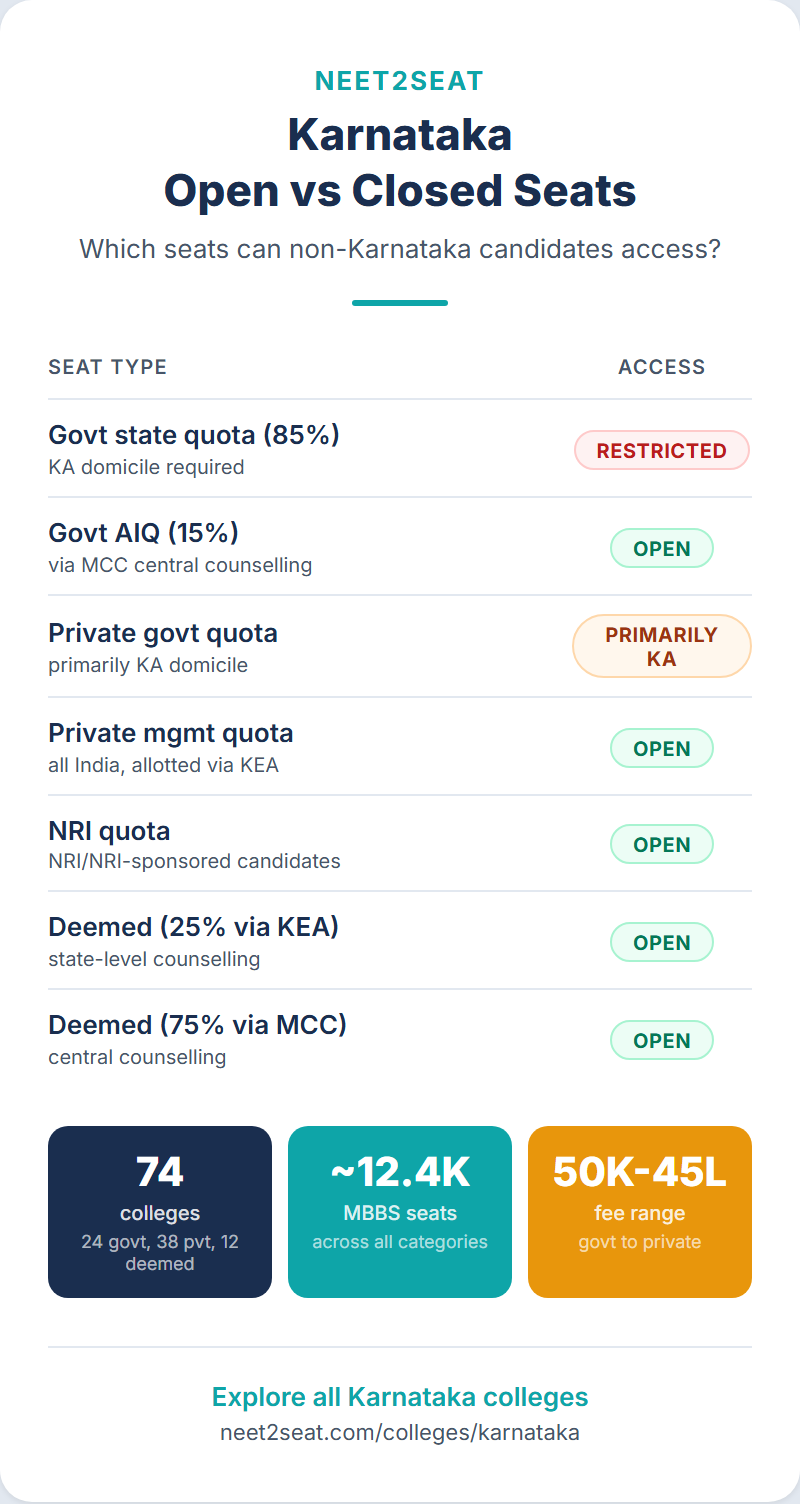
Karnataka had 74 medical colleges in 2025: 24 government, 38 private, and 12 deemed universities. Our database tracks allotment data across all three categories from 2023 through 2025, covering 45,673 individual records. If you are looking for how Karnataka’s process compares to the central MCC process, see our AIQ vs state quota guide. For Maharashtra’s counselling process, see our CET Cell guide.
Seats: government, private, and deemed
Karnataka’s seat pool is split unevenly across three institution types:
| Type | Colleges | Approximate MBBS seats |
|---|---|---|
| Government | 24 | ~3,800 |
| Private | 38 | ~6,000 |
| Deemed | 12 | ~2,600 |
| Total | 74 | ~12,400 |
Unlike Maharashtra where government colleges hold the majority of seats, Karnataka’s private sector accounts for nearly half the total MBBS capacity. The fee range spans Rs 50,000/yr (government) to Rs 45 lakh/yr (management quota at deemed universities).
Unlike Maharashtra where government colleges hold the majority of seats, Karnataka’s private sector accounts for nearly half the total MBBS capacity. This has practical consequences: the fee range across Karnataka colleges spans from Rs 50,000 per year at government colleges to over Rs 25 lakh at private ones and Rs 45 lakh for management quota seats at deemed universities.
The seat split for government colleges follows the standard All India pattern: 15% goes to MCC for All India Quota, 85% stays with KEA. Private colleges contribute their government quota seats to KEA and fill management and NRI quotas separately. Deemed universities allocate roughly 25% of seats as government quota through KEA, with the remaining 75% going through MCC.
Karnataka is an open state
Karnataka allows candidates from any state to apply for private college and deemed university seats through KEA counselling. No domicile certificate is required for these seats. Government state quota seats (85%) remain restricted to Karnataka domicile.
This is the single most consequential structural fact about Karnataka’s medical admissions. Karnataka allows candidates from any state to apply for private college and deemed university seats through KEA counselling. No domicile certificate is required for these seats.
Government college state quota seats (the 85%) remain restricted to Karnataka domicile candidates. But private college seats, which are the majority of Karnataka’s capacity, are open to everyone. This makes Karnataka one of the most popular destinations for out-of-state NEET candidates, particularly from states with fewer colleges or higher cutoffs.
The practical split:
| Seat type | Open to non-Karnataka? |
|---|---|
| Government state quota (85%) | No (Karnataka domicile required) |
| Government AIQ (15%) | Yes (through MCC) |
| Private government quota | Primarily Karnataka domicile |
| Private/management quota | Yes (all India, through KEA) |
| NRI quota | Yes |
| Deemed university | Yes (25% via KEA, 75% via MCC) |
Non-Karnataka candidates cannot claim reservation in state quota seats. They compete on open merit for available seats and must meet the General/UR eligibility threshold (50th percentile) regardless of their home state category.
Reservation categories: the suffix system
Karnataka’s reservation structure differs from both the central government system and Maharashtra’s system. The state recognizes eight base categories for medical admissions:
GM (General Merit): unreserved, open to all on merit. Roughly half of state quota seats fall under GM after all reservations are applied.
Category 1: the most backward among OBC groups. 4% reservation. Unlike other OBC categories, creamy layer exclusion does not apply to Category 1.
Category 2A: the largest OBC subcategory. 15% reservation. This is the most populated reservation category in Karnataka.
Category 2B: 5% reservation. Smaller candidate pool than 2A, with cutoff ranks often higher (less competitive) than 2A at the same college.
Category 3A: 4% reservation. Includes the Vokkaliga community and related groups.
Category 3B: 4% reservation. Includes the Veerashaiva-Lingayat community and related groups.
SC (Scheduled Castes): 15% reservation. In 2024, Karnataka restructured SC reservation internally into four sub-groups (SC Left, SC Right, Touchable, Others), though the total allocation remains the same for counselling purposes.
ST (Scheduled Tribes): 3% reservation. The smallest reservation category in Karnataka’s medical admissions.
EWS (Economically Weaker Sections): 10% reservation for unreserved category candidates with family income below Rs 8 lakh, applied post the 103rd Constitutional Amendment.
These eight base categories are then combined with a suffix system that creates sub-quotas. Each base category can carry one of six suffixes:
- G: General (no additional sub-quota; standard pathway)
- K: Kannada medium (studied Classes 1 through 10 in Kannada medium schools)
- R: Rural (studied in schools in rural areas of Karnataka)
- H: Hyderabad-Karnataka region (from the six HK districts under Article 371J)
- KH: Kannada medium + HK region (both criteria must be met)
- RH: Rural + HK region (both criteria)
This gives 48 regular category codes (8 bases multiplied by 6 suffixes). On top of these, KEA uses special codes for private college seats (GMP, OPN), minority quotas (MA, MC, ME, MM, MU), religious congregation seats at deemed universities (RC1 through RC8), NRI, PWD, Defence, NCC, and Sports quotas. In total, our database tracks 78 distinct category codes in Karnataka’s allotment data.
In the Karnataka cutoff analyzer, you can filter by any of these category codes to see closing ranks for specific sub-quotas.
The Choice 1 / Choice 2 / Choice 3 system
This is Karnataka’s version of the float/freeze mechanism used in other states. After each round’s allotment, every allotted candidate must pick one of three options within the deadline:
Choice 1: accept and exit
You are satisfied with the allotted seat. You pay the full course fee, download the seat guarantee card, and report to the college. You cannot participate in any subsequent round. This is equivalent to “Freeze” in MCC terminology.
Choice 2: accept and seek upgrade
Choice 2 carries no penalty if you are not upgraded. You keep your Round 1 seat and pay the remaining balance. It is the safe way to seek a better seat while holding your current one.
You accept the allotted seat but want to try for a better seat in Round 2. For seats with course fees exceeding Rs 12 lakh, KEA requires only Rs 12,001 as an advance payment (a 2025 rule change; previously the full course fee was required). SC/ST/Category 1 candidates pay Rs 2,000 as a caution deposit. If upgraded in Round 2, the old seat is released automatically. If not upgraded, you keep the original seat and pay the remaining balance. This is equivalent to “Float.”
A notable advantage of Choice 2: you can cancel your KEA seat before Round 2 results without forfeiting fees, if you received admission elsewhere (for example, through MCC).
Choice 3: decline and re-enter
Choice 3 is the highest-risk option. Your Round 1 seat is permanently forfeited. If you receive no allotment in Round 2, you must pay Rs 1,00,000 (Rs 50,000 for SC/ST) just to stay eligible for the mop-up round.
You reject the allotted seat entirely and re-enter the pool for Round 2. No fee payment or college reporting is required. But this carries real risk: your Round 1 seat is forfeited, and there is no guarantee you will get any seat in Round 2. If you chose Choice 3 in Round 1 and do not receive an allotment in Round 2, you must pay a caution deposit of Rs 1,00,000 (Rs 50,000 for SC/ST) to remain eligible for subsequent rounds.
For a deeper analysis of when to use each option, see our Choice 1 vs Choice 2 guide.
How the rounds work
KEA typically runs three counselling rounds plus an optional stray vacancy round:
Round 1: the largest round. After online registration and in-person document verification, candidates receive a secret key to activate their counselling account. KEA publishes a mock allotment first, allowing candidates to modify their preference list. After the final allotment, candidates select Choice 1, 2, or 3. In 2025, Round 1 filled 8,320 seats.
Round 2: Choice 2 and Choice 3 candidates from Round 1 participate. Choice 2 candidates retain their Round 1 seat while seeking an upgrade. The preference list from Round 1 is generally carried forward. Round 2 is consistently the largest round by allotment count: 9,957 seats in 2025, 8,758 in 2024. Many seats become available because of Choice 1 exits and new seats being added.
Round 3 (Mop-up): fills remaining seats across all college types. KEA opens fresh registration for candidates who did not register earlier. This round is much smaller: 967 seats in 2025, 622 in 2024. At government colleges, only a handful of seats remain by this point; in 2025, just 6 government colleges had GM seats in Round 3, filling 11 total.
Stray vacancy round: conducted in person at the KEA office. Only for candidates who were not allotted any seat in previous rounds. This is the final opportunity.
How seat allotment runs inside each round
A round is not a single pass. The software sweeps the seat matrix in three phases and repeats each phase until no candidate’s allotment changes, which is why a category’s closing rank can shift several times within one round. Phase 1 fills General Merit and the special categories (PwD, NCC, Sports) strictly by rank and option, with Medical and Dental allotted first, then AYUSH, then the other streams. Phase 2 folds unfilled Rural and Kannada-medium reserved seats into the parent reserved category (for example, SC-Rural and SC-Kannada become SC-General) and offers them to reserved candidates only. Phase 3 converts any reserved seats still empty into General Merit and opens them to everyone.
The practical takeaway: a seat you could not reach under your sub-quota early in a round can open later in the same round through these conversions. Keep those options on your list rather than deleting them on the assumption they are out of reach.
Fees
The fee structure varies dramatically by seat type. Our database records actual fee amounts from allotment data:
| Seat type | Annual fee range (2025) | Average |
|---|---|---|
| Government | Rs 50,000 to Rs 6,09,084 | ~Rs 1,06,911 |
| Private (government quota) | Rs 8,10,535 to Rs 25,15,000 | ~Rs 14,17,169 |
| Management quota | Rs 25,00,000 to Rs 45,40,750 | ~Rs 35,87,749 |
| NRI quota | Rs 25,09,350 to Rs 45,40,750 | ~Rs 36,41,774 |
The base government MBBS fee in Karnataka is Rs 50,000 per year. SC/ST candidates may pay as little as Rs 500 to Rs 2,000 due to fee exemptions. ESI colleges charge higher: approximately Rs 1,09,350 per year.
Private college fees saw a 10% increase for 2025-26 after the Karnataka government approved the hike. Management and NRI quota fees are set by the Fee Regulatory Committee and can exceed Rs 45 lakh per year at certain deemed universities.
Registration fee
Karnataka candidates of every category pay the same registration fee: Rs 750 (SC/ST/Category 1/PWD and GM/2A/2B/3A/3B alike). Non-Karnataka candidates pay Rs 2,500, and NRI/OCI/PIO/Foreign nationals Rs 5,000. A separate non-refundable option-entry fee of Rs 750 applies to all candidates in each seat-allotment round.
Registration and document verification
The registration process runs in steps:
- Register online at cetonline.karnataka.gov.in with personal details and NEET particulars.
- Upload passport photo, signature, and thumb impression.
- Pay the registration fee online.
- Attend in-person document verification at KEA or designated centres. Bring all originals plus self-attested photocopies.
- After verification, receive a secret key to activate your counselling account.
- Fill college preferences in order of priority. No limit on the number of options.
- Review the mock allotment and modify preferences if needed.
- Lock final preferences before the deadline.
Candidates who already registered for KCET (Karnataka Common Entrance Test, used for engineering admissions) can link their NEET roll number to the existing registration instead of re-registering from scratch.
For the full document checklist, see our documents guide.
Biometric login and admission
For 2026 the process is biometric from start to finish. You log in to option entry by scanning the QR code on your verification slip, entering an OTP sent to your registered mobile, and passing a live face-recognition check. At the college, admission is finalised only after an online face-recognition match and an OTP delivered over WhatsApp, after which the college downloads your admission letter; you cannot download it yourself. Keep the mobile number you registered with active through every round. The 2025 process used only a user ID and secret key. For a summary of what changed this year, see our 2026 KEA rule-change rundown.
Eligibility for state quota seats
Domicile qualification for government seats works through multiple pathways: completing Class 10 and 12 from Karnataka schools, or having at least 7 years of schooling in Karnataka, or having a parent who studied at least 7 years in Karnataka with current residency, or having Kannada, Tulu, or Kodava as mother tongue with a parent currently resident in Karnataka. Children of defence personnel who served at least 1 year in Karnataka also qualify.
All candidates must have passed Class 12 with Physics, Chemistry, Biology, and English. Minimum age is 17 years as of December 31 of the admission year. The NEET percentile requirements are: General/UR 50th percentile, OBC/SC/ST 40th percentile, PWD 45th percentile.
Compulsory rural service
All candidates admitted to medical courses in Karnataka must complete 1 year of compulsory rural service in government hospitals after finishing MBBS, per the Karnataka Compulsory Service Training Act of 2012. There is no monetary penalty for UG rural service non-compliance (unlike PG, which carries a Rs 50 lakh penalty for a 3-year bond).
Hyderabad-Karnataka region reservation
Article 371(J) of the Constitution, inserted by the 98th Amendment in 2012, grants special reservation to candidates from the Hyderabad-Karnataka (now Kalyana-Karnataka) region. Six districts qualify: Bidar, Kalaburagi, Raichur, Yadgir, Koppal, and Ballari. These were part of the erstwhile Hyderabad State under the Nizam and remain among Karnataka’s most economically backward areas.
In medical admissions, 8% of state quota seats across all government colleges statewide are reserved for HK candidates. In colleges located within the HK region, the reservation rises to 70% of state quota seats. This creates a meaningful cutoff advantage, particularly at colleges like Gulbarga Institute of Medical Sciences (GIMS) in Kalaburagi.
HK reservation is encoded in the suffix system. A candidate from Kalaburagi district competing under SC category with rural school background would have the code “SCRH” (SC + Rural + HK). The certificate required is the “Article 371(J) Certificate” or “Hyderabad-Karnataka Domicile Certificate” issued by the Tahasildar’s office.
What our data shows
Bangalore Medical College’s Round 1 closing AIR dropped from 3,508 in 2023 to 1,299 in 2025: a 63% tightening in two years. This pattern holds across top-tier government colleges as competition intensifies.
We track allotment data for all 74 Karnataka colleges across 2023, 2024, and 2025. The 2025 dataset alone contains 19,244 allotment records across three rounds.
Top government colleges by closing AIR (GM category, Round 2, 2025)
| College | Opening AIR | Closing AIR |
|---|---|---|
| Bangalore Medical College, Bengaluru | 398 | 3,025 |
| Atal Bihari Vajpayee Medical College, Bengaluru | 3,240 | 7,669 |
| Mysore Medical College, Mysuru | 2,403 | 8,394 |
| ESIC Medical College, Bengaluru | 5,700 | 12,937 |
| Karnataka Institute of Medical Sciences, Hubballi | 4,941 | 13,488 |
| Mandya Institute of Medical Sciences | 8,509 | 15,588 |
| Shimoga Institute of Medical Sciences, Shivamogga | 8,198 | 21,676 |
| Hassan Institute of Medical Sciences | 5,949 | 21,862 |
| Belagavi Institute of Medical Sciences | 2,968 | 23,365 |
| Gulbarga Institute of Medical Sciences, Kalaburagi | 3,611 | 23,671 |
Year-over-year trends
Cutoffs at top government colleges have tightened consistently over the past three years. Using Round 1 GM closing AIRs for comparison:
| College | 2023 | 2024 | 2025 |
|---|---|---|---|
| Bangalore Medical College | 3,508 | 2,154 | 1,299 |
| Mysore Medical College | 8,243 | 7,069 | 4,053 |
| KIMS Hubballi | 13,106 | 11,378 | 8,343 |
Bangalore Medical College’s R1 closing AIR dropped from 3,508 in 2023 to 1,299 in 2025: a roughly 63% decrease over two years. This pattern holds across the top tier. The data reflects increasing competition for government seats as more candidates target Karnataka specifically because of its open-state status for private colleges, pulling the overall applicant pool up.
The full AIR range in Karnataka 2025 allotment data spans from 22 (the most competitive allotment) to 13,19,086 (the least competitive, typically a management quota seat at a private college). You can explore this data in detail using the Karnataka cutoff analyzer.
Seat type distribution (2025)
Our allotment data breaks down by seat type:
| Seat type | Allotments | Share |
|---|---|---|
| Government | 11,180 | 58% |
| Private (government quota) | 6,195 | 32% |
| Management quota | 1,680 | 9% |
| NRI quota | 189 | 1% |
Management and NRI seats together account for 10% of total allotments but carry fees 20 to 40 times higher than government seats.
How KEA differs from MCC
Beyond the obvious difference in seat pools, several structural differences matter for candidates participating in both tracks:
Choice system vs float/freeze: MCC uses Freeze/Float/Slide with an auto-upgrade mechanism. KEA uses Choice 1/2/3 where the candidate explicitly decides whether to accept, upgrade-seek, or decline. The outcome is similar, but the decision framework is different.
Mock allotment: KEA publishes a mock allotment before the final allotment in Round 1, giving candidates a preview of likely outcomes. MCC does not offer a mock round.
Fresh preference entry: KEA requires preference filling before Round 1 and generally carries it forward. MCC allows preference modification between rounds but within constraints.
Categories: MCC recognizes SC, ST, OBC-NCL, and EWS. KEA recognizes eight base categories with suffix variants, producing 48+ regular codes. A candidate who is OBC-NCL under the central government list might be Category 2A, 2B, 3A, or 3B in Karnataka. The two classifications are independent.
FAQ
Can candidates from other states get government college seats in Karnataka?
Not through state counselling. Government college state quota seats (85%) require Karnataka domicile. Non-Karnataka candidates can only get government seats in Karnataka through the 15% All India Quota via MCC. For private and deemed university seats, Karnataka is open to candidates from all states through KEA counselling.
What is the difference between GM and GMP categories?
GM (General Merit) applies to government college seats. GMP (General Merit Private) applies to private college seats. Both are unreserved and merit-based, but they draw from different seat pools with different fee structures and, in some cases, different eligibility rules for out-of-state candidates.
How does the HK reservation help candidates from those six districts?
HK candidates benefit from two layers. First, 8% of seats across all government colleges statewide are reserved for HK candidates (the H, KH, RH suffix codes). Second, at colleges within the HK region, up to 70% of seats are reserved for HK candidates. This creates significantly lower cutoffs: a candidate from Kalaburagi district might secure a government seat with an AIR that would not qualify under the general pool at the same college.
If I choose Choice 2 and don’t get upgraded, do I lose anything?
No. If you are not upgraded in Round 2, you keep your Round 1 seat. You pay the remaining course fee balance and report to the original college. Choice 2 carries no penalty for non-upgrade. The only risk is the opportunity cost of waiting, since you cannot report to your Round 1 college until Round 2 results are out.
What happens if I choose Choice 3 and don’t get any seat in Round 2?
You must pay a caution deposit of Rs 1,00,000 (Rs 50,000 for SC/ST) to remain eligible for the mop-up round. Your Round 1 seat is permanently forfeited; it goes back into the pool for other candidates. This is why Choice 3 is the highest-risk option: you could end up with no seat and a Rs 1 lakh deposit to pay for continued eligibility.
Are deemed university seats filled through KEA or MCC?
Both. Approximately 25% of deemed university seats are government quota, filled through KEA state counselling. The remaining 75% (management and NRI quotas) go through MCC central counselling. If your target is a specific deemed university in Karnataka, register for both tracks.
Do cutoffs change significantly between Round 1 and Round 2?
Yes, particularly at mid-tier colleges. At the most competitive government colleges, cutoffs in Round 2 are typically within 20% to 40% of Round 1 values (less competitive since the highest-ranked candidates have already locked seats). At private colleges, Round 2 cutoffs can shift substantially as seats vacated by Choice 1 and Choice 3 candidates become available.