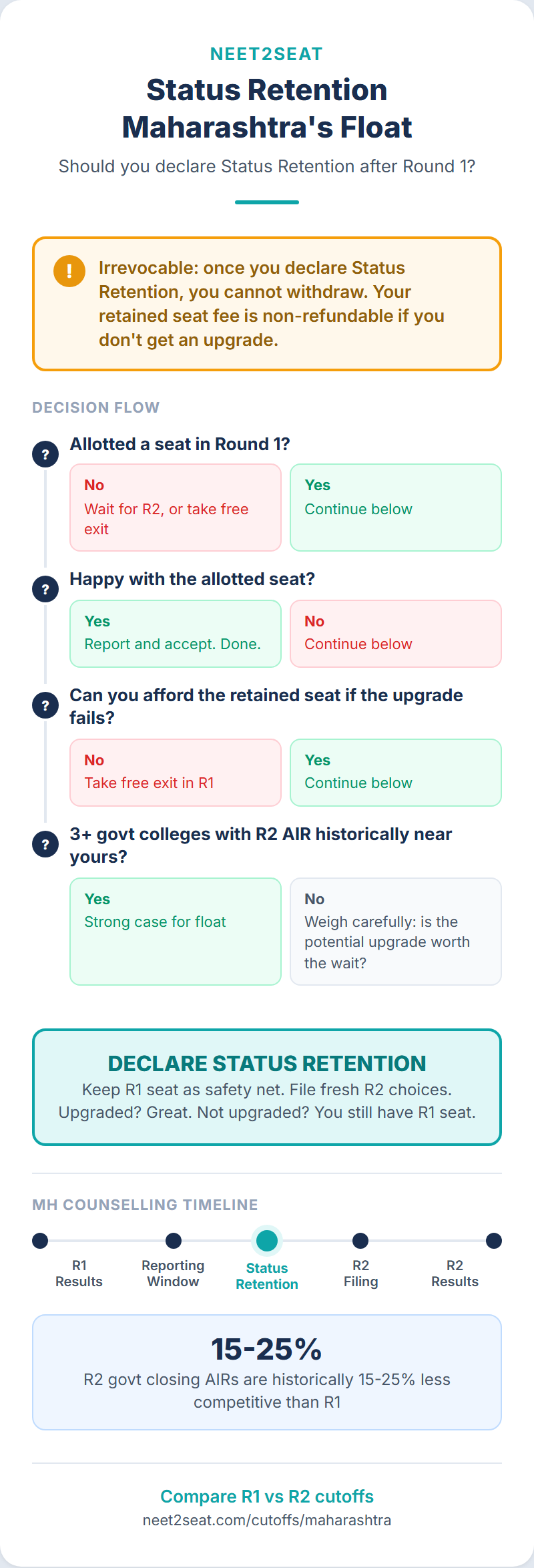
- Status Retention is irrevocable: once declared, you cannot withdraw even if no upgrade materializes.
- Only retain a seat you would genuinely attend for five years at its fee level.
- Round 2 closing AIRs at government colleges are typically 15% to 25% less competitive than Round 1.
- You must still fill Round 2 preferences after declaring Status Retention; the upgrade does not happen automatically.
Status Retention is Maharashtra’s version of floating, with one critical difference: it is irrevocable
In Maharashtra’s CET Cell counselling, “Status Retention” is the mechanism for keeping your Round 1 seat while seeking an upgrade in Round 2. The concept is identical to MCC’s “Float”: you hold your current allotment as a safety net and let the algorithm check whether anything better is available. The difference is in the commitment. Once you declare Status Retention on a seat in Maharashtra, you cannot withdraw from it. If Round 2 does not produce an upgrade, that seat is yours, and you must report to the college.
This guide covers the Maharashtra-specific mechanics. For the general float-vs-freeze framework, see our float vs freeze pillar guide. For Karnataka’s equivalent system, see our Karnataka Choice 1 vs Choice 2 guide.
The timeline: when Status Retention happens
Status Retention applies between Round 1 and Round 2. The sequence:
- Round 1 results are published. You see your allotment (college, category, seat type).
- Reporting window opens. If you want to accept the seat, you report to the college, pay the fees, and confirm admission. This is equivalent to “freezing.”
- Status Retention window opens (usually overlapping with or immediately after reporting). If you want to keep the seat but seek an upgrade, you file a Status Retention declaration through the CET Cell portal. You pay the required deposit.
- Free Exit window. If you do not want the seat at all, you do not report and do not declare Status Retention. Your seat is released, your deposit is refunded, and you enter Round 2 as a fresh candidate.
- Round 2 choice filling opens. You fill a fresh preference list (Maharashtra allows new preferences every round).
- Round 2 results. If upgraded, you report to the new college. If not upgraded, you report to your Round 1 college (the one you retained).
What happens mechanically when you declare Status Retention
When you file Status Retention:
- Your Round 1 seat is locked to you. No other candidate can be allotted to it during Round 2.
- You fill a new Round 2 preference list. Only colleges ranked above your Round 1 allotment (in terms of your preference) are considered for upgrade. If you list the same college you already hold, the system ignores it since you already have it.
- The Round 2 algorithm processes all candidates simultaneously: Status Retention candidates seeking upgrades, fresh candidates, and Round 1 candidates who took free exit.
- If your AIR qualifies for a college on your Round 2 list that is better than your retained seat, you are upgraded. Your Round 1 seat is released to other candidates.
- If no upgrade is available, your Round 1 seat is confirmed. You must report to that college.
The irrevocability rule and why it matters
Status Retention in Maharashtra is binding. Once declared, you cannot change your mind and take free exit, withdraw from the retained seat, or participate in other counselling for that seat. The college you retain becomes your guaranteed minimum outcome. If you retain a private college at Rs 18 lakh per year and are not upgraded, you owe Rs 18 lakh per year for five years.
This is the single most important difference from Round 1’s free exit. In Round 1, listing a college you do not want costs nothing because exit is free. In the Status Retention phase, the college you retain becomes your guaranteed minimum outcome.
Choose what you retain carefully. Only retain a seat you would genuinely attend if the upgrade does not materialise.
Who should use Status Retention
Candidates allotted a private college who want a government upgrade
This is the most common Status Retention scenario. You got a private college in Round 1 (fees Rs 5 lakh to Rs 25 lakh per year depending on the institution) but government colleges you qualify for did not allot to you because cutoffs were tighter than expected. Round 2 cutoffs at government colleges are typically 15% to 25% less competitive than Round 1. Retaining the private seat gives you a safety net while the government upgrade becomes possible.
Check the Maharashtra cutoff analyzer to compare your AIR against Round 2 closing AIRs at government colleges for your category in previous years. If 3 or more government colleges had Round 2 closing AIRs at or above your AIR, Status Retention is well justified.
Candidates allotted a lower-preference government college
If you got a government college in a smaller city but prefer one in Mumbai or Pune, Status Retention lets you hold the current seat while trying for the metropolitan option. The fees are the same either way (approximately Rs 1.62 lakh per year at all Maharashtra government colleges), so the financial stakes are lower. The decision comes down to location and clinical exposure preferences.
Candidates whose AIR is within striking distance of target colleges
If your AIR was 2,000 to 5,000 ranks above (worse than) a target college’s Round 1 closing AIR, Round 2 easing may bring that college within reach. Status Retention is the mechanism to hold your current seat while that window opens.
Who should NOT use Status Retention
Candidates allotted their top 1-3 choices
If you got one of your most preferred colleges, there is no meaningful upgrade available. Report to the college directly. Status Retention adds administrative delay with no upside.
Candidates whose target upgrades are unrealistic
If the colleges above your allotment closed at AIRs 10,000 or more below your rank, Round 2 easing of 15% to 25% will not bridge the gap. Retaining your seat keeps you in the system for another week or two with no practical benefit. Worse, it delays your reporting and preparation.
Candidates uncomfortable with the retained seat’s fees
If you retained a private college at Rs 20 lakh per year and the upgrade does not happen, you owe that money. If that fee level creates genuine financial hardship, do not retain that seat. Take free exit in Round 1, enter Round 2 as a fresh candidate, and build a preference list that only includes colleges you can afford. Free exit has no financial penalty; Status Retention has a commitment.
Status Retention and fresh preference filling
Maharashtra’s fresh preference filling in each round interacts with Status Retention in a specific way. In Round 2, your preference list determines which colleges you can be upgraded to. Since you can build a completely new list, you should:
Three steps for your Round 2 list after declaring Status Retention: (1) Use Round 1 closing AIR data to recalibrate. Colleges that were Reach in Round 1 may now be Target. (2) List only colleges better than your retained seat. (3) Be aggressive: you have a safety net (the retained seat), so load the top of your Round 2 list with ambitious targets.
See our Maharashtra choice filling guide for detailed Round 2 preference strategy.
Deposit and fee mechanics
CET Cell specifies the deposit amount for Status Retention in each year’s information bulletin. The deposit is adjusted against the fees of your final college (whether the retained college or an upgraded one). Key points:
- The Status Retention deposit is separate from the initial counselling registration fee.
- If upgraded, you pay the balance fees at the new college. The deposit transfers.
- If not upgraded, the deposit counts toward your retained college’s fees.
- The deposit is not refundable once Status Retention is declared (this is part of the irrevocability).
Check the current year’s CET Cell information bulletin for the exact deposit amount. It varies by seat type (state quota vs institutional quota) and by college type (government vs private).
Status Retention and MCC dual participation
Many candidates participate in both Maharashtra state counselling and MCC counselling simultaneously. If you have a state counselling allotment and an MCC allotment:
- You can declare Status Retention on your Maharashtra seat while continuing with MCC rounds.
- If you eventually accept an MCC seat, you must cancel your Maharashtra seat per CET Cell rules.
- The cancellation timing matters: cancelling before specific deadlines may entitle you to a partial refund; cancelling after may forfeit the deposit.
- Each year’s information bulletin specifies the exact cross-counselling rules and refund timelines.
If you have a good MCC allotment and a Maharashtra allotment you are retaining, evaluate whether the MCC seat is preferable to both your current Maharashtra seat and the potential upgrade. If the MCC seat is your best option, take it and cancel the Maharashtra retention before the deadline to minimize financial loss.
Common mistakes with Status Retention
Retaining a seat you cannot afford
Candidates sometimes retain a private college seat “just in case” without fully calculating the five-year fee commitment. A private seat at Rs 18 lakh per year means Rs 90 lakh over five years. If the upgrade does not happen, you are locked into that fee structure with no way out. Only retain a seat you can financially sustain.
Not filing Round 2 preferences after declaring Status Retention
Status Retention reserves your seat but does not automatically enter you into Round 2. You must still fill a Round 2 preference list to be considered for upgrades. If you declare Status Retention and forget to fill Round 2 preferences, you simply keep your Round 1 seat with no upgrade attempt. The retention period was wasted.
Assuming Status Retention guarantees an upgrade
Status Retention guarantees that you keep your Round 1 seat. It does not guarantee an upgrade. The upgrade depends on your AIR, your Round 2 preferences, and the available seats. Treat the retained seat as your floor, not your ceiling.
Missing the declaration deadline
CET Cell publishes specific deadlines for Status Retention declarations. Missing the deadline means you default to either acceptance (if you reported to the college) or free exit (if you did not). Neither may be what you intended. Mark the deadline in your calendar the moment the Round 1 results are published.
FAQ
Can I declare Status Retention for a government college seat?
Yes. Status Retention applies to any allotted seat, whether government, private, or deemed university (state quota). If you have a government seat in a smaller city and want to try for a government seat in Mumbai, Status Retention is the mechanism.
What if I declared Status Retention but do not fill Round 2 preferences?
You keep your Round 1 seat. No upgrade attempt is made. You must report to the original college. The deposit is adjusted against the fees.
Can I declare Status Retention for Round 2 to Round 3?
CET Cell’s retention rules between Round 2 and Round 3 vary by year. Some years allow a similar retention mechanism; others require Round 2 allottees to either accept or exit. Check the current year’s information bulletin for the exact Round 2 to Round 3 rules.
If I am upgraded in Round 2, can I then float again for Round 3?
This depends on the specific year’s rules. In general, once upgraded, you are subject to the same accept-or-exit decision as any Round 2 allottee. Whether a second retention is available depends on CET Cell’s policy for that cycle.
What is the difference between Status Retention and “not reporting”?
“Not reporting” in Round 1 is free exit: you give up the seat, your deposit is refunded, and you re-enter as a fresh candidate. Status Retention means you keep the seat (with a financial commitment) while seeking an upgrade. They are opposite actions. Free exit releases the seat; Status Retention locks it.