Category: Float vs Freeze

Post-allotment decisions: retain, upgrade, or freeze your seat

  • Float, freeze, and upgrades in AIQ counselling

    Float, freeze, and upgrades in AIQ counselling

    After each round of MCC NEET UG counselling, allotted candidates face a decision: freeze the seat (accept permanently) or float (accept but request an upgrade in the next round). Getting this wrong can mean losing a good seat or forfeiting your security deposit. This guide explains exactly how each option works, what the risks are round by round, and how to think through the decision.

    The two options at reporting

    When you report to your allotted college after an MCC round, you submit documents, pay fees, and select a willingness option:

    Freeze: You accept this seat permanently. You exit all future MCC counselling rounds. Your seat is confirmed and you begin the academic session at this college. No further changes are possible through MCC.

    Float (also called “upgrade willingness”): You accept this seat and keep it, but you also tell MCC that you want to be considered for an upgrade in the next round. If a seat at a college you ranked higher in your next preference list becomes available, you are automatically upgraded. Your current seat is then released for someone else. If no upgrade is available, you keep your current seat.

    There is also a third implicit option in Round 1: not joining. In Round 1, this is a free exit with full security deposit refund. In later rounds, not joining has consequences.

    Decide your Float-or-Freeze strategy before reporting day. Check round-wise closing rank trends on our AIQ cutoff analyzer for your target colleges. If a preferred college showed significant seat movement between rounds in 2023-2025, floating is a calculated bet worth taking.

    Round-by-round rules

    Round 1

    Action Outcome Deposit
    Join + Freeze Seat confirmed; exit all future rounds Retained by college
    Join + Float Seat held; eligible for upgrade in Round 2 Retained by college
    Free exit (don’t join) No seat; can register for Round 2 or 3 Refunded in full

    Round 1 is the lowest-risk round. If you are not satisfied with your allotment, you can walk away with no financial penalty. If you are moderately satisfied but think you might do better, join with Float. If your allotment is exactly what you wanted, Freeze.

    Round 2

    Action Outcome Deposit
    Join + Freeze Seat confirmed; exit all future rounds Retained by college
    Join + Float Seat held; eligible for upgrade in Round 3 Retained by college
    Don’t join (exit) No seat; deposit forfeited; ineligible for further MCC rounds Forfeited

    The stakes increase in Round 2. If you are allotted a seat and choose not to join, your security deposit (Rs 10,000 for government AIQ; Rs 2,00,000 for deemed) is forfeited and you cannot participate in any further MCC rounds for that cycle. The free exit window is over.

    From Round 2, not joining your allotment costs you both your deposit (up to Rs 2,00,000 for deemed seats) and your eligibility for all remaining MCC rounds. The free exit privilege ends after Round 1.

    Round 3 (mop-up)

    Fresh registration is required. If you are allotted a seat in Round 3, joining is compulsory. Resignation after joining is not permitted. Candidates who joined in Round 2 with Float can be upgraded; if upgraded, they must report to the new college.

    Stray vacancy round

    Joining is compulsory. There is no Float option; you can only Freeze. If allotted and you do not join, your deposit is forfeited and you face permanent disqualification from MCC counselling.

    How upgrades actually happen

    When you select Float after joining in Round 1, here is what happens in Round 2:

    1. You fill fresh choices for Round 2 (your Round 1 list is voided).
    2. The allotment algorithm runs again, processing all candidates by rank. Your Round 1 seat is temporarily considered occupied by you.
    3. If the algorithm finds a college from your Round 2 preference list that is higher than your current allotment and has a vacant seat at your rank, you are upgraded.
    4. Your Round 1 seat is released and becomes available for other candidates in the same Round 2 processing.
    5. If no upgrade is found, you keep your Round 1 seat with no change.

    The same logic applies between Round 2 and Round 3 for candidates who chose Float in Round 2.

    When to Freeze

    Freeze if:

    • You are allotted your first or second preference and would not want to risk any change.
    • You are satisfied with the college and the fee (especially relevant for deemed university seats with Rs 2,00,000 deposit at stake).
    • You are also participating in state counselling and prefer to focus there. Freezing in MCC locks your MCC seat while you continue state counselling. If your state allotment is better, you can resign from MCC (check that year’s MCC bulletin for the resignation process and any penalties).

    When to Float

    Float if:

    • You are content with your current allotment but a significantly better option exists if seats shift. For example, you got your 8th preference and your top 3 are colleges where cutoffs sometimes loosen in Round 2.
    • You have checked historical cutoff data and see movement between rounds. Our AIQ cutoff analyzer shows closing ranks by round for each college across 2023-2025. If the college you want had seats available in Round 2 last year at ranks near yours, floating is reasonable.
    • You are early in the process (Round 1) where the downside of floating is low (you still hold a seat, and there is no deposit risk from floating itself).

    The risk of floating

    Floating does not risk your current seat. If no upgrade is available, you keep what you have. The risk is different: by floating, you opt into the next round’s allotment, which means filling a fresh preference list. If you accidentally omit your current college from the Round 2 list (or list it lower than a college you would not actually prefer), the algorithm may move you to a seat you like less than your Round 1 allotment.

    Floating itself carries no risk of downgrade or seat loss. You keep your current seat unless a higher preference becomes available. The only danger is a mistake in your next-round preference list.

    The safest approach when floating: include your current college in your Round 2 preference list at the position where it truly ranks among your preferences. List better options above it; list worse options below or exclude them. This way, the worst-case outcome of floating is keeping your current seat.

    When floating, always include your current college in your next-round preference list at its true rank. This ensures the worst outcome is keeping the seat you already have. Omitting it by accident is the real risk of floating.

    MCC float/freeze versus state counselling equivalents

    If you are comparing MCC’s system to state counselling mechanisms:

    Maharashtra: Uses “Status Retention” instead of Freeze. Status Retention in Maharashtra is irrevocable and removes you from all future state counselling rounds. MCC’s Freeze is similarly permanent but the mechanism differs (deposit-based in MCC, form-based in Maharashtra). Maharashtra does not have a Float equivalent; instead, candidates who skip Status Retention are automatically considered for upgradation in the next round.

    Karnataka: Uses a Choice-1, Choice-2, Choice-3 system. Choice-1 is similar to Freeze; Choice-2 allows upgradation within the same college; Choice-3 allows upgradation across all colleges (similar to Float). See our Karnataka Choice-1 vs Choice-2 guide for details.

    FAQ

    If I float in Round 1, can I be downgraded to a worse seat in Round 2?

    No. The upgrade mechanism only moves you to a higher preference from your Round 2 list. If no higher preference is available, you keep your Round 1 seat. You cannot be moved to a lower-preference seat through floating.

    Can I switch from Float to Freeze between rounds?

    Yes. If you selected Float in Round 1 and are not upgraded in Round 2, you can choose Freeze when you report for Round 2. At that point, your seat is confirmed and you exit future rounds.

    What is the financial risk of floating with a deemed university seat?

    The security deposit for deemed university registration is Rs 2,00,000. If you float and later decide not to join after Round 2 allotment (not just the float outcome, but a separate exit decision), you lose this deposit. Floating itself does not forfeit your deposit; it only keeps you in the pool. The deposit is at risk only if you actively exit after Round 2.

    Does floating affect my state counselling participation?

    No. Floating or freezing in MCC is independent of your state counselling status. You can hold a seat in MCC (frozen or floating) while participating in state counselling, until the point where cross-track rules apply (typically after Round 3 in either track).

    Should I float if my seat is at AIIMS New Delhi?

    If AIIMS New Delhi is your top preference and you have been allotted a seat there, Freeze. There is nothing higher to upgrade to within MCC. The only scenario for floating from AIIMS New Delhi is if you specifically want a different course (BDS to MBBS, for example) at the same or different institution, which is an unusual situation.
  • How NEET Round 2 cutoffs change from Round 1 (and what to expect)

    • Round 2 cutoffs ease by 15% to 25% at mid-tier government colleges, but only 5% to 10% at top-5 colleges.
    • Private college Round 2 shifts are volatile (10% to 60%) and harder to predict from historical data.
    • A small percentage of colleges (5% to 10%) can actually tighten in Round 2 due to seat additions or cross-counselling timing.
    • Use multi-year historical averages as directional guides, not exact forecasts; actual shifts can vary 5% to 10% from the average.

    Round 2 cutoffs are not Round 1 cutoffs minus a few thousand ranks

    The most common assumption candidates make about Round 2 is that closing AIRs simply ease by a predictable margin: “Round 1 closed at 15,000, so Round 2 will close around 18,000.” The reality is more complex. Round 2 cutoffs shift for specific structural reasons, and those reasons vary by college type, category, state, and year. Some colleges ease substantially. Others barely move. A few actually tighten.

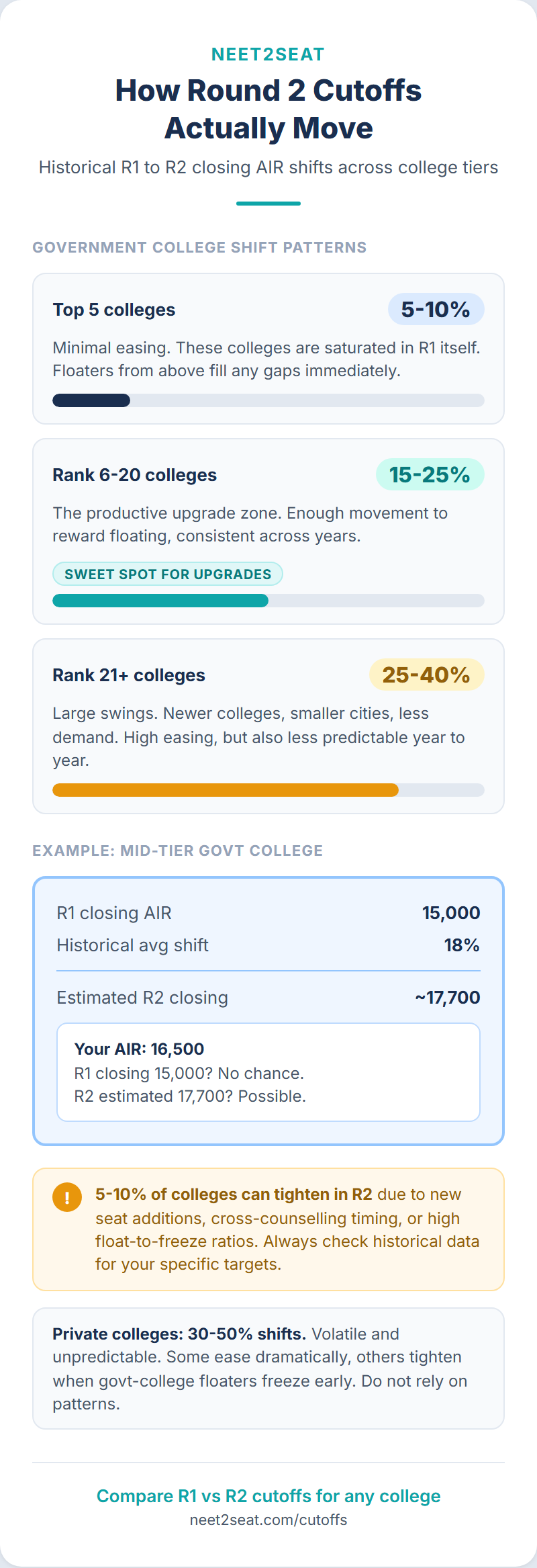
    Infographic showing how NEET cutoffs change in round 2

    This guide explains the mechanics behind Round 2 cutoff changes, using actual patterns from our database of 407,000+ allotment records across Maharashtra and Karnataka (2023 to 2025). For state-specific choice filling strategy, see our Maharashtra guide and our Karnataka guide.

    Why Round 2 cutoffs change at all

    Round 2 has a different candidate pool and a different seat pool than Round 1. Both changes push cutoffs in specific directions.

    The candidate pool shrinks

    After Round 1, some candidates exit permanently:

    • Candidates who chose to freeze (MCC) or Choice 1 (Karnataka) are gone. They accepted Round 1 seats and left counselling.
    • Candidates who took free exit (Maharashtra Round 1) re-enter Round 2, but any candidates who secured seats in other tracks (MCC, other state counselling, deemed university direct admission) may not return.

    A smaller candidate pool means less competition for the same seats, pushing closing AIRs higher (less competitive).

    The seat pool changes

    Seats available in Round 2 are not the same as Round 1:

    • Newly vacated seats: Seats from candidates who took free exit (Maharashtra) or chose Choice 3 (Karnataka) become available.
    • Float/upgrade seats: Seats from candidates who are upgraded in Round 2 are released for others.
    • New additions: NMC may approve additional seats between rounds. Some colleges add capacity.
    • Removed seats: Seats at colleges with compliance issues may be withdrawn.

    The net effect varies: the seat pool usually grows slightly in Round 2 compared to the seats available after Round 1 freezes and exits are processed.

    What our data shows about Round 2 shifts

    Government colleges: consistent easing at mid-tier, minimal at the top

    Across 2023 to 2025 in Maharashtra, the pattern at government colleges is remarkably consistent:

    Top-5 government colleges (Seth GS, Grant, BJ Medical Pune, LTMMC Mumbai, GMC Nagpur) ease by only 5% to 10% in Round 2. These fill with top-ranked candidates who freeze immediately. Mid-tier colleges (ranked 6th to 20th) ease by 15% to 25%: the sweet spot for upgrades. Colleges ranked 21st and below can ease by 30% to 40%, especially in smaller cities.

    Karnataka follows a similar pattern. Bangalore Medical College and Mysore Medical College show 5% to 15% easing in Round 2. Government colleges in Bellary, Shimoga, Mandya, and similar cities show 15% to 30% easing.

    Private colleges: volatile and unpredictable

    Private college Round 2 cutoffs are harder to predict from Round 1 data alone. The reasons:

    • Fee changes: Some private colleges adjust fee structures between rounds or years, affecting demand.
    • Seat type mix: The ratio of state quota to management quota to NRI quota seats available in Round 2 differs from Round 1.
    • Candidate behaviour: Candidates allotted private seats in Round 1 are the most likely to seek upgrades (to government colleges), creating large Round 2 vacancies at some private colleges.

    At competitive private colleges in metropolitan areas (Mumbai, Bengaluru, Pune), Round 2 easing ranges from 10% to 30%. At less competitive private colleges, closing AIRs can jump by 40% to 60% between Round 1 and Round 2, meaning seats that were previously full are now available to candidates with much higher (weaker) ranks.

    Category-specific patterns

    Reserved category cutoffs do not always move in the same direction as OPEN cutoffs. Patterns we observe:

    • SC and ST categories often show larger Round 2 easing than OPEN because fewer reserved category candidates have backup options in other counselling tracks.
    • OBC and EWS categories tend to track OPEN movement more closely.
    • Karnataka suffix categories (K, R, H, KH, RH) can show erratic Round 2 movement because the candidate pools are smaller. A few candidates leaving the system can shift closing AIRs significantly.
    • Maharashtra compound categories (OPENW, SCW, etc.) follow their base category trends but with more volatility due to smaller numbers.

    Year-to-year variation: why last year’s Round 2 is not a guarantee

    Round 2 cutoff changes are not constant across years. Three factors cause year-to-year variation: overall NEET cohort competitiveness, policy changes (such as Karnataka’s 2025 fee cap), and seat matrix changes (new colleges, added seats, NMC compliance actions). Always use multi-year data rather than a single year’s shift to estimate your Round 2 chances.

    Overall competitiveness of the NEET cohort

    If the overall NEET exam is easier or harder than the previous year, all cutoffs shift accordingly. In years when NEET scores are higher across the board (easier paper or larger candidate pool), Round 2 cutoffs tighten relative to what historical data would predict.

    Policy changes

    Karnataka’s 2025 advance fee cap (Rs 12,001 for Choice 2) likely increased the number of candidates using Choice 2 instead of Choice 1 or Choice 3. More Choice 2 candidates means fewer seats vacated after Round 1, which could reduce Round 2 seat availability and temper the expected easing.

    Maharashtra’s information bulletin changes (deposit amounts, deadlines, seat matrix modifications) similarly affect candidate behaviour and Round 2 dynamics.

    Seat matrix changes

    New colleges opening, existing colleges adding seats, or NMC compliance actions removing seats all change the Round 2 seat pool in ways that historical data cannot predict. Maharashtra added several new government medical colleges in recent years, expanding the seat pool. Karnataka’s deemed university government quota allocations change periodically.

    How to use Round 1 data for Round 2 decisions

    After Round 1 results: (1) Go to the cutoff analyzer and filter for your state, current year, and category. (2) Note Round 1 closing AIRs for each college. (3) Check what Round 2 closing AIRs were in 2023, 2024, and 2025 for the same colleges. (4) Calculate the average Round 1 to Round 2 percentage shift. (5) Apply that average to the current Round 1 closing to estimate Round 2. If your AIR falls within the estimated range, the college is a realistic target.

    This is a rough estimation. Actual Round 2 closings can deviate from historical averages. But it is far more reliable than guessing or relying on social media predictions.

    Colleges where Round 2 is harder than Round 1

    In rare cases, Round 2 closing AIRs at a specific college can be lower (more competitive) than Round 1. This happens when:

    • Seats were added after Round 1 at the same college, attracting higher-ranked candidates who missed Round 1 for that institution.
    • A popular college that was under-filled in Round 1 (due to late seat addition or initial uncertainty) draws a rush of candidates in Round 2.
    • Cross-counselling timing: candidates who were waiting for MCC results before committing to state counselling enter Round 2 with strong AIRs, pushing cutoffs lower at specific colleges.

    These cases are uncommon (affecting 5% to 10% of colleges in any given year), but they serve as a reminder that Round 2 easing is a tendency, not a law. Always check multi-year data for your specific target colleges rather than assuming directional movement.

    Round 2 vs Round 3 and mop-up: diminishing returns

    The magnitude of cutoff easing typically peaks in Round 2 and diminishes in subsequent rounds:

    • Round 2: The largest movement. Maximum seat turnover from Round 1 exits and floats. Closing AIRs ease 15% to 25% at most mid-tier colleges.
    • Round 3: Smaller seat pool. Movement is 5% to 15% additional easing from Round 2, if any. Some colleges do not have Round 3 seats at all.
    • Mop-up: Minimal seat pool. Cutoffs can jump wildly (both easier and harder) because the candidate numbers are small and behaviour is unpredictable.

    If your target college did not become achievable in Round 2, the probability of it becoming achievable in Round 3 or mop-up is low (but not zero). See our mop-up round guide for that specific scenario.

    FAQ

    Do all Round 2 cutoffs ease, without exception?

    No. Most colleges see easing in Round 2, but a small percentage (5% to 10%) may see tightening due to seat additions, cross-counselling timing, or other structural factors. Always check multi-year data for your specific target colleges.

    Is the percentage easing consistent across categories?

    Not exactly. OPEN category easing tends to be the most predictable. Reserved categories with smaller candidate pools (ST, Karnataka suffix codes) show more volatile Round 2 shifts. Use category-specific historical data, not OPEN data, to estimate your Round 2 chances.

    Should I count on Round 2 easing when building my Round 1 preference list?

    No. Build your Round 1 list based on Round 1 data. Round 2 easing is a potential opportunity, not a planning assumption. If you under-fill your Round 1 list because you are “counting on Round 2,” and Round 2 easing is less than expected, you end up with no seat in either round.

    How accurate is the historical average shift as a predictor?

    It is the best available predictor, but not precise. Actual shifts can vary 5% to 10% from the historical average in any given year. Use the average as a directional guide, not an exact forecast. The more years of data you average, the more stable the estimate.

    Does the cutoff analyzer show Round 2 data separately from Round 1?

    Yes. Filter by round to see closing AIRs for each round independently. This lets you calculate Round 1 to Round 2 shifts directly from the data. On the cutoff analyzer, select the specific year and round to compare.

  • NEET mop-up round: what seats remain and how to approach them

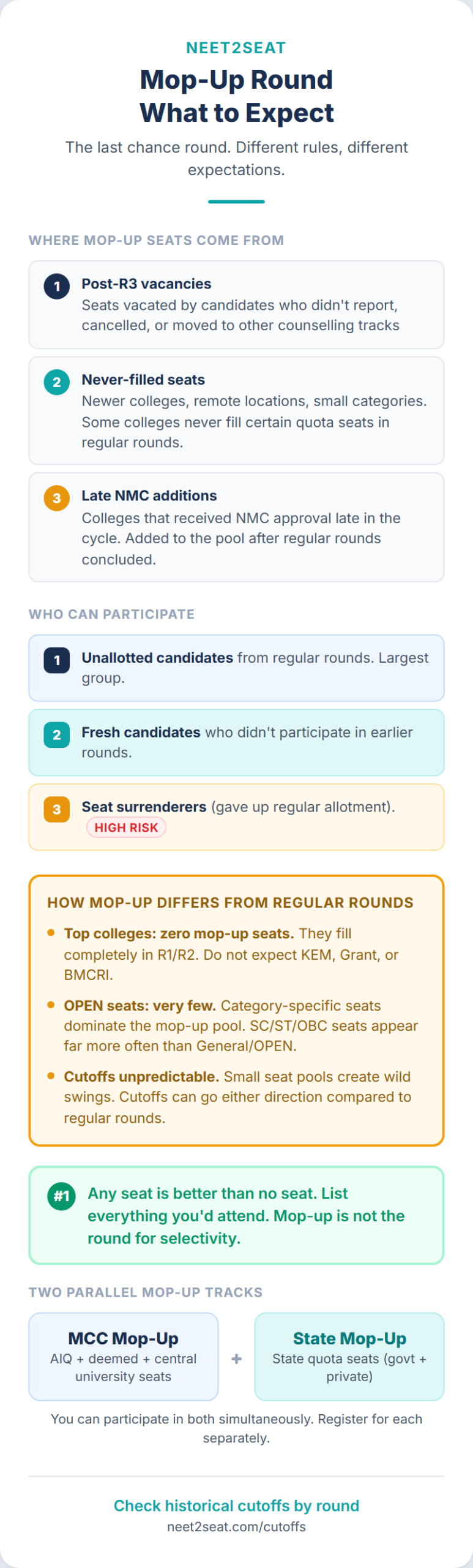
    • Mop-up seats are disproportionately at private colleges and in reserved categories; top government colleges rarely have vacancies.
    • Do not extrapolate regular round cutoffs to mop-up; the dynamics are fundamentally different with small, unpredictable seat pools.
    • The mop-up round is not the time for selectivity. List every available college in order of preference.
    • Reporting deadlines are tight (2-3 days) and allotments are typically binding with no free exit.

    The mop-up round is not a second chance. It is a last resort with different rules.

    After Rounds 1, 2, and 3 of regular counselling, some medical college seats remain unfilled. The mop-up round (sometimes called the stray vacancy round) exists to fill these leftover seats. Candidates still without an MBBS admission, or those willing to give up an existing seat for a potentially better one, can participate.

    Infographic explaining the NEET mop-up round

    The mop-up round operates under a different set of rules than regular rounds. The seat pool is small and unpredictable. The candidate pool is a mix of newcomers, previous round rejects, and strategic upgraders. Cutoff behaviour deviates from what historical data would suggest for regular rounds. Approach it as a last resort, not a planned strategy.

    This guide covers what the mop-up round actually looks like and how to approach it. For the regular round structure, see our counselling process overview. For round-to-round cutoff shifts, see our Round 2 cutoff changes guide.

    What seats are available in the mop-up round

    Mop-up seats come from three sources:

    Seats vacated after Round 3

    Candidates who were allotted in Round 2 or 3 but did not report, or who cancelled their admission before the mop-up deadline, leave behind vacant seats. These cancellations happen for various reasons: the candidate secured a better seat in another counselling track (MCC, deemed university management quota), decided against MBBS entirely, or could not arrange finances for the allotted college’s fees.

    Seats that were never filled

    Some seats go unfilled through all three regular rounds. This typically happens at newer colleges in remote locations, colleges with recent NMC compliance issues, or specific category-seat type combinations where the eligible candidate pool is smaller than the seat count. Private colleges in non-metropolitan areas and deemed university government quota seats are the most common unfilled categories.

    Late additions

    Seats approved by NMC after the regular counselling cycle began, or seats from colleges that received late recognition, may appear for the first time in the mop-up round.

    Who participates in the mop-up round

    Unallotted candidates from regular rounds

    Candidates who participated in Rounds 1 through 3 but were not allotted anywhere. This includes candidates whose AIR was not competitive enough for any college on their preference list in any round. These candidates have the most to gain from the mop-up round: any seat is better than no seat.

    Fresh candidates who did not participate earlier

    Some candidates skip regular rounds (for various reasons: documentation issues, waiting for other entrance exam results, personal circumstances) and enter at the mop-up stage. They bring a fresh set of AIRs into the pool, which can shift cutoffs unpredictably.

    Candidates who forfeited earlier seats

    In Karnataka, Choice 3 candidates who rejected Round 1 seats and were not allotted in Round 2 may be eligible for the mop-up round (depending on KEA’s rules for that year). These candidates have known AIRs and a history of participation.

    Candidates surrendering current seats for upgrades

    In some counselling tracks, candidates with existing seats can surrender them and participate in the mop-up round, hoping for a better allotment. This is high-risk: surrendering a guaranteed seat for a thin, unpredictable mop-up pool is rarely advisable unless the current seat is genuinely unacceptable.

    How mop-up cutoffs differ from regular rounds

    Wider spread, less predictability

    In regular rounds, cutoffs follow a roughly predictable gradient: top colleges have the lowest (most competitive) closing AIRs, mid-tier colleges cluster in the middle, and less competitive colleges close at higher AIRs The gradient is consistent year over year.

    In the mop-up round, this gradient breaks down. The seat pool is small (sometimes only 5 to 20 seats at a given college, compared to hundreds in Round 1), and the candidate pool is mixed. A college that closed at AIR 40,000 in Round 2 might have mop-up seats closing at AIR 80,000 or at AIR 25,000, depending on who shows up. Historical mop-up data is more useful than regular round data for predicting outcomes.

    Some colleges have no mop-up seats

    The top government colleges in both Maharashtra and Karnataka typically fill all their seats in Rounds 1 and 2. By the mop-up stage, Seth GS Medical College (Mumbai), Bangalore Medical College, Grant Medical College (Mumbai), and similar institutions have zero vacancies. If your strategy depends on getting a top government seat, the mop-up round will not help.

    Category seats dominate the mop-up pool

    OPEN seats at desirable colleges fill early. What remains in mop-up is disproportionately composed of reserved category seats (especially smaller categories like ST, EWS, or suffix categories in Karnataka) and private college institutional quota seats. If you are in the OPEN category, your mop-up options are more limited than the total seat count suggests.

    MCC mop-up vs state counselling mop-up

    MCC and state counselling authorities run separate mop-up processes:

    MCC mop-up/stray vacancy

    MCC runs a mop-up round for AIQ (All India Quota) seats at government colleges, and for deemed university seats. The MCC mop-up typically happens after all regular MCC rounds are complete. Candidates who did not secure a seat through MCC regular rounds can participate. The seat pool is from all participating states, making it geographically diverse but unpredictable.

    Maharashtra CET Cell mop-up

    CET Cell conducts its own mop-up/stray vacancy round for state quota seats. The timeline follows the completion of regular state counselling rounds. Maharashtra’s mop-up seats tend to be at private colleges and newer government colleges. The process follows CET Cell’s standard choice-filling mechanism (fresh preference filing).

    Karnataka KEA mop-up

    KEA manages the mop-up for Karnataka state quota seats. The format may differ from regular rounds: some years KEA has conducted spot-round physical counselling (candidates physically present at a venue) rather than online choice filling. Check the current year’s KEA notification for the exact format and arrange travel to the venue in advance if needed.

    You can participate in both MCC and state counselling mop-up rounds if you are eligible for both. The timelines may overlap, so track both schedules.

    Strategy for the mop-up round

    Treat it as “take what is available”

    The mop-up round is not the time for selectivity. If you have reached this stage without a seat, your goal is to secure any MBBS admission. The difference between colleges matters far less than the difference between having a seat and not having one. List every college with available seats, in order of your genuine preference, but include all of them.

    Research the seat matrix before the deadline

    Counselling authorities publish the mop-up seat matrix before the choice-filling window opens. Study it the moment it is released. The matrix tells you exactly what is available, not what you hope might be available. If your target college has zero seats in the mop-up matrix, it is not an option. Cross-reference with your category eligibility to identify every viable option.

    Do not extrapolate from regular round cutoffs

    A college that closed at AIR 50,000 in Round 2 might have mop-up seats closing at AIR 30,000 (because only a few seats are available and strong candidates are competing for them) or at AIR 1,00,000 (because the candidate pool is thinner). Historical mop-up data, if available, is more useful than regular round data for predicting mop-up cutoffs.

    Our cutoff analyzer includes round-level data where available. If the database contains mop-up or Round 3 records for a college, those are your best reference points.

    Be prepared for physical counselling

    Some state authorities (including KEA in some years) conduct mop-up as a physical spot round rather than online. This requires you to be physically present at the designated venue (typically in the state capital) on the specified date. Travel and accommodation need to be arranged in advance. Missing the spot round means missing the opportunity entirely.

    Watch for timing conflicts between MCC and state mop-up

    MCC and state mop-up rounds sometimes overlap in their schedules. If you are participating in both, ensure you can meet deadlines for both tracks. Accepting a seat in one track’s mop-up may require cancelling participation in the other. Understand the cancellation rules and financial implications before committing.

    Financial considerations in the mop-up round

    Mop-up seats are disproportionately at private colleges. A five-year commitment at Rs 15 lakh to Rs 25 lakh per year totals Rs 75 lakh to Rs 1.25 crore. Assess whether you can afford private college fees before filling preferences. Government college seats in the mop-up round are rare but possible, especially at newer or smaller-city institutions. If any government seats appear in the matrix, they should top your list regardless of location.

    Deemed university government quota seats (filled through KEA in Karnataka or through MCC nationally) sometimes appear in mop-up. These can have fees intermediate between government and private levels. Check the exact fee structure for each deemed university in the information bulletin.

    After the mop-up round

    If you secure a seat in the mop-up round, report immediately. Mop-up reporting deadlines are tight, often 2 to 3 days from the allotment announcement. Missing the reporting deadline forfeits the seat.

    If the mop-up round does not produce an allotment, your options narrow significantly:

    • Management quota: Private colleges and deemed universities fill management quota seats through their own admission processes, separate from government counselling. These seats are expensive (Rs 25 lakh to Rs 50 lakh per year) but may still be available after all counselling rounds are complete.
    • NRI quota: NRI seats at some colleges remain unfilled and are converted or offered to other candidates. Availability varies by institution and year.
    • Drop year: If no acceptable seat is available, some candidates choose to prepare for the next year’s NEET exam. This is a significant decision that should account for the opportunity cost of a year, the likelihood of score improvement, and the psychological factors involved.

    FAQ

    Can I participate in the mop-up round if I already have a seat from Rounds 1-3?

    Rules vary by counselling authority and year. In some tracks, you can surrender your current seat and participate in mop-up. In others, current seat holders are not eligible. Check the specific rules for MCC, CET Cell, or KEA for the current year. Surrendering a seat to enter mop-up is high-risk; only consider it if your current seat is genuinely unacceptable.

    Are mop-up round seats binding?

    Generally yes. Mop-up allotments are typically final. There is no free exit after the mop-up round. If allotted, you are expected to report and pay fees. Non-reporting may result in deposit forfeiture and disqualification from future rounds.

    How many seats are typically available in the mop-up round?

    This varies significantly by year. In Maharashtra, mop-up seats can number in the hundreds (predominantly at private colleges). In Karnataka, the mop-up pool depends on how many candidates chose Choice 3 without receiving Round 2 allotments and how many seats were added late. Exact numbers are published in the seat matrix before the mop-up window opens.

    Is the mop-up round worth waiting for?

    If you already have a seat from regular rounds that you can live with, do not give it up for mop-up hopes. If you have no seat, the mop-up round is your last opportunity through government counselling. It is absolutely worth participating in if you are otherwise unallotted. The question is not whether to participate but whether to expect a good outcome: expectations should be modest, but any seat is better than none.

    Do I need to register separately for the mop-up round?

    Some counselling tracks require separate registration or renewal. MCC mop-up may require a fresh choice-filling submission. State counselling authorities may require re-registration or a declaration of intent to participate. Check the notification for your specific track; do not assume that regular round registration carries over to mop-up.

  • Maharashtra Status Retention Form: when to submit and how it works

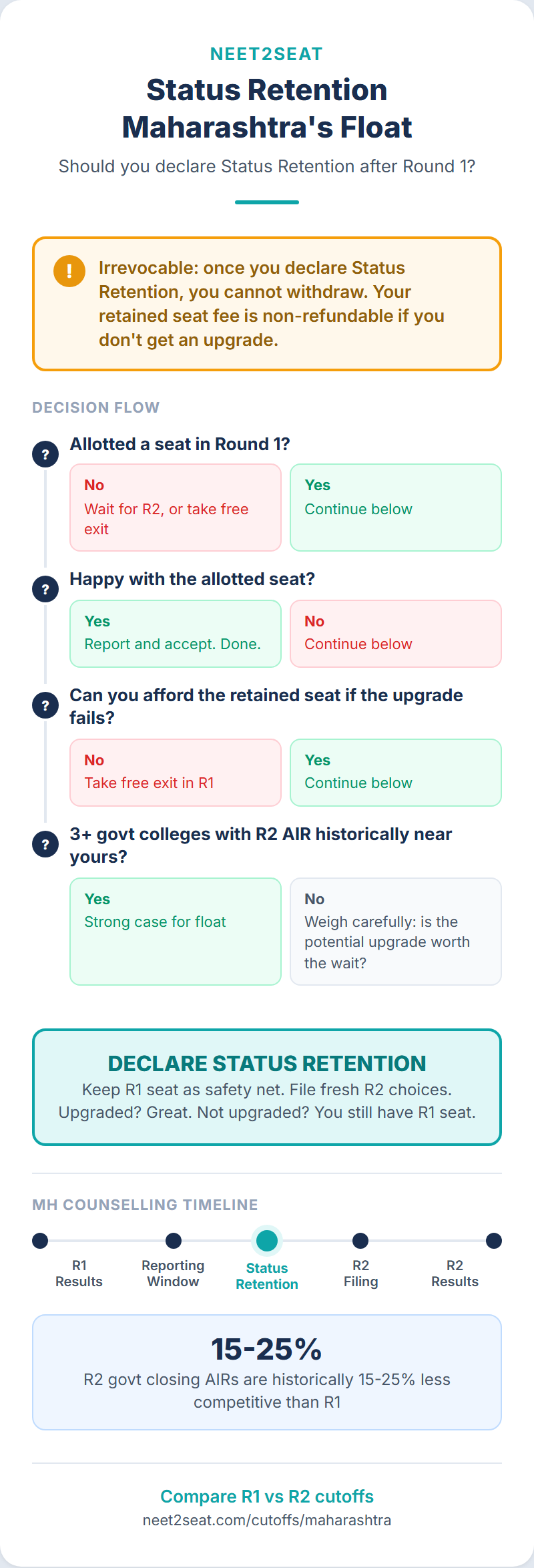
    • Status Retention is irrevocable: once declared, you cannot withdraw even if no upgrade materializes.
    • Only retain a seat you would genuinely attend for five years at its fee level.
    • Round 2 closing AIRs at government colleges are typically 15% to 25% less competitive than Round 1.
    • You must still fill Round 2 preferences after declaring Status Retention; the upgrade does not happen automatically.

    Status Retention is Maharashtra’s version of floating, with one critical difference: it is irrevocable

    In Maharashtra’s CET Cell counselling, “Status Retention” is the mechanism for keeping your Round 1 seat while seeking an upgrade in Round 2. The concept is identical to MCC’s “Float”: you hold your current allotment as a safety net and let the algorithm check whether anything better is available. The difference is in the commitment. Once you declare Status Retention on a seat in Maharashtra, you cannot withdraw from it. If Round 2 does not produce an upgrade, that seat is yours, and you must report to the college.

    Infographic explaining Maharashtra status retention

    This guide covers the Maharashtra-specific mechanics. For the general float-vs-freeze framework, see our float vs freeze pillar guide. For Karnataka’s equivalent system, see our Karnataka Choice 1 vs Choice 2 guide.

    The timeline: when Status Retention happens

    Status Retention applies between Round 1 and Round 2. The sequence:

    1. Round 1 results are published. You see your allotment (college, category, seat type).
    2. Reporting window opens. If you want to accept the seat, you report to the college, pay the fees, and confirm admission. This is equivalent to “freezing.”
    3. Status Retention window opens (usually overlapping with or immediately after reporting). If you want to keep the seat but seek an upgrade, you file a Status Retention declaration through the CET Cell portal. You pay the required deposit.
    4. Free Exit window. If you do not want the seat at all, you do not report and do not declare Status Retention. Your seat is released, your deposit is refunded, and you enter Round 2 as a fresh candidate.
    5. Round 2 choice filling opens. You fill a fresh preference list (Maharashtra allows new preferences every round).
    6. Round 2 results. If upgraded, you report to the new college. If not upgraded, you report to your Round 1 college (the one you retained).

    What happens mechanically when you declare Status Retention

    When you file Status Retention:

    • Your Round 1 seat is locked to you. No other candidate can be allotted to it during Round 2.
    • You fill a new Round 2 preference list. Only colleges ranked above your Round 1 allotment (in terms of your preference) are considered for upgrade. If you list the same college you already hold, the system ignores it since you already have it.
    • The Round 2 algorithm processes all candidates simultaneously: Status Retention candidates seeking upgrades, fresh candidates, and Round 1 candidates who took free exit.
    • If your AIR qualifies for a college on your Round 2 list that is better than your retained seat, you are upgraded. Your Round 1 seat is released to other candidates.
    • If no upgrade is available, your Round 1 seat is confirmed. You must report to that college.

    The irrevocability rule and why it matters

    Status Retention in Maharashtra is binding. Once declared, you cannot change your mind and take free exit, withdraw from the retained seat, or participate in other counselling for that seat. The college you retain becomes your guaranteed minimum outcome. If you retain a private college at Rs 18 lakh per year and are not upgraded, you owe Rs 18 lakh per year for five years.

    This is the single most important difference from Round 1’s free exit. In Round 1, listing a college you do not want costs nothing because exit is free. In the Status Retention phase, the college you retain becomes your guaranteed minimum outcome.

    Choose what you retain carefully. Only retain a seat you would genuinely attend if the upgrade does not materialise.

    Who should use Status Retention

    Candidates allotted a private college who want a government upgrade

    This is the most common Status Retention scenario. You got a private college in Round 1 (fees Rs 5 lakh to Rs 25 lakh per year depending on the institution) but government colleges you qualify for did not allot to you because cutoffs were tighter than expected. Round 2 cutoffs at government colleges are typically 15% to 25% less competitive than Round 1. Retaining the private seat gives you a safety net while the government upgrade becomes possible.

    Check the Maharashtra cutoff analyzer to compare your AIR against Round 2 closing AIRs at government colleges for your category in previous years. If 3 or more government colleges had Round 2 closing AIRs at or above your AIR, Status Retention is well justified.

    Candidates allotted a lower-preference government college

    If you got a government college in a smaller city but prefer one in Mumbai or Pune, Status Retention lets you hold the current seat while trying for the metropolitan option. The fees are the same either way (approximately Rs 1.62 lakh per year at all Maharashtra government colleges), so the financial stakes are lower. The decision comes down to location and clinical exposure preferences.

    Candidates whose AIR is within striking distance of target colleges

    If your AIR was 2,000 to 5,000 ranks above (worse than) a target college’s Round 1 closing AIR, Round 2 easing may bring that college within reach. Status Retention is the mechanism to hold your current seat while that window opens.

    Who should NOT use Status Retention

    Candidates allotted their top 1-3 choices

    If you got one of your most preferred colleges, there is no meaningful upgrade available. Report to the college directly. Status Retention adds administrative delay with no upside.

    Candidates whose target upgrades are unrealistic

    If the colleges above your allotment closed at AIRs 10,000 or more below your rank, Round 2 easing of 15% to 25% will not bridge the gap. Retaining your seat keeps you in the system for another week or two with no practical benefit. Worse, it delays your reporting and preparation.

    Candidates uncomfortable with the retained seat’s fees

    If you retained a private college at Rs 20 lakh per year and the upgrade does not happen, you owe that money. If that fee level creates genuine financial hardship, do not retain that seat. Take free exit in Round 1, enter Round 2 as a fresh candidate, and build a preference list that only includes colleges you can afford. Free exit has no financial penalty; Status Retention has a commitment.

    Status Retention and fresh preference filling

    Maharashtra’s fresh preference filling in each round interacts with Status Retention in a specific way. In Round 2, your preference list determines which colleges you can be upgraded to. Since you can build a completely new list, you should:

    Three steps for your Round 2 list after declaring Status Retention: (1) Use Round 1 closing AIR data to recalibrate. Colleges that were Reach in Round 1 may now be Target. (2) List only colleges better than your retained seat. (3) Be aggressive: you have a safety net (the retained seat), so load the top of your Round 2 list with ambitious targets.

    See our Maharashtra choice filling guide for detailed Round 2 preference strategy.

    Deposit and fee mechanics

    CET Cell specifies the deposit amount for Status Retention in each year’s information bulletin. The deposit is adjusted against the fees of your final college (whether the retained college or an upgraded one). Key points:

    • The Status Retention deposit is separate from the initial counselling registration fee.
    • If upgraded, you pay the balance fees at the new college. The deposit transfers.
    • If not upgraded, the deposit counts toward your retained college’s fees.
    • The deposit is not refundable once Status Retention is declared (this is part of the irrevocability).

    Check the current year’s CET Cell information bulletin for the exact deposit amount. It varies by seat type (state quota vs institutional quota) and by college type (government vs private).

    Status Retention and MCC dual participation

    Many candidates participate in both Maharashtra state counselling and MCC counselling simultaneously. If you have a state counselling allotment and an MCC allotment:

    • You can declare Status Retention on your Maharashtra seat while continuing with MCC rounds.
    • If you eventually accept an MCC seat, you must cancel your Maharashtra seat per CET Cell rules.
    • The cancellation timing matters: cancelling before specific deadlines may entitle you to a partial refund; cancelling after may forfeit the deposit.
    • Each year’s information bulletin specifies the exact cross-counselling rules and refund timelines.

    If you have a good MCC allotment and a Maharashtra allotment you are retaining, evaluate whether the MCC seat is preferable to both your current Maharashtra seat and the potential upgrade. If the MCC seat is your best option, take it and cancel the Maharashtra retention before the deadline to minimize financial loss.

    Common mistakes with Status Retention

    Retaining a seat you cannot afford

    Candidates sometimes retain a private college seat “just in case” without fully calculating the five-year fee commitment. A private seat at Rs 18 lakh per year means Rs 90 lakh over five years. If the upgrade does not happen, you are locked into that fee structure with no way out. Only retain a seat you can financially sustain.

    Not filing Round 2 preferences after declaring Status Retention

    Status Retention reserves your seat but does not automatically enter you into Round 2. You must still fill a Round 2 preference list to be considered for upgrades. If you declare Status Retention and forget to fill Round 2 preferences, you simply keep your Round 1 seat with no upgrade attempt. The retention period was wasted.

    Assuming Status Retention guarantees an upgrade

    Status Retention guarantees that you keep your Round 1 seat. It does not guarantee an upgrade. The upgrade depends on your AIR, your Round 2 preferences, and the available seats. Treat the retained seat as your floor, not your ceiling.

    Missing the declaration deadline

    CET Cell publishes specific deadlines for Status Retention declarations. Missing the deadline means you default to either acceptance (if you reported to the college) or free exit (if you did not). Neither may be what you intended. Mark the deadline in your calendar the moment the Round 1 results are published.

    FAQ

    Can I declare Status Retention for a government college seat?

    Yes. Status Retention applies to any allotted seat, whether government, private, or deemed university (state quota). If you have a government seat in a smaller city and want to try for a government seat in Mumbai, Status Retention is the mechanism.

    What if I declared Status Retention but do not fill Round 2 preferences?

    You keep your Round 1 seat. No upgrade attempt is made. You must report to the original college. The deposit is adjusted against the fees.

    Can I declare Status Retention for Round 2 to Round 3?

    CET Cell’s retention rules between Round 2 and Round 3 vary by year. Some years allow a similar retention mechanism; others require Round 2 allottees to either accept or exit. Check the current year’s information bulletin for the exact Round 2 to Round 3 rules.

    If I am upgraded in Round 2, can I then float again for Round 3?

    This depends on the specific year’s rules. In general, once upgraded, you are subject to the same accept-or-exit decision as any Round 2 allottee. Whether a second retention is available depends on CET Cell’s policy for that cycle.

    What is the difference between Status Retention and “not reporting”?

    “Not reporting” in Round 1 is free exit: you give up the seat, your deposit is refunded, and you re-enter as a fresh candidate. Status Retention means you keep the seat (with a financial commitment) while seeking an upgrade. They are opposite actions. Free exit releases the seat; Status Retention locks it.

  • Float vs freeze: when to hold your NEET seat and when to accept

    • Floating is a no-lose proposition: you either upgrade to a better college or keep your current seat.
    • The government-private fee gap (Rs 35 lakh to Rs 65 lakh over 5 years) makes floating almost always worthwhile when government colleges are on your upgrade path.
    • Use multi-year Round 2 closing AIR data to assess realistic upgrade targets; do not float for aspirational colleges far beyond your rank.
    • Terminology varies (MCC: Float/Freeze, Maharashtra: Status Retention, Karnataka: Choice 1/2/3) but the underlying decision is the same.

    The single decision that costs more candidates seats than any other

    The float vs freeze decision in NEET counselling is the single choice that costs more candidates seats than any other. After each round, allotted candidates face a binary choice: keep the seat and try for something better, or accept it and walk away. The terminology varies by counselling authority (MCC calls it “Float” and “Freeze”; Maharashtra calls it “Status Retention”; Karnataka calls it “Choice 1, Choice 2, Choice 3”), but the underlying decision is the same everywhere. Get it right, and you either upgrade to a better college or keep a solid backup. Get it wrong, and you either lose a seat you should have kept or stay locked into one you could have improved.

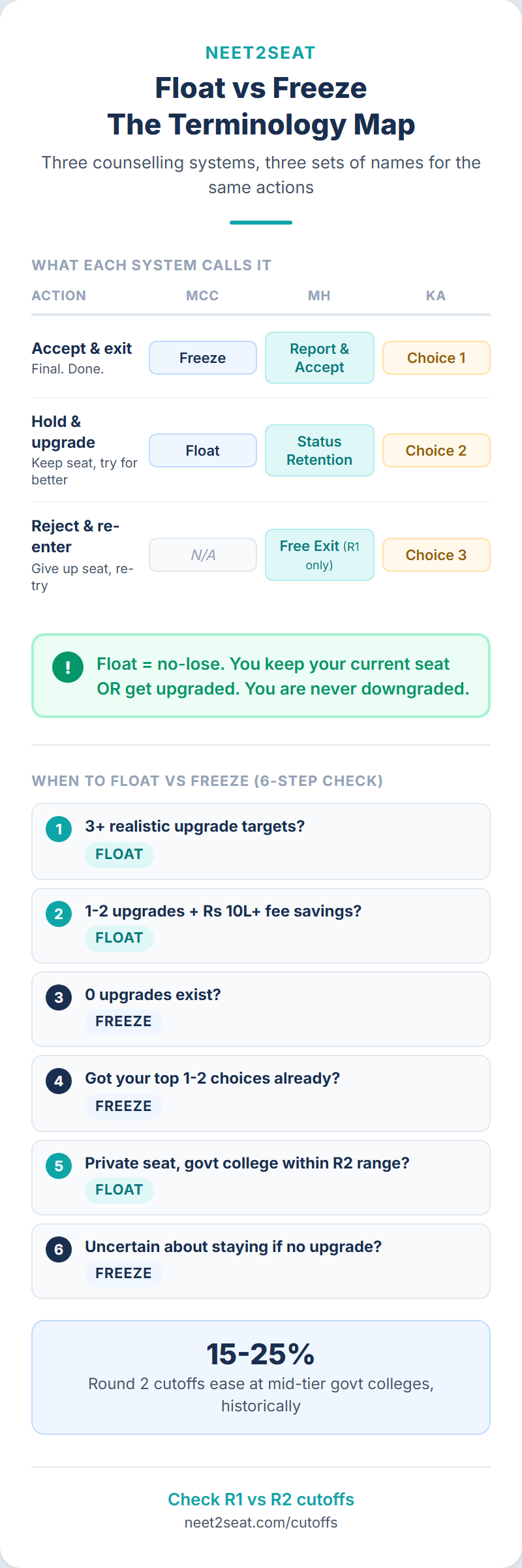
    Infographic explaining float vs freeze in NEET counselling

    This guide covers the general framework for making this decision in NEET 2026 counselling. For state-specific mechanics, see our Maharashtra Status Retention guide and our Karnataka Choice 1 vs Choice 2 guide.

    The terminology, mapped across systems

    Three counselling systems, three vocabularies, one underlying decision:

    ActionMCC termMaharashtra termKarnataka term
    Accept seat, exit counsellingFreezeDo not retain (report and accept)Choice 1
    Keep seat, seek upgrade in next roundFloatStatus RetentionChoice 2
    Reject seat, re-enter poolNot available (must float or freeze)Free Exit (Round 1 only)Choice 3

    MCC’s system is the simplest: two options, Float or Freeze. Maharashtra adds a free exit option in Round 1 and a binding Status Retention mechanism in Round 2. Karnataka adds a third path (Choice 3: reject and re-enter) that carries genuine risk of ending up with no seat at all.

    The rest of this guide uses “float” (lowercase) to mean “keep current seat while seeking upgrade” and “freeze” to mean “accept current seat and exit.” These are the most widely understood terms, even outside MCC counselling.

    How floating works at a mechanical level

    When you float (or declare Status Retention, or choose Choice 2), the system does three things:

    1. Your current seat is reserved for you. No other candidate can take it during the next round. It is held in your name until the round concludes.
    2. Your preference list is checked for upgrades. The algorithm looks at colleges ranked higher than your current allotment on your preference list. If any of those colleges has a vacancy and your AIR qualifies, you are upgraded.
    3. If upgraded, your old seat is released. It becomes available for other candidates in the current round. If not upgraded, you keep your original seat with no penalty.

    Floating is a no-lose proposition in most counselling systems. You either get something better or keep what you have. The only costs are financial (a deposit or partial fees to hold the seat) and logistical (waiting longer for a final answer). The algorithm cannot downgrade you to a college ranked lower on your preference list.

    When to freeze

    Freeze when any of these conditions is true:

    You got your first or second choice

    If the allotted college is at or near the top of your preference list, there is little room for upgrade. Floating would keep you in the system for another round with almost no chance of improvement. Freeze, report to the college, and start preparing for MBBS.

    The financial cost of floating is unacceptable

    In Karnataka, Choice 2 candidates with allotted seats having course fees above Rs 12 lakh previously had to pay the full fee upfront. The 2025 rule change capped this at Rs 12,001, making floating much more accessible. But in some counselling tracks, the deposit or advance fee required to hold a seat while floating can be substantial. If paying that amount creates financial strain with minimal upgrade probability, freezing is the safer financial decision.

    The college meets your minimum requirements

    If the allotted college is a government college with acceptable fees, reasonable location, and adequate infrastructure, and the only colleges ranked higher are marginal improvements (say, a government college in a slightly larger city), the risk-reward calculus favours freezing. A guaranteed seat at a good college is worth more than a slim chance at a marginally better one.

    You are in Round 3 or a mop-up round

    Late rounds have smaller seat pools and fewer upgrade opportunities. If you have a seat in Round 3, freeze it. The probability of meaningful improvement in subsequent rounds is low, and the risk of administrative complications increases.

    When to float

    Float when any of these conditions is true:

    Your current allotment is significantly below your preference list position

    If you listed 30 colleges and got allotted number 25, there are 24 colleges above your allotment that you prefer. Even if only 2 or 3 of those colleges have vacancies in the next round, your chances of an upgrade are real. The gap between your allotment and your top choices determines the upside of floating.

    The government-private gap applies

    You are allotted a private college at Rs 14 lakh per year but have government colleges ranked higher on your list. Government college fees in Maharashtra are approximately Rs 1.62 lakh per year; in Karnataka, approximately Rs 50,000 per year. The five-year savings from upgrading to a government seat range from Rs 35 lakh to Rs 65 lakh. Even if the upgrade probability is only 15%, the expected value (probability times savings) far exceeds the cost of holding the seat.

    You are in Round 1 or Round 2

    Early rounds have the largest seat pools and the most movement. In Karnataka, Round 2 had 9,957 allotments versus 8,320 in Round 1 in 2025, meaning significant seat turnover between rounds. In Maharashtra, Round 2 closes at higher (less competitive) AIRs than Round 1 at most colleges, creating upgrade opportunities that did not exist in Round 1.

    Historical data supports the upgrade

    Check the cutoff analyzer for the colleges above your allotment. Filter by Round 2, your category, and multiple years (2023-2025). If their Round 2 closing AIRs were at or above your AIR in at least 2 of 3 years, the upgrade is plausible. If they were well below your AIR in all years, the upgrade is not realistic regardless of floating.

    The data behind round-to-round movement

    From our database of 407,000+ allotment records across Maharashtra and Karnataka (2023 to 2025), several patterns affect the float-vs-freeze decision:

    Round 2 closing AIRs are consistently higher than Round 1

    At government colleges in Maharashtra, Round 2 closing AIRs for OPEN category averaged 15% to 25% higher (less competitive) than Round 1 across 2023 to 2025. At Karnataka government colleges, the shift was similar: Round 2 typically closed at 10% to 20% higher AIRs than Round 1.

    The easing pattern is not uniform. Top-5 government colleges show only 5% to 10% easing (their candidates freeze immediately). Mid-tier colleges (ranked 10th to 25th) show 15% to 25% easing: the sweet spot for upgrades. Lower-ranked colleges can ease by 30% to 40%.

    Top colleges show the smallest movement

    The most competitive government colleges (Seth GS Medical College in Mumbai, Bangalore Medical College in Karnataka) show minimal closing AIR movement between rounds. These colleges fill with top-ranked candidates who freeze immediately. If your upgrade target is a top-5 college, floating is less likely to help unless your AIR is very close to the Round 1 closing.

    Mid-tier colleges show the largest movement

    Government colleges ranked 10th to 25th in each state show the most Round 1 to Round 2 movement. These colleges experience the most seat turnover from candidates who were allotted there but chose to float (hoping for a top college) or who took free exit. If your upgrade targets are in this mid-tier range, floating has the highest probability of success.

    Private college movement is volatile

    Private college closing AIRs can shift by 30% to 50% between rounds, depending on fee changes, new seat additions, and candidate behaviour. If your backup is a private college and your upgrade targets are also private colleges, the outcome is harder to predict from historical data alone.

    The reject-and-re-enter option (Karnataka Choice 3)

    Karnataka’s Choice 3 is unique and high-risk: you reject the allotted seat entirely and re-enter the candidate pool for Round 2. Unlike floating, you have no safety net. If Round 2 does not produce an allotment, you are left with no seat and a forfeited caution deposit (Rs 1,00,000 general; Rs 50,000 SC/ST). For strategic upgrades, Choice 2 is almost always better because it preserves your Round 1 seat.

    The only scenario where Choice 3 makes strategic sense: your AIR is strong enough that historical data across multiple years confirms you would be allotted in Round 2, and the Rs 1,00,000 deposit is an acceptable cost if the prediction is wrong. Even then, Choice 2 achieves the same upgrade with zero risk.

    Financial analysis: when is floating worth the deposit?

    The financial question is straightforward: does the expected savings from an upgrade exceed the cost of holding the seat?

    Scenario 1: Private to government upgrade

    Current allotment: private college, Rs 14 lakh/year fees. Target upgrade: government college, Rs 50,000/year (Karnataka) or Rs 1.62 lakh/year (Maharashtra). Floating cost: Rs 12,001 (Karnataka 2025 rule) or deposit amount per Maharashtra rules.

    Five-year savings if upgraded: Rs 60 lakh to Rs 67.5 lakh. Even if the upgrade probability is only 15%, the expected value (probability times savings) is Rs 9 lakh to Rs 10 lakh. Against a floating cost of Rs 12,001, this is a clear float.

    Scenario 2: Government to better government upgrade

    Current allotment: government college in a smaller city. Target upgrade: government college in a metropolitan area. Fees are the same at both colleges. The financial savings are zero.

    The value here is non-financial: clinical exposure, research access, professional network, quality of life. If those factors are important enough to justify waiting another round, float. If the current college is acceptable, freeze and save the time.

    Scenario 3: Private to slightly cheaper private

    Current allotment: private college at Rs 18 lakh/year. Target upgrade: private college at Rs 12 lakh/year. Five-year savings if upgraded: Rs 30 lakh. If the upgrade probability is reasonable (check historical cutoffs), float. If the target college’s closing AIR is far below your AIR even in Round 2, the savings are theoretical and freezing is more practical.

    The psychological trap: anchoring to a specific college

    Many candidates float not because the math supports it, but because they are fixated on a specific college. “I want Seth GS” or “I only want Bangalore Medical College.” If your AIR is 20,000 and the target college closed at AIR 3,000, no amount of floating will get you there. The college’s Round 2 closing AIR might ease to 3,500 or 4,000, still far beyond your reach.

    Use the cutoff analyzer to check multi-year closing AIR ranges for your target colleges. If the best-case scenario across three years of data still does not reach your AIR, the upgrade is not realistic. Float for achievable upgrades, not aspirational ones.

    Decision framework

    Follow these steps: (1) Identify colleges above your allotment on your preference list. (2) Check Round 2 closing AIRs for those colleges in the cutoff analyzer, filtering by your category. (3) Count how many have closings at or above your AIR. (4) If 3+ colleges qualify, float. (5) If 1-2 qualify, float if the fee savings exceed Rs 10 lakh over five years. (6) If zero qualify, freeze.

    FAQ

    If I float and am not upgraded, do I lose my current seat?

    No. In all three counselling systems (MCC Float, Maharashtra Status Retention, Karnataka Choice 2), failing to upgrade means you keep your existing seat. The float mechanism is designed to be risk-free in terms of seat retention. The only costs are financial (deposit or advance fees) and time.

    Can I float in one counselling track and freeze in another?

    If you are participating in both MCC and state counselling simultaneously, each track’s decisions are independent until you receive a final allotment from both and must choose one. Floating in MCC does not affect your state counselling seat, and vice versa. However, the timelines may overlap, so track both deadlines carefully.

    What happens to my seat if I do not respond to the float/freeze deadline?

    Policies vary. In MCC, failure to exercise the option by the deadline typically results in seat cancellation. In Maharashtra, the default may be treated as free exit (Round 1) or seat cancellation (later rounds). In Karnataka, missed deadlines can result in forfeiture. Never rely on defaults; always submit your decision before the deadline.

    Is there a limit to how many times I can float?

    In MCC, you can float after each round until you either freeze or the final round concludes. In Maharashtra, Status Retention applies between specific rounds (Round 1 to Round 2 primarily). In Karnataka, the Choice 1/2/3 decision occurs after each round’s allotment. Check the current year’s counselling bulletin for exact rules on sequential floating.

    Does floating affect my deposit or fees?

    In MCC, the initial security deposit (typically Rs 25,000 for government quota; Rs 2,00,000 for deemed/private management quota) must remain deposited while floating. In Karnataka, the 2025 rule caps the advance fee at Rs 12,001 for seats above Rs 12 lakh. In Maharashtra, the deposit requirements for Status Retention are specified in the CET Cell information bulletin. The deposit is adjusted against the final college’s fees if you eventually freeze or are upgraded.

    What if I float and get upgraded to a college I like less than my current allotment?

    This cannot happen. The algorithm only upgrades you to colleges ranked higher (better) on your preference list than your current allotment. If you have College A at position 5 and College B (your current seat) at position 12, you can only be upgraded to colleges at positions 1 through 11. You will never be moved to a college ranked lower than your current seat.

    What is the difference between freeze and float in counselling?

    Float means you accept your current allotment but remain in the pool for an upgrade in the next round. If a better college (higher on your preference list) becomes available, you are automatically upgraded. If not, you keep your current seat. Freeze means you accept your current allotment and exit the counselling process entirely; you will not be considered for any further rounds. The terminology varies by state: Maharashtra calls it “Status Retention” (equivalent to float), and Karnataka uses “Choice 1” (freeze) and “Choice 2” (float).

  • Karnataka Choice 1 vs Choice 2: accept, upgrade, or re-enter

    • Choice 2 is risk-free: you either upgrade to a better college or keep your Round 1 seat with no penalty.
    • The 2025 fee cap (Rs 12,001 advance) makes Choice 2 accessible to virtually all candidates regardless of the allotted college’s fees.
    • Upgrade eligibility is limited to colleges ranked above your current allotment on your original preference list.
    • Choice 3 (reject and re-enter) carries genuine risk of ending up with no seat; use it only when the allotted seat is genuinely unacceptable.

    Choice 1 ends your counselling. Choice 2 keeps it alive. The wrong pick costs lakhs.

    After Karnataka’s KEA publishes each round’s allotment, every allotted candidate selects one of three options: Choice 1 (accept and exit), Choice 2 (accept and seek upgrade), or Choice 3 (reject and re-enter). The decision between Choice 1 and Choice 2 is the Karnataka equivalent of “freeze vs float” in MCC terminology. Choice 3 is a separate, higher-risk path covered at the end of this guide.

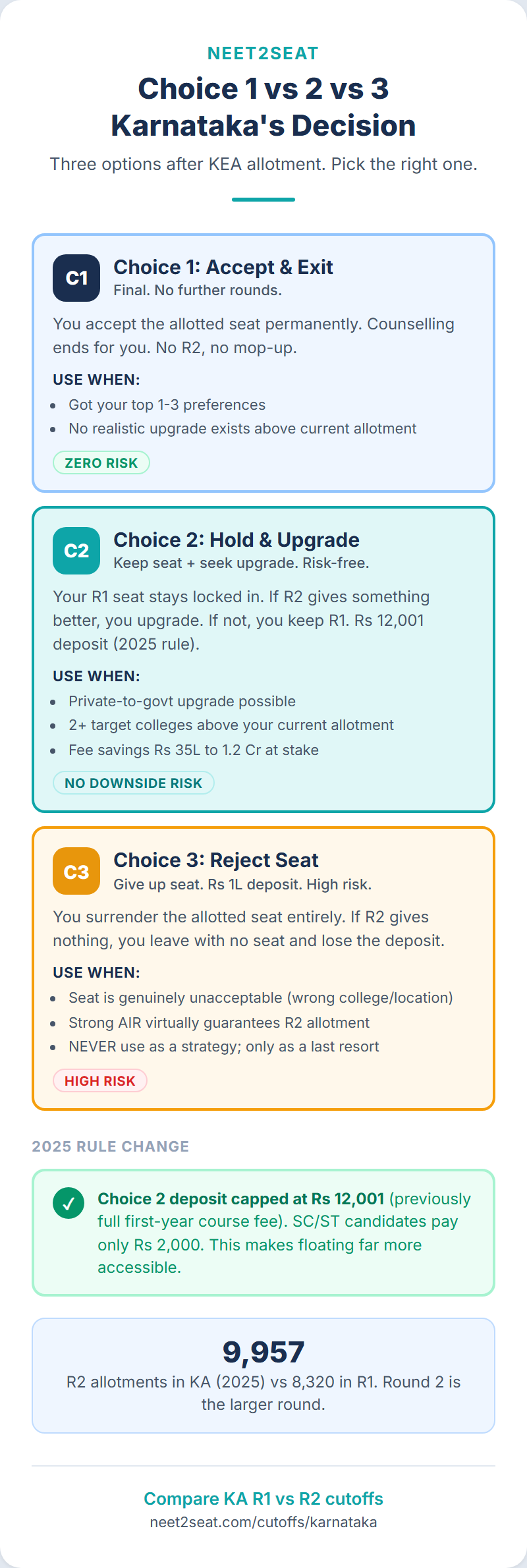
    Infographic comparing Karnataka Choice 1 and Choice 2

    This guide covers Karnataka-specific mechanics. For the general float-vs-freeze framework, see our float vs freeze pillar guide. For Maharashtra’s Status Retention system, see our Maharashtra Status Retention guide.

    What each choice does, precisely

    Choice 1: accept and exit

    You take the allotted seat and leave the counselling process. Your preference list becomes irrelevant. You pay the full course fees and report to the college. This is final: you cannot re-enter counselling in later rounds (for the current year’s KEA process).

    Choose Choice 1 when the allotted college is at or near the top of your preference list and no realistic upgrade exists.

    Choice 2: accept and seek upgrade

    You accept the allotted seat as your guaranteed minimum while the system checks for upgrades in the next round. In Round 2, the algorithm looks at your preference list for colleges ranked above your current allotment. If any of those colleges has a vacancy and your AIR qualifies, you are automatically upgraded. Your old seat is released for other candidates.

    If no upgrade is available, you keep your Round 1 seat. Choice 2 is the no-risk path for upgrade-seeking candidates in Karnataka.

    The 2025 advance fee change made Choice 2 significantly more accessible. Previously, candidates allotted seats with course fees above Rs 12 lakh had to pay the full fee upfront. The 2025 rule caps the advance at Rs 12,001. SC/ST/Category 1 candidates pay just Rs 2,000 as a caution deposit. A candidate allotted a private seat at Rs 20 lakh now pays Rs 12,001 to hold it, down from Rs 20 lakh previously.

    Choice 3: reject and re-enter

    You decline the allotted seat entirely. Your seat is released immediately. You re-enter the candidate pool for Round 2 with no guaranteed seat. The preferences above your rejected college are active for Round 2.

    Choice 3 requires a caution deposit of Rs 1,00,000 (Rs 50,000 for SC/ST). If you are not allotted in Round 2, this deposit is forfeited. Choice 3 is the only option that carries genuine risk of ending up with no seat.

    The preference list interaction that most candidates miss

    In Karnataka, your initial preference list carries forward across rounds. When you select Choice 2, the upgrade algorithm checks only colleges ranked above your current allotment on that original list. If a college you now want was ranked below your allotment (say, at position 22 when you were allotted position 18), you cannot be upgraded to it. The algorithm only looks upward. This is why the initial preference order is the most critical decision in Karnataka counselling.

    Example: you ranked 30 colleges. You were allotted college number 18 on your list. Choice 2 means the algorithm checks colleges 1 through 17 for vacancies in Round 2. If one of those colleges has an opening and your AIR qualifies, you are upgraded.

    See our Karnataka choice filling guide for preference list construction.

    When to choose Choice 1 (accept and exit)

    Choice 1 is correct when:

    You were allotted one of your top 3 preferences

    If colleges ranked 1, 2, or 3 on your list have marginal differences (same city, same fee tier, similar reputation), and you got one of them, the upgrade potential is negligible. Accept and focus on starting MBBS.

    Every college above your allotment is unrealistic

    Check the Karnataka cutoff analyzer. Filter by Round 2, your category (including all suffix variants), and multiple years. If every college above your allotment closed at AIRs 5,000+ below your rank in Round 2 across all years, the upgrade is not happening. Round 2 easing of 10% to 20% will not bridge that gap.

    You need to start clinical preparations

    Choice 2 delays your final admission confirmation. If you need time-sensitive access to college facilities (hostel allocation, library access, bank loan processing that requires confirmed admission), the delay from Choice 2 may carry practical costs beyond the financial deposit.

    When to choose Choice 2 (accept and seek upgrade)

    Choice 2 is correct when:

    The government-private gap applies

    You were allotted a private college. Government colleges ranked higher on your list had tighter cutoffs in Round 1 than expected. Government fees in Karnataka are approximately Rs 50,000 per year versus Rs 8 lakh to Rs 25 lakh at private colleges. The five-year savings from upgrading to a government seat can exceed Rs 35 lakh to Rs 1.2 crore depending on the private college’s fee level.

    With the 2025 fee cap, holding the private seat costs only Rs 12,001 (versus previously paying full fees upfront). The upgrade attempt now costs almost nothing financially.

    Round 2 data supports the upgrade

    Karnataka Round 2 is consistently the largest round. In 2025, Round 2 saw 9,957 allotments compared to 8,320 in Round 1. Seats vacated by Choice 1 and Choice 3 candidates create a substantial pool of opportunities. At mid-tier government colleges (ranked 10th to 24th), closing AIRs in Round 2 are typically 10% to 20% less competitive than Round 1.

    Use the cutoff analyzer to compare your AIR against Round 2 closing AIRs for colleges above your allotment. If 2 or more colleges had Round 2 closings at or above your AIR in previous years, the upgrade probability is meaningful.

    Your preference list has good colleges above your current allotment

    This is where Karnataka’s carry-forward system matters. If you ranked 12 colleges above your current allotment and 5 of them are realistic targets based on historical data, the upgrade pool is large enough to justify Choice 2. If only 1 college is above your allotment and its closing AIR is far below your rank, Choice 2 adds time and paperwork with minimal payoff.

    The 2025 advance fee rule change in detail

    Before 2025, Choice 2 had a significant financial barrier. A candidate allotted a private college seat at Rs 15 lakh per year had to pay the full Rs 15 lakh upfront to hold the seat while seeking an upgrade. This effectively priced out many candidates from using Choice 2, forcing them into either Choice 1 (accept a seat they did not want) or Choice 3 (reject and risk everything).

    The 2025 rule change:

    • For seats with course fees exceeding Rs 12 lakh: advance payment capped at Rs 12,001
    • For seats with course fees Rs 12 lakh or below: the full course fee is still required
    • SC/ST/Category 1 candidates: caution deposit of Rs 2,000

    The practical impact: a candidate allotted a private seat at Rs 20 lakh now pays Rs 12,001 to hold it while seeking a government upgrade (where fees are Rs 50,000 per year). Previously, they would have needed Rs 20 lakh in hand. This change significantly expanded access to the Choice 2 pathway for middle-income families.

    If upgraded, the Rs 12,001 is refunded or adjusted against the new college’s fees. If not upgraded, the candidate pays the remaining balance at the original college.

    Choice 3: when it makes sense and when it does not

    Choice 3 (reject and re-enter) is the highest-risk option. You give up your Round 1 seat entirely. If Round 2 does not allot you a seat, you have no MBBS admission for the year and you forfeit Rs 1,00,000 (Rs 50,000 for SC/ST). For strategic upgrades, Choice 2 is almost always better. Reserve Choice 3 only for genuinely unacceptable seats.

    When Choice 3 makes sense

    • The allotted seat is genuinely unacceptable. The college is in a location you cannot physically reach (extreme distance, no transport), or the fees are completely unaffordable, or the seat type was not what you intended (NRI quota allotted when you wanted government quota).
    • Your AIR strongly predicts a Round 2 allotment. If historical data across 2023 to 2025 shows that candidates with your AIR range were consistently allotted in Round 2 (not just occasionally, but in every year), the risk is lower.

    When Choice 3 does not make sense

    • You want an upgrade but have a decent current seat. Use Choice 2 instead. Choice 2 gives you the same upgrade opportunity without risking your current seat.
    • Your AIR is borderline. If you are near the tail end of the allotment pool (close to the last person allotted), Round 2 is not guaranteed. Borderline candidates should never use Choice 3.
    • You are using it as a negotiating tactic. Some candidates believe rejecting a seat signals to the system that they deserve better. The algorithm does not work this way. Your AIR determines your allotment, not your prior choices. Choice 3 carries real risk with no strategic advantage over Choice 2.

    Choice 2 with suffix categories: a Karnataka-specific consideration

    Karnataka’s suffix system (G, K, R, H, KH, RH) expands your effective upgrade pool. A college unreachable for your base category (2AG) might have a vacancy in a suffix variant (2AH) where competition is lower. When evaluating Choice 2, check cutoffs across all applicable suffix codes in the cutoff analyzer. Filter by each suffix variant separately to see the full picture.

    When you select Choice 2, the upgrade algorithm checks all suffix variants you are eligible for at each college above your allotment. This expands the effective upgrade pool beyond what a simple base-category analysis would suggest.

    Round 2 to Round 3: does the choice system repeat?

    Yes. After Round 2 allotment, candidates again face the Choice 1/2/3 decision. The mechanics are the same. However, by Round 3 the seat pool is much smaller, and upgrade opportunities are limited. Most counselling advisors recommend choosing Choice 1 after Round 2 unless you have very strong data supporting a Round 3 upgrade at a specific college.

    Round 3 in Karnataka is a smaller round. The allotment numbers drop significantly from Round 2. Candidates who still have not been allotted after Round 2 face a thin pool of remaining seats. At this stage, securing any medical seat matters more than optimizing for the perfect one.

    Decision framework for Karnataka

    Step-by-step: (1) Count colleges above your allotment on your preference list. (2) Check Round 2 closing AIRs in the cutoff analyzer for your category and all suffix variants. (3) Count realistic upgrades (Round 2 closings at or above your AIR). (4) If 3+ exist: Choice 2. (5) If 1-2 exist and fee savings exceed Rs 10 lakh: Choice 2. (6) If zero exist: Choice 1. (7) Choice 3 only if the seat is genuinely unacceptable AND your AIR strongly predicts a Round 2 allotment.

    FAQ

    If I choose Choice 2 and am not upgraded, do I lose anything?

    No. You keep your Round 1 seat. You pay the remaining course fee balance at the original college. Choice 2 carries no penalty for non-upgrade. The only cost is time (waiting for Round 2 results) and the advance payment (which is adjusted against your final fees).

    Can I modify my preference list after choosing Choice 2?

    The general rule in Karnataka is that preferences carry forward. Some recent KEA cycles have allowed limited modification between rounds. Check the current year’s KEA notification. Even if modification is allowed, the structural constraint remains: upgrades can only happen to colleges above your current allotment on the (potentially modified) list.

    What happens if I choose Choice 3 and am not allotted in Round 2?

    You exit the KEA counselling process with no seat. Your caution deposit (Rs 1,00,000; Rs 50,000 for SC/ST) is forfeited. You can still participate in MCC mop-up rounds or management quota counselling if seats remain, but the KEA process is over for you.

    Can I choose Choice 2 after Round 2 (for Round 3)?

    Yes, the Choice 1/2/3 mechanism repeats after each round. However, the Round 3 seat pool is much smaller, and upgrade odds are reduced. Most candidates should choose Choice 1 after Round 2 unless specific data supports a Round 3 upgrade.

    Does the Rs 12,001 fee cap apply to Choice 3 as well?

    No. The Rs 12,001 cap applies specifically to Choice 2 (where you are holding a seat). Choice 3 rejects the seat entirely, so no course fees are involved. The Choice 3 caution deposit is a separate Rs 1,00,000 (Rs 50,000 SC/ST), unrelated to the course fee cap.

    I am an out-of-state candidate. Do the same rules apply?

    Yes, the Choice 1/2/3 mechanism applies to all candidates allotted through KEA. However, out-of-state candidates are only eligible for private college management/NRI/institutional quota seats. Your upgrade pool is limited to those seat types at colleges ranked above your current allotment.