If you’re appearing for NEET 2026 and planning to apply under Karnataka or Maharashtra state quota, the seat picture has changed since last year. Both states added government MBBS seats for 2025-26, and some of those seats are in colleges that are brand new.
Karnataka: 400 new government seats across 8 GMCs
Karnataka now has the most MBBS seats of any state in India at 13,944 (per the NMC’s final seat matrix, December 2025).
Eight government medical colleges each received 50 additional seats:
College
Previous
Now
Change
Mysore Medical College
200
250
+50
Belagavi Institute of Medical Sciences
150
200
+50
Gulbarga Institute of Medical Sciences
150
200
+50
Hassan Institute of Medical Sciences
150
200
+50
Raichur Institute of Medical Sciences
150
200
+50
Vijayanagar Institute of Medical Sciences, Bellary
200
250
+50
Shri Atal Bihari Vajpayee Medical College, Bengaluru
150
200
+50
Chikkaballapur Institute of Medical Sciences
100
150
+50
Several private colleges also expanded. Farookh Academy of Medical Education in Mysuru is the only entirely new college in the state this cycle, with 100 seats.
Two proposed new GMCs in Ramanagara and Kanakapura did not receive NMC approval this round. If they come through in a future cycle, they would add another 200 to 250 government seats.
For Karnataka state-quota aspirants, 400 extra government seats shifts counselling cutoffs at the margin. District GMCs like Chikkaballapur, Raichur, and Gulbarga typically see more accessible closing ranks than the established colleges in Bangalore and Mysore. Fifty additional seats at each of those colleges pushes the cutoff outward, which matters most for students in the mid-rank range where a few hundred positions decide the outcome.
Maharashtra: three brand-new GMCs, plus established colleges
Maharashtra has 12,824 MBBS seats for 2025-26, fourth nationally behind Karnataka, Uttar Pradesh, and Tamil Nadu.
Three government medical colleges started admissions in 2024 and are now part of the counselling pool for the first time at scale:
GMC Bhandara (100 seats), inaugurated October 2024
GMC Hingoli (100 seats), inaugurated 2024
GMC Gadchiroli (100 seats), inaugurated 2024
These are genuinely new institutions in districts that previously had no government medical college. GMC Baramati (100 seats), established in 2019, is also still relatively early in its counselling history.
Other district GMCs have been around longer but continue to offer realistic options for mid-rank candidates:
College
Seats
Notes
GMC Chandrapur
150
Established
GMC Gondia
150
Established
GMC Jalgaon
150
Established
GMC Latur
150
Founded 2002
GMC Amravati
100
Established
For Maharashtra state-quota aspirants, the three new GMCs expand geographic access in Vidarbha and Marathwada. A student from eastern Maharashtra no longer needs to score high enough for GMC Nagpur; Bhandara, Gadchiroli, and Hingoli are closer to home. New colleges in their first couple of counselling cycles tend to have less established reputations, which means cutoffs are often more accessible than their location and infrastructure would suggest. That gap narrows as the college matures.
How this connects to AIQ
Under All India Quota, 15% of seats in government colleges from both states feed into the national pool. More state government seats means a proportionally larger AIQ allocation. If you’re applying under AIQ and targeting colleges in either state, the expanded seat counts mean a few more AIQ seats at colleges that weren’t previously in the mix.
Use the neet2seat college explorer to check specific colleges and their historical cutoffs across state quota and AIQ.
Data sources: NMC MBBS Seat Matrix 2025-26 (final, Dec 3, 2025), Medical Dialogues, Edufever.
22.79 lakh students have registered for NEET 2026. India’s MBBS seat count has hit 1,29,026, an all-time high. Both numbers get thrown around in headlines, but they need context to be useful.
The seat count
The NMC’s final seat matrix for 2025-26 puts total MBBS seats at 1,29,026, up from 1,17,750 the previous year. That’s roughly 11,000 new seats, one of the largest single-year increases in recent years.
Much of this came through the central government’s CSS scheme, which funded new Government Medical Colleges in 19 states. This isn’t just private colleges padding the total. Districts that had no medical college two years ago now have one.
Karnataka leads the country with 13,944 MBBS seats. Eight government GMCs each received 50 additional seats, adding 400 new government seats to the state pool. Several private colleges also expanded, bringing the state’s overall increase to nearly 1,000 seats.
Maharashtra sits fourth nationally at 12,824 seats. The NMC approved four new colleges in the state, and existing district GMCs at places like Bhandara, Gadchiroli, and Hingoli (all three inaugurated in 2024) now contribute to the seat pool for the first time.
The government has signalled further expansion, but no confirmed numbers exist beyond the current NMC matrix. Additional seats for 2026-27, if any, will show up when the next matrix is published, typically as counselling season begins.
Who’s actually sitting the exam
Registrations barely moved: 22.79 lakh this year versus 22.76 lakh in 2025. The number that matters more is attendance.
Last year, about 22.09 lakh of the 22.76 lakh registered actually wrote the exam, roughly 97%. NTA has said that 99% of NEET 2026 candidates received their first-choice exam city. Fewer logistical barriers should push attendance a little higher. At 98%, approximately 22.33 lakh students will be in exam halls on May 3. That’s about 24,000 more than last year. A small absolute increase, but every extra test-taker is one more person competing for the same seats.
What the ratio looks like
At 98% attendance and a 56% qualification rate (more on why that number is fixed in our separate piece on the percentile system), about 12.5 lakh students will be competing for 1.29 lakh seats. That’s roughly 9.7 qualified candidates per seat, an improvement over last year’s approximately 10.5 to 1. The 11,000 extra seats are doing the work, not any change in the candidate pool.
What paper difficulty actually does
A tough paper (like 2025, where the top score was 686 out of 720) spreads out scores and makes rank gaps between colleges larger. Gaining or losing 10 marks might move you 5,000 ranks. An easy paper (like 2024, where multiple students hit 720) compresses the top end. Scores cluster, and a single question can separate a top government college from a mid-tier private one.
Neither scenario changes how many people qualify. Both change which specific college you can reach at your rank. Students preparing for NEET 2026 are better off building a preference list that covers a range of outcomes rather than banking on the paper being easy or hard.
The government seat gap
The overall 9.7 to 1 ratio hides a sharper divide. Of 1.29 lakh total seats, government colleges account for roughly 59,000 to 63,000, depending on how central institutions and ESIC colleges are counted. The rest are at private and deemed universities where annual fees run ₹15 to 50 lakh or higher.
For families who can only consider government colleges, the effective competition is roughly 1 seat for every 20 qualified candidates. The new GMCs in Maharashtra and Karnataka chip away at this, but the imbalance between demand and affordable supply remains wide.
Under All India Quota, both Karnataka and Maharashtra contribute a large share of seats to the national pool, so the expansion benefits AIQ aspirants too. If you’re deciding between state and AIQ counselling, the new district GMCs are worth factoring in; they often have more favourable cutoffs under state quota than under AIQ.
What to do with this information
Run your expected or actual rank through the neet2seat prediction tool to see which colleges were reachable at that rank last year. Build your preference list with the AI Choice Filler, and include colleges across a range, not just your top picks. The new seats improve odds at the margins, and margins are where counselling outcomes are decided.
Data sources: NMC MBBS Seat Matrix 2025-26 (published Dec 3, 2025), NTA NEET UG 2026 registration bulletin, Times of India (April 28, 2026).
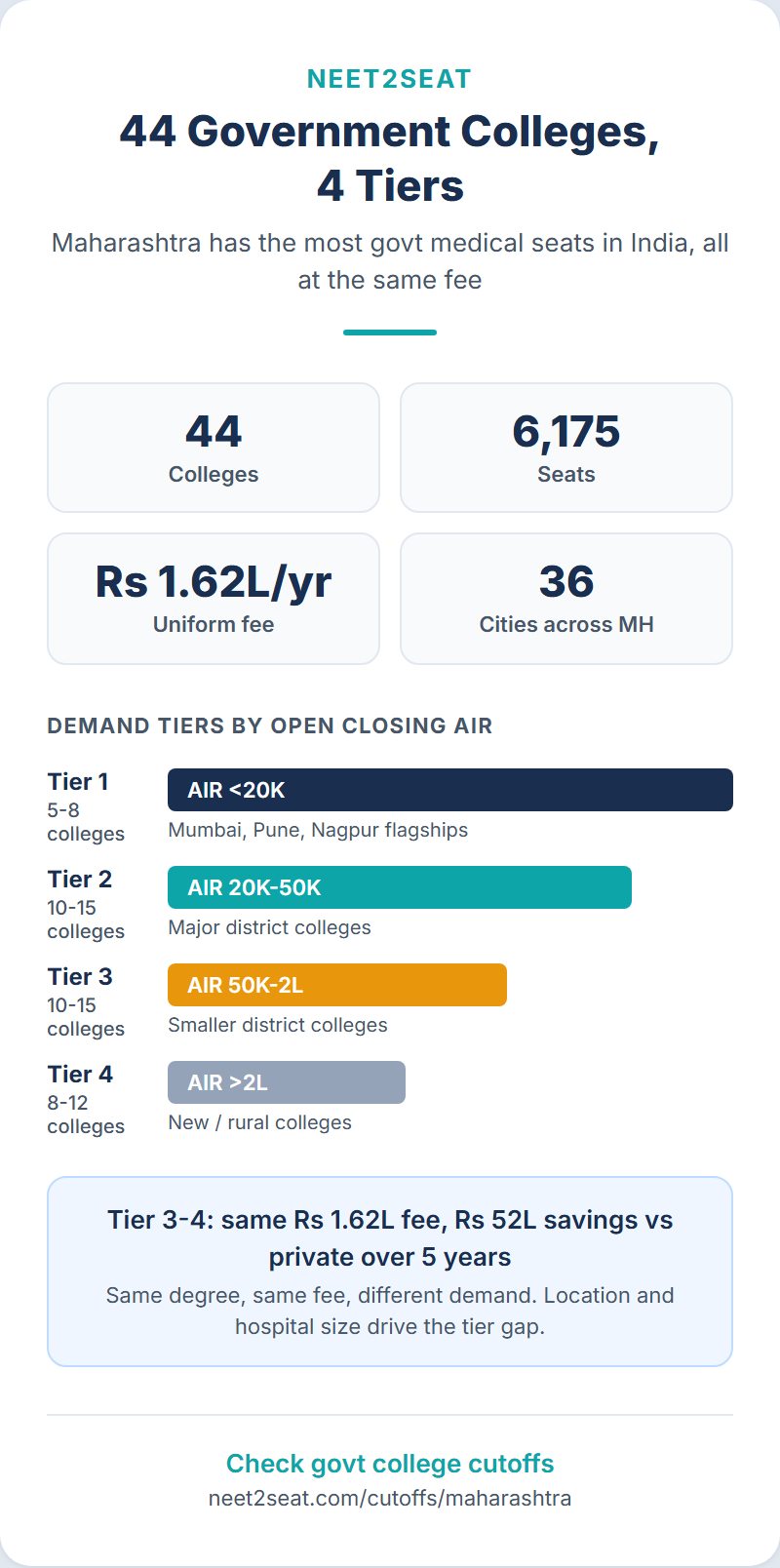
44 government colleges at Rs 1.62 lakh per year: the complete list and what each one offers
Maharashtra’s 44 government medical colleges share a uniform fee (approximately Rs 1.62 lakh per year) and grant the same MBBS degree. The differences are in clinical volume, hospital infrastructure, location, faculty, and the research environment. This guide ranks all 44 by competitiveness and maps what distinguishes the top tier from the rest.
For the full Maharashtra overview including private and deemed colleges, see our state overview. For individual college cutoffs, use the cutoff analyzer.
All 44 government colleges charge Rs 1.62L/yr and grant the same MBBS degree — the differences are in infrastructure and location
Tier 1 (AIR under 20,000): Mumbai and Pune flagships with 1,000+ bed teaching hospitals
Tier 3/4 colleges (AIR 50,000+) offer the same degree at 30-50% lower living costs than metro cities
List every government college where your AIR qualifies — extras are invisible safety nets that cost nothing
How we rank government colleges
We use the 2025 Round 2 OPEN closing AIR as the primary ranking metric. A lower closing AIR means the college fills with higher-ranked candidates, which correlates (imperfectly but consistently) with institutional reputation, hospital quality, and student demand. This is not a quality rating; it is a demand indicator.
Closing AIR measures demand, not quality. A Tier 4 college with higher closing AIRs may have modern buildings and equipment (from recent government investment) while a Tier 2 college with lower closing AIRs may have older infrastructure. Use closing AIR for competitiveness assessment, but verify infrastructure through college visits or NMC inspection reports.
Tier 1: OPEN closing AIR under 20,000 (approximately 5 to 8 colleges)
These are the most competitive government colleges in Maharashtra. They fill with candidates in the top 20,000 NEET ranks nationally.
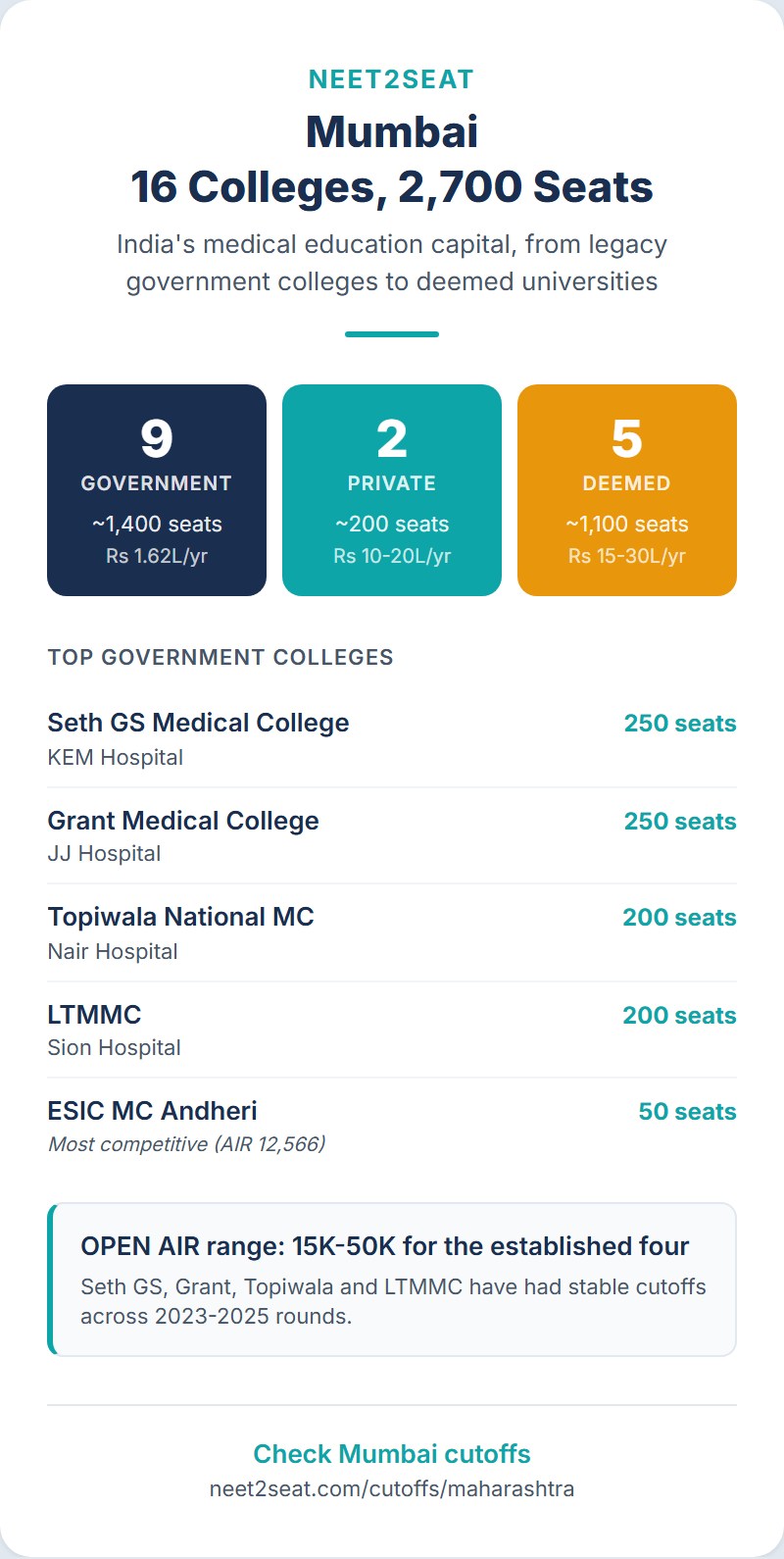
ESIC Medical College Andheri (AIR 12,566 in 2025 R2) leads this tier, though with only 50 seats, its dynamics are distinct from larger institutions. The traditional Big Four of Maharashtra government medical education are Seth GS (KEM Hospital), Grant (JJ Hospital), BJ Medical College Pune (Sassoon Hospital), and LTMMC (Sion Hospital). GMC Nagpur, with 250 seats and a large hospital, also competes for Tier 1 positions in most years.
What distinguishes Tier 1: affiliated hospitals are large tertiary care centres (1,000+ beds), departments span all major specialities and super-specialities, research output is the highest among Maharashtra government colleges, and PG department reputations drive student demand.
Tier 2: OPEN closing AIR 20,000 to 50,000 (approximately 10 to 15 colleges)
Mid-tier government colleges in established cities: Aurangabad (Chhatrapati Sambhajinagar), Solapur, Kolhapur, Sangli, Miraj, Dhule, Akola, Amravati, and Jalgaon. These colleges have been operating for decades, have 200 to 250 seats each, and are affiliated with district-level hospitals that handle significant patient loads.
Clinical exposure at Tier 2 colleges is strong. District hospitals see a broad range of cases (general medicine, surgery, obstetrics, paediatrics, emergency medicine) because they are often the only tertiary referral point for a large geographic catchment. Students at GMC Aurangabad or GMC Kolhapur may get more hands-on procedural experience than peers at Mumbai colleges, where residents and PG students handle more cases.
Living costs in Tier 2 cities are 30% to 50% lower than Mumbai. Hostel availability is generally better (less demand, more space). The social and cultural environment is more limited than Mumbai or Pune, which matters to some candidates and is irrelevant to others.
Tier 2 colleges in district headquarters often provide more hands-on procedural experience than Tier 1 metro colleges, where PG residents handle many procedures. If clinical skill-building is your priority, Tier 2 colleges in Aurangabad, Kolhapur, or Solapur offer strong training at 30-50% lower living costs.
Tier 3: OPEN closing AIR 50,000 to 2,00,000 (approximately 10 to 15 colleges)
Colleges in smaller district headquarters and newer institutions. Cities include Nanded, Latur, Chandrapur, Yavatmal, Beed, Washim, and Osmanabad (Dharashiv). These colleges typically have 100 to 200 seats and were established in the last 10 to 20 years.
Infrastructure varies. Some Tier 3 colleges have modern buildings and equipment (recent government investments in medical education infrastructure). Others are still developing their clinical departments and hospital facilities. Patient volumes are lower than Tier 1 or 2 but sufficient for MBBS training requirements.
The value proposition of Tier 3 is straightforward: Rs 1.62 lakh/year for an MBBS degree that carries the same weight as a degree from Seth GS. If your AIR is 80,000 and the choice is between GMC Nanded at Rs 1.62 lakh/year and a private college in Pune at Rs 12 lakh/year, the five-year savings of Rs 52 lakh make the government option compelling even with a less preferred location.
A candidate with AIR 80,000 choosing between GMC Nanded (Rs 1.62L/yr) and a Pune private college (Rs 12L/yr): five-year tuition difference is Rs 52 lakh. Add lower living costs in Nanded (Rs 5K/month vs Rs 10K/month in Pune), and the total savings approach Rs 55 lakh. Both degrees carry identical weight for NEET PG eligibility.
Tier 4: OPEN closing AIR above 2,00,000 (approximately 8 to 12 colleges)
The newest government colleges in the most underserved areas: Nandurbar, Sindhudurg, Gondia, Alibaug (Raigad), and similar locations. Some of these colleges close at AIRs above 5,00,000, meaning candidates with relatively high (weak) ranks can still secure a government seat.
These colleges are sometimes dismissed as “not real options” by candidates focused on metropolitan colleges. This is a mistake for two reasons:
The degree is identical. NMC accreditation ensures that all government colleges meet minimum standards for faculty, equipment, and clinical training. The MBBS degree from GMC Nandurbar is legally and professionally identical to one from Seth GS.
The alternative may be no seat. A candidate with AIR 3,00,000 who lists only 10 colleges (all in Mumbai and Pune) may end up with no allotment. Adding Tier 4 government colleges at the bottom of the list provides a safety net at Rs 1.62 lakh/year.
Never dismiss Tier 4 government colleges. A candidate with AIR 3,00,000 who lists only metro colleges risks ending up with no allotment. Adding Nandurbar, Sindhudurg, or Gondia at the bottom of your list costs nothing and prevents the worst outcome: no medical seat at all at Rs 1.62L/yr.
The complete ranking: 2025 Round 2 OPEN closing AIRs
Use the cutoff analyzer to see the full ranked list with exact closing AIRs for any year, round, and category. Filter by state=Maharashtra, year=2025, category=OPEN, and sort by closing AIR to see every government college ranked from most to least competitive.
For Round 3 data (which shows slightly relaxed cutoffs at most colleges), add the Round 3 filter. Comparing R2 and R3 closing AIRs gives you the realistic range for each college.
City cluster analysis
Mumbai (9 colleges): Widest range of Tier 1 options. See Mumbai guide.
Pune (2 colleges + AFMC): BJM is Tier 1; AFMC is separate admission. See Pune guide.
Nagpur (2 colleges): GMC Nagpur is Tier 1/2. Indira Gandhi GMC is Tier 2/3.
Marathwada region (Aurangabad, Latur, Nanded, Ambejogai, Osmanabad): Multiple Tier 2/3 options. Historically underserved in medical education; new colleges are expanding access.
Vidarbha region (Nagpur, Chandrapur, Yavatmal, Akola, Amravati, Gondia): Tier 2/3/4 spread. Strong clinical diversity due to tribal and rural populations.
Western Maharashtra (Kolhapur, Sangli, Miraj, Satara, Ratnagiri): Established Tier 2 colleges with stable demand.
Open the cutoff analyzer, set state=Maharashtra, year=2025, category=OPEN, and sort by closing AIR. Identify every government college where your AIR falls within the closing range, then list all of them on your preference list. The algorithm gives you the best match; unlisted colleges cannot help you.
FAQ
Are all 44 government colleges in CET Cell counselling?
Most are. AFMC Pune has a separate admission process. ESIC colleges are included in CET Cell counselling for state quota. Check the current year’s seat matrix for the exact participating list.
Do government college closing AIRs tighten every year?
Generally yes, especially at Tier 1 and 2 colleges, due to increasing NEET registrations and overall score inflation. Tier 3 and 4 colleges show more stability because demand is less concentrated. Plan with a 10% to 15% buffer when using historical data.
Should I list all 44 government colleges?
List every government college where your AIR qualifies and you would accept the seat if allotted. For most candidates, that means 20 to 35 government colleges. Even if you list 40+ options, the algorithm gives you the highest-ranked one you qualify for. The extras are invisible safety nets.
What about the quality difference between Tier 1 and Tier 4?
Tier 1 colleges have larger hospitals, more specialities, more research, and a stronger alumni network. Tier 4 colleges are newer and still building these features. The MBBS curriculum and degree are the same. The practical training experience differs in volume and variety, not in kind. For PG entrance, what matters is your exam score, not which government college you attended.
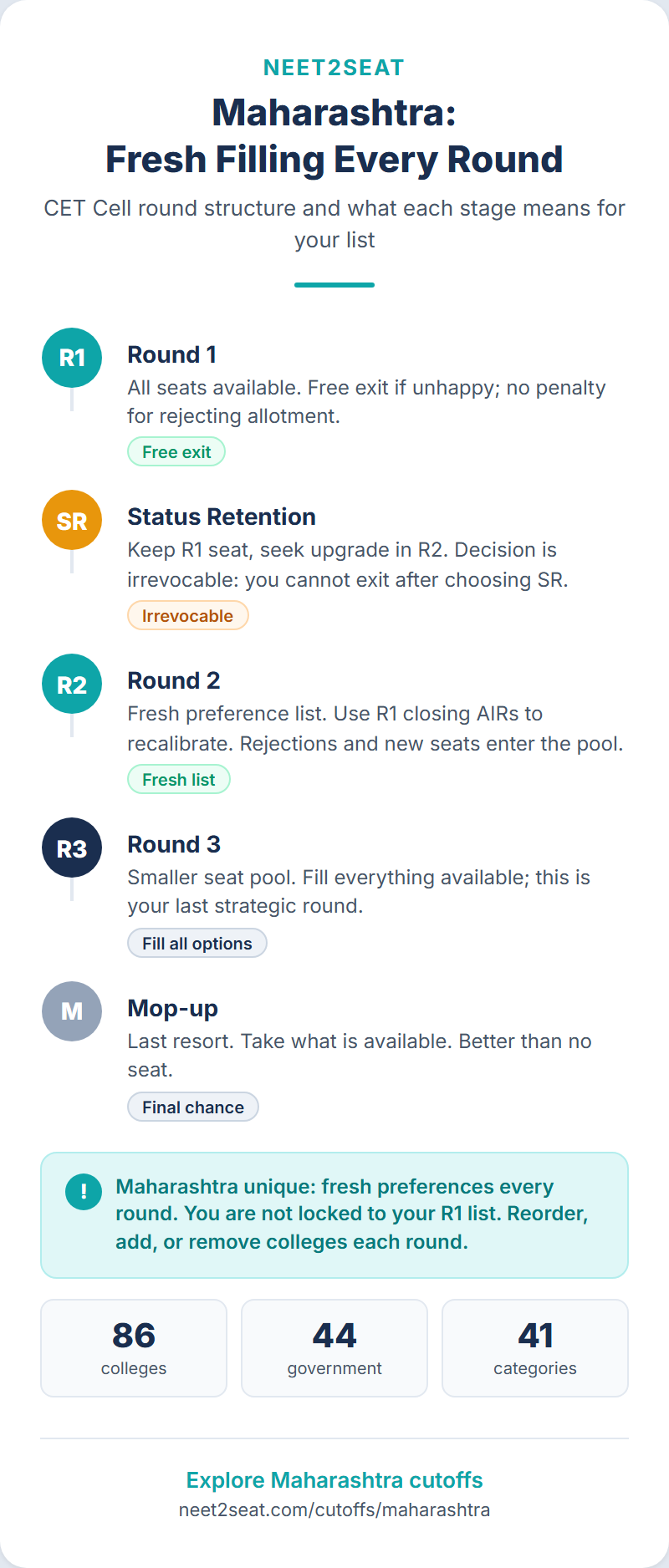
Maharashtra allows fresh preference filling every round: you can rebuild your entire list after each result.
Use Round 1 closing AIRs to reclassify colleges from Reach to Target or Safe for Round 2.
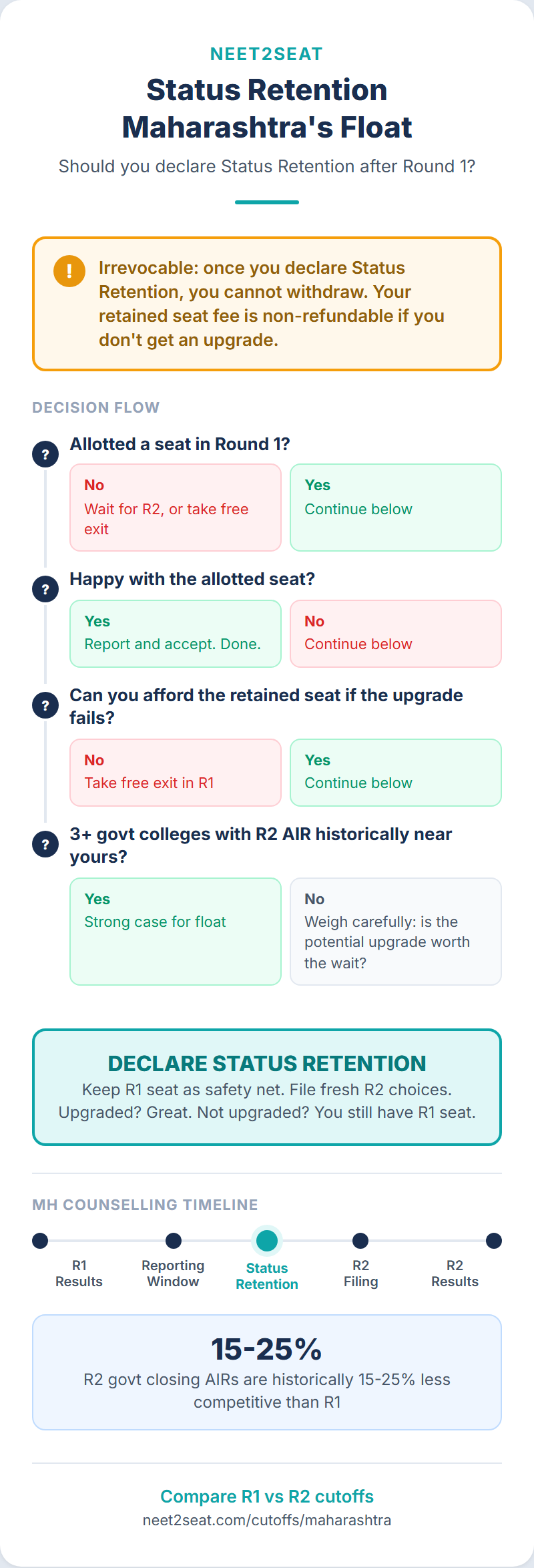
Status Retention is irrevocable. Once declared, you cannot withdraw even if no upgrade comes.
Government fees (~Rs 1.62 lakh/year) vs private fees (Rs 5-25 lakh/year) should heavily influence your ordering.
Maharashtra allows fresh preference filling every round
Maharashtra’s CET Cell counselling process gives you a structural advantage that candidates in many other states do not have: you can submit an entirely new preference list in each round. Round 1, Round 2, and Round 3 each open fresh choice-filling windows. You are not locked into your Round 1 preferences for the rest of the process.
This matters because the seat pool changes between rounds. Seats vacated by candidates who took free exit in Round 1 become available in Round 2. Round 3 adds stray vacancy seats. Each round’s closing AIRs provide concrete information that did not exist when you filled your Round 1 list. Fresh filling lets you incorporate that information.
The round structure and what changes between rounds
Round 1
All seats are available: 85% state quota at government and private colleges, institutional quota seats at private colleges. You fill preferences based on historical data and your AIR. Exit is free; if allotted, you can simply not report and your deposit is refunded.
After Round 1 results, CET Cell publishes the allotment list showing which colleges were allotted at which closing AIRs by category. This data becomes your strongest input for Round 2.
Between Round 1 and Round 2: Status Retention
Status Retention is irrevocable. Once you declare Status Retention on a seat, you cannot withdraw from it, even if you do not get upgraded in Round 2. If you are not upgraded, you continue with the Round 1 seat. Think of it as Maharashtra’s equivalent of “Float” in other states. Only declare Status Retention if you are genuinely willing to keep your Round 1 seat as a floor.
If you were allotted a seat in Round 1 and want to keep it while seeking an upgrade, you file a Status Retention declaration. See our Status Retention guide for the full mechanics and when to use it.
Candidates who did not receive an allotment in Round 1, or who took free exit, enter Round 2 with a clean slate.
Round 2
Fresh preference filling opens. The seat pool now includes seats vacated by Round 1 exits plus any new seats added. Closing AIRs in Round 2 are typically higher (less competitive) than Round 1 for most colleges because the candidate pool has shrunk (those who accepted Round 1 seats and declared Status Retention are no longer competing for new seats; they only compete for upgrades within their retained category).
Use Round 1 closing AIR data to recalibrate your list. A college that was Reach in Round 1 might now be Target or even Safe based on observed data.
Round 3
The final regular round. The seat pool is smaller. Many top colleges have already filled their seats. Fresh preference filling still applies. This is the round where candidates who have been waiting for a specific college should reconsider their position: if that college is fully filled, listing alternatives becomes more urgent.
Maharashtra-specific preference considerations
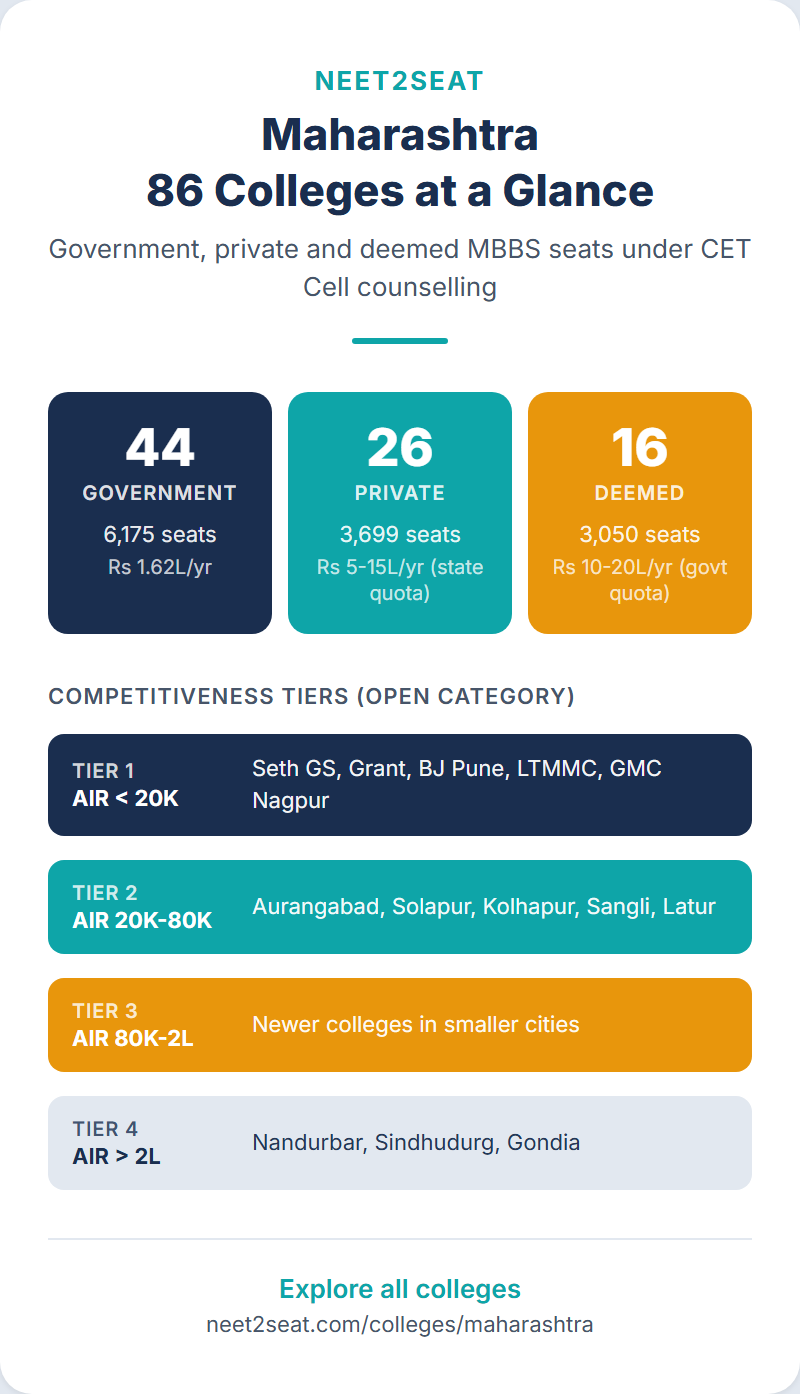
86 colleges across three types
CET Cell handles admissions for 44 government colleges, 26 private colleges, and 16 deemed universities. Your preference list can include any combination of these, though deemed university seats going through state counselling are limited to the government quota portion.
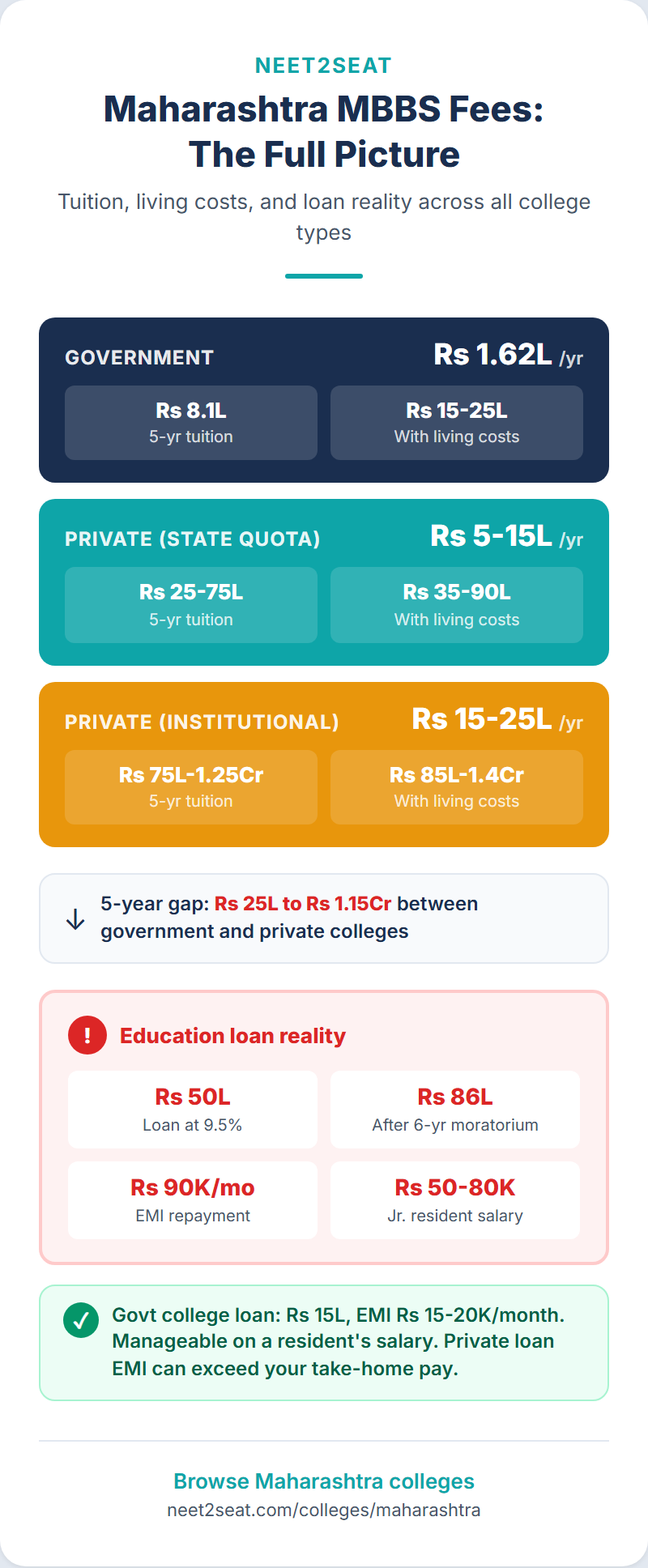
Government fees are roughly Rs 1.62 lakh per year (tuition plus development fee). Private college fees range from Rs 5 lakh to Rs 25 lakh depending on the institution. This fee gap means that for most candidates, government colleges should dominate the upper portion of the preference list.
The 41 category codes
Maharashtra’s parallel reservation system creates compound categories. OPENW (Open + Female), SCW (SC + Female), OPENDEF (Open + Defence), OPENDEFPH (Open + Defence + PWD), and so on. Your preference list applies to your specific category combination.
If you are a female candidate in a constitutional category (say, SC), you may be eligible for both SC and SCW seats. Use the cutoff analyzer to check closing AIRs for both category codes at each college. Understanding which compound code applies to you determines which cutoffs are relevant. See our Maharashtra categories guide for a full breakdown.
Government colleges are concentrated in a few cities
Mumbai alone has 8 to 10 government medical colleges (depending on how the GMC/Cama Hospital new institutions are counted). Pune has 4. Nagpur has 2. Aurangabad (Chhatrapati Sambhajinagar), Kolhapur, Solapur, Latur, Dhule, Akola, and others each have one.
If you are a candidate from Mumbai, your natural tendency is to list Mumbai colleges first. That is reasonable if you genuinely prefer Mumbai. But if your AIR puts you in the Target zone for Mumbai colleges and the Safe zone for colleges in Nagpur or Aurangabad, listing only Mumbai colleges is risky. Add government colleges in other cities as safety options.
Inter-se for unfilled reserved seats
Maharashtra operates a three-group inter-se mechanism. Unfilled SC/ST seats go to the other group within Group I. Unfilled VJ/NT-B seats go within Group II. Unfilled NT-C/NT-D/OBC seats go within Group III. If still unfilled, seats go to combined merit of all reserved categories, then to common merit. Colleges with historically unfilled reserved seats in your group may offer additional opportunities in later rounds.
Using Round 1 data to build your Round 2 list
After Round 1 results, follow these steps: (1) Go to the Maharashtra cutoff analyzer and filter for your category. (2) Note Round 1 closing AIRs for each college. (3) Compare to your AIR. (4) Move newly realistic colleges higher, push colleges that filled at much lower AIRs to the bottom. (5) Add colleges that did not fill in Round 1.
Institutional quota seats
Private colleges in Maharashtra allocate 15% of seats as institutional quota, filled on an all-India basis through CET Cell’s counselling process. These seats are open to NRI, OCI, and out-of-state candidates, and they carry higher fees than state quota seats.
If your AIR qualifies for institutional quota at a private college but not for state quota, listing the institutional quota option as a backup gives you an additional pathway. The fees are higher (typically 2x to 3x state quota), but it is better to have the option than to miss out entirely.
FAQ
Can I add colleges in Round 2 that I did not list in Round 1?
Yes. Maharashtra allows fresh preference filling in each round. Your Round 2 list is completely independent of your Round 1 list. You can add new colleges, remove old ones, and reorder everything.
If I declared Status Retention, does my preference list in Round 2 matter?
Yes. Your Round 2 preferences determine which college you might be upgraded to. If you listed College A (better than your Round 1 seat) at position 1 and your AIR qualifies, you get upgraded. If not, you keep your Round 1 seat. Status Retention candidates compete for upgrades alongside fresh Round 2 candidates.
Should I fill institutional quota seats?
Only if the higher fees are acceptable to you. Institutional quota fees at private colleges are typically 2x to 3x the state quota fees. If you can afford it and the alternative is no seat, list them at the bottom of your preference list as a safety net.
What happens if I do not fill any preferences in Round 2?
If you were not allotted in Round 1, you are automatically eligible for Round 2 but must fill preferences to participate. If you do not file a preference list, you receive no allotment in Round 2. There is no carryover from Round 1.
How do I know which seats are available in Round 2?
CET Cell publishes an updated seat matrix before each round’s choice-filling window opens. This shows remaining seats by college, category, and seat type. Cross-reference it with your eligibility to identify options.
Status Retention is irrevocable: once declared, you cannot withdraw even if no upgrade materializes.
Only retain a seat you would genuinely attend for five years at its fee level.
Round 2 closing AIRs at government colleges are typically 15% to 25% less competitive than Round 1.
You must still fill Round 2 preferences after declaring Status Retention; the upgrade does not happen automatically.
Status Retention is Maharashtra’s version of floating, with one critical difference: it is irrevocable
In Maharashtra’s CET Cell counselling, “Status Retention” is the mechanism for keeping your Round 1 seat while seeking an upgrade in Round 2. The concept is identical to MCC’s “Float”: you hold your current allotment as a safety net and let the algorithm check whether anything better is available. The difference is in the commitment. Once you declare Status Retention on a seat in Maharashtra, you cannot withdraw from it. If Round 2 does not produce an upgrade, that seat is yours, and you must report to the college.
Status Retention applies between Round 1 and Round 2. The sequence:
Round 1 results are published. You see your allotment (college, category, seat type).
Reporting window opens. If you want to accept the seat, you report to the college, pay the fees, and confirm admission. This is equivalent to “freezing.”
Status Retention window opens (usually overlapping with or immediately after reporting). If you want to keep the seat but seek an upgrade, you file a Status Retention declaration through the CET Cell portal. You pay the required deposit.
Free Exit window. If you do not want the seat at all, you do not report and do not declare Status Retention. Your seat is released, your deposit is refunded, and you enter Round 2 as a fresh candidate.
Round 2 choice filling opens. You fill a fresh preference list (Maharashtra allows new preferences every round).
Round 2 results. If upgraded, you report to the new college. If not upgraded, you report to your Round 1 college (the one you retained).
What happens mechanically when you declare Status Retention
When you file Status Retention:
Your Round 1 seat is locked to you. No other candidate can be allotted to it during Round 2.
You fill a new Round 2 preference list. Only colleges ranked above your Round 1 allotment (in terms of your preference) are considered for upgrade. If you list the same college you already hold, the system ignores it since you already have it.
The Round 2 algorithm processes all candidates simultaneously: Status Retention candidates seeking upgrades, fresh candidates, and Round 1 candidates who took free exit.
If your AIR qualifies for a college on your Round 2 list that is better than your retained seat, you are upgraded. Your Round 1 seat is released to other candidates.
If no upgrade is available, your Round 1 seat is confirmed. You must report to that college.
The irrevocability rule and why it matters
Status Retention in Maharashtra is binding. Once declared, you cannot change your mind and take free exit, withdraw from the retained seat, or participate in other counselling for that seat. The college you retain becomes your guaranteed minimum outcome. If you retain a private college at Rs 18 lakh per year and are not upgraded, you owe Rs 18 lakh per year for five years.
This is the single most important difference from Round 1’s free exit. In Round 1, listing a college you do not want costs nothing because exit is free. In the Status Retention phase, the college you retain becomes your guaranteed minimum outcome.
Choose what you retain carefully. Only retain a seat you would genuinely attend if the upgrade does not materialise.
Who should use Status Retention
Candidates allotted a private college who want a government upgrade
This is the most common Status Retention scenario. You got a private college in Round 1 (fees Rs 5 lakh to Rs 25 lakh per year depending on the institution) but government colleges you qualify for did not allot to you because cutoffs were tighter than expected. Round 2 cutoffs at government colleges are typically 15% to 25% less competitive than Round 1. Retaining the private seat gives you a safety net while the government upgrade becomes possible.
Check the Maharashtra cutoff analyzer to compare your AIR against Round 2 closing AIRs at government colleges for your category in previous years. If 3 or more government colleges had Round 2 closing AIRs at or above your AIR, Status Retention is well justified.
Candidates allotted a lower-preference government college
If you got a government college in a smaller city but prefer one in Mumbai or Pune, Status Retention lets you hold the current seat while trying for the metropolitan option. The fees are the same either way (approximately Rs 1.62 lakh per year at all Maharashtra government colleges), so the financial stakes are lower. The decision comes down to location and clinical exposure preferences.
Candidates whose AIR is within striking distance of target colleges
If your AIR was 2,000 to 5,000 ranks above (worse than) a target college’s Round 1 closing AIR, Round 2 easing may bring that college within reach. Status Retention is the mechanism to hold your current seat while that window opens.
Who should NOT use Status Retention
Candidates allotted their top 1-3 choices
If you got one of your most preferred colleges, there is no meaningful upgrade available. Report to the college directly. Status Retention adds administrative delay with no upside.
Candidates whose target upgrades are unrealistic
If the colleges above your allotment closed at AIRs 10,000 or more below your rank, Round 2 easing of 15% to 25% will not bridge the gap. Retaining your seat keeps you in the system for another week or two with no practical benefit. Worse, it delays your reporting and preparation.
Candidates uncomfortable with the retained seat’s fees
If you retained a private college at Rs 20 lakh per year and the upgrade does not happen, you owe that money. If that fee level creates genuine financial hardship, do not retain that seat. Take free exit in Round 1, enter Round 2 as a fresh candidate, and build a preference list that only includes colleges you can afford. Free exit has no financial penalty; Status Retention has a commitment.
Status Retention and fresh preference filling
Maharashtra’s fresh preference filling in each round interacts with Status Retention in a specific way. In Round 2, your preference list determines which colleges you can be upgraded to. Since you can build a completely new list, you should:
Three steps for your Round 2 list after declaring Status Retention: (1) Use Round 1 closing AIR data to recalibrate. Colleges that were Reach in Round 1 may now be Target. (2) List only colleges better than your retained seat. (3) Be aggressive: you have a safety net (the retained seat), so load the top of your Round 2 list with ambitious targets.
CET Cell specifies the deposit amount for Status Retention in each year’s information bulletin. The deposit is adjusted against the fees of your final college (whether the retained college or an upgraded one). Key points:
The Status Retention deposit is separate from the initial counselling registration fee.
If upgraded, you pay the balance fees at the new college. The deposit transfers.
If not upgraded, the deposit counts toward your retained college’s fees.
The deposit is not refundable once Status Retention is declared (this is part of the irrevocability).
Check the current year’s CET Cell information bulletin for the exact deposit amount. It varies by seat type (state quota vs institutional quota) and by college type (government vs private).
Status Retention and MCC dual participation
Many candidates participate in both Maharashtra state counselling and MCC counselling simultaneously. If you have a state counselling allotment and an MCC allotment:
You can declare Status Retention on your Maharashtra seat while continuing with MCC rounds.
If you eventually accept an MCC seat, you must cancel your Maharashtra seat per CET Cell rules.
The cancellation timing matters: cancelling before specific deadlines may entitle you to a partial refund; cancelling after may forfeit the deposit.
Each year’s information bulletin specifies the exact cross-counselling rules and refund timelines.
If you have a good MCC allotment and a Maharashtra allotment you are retaining, evaluate whether the MCC seat is preferable to both your current Maharashtra seat and the potential upgrade. If the MCC seat is your best option, take it and cancel the Maharashtra retention before the deadline to minimize financial loss.
Common mistakes with Status Retention
Retaining a seat you cannot afford
Candidates sometimes retain a private college seat “just in case” without fully calculating the five-year fee commitment. A private seat at Rs 18 lakh per year means Rs 90 lakh over five years. If the upgrade does not happen, you are locked into that fee structure with no way out. Only retain a seat you can financially sustain.
Not filing Round 2 preferences after declaring Status Retention
Status Retention reserves your seat but does not automatically enter you into Round 2. You must still fill a Round 2 preference list to be considered for upgrades. If you declare Status Retention and forget to fill Round 2 preferences, you simply keep your Round 1 seat with no upgrade attempt. The retention period was wasted.
Assuming Status Retention guarantees an upgrade
Status Retention guarantees that you keep your Round 1 seat. It does not guarantee an upgrade. The upgrade depends on your AIR, your Round 2 preferences, and the available seats. Treat the retained seat as your floor, not your ceiling.
Missing the declaration deadline
CET Cell publishes specific deadlines for Status Retention declarations. Missing the deadline means you default to either acceptance (if you reported to the college) or free exit (if you did not). Neither may be what you intended. Mark the deadline in your calendar the moment the Round 1 results are published.
FAQ
Can I declare Status Retention for a government college seat?
Yes. Status Retention applies to any allotted seat, whether government, private, or deemed university (state quota). If you have a government seat in a smaller city and want to try for a government seat in Mumbai, Status Retention is the mechanism.
What if I declared Status Retention but do not fill Round 2 preferences?
You keep your Round 1 seat. No upgrade attempt is made. You must report to the original college. The deposit is adjusted against the fees.
Can I declare Status Retention for Round 2 to Round 3?
CET Cell’s retention rules between Round 2 and Round 3 vary by year. Some years allow a similar retention mechanism; others require Round 2 allottees to either accept or exit. Check the current year’s information bulletin for the exact Round 2 to Round 3 rules.
If I am upgraded in Round 2, can I then float again for Round 3?
This depends on the specific year’s rules. In general, once upgraded, you are subject to the same accept-or-exit decision as any Round 2 allottee. Whether a second retention is available depends on CET Cell’s policy for that cycle.
What is the difference between Status Retention and “not reporting”?
“Not reporting” in Round 1 is free exit: you give up the seat, your deposit is refunded, and you re-enter as a fresh candidate. Status Retention means you keep the seat (with a financial commitment) while seeking an upgrade. They are opposite actions. Free exit releases the seat; Status Retention locks it.
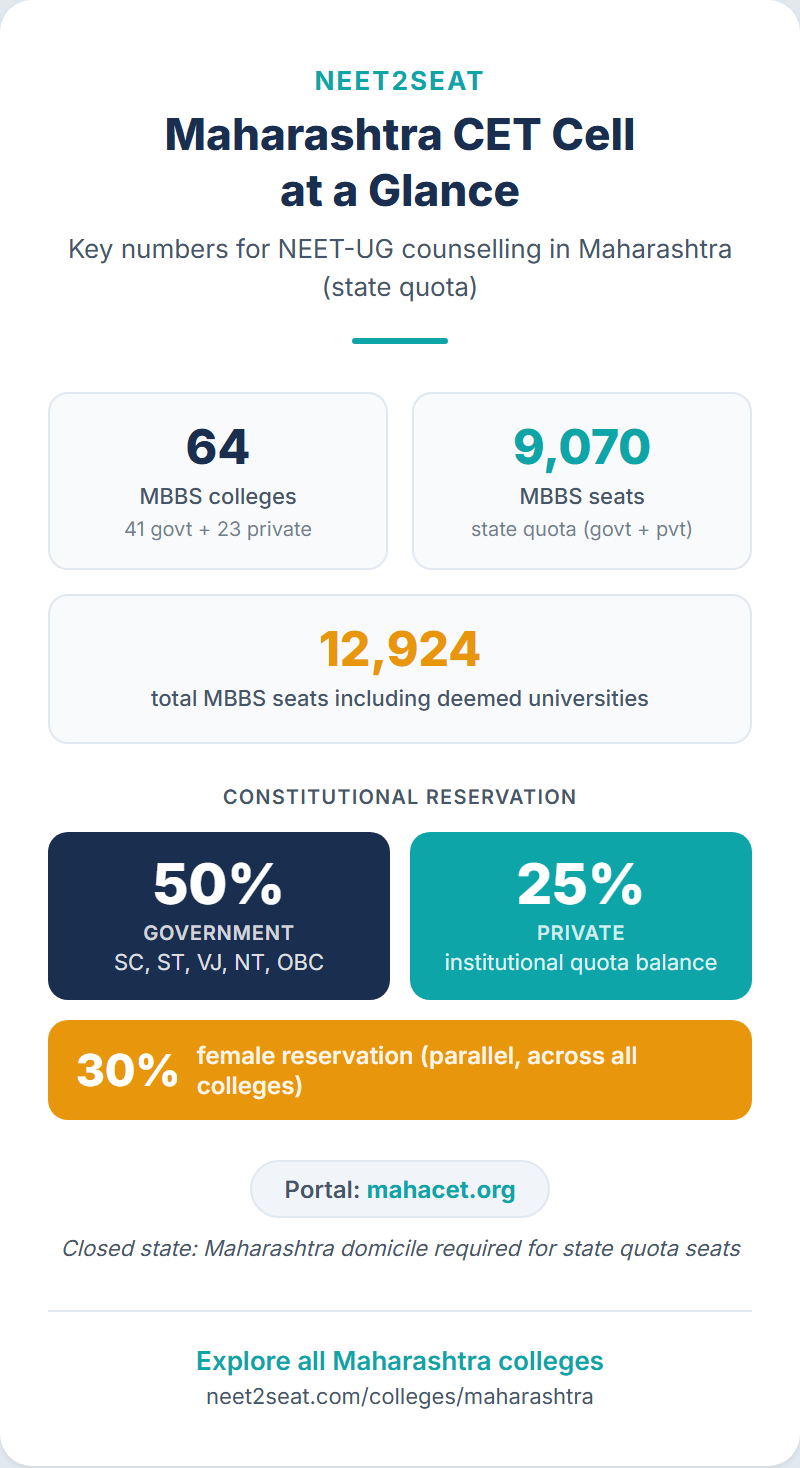
CET Cell runs counselling for 64 colleges (9,070 seats) through mahacet.org; 16 more deemed universities fill seats through MCC
Closed state: only Maharashtra domicile holders qualify for state quota. Non-domicile candidates are limited to the 15% institutional quota at private colleges
Fresh preferences every round: Round 1 choices do not carry forward to Round 2
Status Retention is irrevocable: once submitted, you exit all future rounds permanently
Who runs Maharashtra medical counselling
Maharashtra NEET counselling 2026 is conducted by the Office of the Commissioner, State Common Entrance Test Cell (CET Cell) in Mumbai. The CET Cell process runs under the authority of the Medical Education and Drugs Department, Government of Maharashtra, and follows rules published in the NEET UG Information Brochure issued each year. For the 2025-26 cycle, the brochure was approved on 22 July 2025 and runs to 337 pages of rules, annexures, college lists, and seat matrices.
Everything happens on one portal: mahacet.org. Registration, document uploading, preference filling, allotment results, status retention, and stray vacancy rounds all run through this single website. There is no offline preference form.
Maharashtra is a closed state for private college admissions. Only candidates with Maharashtra domicile (or those exempted under specific rules for children of government employees posted outside the state) can apply for state quota seats. Candidates from other states cannot participate in Maharashtra state counselling, except for the 15% institutional quota at private colleges, which is open on an all-India basis.
How many colleges and seats
According to the 2025 Information Brochure (college list dated 23 July 2025), Maharashtra has 64 MBBS colleges with a combined intake of 9,070 seats. Of these, 41 are government or corporation colleges (5,850 seats) and 23 are private unaided colleges (3,220 seats).
Including deemed universities, Maharashtra has 86 medical colleges with a combined capacity of 12,924 MBBS seats across all admission pathways. The 16 deemed universities fill seats through MCC, not CET Cell.
The state also has 16 deemed universities with MBBS programmes, but these fill seats through MCC (central counselling), not the CET Cell. Including deemed universities, our database tracks 86 medical colleges in Maharashtra with a combined capacity of 12,924 MBBS seats across all admission pathways.
The four largest government colleges each have 250 seats: Grant Government Medical College Mumbai, Seth GS Medical College and KEM Hospital Mumbai, BJ Government Medical College Pune, and Government Medical College Nagpur. The smallest government colleges (GMC GT and Cama Hospital Mumbai, GMC Parbhani) have 50 seats each.
How seats are distributed
Maharashtra splits its seats across three tracks:
All India Quota (AIQ): 15% of seats in government and corporation MBBS and BDS colleges go to the All India Quota, filled by MCC through central counselling. These are open to candidates from any state. Per the 2025 brochure, AIQ seats from government and corporation medical and dental colleges do not revert back to the state if unfilled.
State quota: 85% of government college seats and 85% of private college seats are filled by the CET Cell from the state merit list. Constitutional reservation, specified reservation, and female reservation all apply to state quota seats.
Institutional quota: 15% of seats in private unaided colleges are institutional quota seats. The CET Cell fills these through CAP rounds on an all-India basis, open to NRI, OCI, and out-of-Maharashtra (OMS) candidates. This is the only route for non-domicile candidates to get a private college seat in Maharashtra through state counselling.
Maharashtra’s reservation structure
Maharashtra has one of the most layered reservation systems in Indian medical admissions. The categories here differ from most other states, so pay close attention if you are comparing across states.
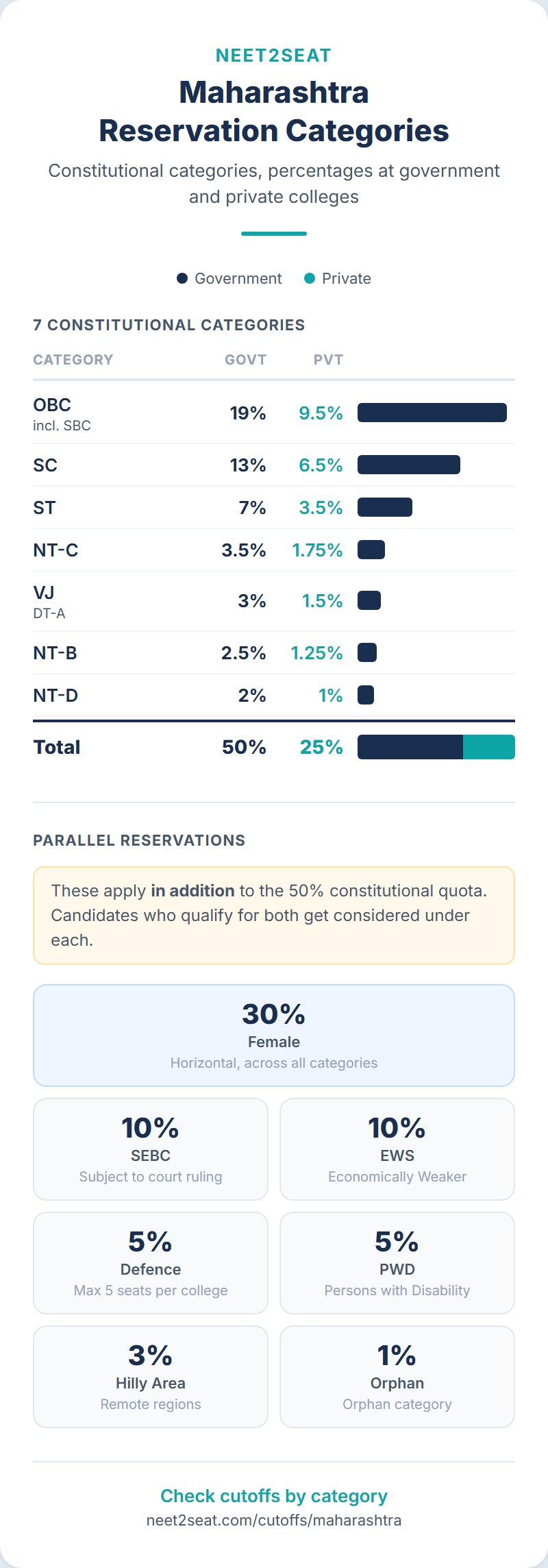
Constitutional reservation (government colleges): 50% of state quota
Category
Reservation
Scheduled Castes and SC converts to Buddhism (SC)
13%
Scheduled Tribes (ST)
7%
Vimukta Jati / DT-A (VJ)
3%
Nomadic Tribes B (NT-B)
2.5%
Nomadic Tribes C (NT-C)
3.5%
Nomadic Tribes D (NT-D)
2%
Other Backward Classes including SBC (OBC)
19%
Total
50%
Constitutional reservation (private unaided colleges): 25% of total intake
Private colleges carry exactly half the government percentages: SC 6.5%, ST 3.5%, VJ 1.5%, NT-B 1.25%, NT-C 1.75%, NT-D 1%, OBC 9.5%. This comes from the Maharashtra Act No. XXX of 2006.
Additional reservations (parallel/specified)
These operate in parallel with constitutional reservation, meaning a candidate can hold both a constitutional category seat and a specified quota seat simultaneously:
SEBC (Socially and Educationally Backward Classes): 10% of available state quota seats, in government and private colleges (excluding minority institutions). This reservation is subject to the outcome of W.P. No. 3468/2024 in the Bombay High Court.
EWS (Economically Weaker Section): 10% of available state quota seats, same scope as SEBC.
Defence (DEF): 5% of intake, maximum 5 seats per government/corporation/government-aided college. Three sub-categories: DEF-1 (ex-service, MH domicile), DEF-2 (active, MH domicile), DEF-3 (active, transferred to MH).
PWD (Persons with Disability): 5% of annual sanctioned intake, per the Rights of Persons with Disabilities Act 2016. Constitutional reservation applies within PWD quota seats.
Hilly Area (HA): 3% at government/corporation medical colleges, MBBS only.
Orphan: 1% of available seats. Constitutional reservation applies within orphan quota.
Female: 30% reservation at all colleges under CAP, across all categories. Female candidates fill female quota seats first; after those are exhausted, they compete for general seats on merit.
Specified reservations (DEF, PWD, HA, MKB, Orphan, Female) are allotted before general seats in each round. If specified quota seats go unfilled, they revert to the respective category in the state quota.
Inter-se for unfilled reserved seats
When reserved category seats remain vacant after allotment, Maharashtra uses a three-group inter-se mechanism. Unfilled seats first go to candidates from the same group:
Group I: SC and ST (share unfilled seats between these two)
Group II: VJ and NT-B
Group III: NT-C, NT-D, and OBC (including SBC)
If seats remain vacant after group inter-se, they go to the combined merit list of all reserved categories. If still vacant, they go to the common (open) merit list. SEBC and EWS unfilled seats skip this cascade entirely and revert directly to general category.
Ear-marking
When a reserved category candidate qualifies on open merit, they can choose to take either the open seat or their category seat. If they choose their category seat, one open seat at that college is “ear-marked” for the next eligible candidate from that reserved category. This mechanism prevents reserved category candidates from inadvertently blocking seats for their own community. Ear-marking does not apply to specified reservations.
The round structure
Maharashtra runs three regular CAP (Centralized Admission Process) rounds plus stray vacancy rounds. The structure differs from MCC counselling in one critical way: you fill fresh preferences for every round. Choices from one round do not carry forward to the next (except stray vacancy round choices, which carry forward to subsequent stray rounds).
Unlike MCC, Maharashtra requires fresh preferences for each round. Your Round 1 choices are completely voided before Round 2. Do not assume your earlier preferences carry forward.
Round 1
All registered candidates fill preferences and the software allots seats based on NEET AIR and preference order. If you are allotted a seat, you must report to the college and complete admission formalities (document verification, fee payment, original document submission) within the prescribed window.
If you do not report, your selection stands cancelled and the seat becomes vacant for Round 2. You remain eligible for Round 2 without re-registration. This is effectively a free exit: no penalty, no lost deposit, no consequences beyond losing that particular seat.
Round 1 carries zero risk. Not reporting after allotment is a free exit with no penalty or deposit forfeiture. Fill as many preferences as you are willing to consider.
If you join and are satisfied, you fill the Status Retention Form (more on this below). If you join but want to try for a better seat, you skip Status Retention and fill fresh choices for Round 2.
Status Retention
This is Maharashtra’s equivalent of “freezing” your seat. After joining your Round 1 college, you submit the Status Retention Form (Annexure J in the Information Brochure) to the Dean or Principal of your allotted college within the prescribed window. The form is a physical document, signed by you, your parent or guardian, and the Dean or Principal.
Two rules make Status Retention consequential. First, it is irrevocable and irreversible. Once submitted, you cannot withdraw it under any circumstances. Second, after submitting it, you are removed from consideration for all subsequent rounds of the 2025-26 admission process. Your seat is locked; you are done.
Status Retention is irrevocable. Once submitted, you cannot withdraw it and you are removed from all subsequent rounds. If there is any chance you want a better seat in Round 2, do not submit this form.
There is one exception: a candidate who has submitted Status Retention can still resign from the allotted seat before the prescribed date and become eligible for Round 2. But this effectively means giving up a confirmed seat to re-enter the pool with no guarantee of getting anything better.
Available seats include everything left from Round 1: unallotted seats, seats vacated by candidates who did not join, and seats freed by candidates who joined Round 1 but got upgraded in Round 2.
Candidates who joined during Round 1 and did not fill Status Retention are automatically considered for upgradation. If upgraded, their Round 1 seat is released and allotted to someone else in the same round. If not upgraded, they keep their Round 1 seat.
Fresh preferences are required. Round 1 choices are treated as null and void.
If you are allotted a seat in Round 2 and do not join, you must re-register (and pay the registration fee again) to participate in Round 3.
Round 3
Seats unallotted or vacated from Round 2 are available. Fresh preferences required; all previous preferences are null and void. If allotted a seat in Round 3, joining is mandatory. After Round 3 allotment, you are not eligible for any further state counselling rounds. The CET Cell informs MCC of all candidates allotted in Round 3.
Stray vacancy rounds
After Round 3, if seats remain vacant, the CET Cell conducts online stray vacancy rounds. Only candidates who registered and filled preferences previously but did not receive any allotment through Round 3 are eligible. Candidates who joined in any earlier round are not eligible. No new registrations are accepted for stray rounds. Fresh choices are required (Round 3 choices are voided), but stray round choices carry forward to subsequent stray rounds if any.
There is no institutional-level round for MBBS and BDS seats. All rounds run through the CET Cell’s centralized software, per an NMC circular dated 24 July 2023.
Registration and fees
Registration happens on mahacet.org during two windows: before Round 1, and again before Round 3 (for candidates who need fresh registration). You submit an online application form combined for all institution types (government, corporation, private, minority).
Application type
Fee (non-refundable)
State quota only
Rs 1,000
Institutional quota only
Rs 5,000
Both state and institutional quota
Rs 6,000
After payment, you upload documents online (NEET admit card, scorecard, government ID, domicile certificate, SSC and HSC certificates, category certificates if applicable). Physical document verification happens at the allotted college during reporting.
Eligibility for Maharashtra state quota
The core requirements from the 2025 Information Brochure (Section 4):
Nationality: Indian citizen. OCI cardholders who obtained OCI status before 4 March 2021 and passed 10th and 12th from Maharashtra with MH domicile are eligible (per Supreme Court order in W.P.(C) No. 891/2021, dated 3 February 2023).
Domicile: Maharashtra domicile certificate required (except for institutional quota, defence, and MKB candidates).
SSC: Must have passed SSC (10th) from an institution in Maharashtra.
HSC: Must have passed HSC (12th) from an institution in Maharashtra with English, Physics, Chemistry, and Biology.
HSC marks: OPEN and EWS candidates need minimum 50% in PCB combined (150/300). Constitutional reservation, SEBC, and PWD candidates from reserved categories need 40% (120/300). PWD candidates in General category need 45% (135/300).
Age: Born on or before 31 December 2008.
NEET percentile: OPEN and EWS need 50th percentile. Reserved categories and SEBC need 40th percentile. PWD in General need 45th percentile.
Exceptions exist for children of Maharashtra government employees posted outside the state, children of central government employees transferred to Maharashtra, and defence personnel with MH domicile posted elsewhere. These candidates can have their SSC/HSC from outside Maharashtra. Details are in Sections 4.7 and 4.8 of the brochure.
Fee structure
Government and corporation college MBBS fees for 2025-26, per the brochure:
Fee component
Amount per year
Tuition fee
Rs 1,52,100
Development fee
Rs 5,000
Gymkhana fee
Rs 500
Hostel fee
Rs 4,000
Library fee
Rs 1,000
One-time fees at admission: Rs 1,500 admission fee and Rs 2,000 library deposit.
Total first-year cost at a government MBBS college in Maharashtra comes to about Rs 1,65,100. Subsequent years are roughly Rs 1,62,600.
Private college fees are set by the Fee Regulating Authority of Maharashtra (mahafra.org) and vary widely by institution. The brochure does not list private college fee amounts; it directs candidates to check each college’s website or the FRA portal. Based on publicly available FRA data from recent years, private MBBS fees in Maharashtra typically range from Rs 5 lakh to Rs 25 lakh per year, though some institutions charge more.
Backward class candidates selected on open merit are eligible for freeship and scholarship schemes. The MAHADBT portal (mahadbtmahait.gov.in) handles applications for post-matric scholarships, the Rajarshi Chhatrapati Shahu Maharaj Shikshan Shulk Shishyavrutti scheme (for OPEN/EWS candidates with family income below Rs 8 lakh), and minority scholarship schemes.
What our data shows for Maharashtra
neet2seat tracks 244,015 Maharashtra allotment records across 2023, 2024, and 2025, covering 86 colleges and every round of state counselling.
neet2seat tracks allotment data for 86 Maharashtra medical colleges across 2023, 2024, and 2025. Our database contains 244,015 Maharashtra allotment records across these three years, covering every round of state counselling.
In 2025 specifically, Maharashtra state counselling processed 97,011 records across three rounds (R1, R2, R3), with 30,988 candidates receiving final allotments at 95 distinct colleges. AIR ranks ranged from 10 (top seats in Round 1) to over 13,19,000 (last seats filled in Round 3).
Closing AIRs for OPEN category at the most competitive government colleges in 2025 (final round, excluding sub-quotas):
College
Closing AIR (2025)
Closing AIR (2024)
Closing AIR (2023)
Seth GS Medical College and KEM Hospital, Mumbai
2,571
3,689
3,331
Lokmanya Tilak Municipal MC, Sion, Mumbai
6,033
9,357
8,379
BJ Government Medical College, Pune
8,634
5,595
7,716
Government Medical College (Grant), Mumbai
9,433
9,264
10,416
GMC Nagpur
11,360
12,700
15,077
Some patterns from the three-year data: Seth GS/KEM tightened significantly in 2025 (closing at AIR 2,571, down from 3,689 in 2024). GMC Nagpur has tightened steadily year over year. BJ Medical Pune fluctuates: it closed at 5,595 in 2024 but loosened to 8,634 in 2025. These shifts reflect changes in candidate preference patterns and seat availability each year, not necessarily changes in college quality.
You can explore this data in detail using our Maharashtra cutoff analyzer, which lets you filter by college, category, round, and year. For a quick look at where your rank might land you, try the college predictor.
How Maharashtra state counselling differs from MCC
If you are also participating in MCC (All India Quota) counselling, note these differences in the Maharashtra state process:
Fresh choices every round. MCC carries forward your original preference list across rounds. Maharashtra requires fresh preferences for each round. Round 1 choices are voided before Round 2, Round 2 choices are voided before Round 3.
Status Retention vs. Freeze. MCC uses Freeze (keep current seat, no upgradation) and Float (stay in pool for upgradation). Maharashtra uses Status Retention (irrevocable exit from all future rounds). The consequence is sharper: in MCC, freezing still keeps you enrolled in the system through subsequent rounds. In Maharashtra, Status Retention removes you entirely.
No deposit system. MCC charges a refundable security deposit (Rs 10,000 to Rs 2,00,000). Maharashtra charges a non-refundable registration fee (Rs 1,000 to Rs 6,000) and you pay college fees directly at reporting. There is no separate security deposit to forfeit or refund.
Maharashtra-specific categories. VJ (Vimukta Jati), NT-B, NT-C, NT-D, and SEBC are Maharashtra categories with no direct equivalent in MCC counselling.
Round 3 is binding. In Maharashtra, if you are allotted a seat in Round 3, joining is mandatory and you are barred from subsequent state counselling rounds. MCC’s mop-up round has similar rules, but the terminology and timeline differ.
Common mistakes
Based on patterns we see in the data and recurring questions from candidates:
Not filling enough preferences in early rounds. Since each round requires fresh preferences and Round 1 carries no risk (you can simply not report), there is no reason to be conservative. Fill as many preferences as you are willing to consider. You can always decline by not joining.
Confusing Status Retention with MCC’s Freeze option. They are not the same. Status Retention in Maharashtra pulls you out of the process entirely. If there is any chance you want a better seat in Round 2, do not fill the Status Retention Form.
Missing the re-registration deadline for Round 3. If you were allotted a seat in Round 2 and did not join, you must register again (and pay again) before the Round 3 deadline. Missing this window means you are out of the process.
Not having category certificates ready. Maharashtra requires the Caste Validity Certificate (not just the caste certificate) and the Non-Creamy Layer certificate at document verification. These take time to obtain. If you fail to produce them, you are automatically treated as an Open category candidate, which can mean losing your seat entirely if your rank does not qualify under Open.
If you belong to a reserved category, start your Caste Validity Certificate and Non-Creamy Layer certificate applications now. These documents take weeks to process. Without them at verification, you will be treated as Open category and may lose your seat.
FAQ
Can I participate in both MCC and Maharashtra CET Cell counselling?
Yes. Register separately for each. If you receive allotments from both, you choose one and vacate the other within the reporting window.
I am from another state. Can I get a private medical college seat in Maharashtra?
Only through the 15% institutional quota at private unaided colleges, which the CET Cell fills on an all-India basis through CAP rounds. You cannot apply for state quota (85%) seats at private colleges. Maharashtra is a closed state.
What if I join in Round 1 but want to try for a better seat in Round 2?
Do not fill the Status Retention Form. Fill fresh preferences for Round 2 instead. If upgraded, your Round 1 seat is automatically released. If not upgraded, you keep your Round 1 seat. There is no risk to trying, as long as you skip Status Retention.
Is there a fee penalty for not joining after Round 1 allotment?
No. Not reporting after Round 1 is treated as a free exit. Your registration fee (Rs 1,000 to Rs 6,000) is non-refundable regardless, but there is no additional penalty or deposit forfeiture.
When does the CET Cell publish the seat matrix?
The seat matrix (college-wise distribution of seats by category) is published on mahacet.org before preference filling opens for each round. The exact date is announced in the schedule notification. It typically comes out after the provisional merit list is published and the document verification window closes.
Do SEBC and EWS unfilled seats go through inter-se?
No. Unlike constitutional reservation categories (SC, ST, VJ, NT-B, NT-C, NT-D, OBC), unfilled SEBC and EWS seats revert directly to general category. They do not participate in the three-group inter-se mechanism.
What is the Non-Creamy Layer certificate requirement?
Candidates from DT-A (VJ), NT-B, NT-C, NT-D, SEBC, and OBC (including SBC) must produce a Non-Creamy Layer certificate valid up to 31 March 2026 or later. This must be submitted at physical document verification. Without it, you are treated as an Open category candidate. SC and ST candidates are exempt from this requirement.
Can I use a central government format EWS certificate?
The CET Cell requires the state government format EWS certificate (Annexure T of the Information Brochure). Central government format certificates are not accepted for Maharashtra state counselling.
No. The CET Cell explicitly requires the state government format EWS certificate (as given in Annexure T of the Information Brochure). Central government format certificates are not accepted for Maharashtra state counselling.
Maharashtra recognizes 7 constitutional categories (50% at government colleges), 2 additional categories (SEBC 10%, EWS 10%), and 6 parallel reservation types.
Your Maharashtra category may differ from your central government category. Check the state backward classes list for your specific caste.
Non-Creamy Layer certificates are required for VJ, NT-B, NT-C, NT-D, SEBC, and OBC candidates. SC and ST are exempt.
All category claims must be made in the original application. You cannot add or change after the deadline.
Maharashtra’s category system is not the same as the central government’s
If you have only seen the MCC (All India Quota) counselling categories (SC, ST, OBC-NCL, EWS, General), Maharashtra’s category list will look unfamiliar. The state recognizes seven constitutional reservation categories, two additional reservation categories, and six specified (parallel) reservation types. These categories determine which seats you can compete for, what cutoffs apply to you, and which documents you need.
Your central government category (for MCC counselling) and your Maharashtra state category (for CET Cell counselling) are determined by different lists. Some castes appear on both, some only on one. You could be OBC centrally and NT-C in Maharashtra, or vice versa. Check your specific caste against the Maharashtra backward classes list independently.
This guide covers every category used in Maharashtra NEET UG state counselling, based on the 2025 Information Brochure issued by the CET Cell and the reservation rules in Annexure B. If you are looking for Karnataka categories, see our Karnataka categories guide.
Constitutional reservation categories: 50% at government colleges
These seven categories account for 50% of state quota seats at government and corporation medical colleges in Maharashtra. At private unaided colleges, the same seven categories share 25% of total intake (exactly half the government percentages).
SC (Scheduled Castes and SC converts to Buddhism): 13% government, 6.5% private
Maharashtra’s SC reservation includes both Scheduled Castes and Scheduled Caste converts to Buddhism (Nav-Baudh). Maharashtra has a large Buddhist population (mostly Ambedkarite conversions), which is why Nav-Baudh are included under SC rather than as a separate category. The state percentage (13%) is lower than the central government’s 15% for SC at AIQ, but the eligible group is broader because it includes Nav-Baudh converts who may not be on the central SC list. No Non-Creamy Layer certificate is required for SC candidates. Caste certificate and Caste Validity Certificate (CVC) from the Divisional Caste Certificate Scrutiny Committee are required.
ST (Scheduled Tribes): 7% government, 3.5% private
Includes Scheduled Tribes living both within and outside specified scheduled areas. Same as the national list. Tribe Validity Certificate from the Tribe Certificate Scrutiny Committee is required (different authority from the SC committee). No Non-Creamy Layer certificate needed.
Vimukta Jati literally means “liberated castes.” These are communities that were classified as “criminal tribes” under British colonial law (the Criminal Tribes Act of 1871) and were “denotified” after independence. The term DT-A (Denotified Tribes Category A) is used interchangeably with VJ. This category has no equivalent in the central government reservation system. For AIQ counselling, VJ candidates may qualify as OBC-NCL if their specific caste is on the central OBC list.
Non-Creamy Layer certificate is required (valid up to 31 March 2026 for the 2025-26 cycle). Caste certificate and CVC also required.
Nomadic Tribes are communities with historically itinerant lifestyles who do not have fixed settlements. Maharashtra divides them into three sub-categories (B, C, D) with separate reservation percentages. NT-B is the first of these. The specific castes in each sub-category are listed in state government notifications. Non-Creamy Layer certificate required.
The second Nomadic Tribes sub-category. Carries a slightly higher reservation percentage than NT-B. In the inter-se mechanism for unfilled seats, NT-C falls in Group III (along with NT-D and OBC), while NT-B falls in Group II (with VJ). This grouping matters when reserved seats go unfilled. Non-Creamy Layer certificate required.
The third Nomadic Tribes sub-category, with the smallest allocation among the three. Falls in Group III for inter-se purposes. Non-Creamy Layer certificate required.
OBC (Other Backward Classes, including SBC): 19% government, 9.5% private
Maharashtra’s OBC reservation at 19% is lower than the central government’s 27%, but the state’s overall 50% constitutional reservation is distributed across seven categories rather than the central government’s three. OBC here includes SBC (Special Backward Classes). SBC candidates are drawn from their parent OBC category; they do not have a separate reservation percentage. Non-Creamy Layer certificate required.
Private college calculation
At private unaided colleges, the total constitutional reservation is 25% (not 50%). The seven category percentages are exactly half the government figures. This comes from Maharashtra Act No. XXX of 2006. The remaining 75% includes open merit seats, institutional quota (15% on all-India basis), and female reservation.
Additional reservation categories
SEBC (Socially and Educationally Backward Classes): 10%
SEBC is a separate 10% reservation applied to available state quota seats at government, government-aided, corporation, and private unaided colleges (excluding minority institutions). It was introduced through a Maharashtra government resolution and is currently subject to the outcome of Writ Petition No. 3468/2024 in the Bombay High Court. If the court strikes it down, these seats revert to general category.
SEBC candidates must claim the category in their online application form. Non-Creamy Layer certificate required. If SEBC seats go unfilled, they revert to general category (they do not participate in the three-group inter-se mechanism that applies to the seven constitutional categories).
EWS (Economically Weaker Sections): 10%
The EWS certificate must be in the Maharashtra state government format (Annexure T of the Information Brochure). Central government format certificates are explicitly rejected. EWS candidates cannot belong to any constitutional reservation category. If you hold SC, ST, VJ, NT, OBC, SEBC, or SBC status, you are not eligible for EWS.
A 10% reservation for economically weaker candidates from the general (unreserved) category, applied to available state quota seats at the same institution types as SEBC. Like SEBC, unfilled EWS seats revert directly to general category without inter-se.
Specified (parallel) reservation categories
These reservations operate in parallel with constitutional reservation. A candidate can simultaneously benefit from a constitutional category (say, SC) and a specified quota (say, Female or PWD). The seat is coded with both designations. In our Maharashtra cutoff analyzer, you will see compound categories like “SCW” (SC Female) or “OPENDEFPH” (Open category, Defence, PWD) reflecting these parallel reservations.
DEF (Defence): 5% of intake, maximum 5 seats per college
Reserved for children of defence personnel at government, corporation, and government-aided colleges only. Three sub-categories:
DEF-1: Children of ex-servicemen with Maharashtra domicile
DEF-2: Children of active service personnel with Maharashtra domicile
DEF-3: Children of active service personnel transferred to Maharashtra
If defence seats in one sub-category go unfilled, they transfer to the other two sub-categories by inter-se merit. The minimum eligibility for defence quota is the same as for open merit candidates. Defence quota is a specified reservation, so these seats are allotted before general seats in each round.
PWD (Persons with Disability): 5% of sanctioned intake
Under the Rights of Persons with Disabilities Act 2016, 5% of seats are reserved for candidates with benchmark disabilities. Constitutional reservation applies within PWD quota seats (so there are PWD-SC, PWD-ST, PWD-OBC seats, etc.). The disability certificate must be from one of the 16 designated Disability Assessment Boards listed in the Information Brochure and must be issued in 2025. Certificates from other medical boards are not accepted.
Unfilled PWD seats revert to the respective constitutional category in the state quota. No fresh preferences are called; the reverted seats are added to the seat matrix and allotted based on existing preferences.
HA (Hilly Area): 3% at government/corporation MBBS colleges only
Reserved for candidates from designated hilly areas in Maharashtra. Only applies to government and corporation medical colleges, and only for the MBBS course. Constitutional reservation and female reservation apply within HA quota. If HA seats go unfilled, they revert to the state quota in the respective category.
Orphan: 1% of available seats
For candidates with orphan status, certified by the Women and Child Welfare Department. Constitutional reservation applies within orphan quota seats. Unfilled orphan seats revert to respective categories.
Female: 30% at all colleges under CAP
The 30% female reservation operates in parallel with constitutional reservation. A seat can be simultaneously coded as SC (constitutional) and Female (specified). The total effective reservation can exceed 50% because of this parallel operation. Female candidates are first allotted female quota seats; after those are exhausted, they compete for general seats on merit.
For residents of the Maharashtra-Karnataka border disputed area. Filled from the state merit list. Unfilled MKB seats revert to Open category since they are carved from it. MKB is allotted before general seats.
How inter-se works for unfilled seats
Maharashtra’s three-group inter-se cascade: Group I (SC and ST share unfilled seats), Group II (VJ and NT-B share), Group III (NT-C, NT-D, and OBC share). If still unfilled after within-group sharing, seats go to combined merit of all reserved categories, then to open merit. SEBC and EWS are excluded from this cascade; their unfilled seats go directly to general category.
The inter-se round runs at the end of each admission process, during Round 3. It is not a separate round that candidates need to register for; it operates on existing preferences.
Ear-marking: when reserved category candidates qualify on open merit
When a reserved category candidate’s NEET AIR qualifies them for an open merit seat, the candidate can choose: take the open seat, or take a seat under their reserved category. If they choose the reserved category seat, one open seat at the college where they would have been admitted on open merit is “ear-marked” for the next eligible candidate from their reserved category.
This prevents a situation where high-ranking reserved category candidates occupy open seats while blocking seats for lower-ranking candidates from their own category. The ear-marked seat is filled immediately in the same round.
Ear-marking applies only to constitutional reservation categories. It does not apply to specified reservations (DEF, PWD, HA, Female, Orphan, MKB).
What our data shows about category cutoffs
Our database tracks allotment data for 86 Maharashtra colleges across 2023, 2024, and 2025, with 41 distinct seat categories (including compound categories from parallel reservations). You can filter cutoffs by any of these categories using the Maharashtra cutoff analyzer.
Some patterns from the data:
The gap between OPEN and reserved category closing AIRs varies widely by college. At the most competitive government colleges (Seth GS/KEM, BJ Pune), the OPEN closing AIR in 2025 was around 2,500 to 8,600. SC closing AIRs at the same colleges were typically 2x to 4x higher (less competitive). At mid-tier government colleges, the OPEN-to-SC gap narrows.
SEBC and EWS closing AIRs tend to fall between OPEN and the constitutional reservation categories, since these candidates must first not qualify under any constitutional category.
Female reservation (the “W” suffix in our data, as in “OPENW” or “SCW”) consistently shows slightly higher closing AIRs than the corresponding non-female category at the same college. The 30% parallel reservation for women means additional seats open up, and these seats tend to close at higher (less competitive) AIRs than the general category equivalent.
Caste certificate + CVC + Non-Creamy Layer certificate (valid up to 31/3/2026)
SEBC
Caste certificate + CVC + Non-Creamy Layer certificate
EWS
EWS certificate in state government format (Annexure T), for 2025-26
DEF
Defence service certificate per Annexure C
PWD
Disability certificate from designated board, issued in 2025
HA
Hilly Area residence certificate per Annexure F
Orphan
Orphan certificate from Women and Child Welfare Dept
MKB
MKB area certificate per Annexure E
All category claims must be made in the original online application form. You cannot add or change your category after the deadline. If you fail to produce required documents at physical verification, you are automatically treated as OPEN category. Start gathering documents the moment your NEET result is out. See our documents guide for the complete checklist.
Non-Creamy Layer: the detail that trips people up
The NCL certificate is required for VJ, NT-B, NT-C, NT-D, SEBC, and OBC (including SBC) candidates. SC and ST are exempt. If your NCL certificate is missing, expired, or in the wrong format at document verification, your reservation claim is denied and you are treated as OPEN. If your AIR does not qualify under OPEN at your allotted college, your admission is cancelled. The Information Brochure states this twice. Verification officers enforce it strictly.
The certificate is issued by the Sub-Divisional Officer, Deputy Collector, or Collector of the district and must be valid up to 31 March 2026 or later. The “creamy layer” concept excludes candidates whose families exceed a certain income or asset threshold from reservation benefits.
FAQ
I am OBC in the central list. Does that automatically make me OBC in Maharashtra?
Not necessarily. The central OBC list and the Maharashtra OBC list are different. Some castes appear on both, some only on one. Your Maharashtra category is determined by Maharashtra state notifications. Check your specific caste against the Maharashtra backward classes list. You could be OBC centrally and NT-C in Maharashtra, or vice versa.
What is the difference between VJ and NT categories?
VJ (Vimukta Jati) comprises communities that were classified as “criminal tribes” under British law and later denotified. NT (Nomadic Tribes) comprises communities with historically nomadic lifestyles. Both are socially marginalized groups, but the historical basis for their classification differs. In the inter-se mechanism, VJ and NT-B form Group II, while NT-C, NT-D, and OBC form Group III.
Can I claim both constitutional reservation and EWS?
No. EWS is specifically for candidates from the general (unreserved) category. If you belong to SC, ST, VJ, NT-B, NT-C, NT-D, OBC, SEBC, or SBC, you are not eligible for EWS reservation. You claim one or the other, not both.
What does “SBC” mean in the context of OBC?
Special Backward Classes (SBC) are a sub-group within OBC. Per Maharashtra Act No. XXX of 2006, SBC candidates are considered from within the OBC reservation quota. They do not have a separate reservation percentage. In practice, SBC candidates compete under the 19% OBC allocation.
Do specified reservations (Female, DEF, PWD) reduce the seats available for constitutional categories?
No. Specified reservations operate in parallel. A seat can be simultaneously coded as SC (constitutional) and Female (specified). The 30% female reservation does not reduce the 13% SC reservation; they overlap. The total effective reservation can exceed 50% because of this parallel operation.
How do I know which categories to filter for in the cutoff analyzer?
Use your constitutional reservation category as the base, and add any specified quota suffix if applicable. For example: OPEN for general merit, SC for Scheduled Caste, OPENW for general merit female, SCW for SC female, OPENDEF for general merit defence. The cutoff analyzer shows all available categories in the filter dropdown for Maharashtra.
86 medical colleges fill 12,924 MBBS seats through Maharashtra state-quota counselling (excludes AIQ government and deemed seats), with a fee range from Rs 1.62 lakh to Rs 25 lakh per year
Maharashtra has the second-largest medical education system in India. The 86 medical colleges in Maharashtra span 44 government colleges, 26 private colleges, and 16 deemed universities, with 12,924 MBBS seats filled through Maharashtra state-quota counselling (excludes AIQ and deemed seats). Understanding the full picture for NEET 2026 (who these colleges are, where they are, what they cost, and how competitive they are) is the first step toward building an informed preference list.
Government college closing AIRs range from 12,566 to above 9,71,403 — every AIR level has a government option
Mumbai + Navi Mumbai cluster has 16 colleges, the densest medical education ecosystem in any Indian metro
List all government colleges before private ones on your preference list to maximize fee savings
Government medical colleges: 44 colleges, 6,175 seats
Maharashtra’s 44 government medical colleges are spread across 36 cities. Nine are concentrated in Mumbai alone. Pune has 4 (including the Armed Forces Medical College, which has its own admission process). Nagpur has 2. The remaining colleges are distributed across district headquarters and smaller cities.
Annual fees at all government colleges are approximately Rs 1.62 lakh per year. See our Maharashtra fees guide for the complete breakdown.
The competitiveness spectrum
Government colleges in Maharashtra span a wide competitiveness range. From our 2025 data (Round 2, OPEN category):
The most competitive government colleges close at AIRs below 20,000. ESIC Medical College Andheri closed at AIR 12,566 (though ESIC colleges operate under central government and may have distinct dynamics). Grant Medical College (Mumbai), Seth GS Medical College (Mumbai), and BJ Medical College (Pune) are consistently among the most competitive, closing below AIR 15,000 in recent years.
Mid-tier government colleges close between AIR 20,000 and 80,000. This band includes well-established colleges in cities like Aurangabad (Chhatrapati Sambhajinagar), Solapur, Kolhapur, Sangli, and Latur. These colleges offer solid clinical training with lower living costs than Mumbai or Pune.
The least competitive government colleges close at AIRs above 80,000, extending to AIR 9,71,403 at the furthest end. Newer government colleges in Nandurbar, Sindhudurg, Gondia, and similar rural districts fill at higher ranks. Despite their lower competitiveness, they offer the same Rs 1.62 lakh/year fee structure and an equivalent MBBS degree.
The 30x fee gap between government (Rs 1.62L/yr) and private (Rs 5-15L/yr) colleges makes every government seat worth listing, regardless of location. Even a Tier 4 government college saves Rs 20-65 lakh over five years compared to a private alternative.
Mumbai’s government college cluster
Mumbai has 9 government medical colleges, making it the single largest cluster in any Indian city. These include Seth GS Medical College (KEM Hospital), Grant Medical College (JJ Hospital), LTMMC (Sion Hospital), Topiwala National Medical College (Nair Hospital), ESIC Andheri, Gokuldas Tejpal, and others. With approximately 1,400 combined seats, Mumbai’s government cluster absorbs a significant portion of Maharashtra’s top-ranked candidates.
Maharashtra has been adding new government medical colleges in underserved districts. Colleges in Nandurbar, Alibaug (Raigad), Parbhani, Usmanabad, and similar locations were established in recent years. These newer colleges typically have smaller intakes (50 to 100 seats), less established infrastructure, and higher closing AIRs For candidates in the AIR 50,000 to 2,00,000 range, these colleges represent accessible government seats that many candidates overlook in favour of private colleges in larger cities.
Newer government colleges in districts like Nandurbar and Sindhudurg are often overlooked. If your AIR is between 50,000 and 2,00,000, these colleges give you government fees and an identical MBBS degree. List them as safety options below your preferred choices.
Private medical colleges: 26 colleges, 3,699 seats
Maharashtra’s 26 private medical colleges are concentrated in a few urban corridors. Pune has 3, Nagpur has the NKP Salve Institute (250 seats), and Ahmednagar, Kolhapur, Nashik, Sangli, and other cities each have one or two.
State quota fees range from Rs 5 lakh to Rs 15 lakh per year. Institutional quota (15% of seats) charges 2x to 3x the state quota fee. See the fees guide for details.
The private college competitive range
Private colleges in Maharashtra close at AIRs ranging from approximately 38,000 (top private colleges like KJ Somaiya in Mumbai) to above 5,00,000 (less established or newer institutions). The wide range means that candidates across a broad AIR spectrum (30,000 to 5,00,000+) will find private college options available to them.
For candidates who exhaust their government college options on the preference list, private colleges provide essential backup. Even if the fee is Rs 10 lakh to Rs 15 lakh per year, having a private seat is better than no seat at all in Round 1 (where exit is free).
Private college fees are 3x to 10x higher than government fees. Always exhaust your government college options on the preference list before adding private colleges. In Round 1, where exit is free, listing a private college as a backup costs nothing.
Deemed universities: 16 colleges, 3,050 seats
Maharashtra’s 16 deemed universities account for 3,050 MBBS seats. Five are concentrated in Navi Mumbai: DY Patil Medical College (3 separate campuses), MGM Medical College, and Terna Medical College. Others are in Pune (3), Wardha (2), and scattered across other cities.
Deemed university government quota seats (approximately 25%) are filled through CET Cell counselling. The remaining seats go through MCC or the university’s own admission process. Fees range from Rs 10 lakh to Rs 25 lakh per year depending on seat type and institution.
One detail worth watching: deemed universities in Maharashtra do not participate in state counselling for all their seats. The government quota portion (filled through CET Cell) has different cutoffs from the MCC portion. Check both tracks if you are considering a deemed university.
Deemed university seats are split across CET Cell and MCC counselling. If targeting a deemed university, register for both counselling processes and compare government quota fees across the two tracks.
Geographic distribution
Maharashtra’s medical colleges span 45 cities. The concentration:
Mumbai + Navi Mumbai: 16 colleges (9 government, 2 private, 5 deemed). The largest cluster in any Indian metropolitan area for medical education.
Pune: 8 colleges (2 government including AFMC, 3 private, 3 deemed).
Nagpur: 3 colleges (2 government, 1 private).
Remaining cities: 1 to 2 colleges each, mostly government.
For most candidates, the geographic decision is between pursuing a college in the Mumbai-Pune corridor (higher living costs, more clinical exposure, larger peer network) versus a college in a smaller city (lower costs, less competitive cutoffs, potentially more hands-on clinical rotations due to smaller batch sizes).
How to use this information for preference ordering
The 86 colleges fall into natural tiers for preference list construction:
Top government colleges in metro areas (Seth GS, Grant, BJ Pune, LTMMC): positions 1 through 5 on most candidates’ lists.
Remaining Mumbai and Pune government colleges: positions 6 through 15.
Government colleges in mid-size cities (Nagpur, Aurangabad, Kolhapur, Solapur): positions 15 through 30.
Government colleges in smaller cities and newer institutions: positions 30 through 44.
Top private colleges (KJ Somaiya, DY Patil, etc.): positions 44 through 55.
Remaining private and deemed university government quota: positions 55 through 86.
This ordering puts all government colleges above all private colleges, reflecting the fee advantage. Adjust based on your specific location preferences and financial situation. Use the college predictor to classify each college as Safe, Target, or Reach for your AIR.
Open the college predictor, enter your expected AIR and category, and classify each of Maharashtra’s 86 colleges as Safe, Target, or Reach. Then build your preference list following the tier order above, with all Safe and Target government colleges first.
FAQ
How many government colleges are in Maharashtra?
44 government medical colleges with a combined intake of 6,175 MBBS seats, spread across 36 cities.
Which Maharashtra medical college is the most competitive?
Based on 2025 data, ESIC Medical College Andheri had the lowest OPEN closing AIR among government colleges. Among traditional government colleges, Grant Medical College and Seth GS Medical College in Mumbai are consistently the most competitive. Among private colleges, KJ Somaiya Medical College in Mumbai has the lowest closing AIR.
Are deemed university seats worth considering?
Yes, if you can afford the fees. Government quota seats at deemed universities (filled through CET Cell) have moderate fees and can be less competitive than equivalent-quality private colleges. Deemed universities often have well-equipped hospitals and research facilities. List them in the private/deemed tier of your preference list.
Do all 86 colleges participate in CET Cell counselling?
Most do, but AFMC Pune has its own admission process, and some deemed universities fill only a portion of their seats through CET Cell (the rest go through MCC or university-level admissions). Check the current year’s CET Cell seat matrix for the exact list of participating colleges and available seats.
Can I get MBBS with 400 marks in NEET in Maharashtra?
400 marks in NEET typically translates to an AIR in the range of 1,00,000 to 1,50,000 (the exact rank depends on the year’s difficulty and number of candidates). At this range in Maharashtra, government colleges in smaller cities (Tier 3 and Tier 4 in our ranking) and several private colleges are within reach for the OPEN category. Reserved category candidates at this mark range have access to a wider set of government colleges. Use the college predictor with your exact AIR to see your Safe, Target, and Reach options.
Maharashtra medical college fees range from Rs 1.62 lakh to Rs 25 lakh per year, depending on three variables
The cost of an MBBS degree in Maharashtra depends on three factors: whether the college is government, private, or deemed; which seat type you hold (state quota, institutional quota, or management quota); and whether your category qualifies for fee concessions. Over a five-year MBBS programme, these variables create a total cost range from under Rs 10 lakh to over Rs 1.25 crore.
This guide breaks down the fee structures across all three college types in Maharashtra, using current fee data. For college-specific cutoff data, see the Maharashtra cutoff analyzer. For a full list of colleges, see our Maharashtra college directory.
Government: Rs 1.62L/yr (total Rs 15-25L over 5 years including living expenses)
Private state quota: Rs 5-15L/yr; institutional quota: 2-3x state quota; management quota: Rs 20-25L+/yr
The 5-year total cost gap spans Rs 10L (government) to Rs 1.25 crore (private management quota) — an 8x spread
A Rs 50L education loan at 9.5% with moratorium accumulates Rs 36L in interest before the first EMI
Government medical colleges: Rs 1.62 lakh per year
Maharashtra has 44 government medical colleges with a combined intake of 6,175 MBBS seats. Government college fees are set by the state government and are uniform across all 44 institutions. Whether you attend Seth GS Medical College in Mumbai or the government medical college in Nandurbar, the tuition fees are the same.
The current annual fee at Maharashtra government medical colleges is approximately Rs 1.52 lakh for tuition, plus a development fee of approximately Rs 10,000, bringing the total to roughly Rs 1.62 lakh per year. Over five years, total tuition costs come to approximately Rs 8.1 lakh.
Additional costs beyond tuition include hostel fees (Rs 10,000 to Rs 30,000 per year depending on the institution), mess charges (Rs 30,000 to Rs 60,000 per year), and examination fees. Total out-of-pocket cost for five years at a Maharashtra government college, including living expenses in a mid-range city, typically falls between Rs 15 lakh and Rs 25 lakh.
Fee concessions for reserved categories
SC, ST, VJ/NT, and OBC candidates in Maharashtra may be eligible for government fee reimbursement schemes. Several state scholarship programmes cover tuition fees partially or fully for economically weaker reserved category students. The exact reimbursement depends on family income thresholds set by the Social Justice Department or Tribal Development Department. Check the current year’s eligibility criteria; the schemes are revised periodically.
If you belong to SC, ST, VJ/NT, or OBC categories, check your eligibility for state fee reimbursement schemes before assuming you need to pay full tuition. At Rs 1.62L/yr, government college fees are often covered entirely by state scholarships for eligible candidates.
The hidden cost advantage of government colleges
Government college fees are indexed to government pay commissions and rarely increase by more than 5% to 10% per year. Private college fees, by contrast, are subject to fee regulatory committee approvals and can increase by 10% to 15% annually. A government college seat that costs Rs 1.62 lakh per year in Year 1 might cost Rs 1.80 lakh by Year 5. A private college seat at Rs 15 lakh in Year 1 could be Rs 20 lakh by Year 5, depending on the approved escalation clause.
Fee escalation compounds the gap over five years. Government fees increase 0-5% annually; private fees increase 10-15%. A private college starting at Rs 15L/yr can reach Rs 20L/yr by Year 5, while a government college stays near Rs 1.62L/yr. The cumulative difference exceeds the Year 1 gap by 20-30%.
Private medical colleges: Rs 5 lakh to Rs 25 lakh per year
Maharashtra has 26 private medical colleges with 3,699 MBBS seats. Private college fees are set by the state Fee Regulatory Authority (FRA), which approves fee structures based on the college’s infrastructure, faculty, and operational costs.
State quota seats
85% of private college seats fall under state quota, filled through CET Cell counselling. State quota fees at private colleges range from approximately Rs 5 lakh to Rs 15 lakh per year. The exact amount varies by institution. Well-established private colleges with good infrastructure and hospital facilities tend to be at the higher end; newer or less established institutions charge less.
Over five years, state quota fees at private colleges total Rs 25 lakh to Rs 75 lakh, excluding living expenses. Adding hostel, mess, and other charges, the total cost ranges from Rs 35 lakh to Rs 90 lakh.
Institutional quota seats
15% of private college seats are institutional quota, also filled through CET Cell but with different fee structures. Institutional quota fees are typically 2x to 3x the state quota fees at the same college. A college charging Rs 10 lakh per year for state quota might charge Rs 20 lakh to Rs 25 lakh per year for institutional quota.
Institutional quota seats are open to NRI, OCI, and out-of-state candidates in addition to Maharashtra domicile candidates. The higher fees reflect the broader eligibility pool and the college’s discretion in setting institutional quota pricing (within FRA limits).
Management quota
Private colleges also have management quota seats, which are filled through a separate process (not through CET Cell counselling). Management quota fees are the highest, often Rs 20 lakh to Rs 25 lakh per year or more. These seats are typically filled last and may be available to candidates who did not secure seats through regular counselling.
Deemed universities: Rs 10 lakh to Rs 25 lakh per year
Maharashtra has 16 deemed universities with 3,050 MBBS seats. Deemed university fee structures are more complex because they have multiple seat types with different fee levels.
Government quota seats (through state counselling)
Approximately 25% of deemed university seats are government quota, filled through CET Cell counselling in Maharashtra. Government quota fees at deemed universities are typically lower than the institution’s private fees but higher than state government college fees. Expect Rs 10 lakh to Rs 18 lakh per year for government quota at most deemed universities.
Private/management quota seats (through university or MCC)
The remaining seats are filled through MCC counselling or the university’s own admission process. Fees for these seats range from Rs 15 lakh to Rs 25 lakh per year, depending on the institution’s reputation and location.
Five deemed universities are concentrated in Navi Mumbai. Others are located across Pune, Wardha, and other cities. The geographic concentration in the Mumbai-Pune corridor means these colleges cater to urban candidates willing to pay premium fees for metro-area clinical exposure.
The five-year cost comparison
College type
Seat type
Annual fees (approx.)
5-year tuition
5-year total (with living)
Government
State quota
Rs 1.62 lakh
Rs 8.1 lakh
Rs 15-25 lakh
Private
State quota
Rs 5-15 lakh
Rs 25-75 lakh
Rs 35-90 lakh
Private
Institutional quota
Rs 15-25 lakh
Rs 75 lakh-1.25 cr
Rs 85 lakh-1.4 cr
Deemed
Government quota
Rs 10-18 lakh
Rs 50-90 lakh
Rs 60 lakh-1.05 cr
Deemed
Private quota
Rs 15-25 lakh
Rs 75 lakh-1.25 cr
Rs 85 lakh-1.4 cr
The gap between government (Rs 15-25L total) and private management quota (Rs 1.25 crore+ total) is 5x to 8x. This difference affects student loan burdens, early-career financial flexibility, and even specialisation choices. Factor the full five-year cost, not just annual tuition, into your preference ordering.
The gap between the cheapest option (government state quota at Rs 15-25 lakh total) and the most expensive (deemed/private management quota at Rs 1.25 crore+ total) is roughly 5x to 8x. Over a doctor’s career, this fee difference affects student loan burdens, early-career financial flexibility, and specialization choices (candidates with large education debts may prioritize high-paying specializations over research or public health).
How fees affect preference ordering
For most candidates, the fee structure should be a primary factor in preference list ordering. A government medical college in Latur at Rs 1.62 lakh per year provides the same MBBS degree as a private college in Mumbai at Rs 15 lakh per year. The five-year savings of Rs 65 lakh or more can fund an entire postgraduate education, clear a family’s other financial obligations, or provide a financial cushion during residency.
When building your preference list on the choice filling optimizer, order all government colleges (even in less preferred cities) above private colleges, unless your family can comfortably absorb the fee difference. The optimizer shows fee tiers alongside cutoff data to help you make this trade-off explicitly rather than by default.
Open the choice filling optimizer and sort your preference list with all government colleges (positions 1-44) above all private colleges. The optimizer shows fee tiers alongside cutoff data so you can see the cost impact of each ordering decision. Adjust only if your family can comfortably absorb the fee difference.
Education loans and financial planning
Most nationalised banks offer education loans for MBBS at recognised institutions. What to know:
Collateral: Loans above Rs 7.5 lakh typically require collateral (property, fixed deposits). Government college costs often fall below this threshold; private college costs almost always exceed it.
Interest rates: Education loan interest rates from public sector banks range from 8% to 10.5% per annum. The interest compounds during the moratorium period (study years + 1 year post-graduation). A Rs 50 lakh loan at 9.5% interest with a 6-year moratorium accumulates approximately Rs 36 lakh in compound interest before the first EMI payment, bringing the outstanding balance to roughly Rs 86 lakh.
Repayment burden: A doctor’s starting salary as a junior resident is Rs 50,000 to Rs 80,000 per month in most states. Monthly EMI on the capitalized Rs 86 lakh balance (15-year tenure at 9.5%) is approximately Rs 90,000. Even calculated on the original Rs 50 lakh principal alone, the EMI would be Rs 52,000. Either way, repayment consumes most or all of a junior doctor’s income for years.
Run the loan math before committing to a private college. Rs 50L at 9.5% with a 6-year moratorium becomes Rs 86L by repayment start. The monthly EMI (Rs 90,000) exceeds most junior residents’ salaries. A government college loan of Rs 10-15L produces EMIs of Rs 15-20K/month — a manageable burden.
These numbers reinforce the financial case for prioritising government college seats. The total loan required for a government MBBS (if any) is under Rs 15 lakh, resulting in manageable EMIs of Rs 15,000 to Rs 20,000 per month.
FAQ
Do government college fees increase during the five years?
Government fees may have annual increments, but they are modest (typically 0% to 5%). The fee structure is set by state government order and revised infrequently. Your Year 1 fee is a reasonable estimate for all five years.
Can I negotiate private college fees?
No. Private college state quota and institutional quota fees are regulated by the Fee Regulatory Authority. The approved fee is the fee you pay. Management quota fees may have some flexibility in specific cases, but this varies by institution and is not guaranteed.
Are NRI quota fees different?
Yes. NRI quota fees are significantly higher, typically Rs 25 lakh to Rs 40 lakh per year or more, depending on the institution. NRI fees are set by the institution (with regulatory oversight) and are denominated in USD at some deemed universities.
Do I need to pay the full five-year fee upfront?
No. Fees are paid annually (or sometimes semester-wise). At the time of admission, you pay the first year’s tuition, development fees, and any required security deposit. Subsequent years are billed at the start of each academic year.
What happens to my fees if I upgrade through Status Retention?
If you are upgraded from a private college to a government college (or to a cheaper private college), the fee deposit paid at the original college is adjusted or refunded per CET Cell rules. You then pay the new college’s fee structure. Check the information bulletin for exact refund timelines and any processing deductions.
How much fees for MBBS in private college in Maharashtra?
Private medical college MBBS fees in Maharashtra range from approximately Rs 5 lakh to Rs 15 lakh per year for state quota seats (85% of intake), Rs 15 lakh to Rs 25 lakh per year for institutional quota seats (15% of intake), and Rs 20 lakh to Rs 25 lakh per year for management quota seats. Over five years, the total tuition at a private college ranges from Rs 25 lakh (state quota, lower-end) to Rs 1.25 crore (management quota, higher-end). Fees are set by the Fee Regulatory Authority and vary by institution.
16 medical colleges in one city: Mumbai has the densest medical education ecosystem in India
Mumbai and Navi Mumbai together house the best medical colleges in Mumbai with approximately 2,700 MBBS seats across 16 institutions. The breakdown: 9 government colleges (approximately 1,400 seats), 2 private colleges, and 5 deemed universities. No other Indian city comes close to this concentration. This guide covers NEET cutoff data, fees, and what distinguishes each Mumbai medical college.
For most Maharashtra candidates, the top portion of their preference list is dominated by Mumbai colleges. Understanding which institutions are here, how competitive they are, and what distinguishes them helps you order those top choices correctly.
16 colleges (9 government, 2 private, 5 deemed) with ~2,700 MBBS seats in Mumbai and Navi Mumbai
AIR under 20,000 gives access to multiple government colleges; AIR 20,000-50,000 gives 1-3 realistic options
Government college total annual cost (tuition + hostel + living) is approximately Rs 2.5-3 lakh
Always list safety colleges outside Mumbai — a government seat in another city at Rs 1.62L/yr beats no seat at all
{{CITY_COLLEGES}}
Government medical colleges in Mumbai
Mumbai’s 9 government medical colleges form the backbone of Maharashtra’s state healthcare system. They are affiliated with the city’s largest public hospitals, providing clinical exposure that few other cities can match.
The established four
Seth GS Medical College (affiliated with KEM Hospital, Parel): One of India’s oldest and most competitive medical colleges. 250 seats. Consistently among the top 2 to 3 most competitive government colleges in Maharashtra. KEM Hospital is a 1,800-bed tertiary care centre with nearly every medical and surgical speciality.
Grant Medical College (affiliated with JJ Hospital, Byculla): Another heritage institution, established in 1845. 250 seats. JJ Hospital is a major trauma centre and one of Mumbai’s busiest public hospitals. Closing AIR is consistently competitive, typically in the top 5 government colleges statewide.
Topiwala National Medical College (affiliated with BYL Nair Hospital, Mumbai Central): 200 seats. Nair Hospital is centrally located and handles high patient volumes. Slightly less competitive than Seth GS and Grant but still among the top Mumbai colleges.
LTMMC (Lokmanya Tilak Municipal Medical College, affiliated with Sion Hospital): 200 seats. Sion Hospital serves the eastern suburbs and handles significant trauma caseload. Competitive within the Mumbai cluster.
Mumbai’s four established government colleges (Seth GS, Grant, Topiwala, LTMMC) are affiliated with hospitals that collectively see over 10,000 outpatients daily. This clinical volume translates directly into hands-on training that few other Indian cities can match at the MBBS level.
The ESIC and newer institutions
ESIC Medical College Andheri: Operated under the central government’s ESIC (Employees’ State Insurance Corporation) scheme. 50 seats (expanding). In 2025, it had the most competitive OPEN closing AIR among all Maharashtra government colleges at AIR 12,566. The small seat count and central government affiliation create distinct dynamics.
ESIC Andheri’s AIR 12,566 closing rank is driven by its small seat count (50 seats), not necessarily by institutional superiority. When comparing colleges, look at hospital bed strength and department coverage alongside closing AIRs
Gokuldas Tejpal Medical College: A newer/revived institution. Data availability may be limited for recent years. Check the current year’s CET Cell seat matrix for exact seat count and participation.
Additional government medical colleges in the Mumbai metropolitan area include institutions in Thane and other suburban areas. Check the college directory for the current list.
How competitive are Mumbai government colleges?
From our 2025 data, Mumbai government colleges close at OPEN category AIRs ranging from approximately 12,566 (ESIC Andheri) to approximately 50,000 for the four established colleges (Seth GS, Grant, Topiwala, LTMMC). When you include reserved category allotments, closing AIRs extend well above 1,00,000 at some institutions. The OPEN category range at the established four typically falls between AIR 15,000 and 50,000, with variation across rounds and years.
For candidates with AIR under 20,000, multiple Mumbai government colleges are within reach. For candidates with AIR 20,000 to 50,000, 1 to 3 Mumbai government colleges are realistic targets. For candidates above AIR 50,000, Mumbai government colleges are mostly in the Reach zone.
A candidate with AIR 35,000 (OPEN) might find 1 Mumbai government college as Target and 2-3 as Reach. At this AIR, listing 5+ government colleges outside Mumbai (Nagpur, Aurangabad, Solapur) as Safe options provides a guaranteed government seat if Mumbai does not work out.
Private medical colleges in Mumbai
Mumbai has fewer private medical colleges than government ones. The main institutions:
KJ Somaiya Medical College, Sion: One of Mumbai’s most competitive private colleges, closing at approximately AIR 38,067 for OPEN category in 2025. KJ Somaiya has a well-established hospital and research programme. State quota fees are in the Rs 10 lakh to Rs 15 lakh per year range.
Other private colleges in the Mumbai metropolitan area fill at higher AIRs, providing options for candidates in the 40,000 to 2,00,000+ AIR range.
Deemed universities in Navi Mumbai
Five of Maharashtra’s 16 deemed universities are located in Navi Mumbai, making it a deemed university hub:
DY Patil Medical College (multiple campuses in Navi Mumbai): The DY Patil group operates several medical college campuses. Each has its own fee structure and seat count.
MGM Medical College, Navi Mumbai: Part of the MGM group of institutions.
Terna Medical College, Navi Mumbai.
Deemed universities in Navi Mumbai typically do not appear in CET Cell’s state counselling allotment data for the OPEN category in the way government colleges do. Their seats are primarily filled through MCC’s deemed university pool or the university’s own admission process. Government quota portions (filled through CET Cell) represent a smaller share.
If you are targeting Navi Mumbai deemed universities, check both CET Cell and MCC counselling schedules. The cutoffs and fee structures differ between the two tracks.
Living costs in Mumbai
Mumbai is the most expensive city in Maharashtra for medical students. Monthly living costs (excluding tuition):
Hostel: Government college hostels charge Rs 1,000 to Rs 3,000 per month. Private hostel/PG accommodation near medical colleges ranges from Rs 8,000 to Rs 20,000 per month.
Mess/food: Rs 3,000 to Rs 6,000 per month.
Transport: Mumbai’s suburban railway system is cheap (monthly pass under Rs 1,000), but commuting from distant locations adds 2 to 3 hours per day.
Books, equipment, miscellaneous: Rs 2,000 to Rs 5,000 per month.
Total monthly living cost: Rs 6,000 to Rs 15,000 at a government college with hostel; Rs 15,000 to Rs 35,000 if living off-campus. Over five years, living costs alone add Rs 3.6 lakh to Rs 21 lakh to the tuition cost.
Compare with cities like Latur or Nanded, where monthly living costs are Rs 4,000 to Rs 8,000 total. The living cost difference partially offsets Mumbai’s infrastructure advantage.
Factor total cost (tuition + living + transport), not just tuition, when comparing Mumbai with smaller cities. A government college in Mumbai costs Rs 2.5-3L/yr total. A government college in Latur costs Rs 2-2.5L/yr total. The gap narrows for government seats, but widens dramatically for private colleges.
Why candidates prioritise Mumbai (and when they should not)
Mumbai attracts candidates for legitimate reasons: high patient volumes, exposure to rare cases, access to research institutions (TIFR, ACTREC, Haffkine Institute), and proximity to PG entrance exam preparation resources.
The mistake is prioritising Mumbai at the expense of guaranteed allotment. A candidate with AIR 45,000 who lists only 4 Mumbai government colleges (all in the Target/Reach zone) and no colleges from other cities may end up with no allotment in Round 1. Adding government colleges in Aurangabad, Solapur, and Nagpur at positions 5 through 15 provides a safety net at the same Rs 1.62 lakh/year fee.
The MBBS degree from any government medical college is equivalent for PG entrance eligibility. Mumbai’s advantages are real but not irreplaceable. A seat in Nagpur at Rs 1.62 lakh/year is objectively better than no seat at all.
After listing your preferred Mumbai colleges, add at least 10-15 government colleges from other Maharashtra cities as safety options. Sort them by your location preference within that tier. In Round 1, these extras cost nothing to list and prevent the worst outcome: no allotment at all.
FAQ
How many medical colleges are in Mumbai?
16 total across Mumbai and Navi Mumbai: 9 government, 2 private, 5 deemed universities. Approximately 2,700 MBBS seats combined.
Which Mumbai medical college is the most competitive?
ESIC Medical College Andheri had the lowest OPEN closing AIR in 2025 (AIR 12,566), though with only 50 seats. Among traditional government colleges, Seth GS (KEM) and Grant (JJ) are consistently the most competitive.
Can I afford to study in Mumbai on a government college budget?
Yes. Government college tuition is Rs 1.62 lakh/year. With government hostel and mess, total annual cost is approximately Rs 2.5 lakh to Rs 3 lakh. This is affordable for most families. The challenge is getting allotted, not affording it.
Are Navi Mumbai deemed universities in CET Cell counselling?
Partially. A portion of their seats (government quota) may appear in CET Cell counselling. The majority of deemed university seats are filled through MCC or the university’s own process. Check both tracks if targeting these institutions.
Which government college is best for MBBS in Mumbai?
Seth GS Medical College (KEM Hospital) and Grant Medical College (JJ Hospital) are consistently the two most competitive government colleges in Mumbai, with OPEN closing AIRs typically below 15,000. Both have large teaching hospitals (1,800+ beds at KEM, 1,300+ at JJ), full-spectrum clinical departments, and long institutional histories. The choice between them comes down to location preference and marginally different clinical volumes. Check the cutoff analyzer to compare their closing AIRs across years and categories.