Tag: maharashtra

  • Best medical colleges in Pune with NEET cutoff

    Pune has 8 medical colleges spanning all three categories, including one of India’s most selective military medical colleges

    Pune is Maharashtra’s second-largest medical education hub after Mumbai. The best medical colleges in Pune span 8 institutions: 2 government (including AFMC), 3 private, and 3 deemed universities, with approximately 1,450 MBBS seats across multiple counselling tracks. This guide covers each Pune medical college with NEET cutoff data and fees.
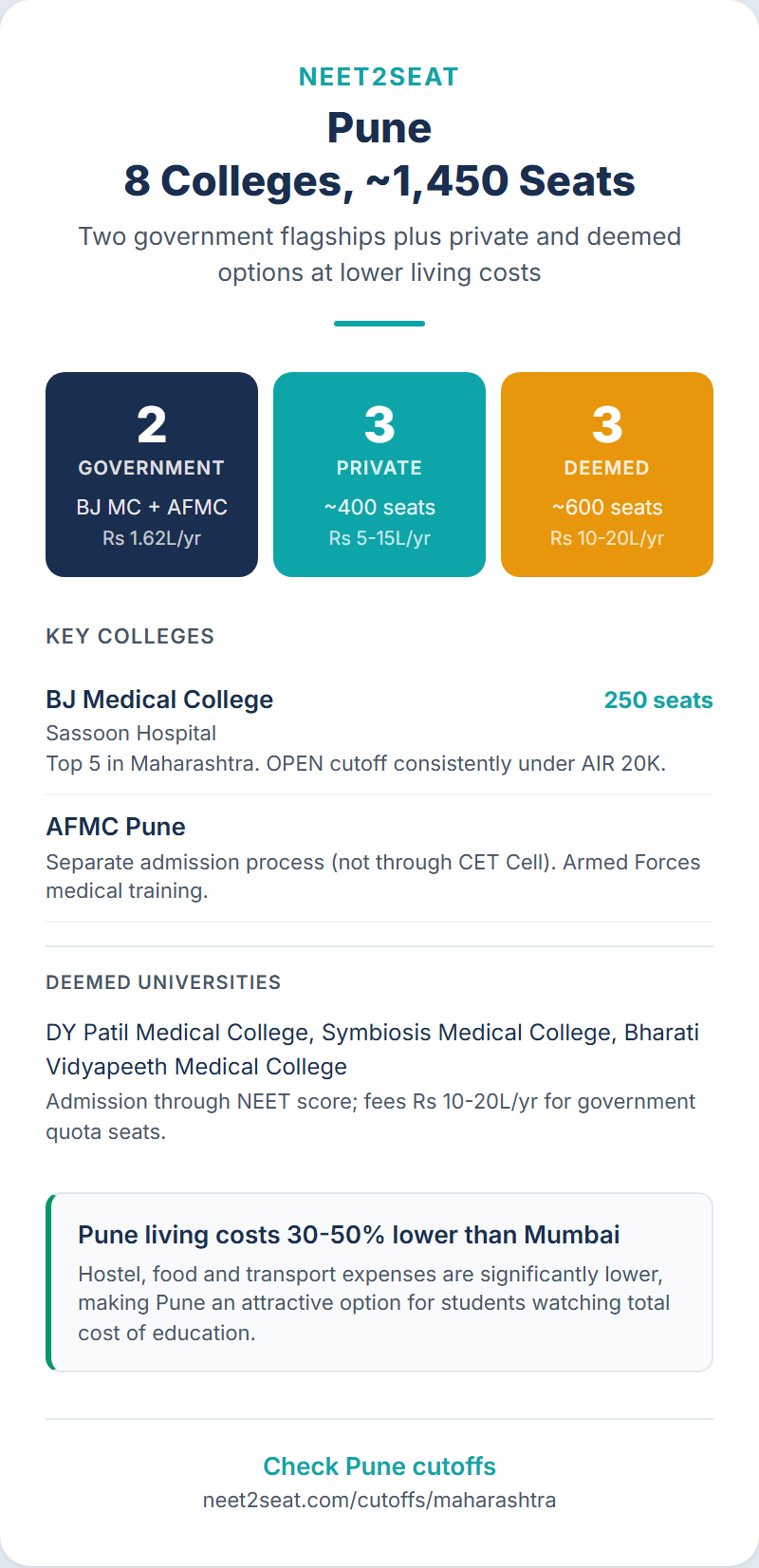
    Infographic showing medical colleges in Pune

    Pune’s medical colleges attract candidates for the city’s academic culture, moderate living costs relative to Mumbai, and the presence of established hospitals. This guide covers what distinguishes each Pune institution and how to position them on your preference list.

    For the statewide overview, see our Maharashtra medical colleges guide. For cutoff data, use the Maharashtra cutoff analyzer.

    • 8 colleges: 2 government (including AFMC), 3 private, 3 deemed, with ~1,450 MBBS seats across multiple counselling tracks
    • BJ Medical College (Sassoon Hospital) is the clear first-choice Pune college — consistently top 5 statewide in competitiveness
    • AFMC has a separate admission process and is NOT part of CET Cell counselling
    • Pune is 20-30% cheaper than Mumbai with comparable clinical training quality

    Government medical colleges

    BJ Government Medical College (Sassoon Hospital)

    BJ Medical College (BJM), affiliated with Sassoon Hospital, is Pune’s primary government medical college. 250 seats. Established in 1878, it is one of the oldest medical colleges in western India. Sassoon Hospital is a 1,300-bed public hospital and the primary tertiary care and trauma centre for the Pune region.

    BJM is consistently among the top 3 to 5 most competitive government colleges in Maharashtra for the OPEN category. The combination of a historic reputation, a large teaching hospital, and Pune’s livability makes it a first-choice college for many candidates.

    BJM’s competitiveness is driven by three factors: Sassoon Hospital’s 1,300-bed clinical volume, Pune’s academic ecosystem (including SPPU, IISER, and NCL), and living costs that are 20-30% lower than Mumbai. For candidates who value lifestyle alongside medical training, BJM often ranks ahead of several Mumbai colleges on their preference lists.

    Armed Forces Medical College (AFMC)

    AFMC Pune is one of India’s most selective medical institutions, but it does not participate in CET Cell counselling. Admission is through a separate AFMC-specific process based on NEET scores plus an interview and service eligibility screening. AFMC graduates are commissioned as officers in the Indian Armed Forces and serve a minimum bond period.

    AFMC is mentioned here for completeness, but it is not part of the CET Cell preference list. If you are interested in AFMC, apply through its separate admission portal alongside your CET Cell participation.

    AFMC does not appear in CET Cell counselling. It has a completely separate admission process (NEET score + interview + service eligibility). Apply through AFMC’s own portal; do not wait for it to appear in the CET Cell seat matrix.

    Private medical colleges

    Pune has 3 private medical colleges. State quota fees range from approximately Rs 5 lakh to Rs 15 lakh per year, depending on the institution.

    Private colleges in Pune tend to close at AIRs in the 50,000 to 2,00,000+ range for OPEN state quota, making them accessible to candidates who find Pune government colleges out of reach. The city’s infrastructure (IT sector presence, educational institutions, moderate climate) keeps demand for Pune private colleges higher than for private colleges in smaller Maharashtra cities.

    Deemed universities

    Pune has 3 deemed universities offering MBBS through a combination of CET Cell, MCC, and institutional processes. These include:

    • DY Patil Medical College, Pimpri (not to be confused with the Navi Mumbai campus): Part of the DY Patil group.
    • Symbiosis Medical College: Part of the Symbiosis International University. Relatively newer entrant in medical education.
    • Bharati Vidyapeeth Medical College: Well-established deemed university with a large hospital complex.

    Deemed university government quota seats in Pune have fees in the Rs 10 lakh to Rs 20 lakh per year range. Their cutoffs are less competitive than BJ Government Medical College but can overlap with the private college range.

    Pune vs Mumbai: the comparison candidates make

    Many candidates agonise over whether to rank Mumbai government colleges above Pune’s BJM or vice versa. The relevant differences:

    • Clinical volume: Mumbai’s hospitals see higher patient volumes due to the city’s larger population. KEM, JJ, and Sion hospitals are among the busiest in India. Sassoon Hospital in Pune also handles high volumes but is somewhat smaller in scale.
    • Living costs: Pune is approximately 20% to 30% cheaper than Mumbai for housing, transport, and food. A student spending Rs 12,000 per month in Mumbai might spend Rs 8,000 to Rs 9,000 for an equivalent lifestyle in Pune.
    • Academic environment: Pune is home to Savitribai Phule Pune University, the National Chemical Laboratory, IISER, and multiple research institutions. The academic ecosystem outside the medical college is broader than in most cities.
    • PG preparation: Both cities have coaching institutes and study groups for NEET PG. Mumbai has a slight edge in the density of PG preparation resources.

    The honest answer for most candidates: rank both Mumbai and Pune government colleges in your top 10, in whatever order reflects your genuine preference. The fee is the same (Rs 1.62 lakh/year). Both cities offer excellent clinical training. The marginal differences are real but not large enough to justify leaving either city out of your top choices.

    Do not overthink the Mumbai vs Pune decision. Rank both cities’ government colleges in your top 10 in your preferred order. The fee is identical (Rs 1.62L/yr), both offer strong clinical training, and the algorithm will give you whichever you qualify for at the highest position.

    Preference ordering for Pune colleges

    For a candidate targeting Pune:

    1. BJM (Sassoon Hospital): The clear first choice among Pune colleges for most candidates. Government fees, established reputation, large hospital.
    2. Private colleges in Pune: If your AIR makes BJM a Reach, Pune private colleges provide a city backup at higher fees.
    3. Deemed universities: Government quota portions offer moderate-fee options. Check both CET Cell and MCC tracks.

    Use the college predictor with your AIR, state MH, and category to see whether BJM is Safe, Target, or Reach for you specifically.

    Enter your AIR in the college predictor with state=MH and your category. If BJM shows as Reach, add Pune private colleges as city-specific backups, then layer government colleges from Nagpur, Aurangabad, and Kolhapur as fee-saving alternatives.

    FAQ

    How many medical colleges are in Pune?

    8 total: 2 government (including AFMC), 3 private, 3 deemed universities. Approximately 1,450 MBBS seats combined, though AFMC’s seats are not part of CET Cell counselling.

    Is AFMC included in CET Cell counselling?

    No. AFMC has a separate admission process based on NEET scores plus interview and service eligibility. Apply through AFMC’s own portal. It does not appear in the CET Cell preference list.

    How competitive is BJ Medical College (Sassoon)?

    Consistently in the top 5 most competitive government colleges in Maharashtra for OPEN category. Check the cutoff analyzer for the most recent closing AIRs Expect OPEN category closing AIRs below 15,000 in most years.

    Is Pune a good city for MBBS?

    Yes. Pune offers strong clinical training at BJM/Sassoon, a broad academic ecosystem, moderate living costs, and good connectivity. For candidates who value lifestyle and affordability alongside medical education, Pune is competitive with Mumbai.
  • Private medical colleges in Maharashtra: fees, competitiveness, and when they make sense

    26 private colleges with fees from Rs 5 lakh to Rs 25 lakh per year: when they make sense and when they do not

    Maharashtra’s 26 private medical colleges offer 3,699 MBBS seats across state quota, institutional quota, and management quota pathways. For candidates whose AIR does not reach any government college, or who strongly prefer a specific city where no government option exists, private colleges are the primary pathway to an MBBS seat through CET Cell counselling.

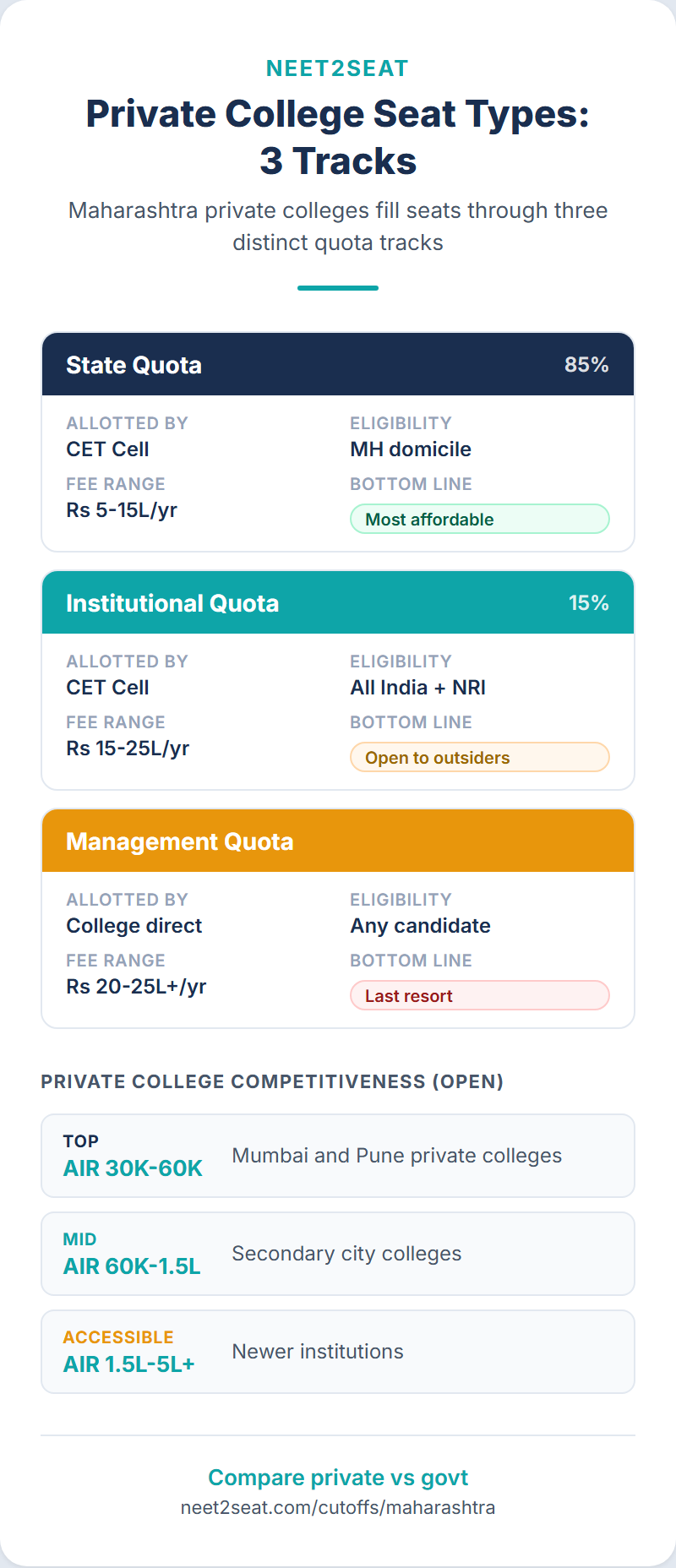
    Infographic showing private medical colleges in Maharashtra

    This guide covers private colleges in detail: fee structures, how competitive they are, and how to position them on your preference list. For the full statewide overview, see our Maharashtra overview. For fee details, see our Maharashtra fees guide.

    • 26 private colleges with 3,699 seats across state quota (85%), institutional quota (15%), and management quota
    • State quota fees: Rs 5-15L/yr (regulated by FRA); institutional quota: 2-3x state quota; management quota: Rs 20-25L+/yr
    • OPEN closing AIRs range from ~38,000 (KJ Somaiya, Mumbai) to above 5,00,000
    • Always list private colleges as safety nets below government colleges — free exit in Round 1 if you prefer not to attend

    The three seat types at private colleges

    State quota (85% of seats)

    85% of private college MBBS seats are state quota, filled through CET Cell counselling alongside government college seats. State quota fees are regulated by the Fee Regulatory Authority (FRA) and range from Rs 5 lakh to Rs 15 lakh per year. This is the most affordable private college pathway.

    State quota seats at private colleges are available to Maharashtra domicile candidates through the same preference-filling process used for government colleges. On your CET Cell preference list, private college state quota seats appear alongside government colleges. You can interleave them in any order.

    Institutional quota (15% of seats)

    15% of seats are institutional quota, also filled through CET Cell but open to a broader pool (NRI, OCI, out-of-state candidates in addition to Maharashtra domicile). Institutional quota fees are typically 2x to 3x state quota: Rs 15 lakh to Rs 25 lakh per year at most institutions.

    Institutional quota appears as a separate option on the CET Cell preference list. You can list the same college twice: once for state quota and once for institutional quota. Place state quota above institutional quota for the same college (it is cheaper). If your AIR does not qualify for state quota, the algorithm falls through to the institutional quota option at a later position.

    List state quota and institutional quota as separate entries for the same college, with state quota ranked higher. The algorithm tries state quota first (cheaper); if your AIR does not qualify, it falls through to institutional quota automatically. This maximises your chances at the lower fee.

    Management quota

    Management quota seats are filled through the college’s own admission process, not CET Cell. Fees range from Rs 20 lakh to Rs 25 lakh per year or more. Management quota is the last resort: it is available to candidates who did not secure seats through state or institutional quota in any round. The process, timeline, and exact fees vary by institution.

    Management quota fees are 2-5x higher than state quota at the same college, and the admission process is outside CET Cell. Exhaust all CET Cell options (state quota, institutional quota, all three rounds, mop-up) before considering management quota. The fee savings can exceed Rs 50 lakh over five years.

    How competitive are private colleges in Maharashtra

    Private college state quota OPEN closing AIRs range from approximately 38,000 (top private colleges in Mumbai) to above 5,00,000 (less established institutions). The distribution:

    • AIR 30,000 to 60,000: Top private colleges (Mumbai and Pune locations). KJ Somaiya in Mumbai is the most competitive private college in the state.
    • AIR 60,000 to 1,50,000: Mid-tier private colleges in secondary cities (Ahmednagar, Kolhapur, Nashik, Sangli). Established institutions with adequate infrastructure.
    • AIR 1,50,000 to 5,00,000+: Newer or less established private colleges. These fill last and may have seats available in Round 2 or Round 3.

    For exact cutoffs by college, use the cutoff analyzer.

    The largest private institutions

    NKP Salve Institute of Medical Sciences, Nagpur: 250 seats. One of the largest private medical colleges in Maharashtra. Located in Nagpur, which also has 2 government colleges, giving the city a substantial medical education cluster.

    Dr. Vithalrao Vikhe Patil Foundation Medical College, Ahmednagar: 200 seats. Located in Ahmednagar district, centrally positioned in Maharashtra.

    Other notable private colleges include institutions in Kolhapur, Latur, Karad (Sangli district), and Nashik, each with 100 to 200 seats.

    When to list private colleges on your preference list

    As a safety net after all government colleges

    This is the most common and financially sound approach. List all government colleges you qualify for (up to 44) in order of preference, then add private colleges below them. In Round 1, where exit is free, the private college listing costs nothing. If you are allotted a private college you would rather not attend, do not report, take free exit, and enter Round 2.

    The value of this approach: if cutoffs tighten and none of your government colleges are available, the private college catches you. Without it, you have no allotment at all.

    Listing a private college below your government options is a zero-cost insurance policy. If you get allotted to a private college in Round 1 and prefer not to attend, take free exit and enter Round 2. If you do not list it and no government college allots you, you have no seat at all. The asymmetry makes listing them a clear win.

    When geography overrides fees

    Some candidates have non-negotiable location constraints (family responsibilities, medical needs, spousal employment). If you must be in Mumbai and your AIR does not reach Mumbai government colleges, Mumbai private colleges become your primary option. Acknowledge the fee premium (Rs 30 lakh to Rs 65 lakh more over five years) as the cost of the location constraint.

    In later rounds, when the seat pool has shrunk

    By Round 2 and Round 3, many government seats are filled. The remaining available seats are disproportionately at private colleges. If you enter Round 2 with no seat, private colleges may be your only realistic options. List them without hesitation at this stage. Having a medical seat (even at Rs 12 lakh/year) is better than having no seat and waiting another year.

    When private colleges are not worth the premium

    Government colleges in smaller cities are available but unlisted

    If your AIR qualifies for 15 government colleges but you listed only 5 (all in Mumbai), and those 5 were all Reach, you may end up at a private college at position 6 that costs Rs 60 lakh more over five years than the government college in Latur that you chose not to list. The government college in Latur grants the same degree. List it.

    Skipping government colleges in smaller cities and then landing at a private college is the single most expensive mistake in preference filling. The Rs 60 lakh fee difference buys nothing the government college does not already provide: the same MBBS degree, the same PG entrance eligibility, the same medical licence.

    The education loan burden is unsustainable

    A Rs 50 lakh education loan at 9.5% interest with a 6-year moratorium (5 years of study plus 1 year grace) accumulates approximately Rs 36 lakh in compound interest before the first EMI. The outstanding balance at repayment start is roughly Rs 86 lakh. Monthly EMI on that capitalized balance (15-year tenure): approximately Rs 90,000. A junior resident earning Rs 60,000 to Rs 80,000 per month cannot cover this. Even on the original Rs 50 lakh (ignoring moratorium interest), the EMI is Rs 52,000, leaving almost nothing for living expenses.

    If a private college requires a loan that creates this kind of burden, and government colleges are available at 20x to 30x lower fees, the government option is financially superior even with a less preferred location.

    Comparing private colleges: what to look for

    Among private colleges at similar fee levels, the differentiators are:

    • Hospital bed strength: Larger teaching hospitals provide more clinical exposure. Check the affiliated hospital’s bed count and average occupancy.
    • Department coverage: Does the hospital have all major departments (medicine, surgery, OBG, paediatrics, orthopaedics, radiology, pathology) with active PG programmes? PG departments mean more teaching faculty and more structured training.
    • Location: A college in a city with additional hospitals (for externship/elective rotations) offers broader clinical exposure than one in an isolated location.
    • NMC compliance history: Colleges with recent NMC compliance issues (conditional approval, reduced intake) may face disruptions. Check the NMC website for the college’s current approval status.

    Before finalising any private college on your preference list, check three things: (1) affiliated hospital bed count and department coverage, (2) NMC approval status on the NMC website, (3) fee escalation policy (fixed vs annual increment). These three data points separate solid private institutions from risky ones.

    FAQ

    Can I list both state quota and institutional quota at the same private college?

    Yes. They appear as separate options in CET Cell’s preference list. State quota is cheaper, so list it first. Institutional quota provides a higher-fee backup at the same college.

    Are management quota seats available through CET Cell?

    No. Management quota is filled through the college’s own admission process, separate from CET Cell counselling. Contact the college directly for management quota availability, process, and fees.

    Do private college fees increase every year?

    Most private colleges have annual fee increments of 5% to 10%, approved by the FRA. Some offer a fixed fee for the full five-year duration. Ask about the fee escalation policy before confirming admission.

    What if I cannot afford even the cheapest private college?

    Focus your preference list entirely on government colleges (44 institutions at Rs 1.62 lakh/year). If no government college allots you in regular rounds, consider the mop-up round for any remaining government seats. Education loans for government college fees (Rs 8 to Rs 10 lakh total) are far more manageable than private college loans. See our mop-up round guide.