The Karnataka Examinations Authority (KEA) has opened a fresh registration window for the 2026-27 medical, dental and AYUSH counselling in the state. A notification dated 16 July 2026 invites online applications from NEET UG 2026 candidates who had not registered for the Karnataka CET (UGCET) 2026. The “UGNEET-2026 new registration” link on the KEA portal opens at 2:00 PM on 17 July 2026 and closes at 11:00 AM on 24 July 2026.
Who needs to register
The window is meant only for candidates who did not register for UGCET-2026. If you already registered for the Karnataka CET-2026, you do not apply again. KEA will shortly publish a separate link on its website for you to add your NEET roll number to the existing CET-2026 application; no fresh registration is needed.
Why the 24 July cut-off matters
The seven-day window is a hard deadline. Per the notification, no new registrations will be allowed after 24 July for the first, second or third round of seat allotment. The only opening after that is the Stray Vacancy Round, for which KEA will publish a schedule later. A candidate who misses this window loses the three main allotment rounds and can enter only at the stray stage, when very few seats are left. Registering now is what keeps all the rounds open to you.
Courses and eligibility
The registration covers MBBS and BDS along with the AYUSH streams: Ayurveda, Homoeopathy and Unani. The minimum qualifying marks fixed by the competent authority after the UGNEET-2026 re-examination results will apply. SC, ST and OBC eligibility applies to Karnataka SC/ST/OBC candidates only. KEA advises every applicant to read the UGNEET-2026 Information Bulletin for the full eligibility rules and seat categories before applying.
Non-Karnataka candidates
Candidates from outside Karnataka can register online, pay the registration fee, and enter their Class 12 marks with a PDF upload in the marks-entry portal. They generally do not need to appear for document verification. The exception is OCI, PIO, NRI and foreign nationals, and any non-Karnataka candidate claiming an NRI ward, religious minority, or a Category RC-2 to RC-8 seat at St John’s Medical College, Bengaluru; they must book a slot and appear for verification at KEA, Bengaluru.
How to register
Register through the KEA portal at cetonline.karnataka.gov.in/kea and select the “UGNEET-2026 new registration” link once the window opens. KEA has reiterated that, following the NMC letter of 24 July 2023, all counselling rounds including the Stray Vacancy Round will be conducted only by KEA in online mode.
Key dates and details
Registration opens: 2:00 PM, 17 July 2026
Registration closes: 11:00 AM, 24 July 2026
Who should apply: NEET UG 2026 candidates who did not register for the Karnataka CET (UGCET) 2026
Already registered for KCET-2026? No fresh registration; add your NEET roll number through the link KEA will publish
Courses: MBBS, BDS, Ayurveda, Homoeopathy, Unani
Portal: cetonline.karnataka.gov.in/kea
Source: KEA notification No. ED/KEA/ADMN/CR-11/2026 dated 16 July 2026, “New Registration for admission to MBBS, BDS and Ayurveda / Homoeopathy / Unani Courses in the State of Karnataka – 2026”.
The Karnataka Examinations Authority (KEA) has released its 2026 method of online seat allotment, the rulebook that turns a NEET-UG rank into a medical or dental seat in the state. It covers the single combined counselling KEA runs for medical, dental, AYUSH, engineering, nursing and pharmacy, so a NEET candidate’s medical options sit on one priority list. The seat is still decided purely by NEET rank and the order of options entered; most of what is new for 2026 is in how the process runs and how strictly exits are policed.
Login and admission are now biometric
Candidates log in to option entry by scanning the QR code on their verification slip, entering an OTP, and clearing a live face-recognition check. At the college, admission is confirmed only after an online face-recognition match and an OTP sent to the candidate’s mobile over WhatsApp, after which the college, not the candidate, downloads the admission letter. The 2025 bulletin described only a user-ID and secret-key login.
Surrender deadlines have tightened
A candidate confirming a seat from another board such as MCC or COMED-K must surrender the KEA seat before the third round begins; the 2025 rule set that deadline at the second-round option-modification stage. A surrender must now be made to KEA in person, where 2025 allowed it in writing. On money, surrendering before the last date for third-round option entry costs a Rs 5,000 processing fee with the balance refunded; surrendering after the final round forfeits the entire fee.
SC internal reservation enters counselling
Following a government order dated 27 April 2026, internal reservation within the Scheduled Caste category now applies to candidates whose income-certificate RD number carries it. Other reservation runs on Karnataka’s existing roster, including the Kalyana-Karnataka (Article 371J) quota.
What stays the same
The structure students already know is unchanged: a 2+1 round system (two regular rounds plus a third casual-vacancy round), a mock allotment before Round 1, and the Choice 1/2/3 decision after each round (accept and exit, hold and seek an upgrade, or reject and re-enter). The option-entry fee is Rs 750 for all Karnataka categories. The college-wise, category-wise seat matrix and 2026 fees come separately before each round, and KEA repeats its standard warning that past cut-off ranks are for reference only and that touts promising seats should be ignored.
NMC has removed the 150-seat cap on MBBS intake per college. The amendment was published in the official gazette on 27 April 2026.
The population ratio rule (100 MBBS seats per 10 lakh state population) has also been removed. States with high medical college density are no longer blocked from adding seats.
The 30-minute travel time rule between college and hospital has been replaced with a fixed distance: 10 km maximum (15 km for North Eastern and Himalayan states).
These changes do not affect the NEET 2026 exam on 3 May. They affect how many seats colleges can offer in future counselling rounds.
What the gazette notification says
On 27 April 2026, the NMC published a gazette notification amending UG-MSR 2023, the regulations governing medical college establishment, new courses, and seat increases. Three changes were made.
1. The 150-seat cap has been removed
UG-MSR 2023 included an objective that read: “Colleges seeking increased number of seats cannot exceed a total of 150 MBBS students from the Year 2024-25.” That line has been deleted.
Prior to UG-MSR 2023, which was notified in August 2023, the regulations allowed colleges to expand MBBS intake up to 250 seats. The 2023 regulations cut this to 150. The April 2026 amendment removes the 150-seat restriction without specifying a new upper limit.
2. The population ratio rule has been removed
UG-MSR 2023 required medical colleges to “follow the ratio of 100 MBBS seats per 10 lakh population in that state/U.T.” This proviso has been deleted.
The population ratio rule had effectively frozen seat additions in states that already had a high density of medical colleges. Karnataka, with roughly 13,900 MBBS seats across 71 colleges, had about 170 seats per 10 lakh population — well over the 100-seat ceiling. Maharashtra, with about 12,800 seats across 69 colleges, sat right at the limit. Both states would have been blocked from approving any new colleges or seat increases under the old rule. With this proviso gone, NMC will no longer use state population as a gatekeeping criterion.
3. The distance rule is now fixed, not time-based
The old requirement said travel time between a medical college and its teaching hospital should not exceed 30 minutes. The new rule sets a fixed distance instead:
10 km maximum for colleges in general
15 km maximum for colleges in North Eastern Region states and Himalayan states
A fixed-distance rule is easier to verify than a travel-time estimate, which varied depending on traffic conditions and the route chosen.
You can read the full gazette notification on the NMC website (PDF).
What this means for NEET 2026 aspirants
The NEET UG 2026 exam is on 3 May. This notification does not change anything about the exam itself, the scoring, or the ranking process.
Where it matters is seat availability during counselling. If colleges receive NMC approval to expand their MBBS intake before the counselling seat matrix is published, those additional seats would appear in the 2026-27 counselling rounds. Whether any approvals come through that quickly is unclear; NMC approval for seat increases typically involves inspection and assessment cycles that take months.
For students using our College Predictor or AI Choice Filler, the current cutoff data remains valid. Historical closing ranks are based on the seat counts that existed during those counselling years. If a college you are tracking adds seats in a future cycle, its closing ranks would likely shift upward (become numerically higher, meaning the college becomes easier to get into). The size of that shift depends on how many seats are added and how much demand exists for that college.
This amendment allows expansion but does not mandate it. Whether individual colleges actually add seats depends on their infrastructure, faculty strength, hospital bed capacity, and willingness to apply for NMC assessment. Many colleges may not expand at all.
Why this matters beyond 2026
India has been expanding MBBS seats steadily over the past decade. The 150-seat cap and population ratio rule, introduced in August 2023, slowed that expansion in states that already had many medical colleges. Removing both restrictions signals that the government wants to accelerate seat growth again.
For NEET aspirants in future years, more seats across the system would mean more options at every rank level. But the effect is gradual: colleges need to apply, get inspected, and receive NMC approval before they can admit additional students. Do not expect a sudden jump in available seats for the upcoming counselling cycle.
We will update our data as soon as the 2026-27 counselling seat matrices are released by MCC, KEA, and CET Cell. If any colleges show increased intake, those new numbers will be reflected in our cutoff explorer and prediction tools.
FAQ
Does this affect the NEET 2026 exam?
No. The exam syllabus, pattern, scoring, and ranking are unrelated to medical college seat regulations. Your NEET 2026 exam on 3 May proceeds as scheduled.
Will there be more MBBS seats in 2026-27 counselling?
Possibly, but not guaranteed. Colleges must apply to NMC for seat increases and pass an assessment before they can admit more students. The gazette notification removes the cap; it does not automatically grant anyone additional seats.
Does this affect All India Quota counselling?
If any government college adds seats before the AIQ seat matrix is finalised, 15% of those new seats would flow into the All India Quota pool. But this depends on whether colleges receive approval in time for the 2026-27 cycle.
What was the MBBS seat cap before 2023?
Before UG-MSR 2023 was notified in August 2023, the regulations allowed colleges to expand MBBS intake up to 250 students. The 2023 regulations lowered this to 150. The April 2026 amendment deletes the 150 cap without specifying a replacement number.
Which states are most affected by the population ratio removal?
Karnataka and Maharashtra, the two states neet2seat currently covers, were both constrained. Karnataka had the highest seat density in India at roughly 170 MBBS seats per 10 lakh population, well above the 100-seat ceiling. Maharashtra sat right at the limit with about 103 per 10 lakh. Other southern states including Tamil Nadu (~150 per 10 lakh), Kerala (~130), and Telangana (~220) were similarly over the cap. Northern and eastern states with fewer medical colleges per capita were largely unaffected by this rule.
If you’re appearing for NEET 2026 and planning to apply under Karnataka or Maharashtra state quota, the seat picture has changed since last year. Both states added government MBBS seats for 2025-26, and some of those seats are in colleges that are brand new.
Karnataka: 400 new government seats across 8 GMCs
Karnataka now has the most MBBS seats of any state in India at 13,944 (per the NMC’s final seat matrix, December 2025).
Eight government medical colleges each received 50 additional seats:
College
Previous
Now
Change
Mysore Medical College
200
250
+50
Belagavi Institute of Medical Sciences
150
200
+50
Gulbarga Institute of Medical Sciences
150
200
+50
Hassan Institute of Medical Sciences
150
200
+50
Raichur Institute of Medical Sciences
150
200
+50
Vijayanagar Institute of Medical Sciences, Bellary
200
250
+50
Shri Atal Bihari Vajpayee Medical College, Bengaluru
150
200
+50
Chikkaballapur Institute of Medical Sciences
100
150
+50
Several private colleges also expanded. Farookh Academy of Medical Education in Mysuru is the only entirely new college in the state this cycle, with 100 seats.
Two proposed new GMCs in Ramanagara and Kanakapura did not receive NMC approval this round. If they come through in a future cycle, they would add another 200 to 250 government seats.
For Karnataka state-quota aspirants, 400 extra government seats shifts counselling cutoffs at the margin. District GMCs like Chikkaballapur, Raichur, and Gulbarga typically see more accessible closing ranks than the established colleges in Bangalore and Mysore. Fifty additional seats at each of those colleges pushes the cutoff outward, which matters most for students in the mid-rank range where a few hundred positions decide the outcome.
Maharashtra: three brand-new GMCs, plus established colleges
Maharashtra has 12,824 MBBS seats for 2025-26, fourth nationally behind Karnataka, Uttar Pradesh, and Tamil Nadu.
Three government medical colleges started admissions in 2024 and are now part of the counselling pool for the first time at scale:
GMC Bhandara (100 seats), inaugurated October 2024
GMC Hingoli (100 seats), inaugurated 2024
GMC Gadchiroli (100 seats), inaugurated 2024
These are genuinely new institutions in districts that previously had no government medical college. GMC Baramati (100 seats), established in 2019, is also still relatively early in its counselling history.
Other district GMCs have been around longer but continue to offer realistic options for mid-rank candidates:
College
Seats
Notes
GMC Chandrapur
150
Established
GMC Gondia
150
Established
GMC Jalgaon
150
Established
GMC Latur
150
Founded 2002
GMC Amravati
100
Established
For Maharashtra state-quota aspirants, the three new GMCs expand geographic access in Vidarbha and Marathwada. A student from eastern Maharashtra no longer needs to score high enough for GMC Nagpur; Bhandara, Gadchiroli, and Hingoli are closer to home. New colleges in their first couple of counselling cycles tend to have less established reputations, which means cutoffs are often more accessible than their location and infrastructure would suggest. That gap narrows as the college matures.
How this connects to AIQ
Under All India Quota, 15% of seats in government colleges from both states feed into the national pool. More state government seats means a proportionally larger AIQ allocation. If you’re applying under AIQ and targeting colleges in either state, the expanded seat counts mean a few more AIQ seats at colleges that weren’t previously in the mix.
Use the neet2seat college explorer to check specific colleges and their historical cutoffs across state quota and AIQ.
Data sources: NMC MBBS Seat Matrix 2025-26 (final, Dec 3, 2025), Medical Dialogues, Edufever.
22.79 lakh students have registered for NEET 2026. India’s MBBS seat count has hit 1,29,026, an all-time high. Both numbers get thrown around in headlines, but they need context to be useful.
The seat count
The NMC’s final seat matrix for 2025-26 puts total MBBS seats at 1,29,026, up from 1,17,750 the previous year. That’s roughly 11,000 new seats, one of the largest single-year increases in recent years.
Much of this came through the central government’s CSS scheme, which funded new Government Medical Colleges in 19 states. This isn’t just private colleges padding the total. Districts that had no medical college two years ago now have one.
Karnataka leads the country with 13,944 MBBS seats. Eight government GMCs each received 50 additional seats, adding 400 new government seats to the state pool. Several private colleges also expanded, bringing the state’s overall increase to nearly 1,000 seats.
Maharashtra sits fourth nationally at 12,824 seats. The NMC approved four new colleges in the state, and existing district GMCs at places like Bhandara, Gadchiroli, and Hingoli (all three inaugurated in 2024) now contribute to the seat pool for the first time.
The government has signalled further expansion, but no confirmed numbers exist beyond the current NMC matrix. Additional seats for 2026-27, if any, will show up when the next matrix is published, typically as counselling season begins.
Who’s actually sitting the exam
Registrations barely moved: 22.79 lakh this year versus 22.76 lakh in 2025. The number that matters more is attendance.
Last year, about 22.09 lakh of the 22.76 lakh registered actually wrote the exam, roughly 97%. NTA has said that 99% of NEET 2026 candidates received their first-choice exam city. Fewer logistical barriers should push attendance a little higher. At 98%, approximately 22.33 lakh students will be in exam halls on May 3. That’s about 24,000 more than last year. A small absolute increase, but every extra test-taker is one more person competing for the same seats.
What the ratio looks like
At 98% attendance and a 56% qualification rate (more on why that number is fixed in our separate piece on the percentile system), about 12.5 lakh students will be competing for 1.29 lakh seats. That’s roughly 9.7 qualified candidates per seat, an improvement over last year’s approximately 10.5 to 1. The 11,000 extra seats are doing the work, not any change in the candidate pool.
What paper difficulty actually does
A tough paper (like 2025, where the top score was 686 out of 720) spreads out scores and makes rank gaps between colleges larger. Gaining or losing 10 marks might move you 5,000 ranks. An easy paper (like 2024, where multiple students hit 720) compresses the top end. Scores cluster, and a single question can separate a top government college from a mid-tier private one.
Neither scenario changes how many people qualify. Both change which specific college you can reach at your rank. Students preparing for NEET 2026 are better off building a preference list that covers a range of outcomes rather than banking on the paper being easy or hard.
The government seat gap
The overall 9.7 to 1 ratio hides a sharper divide. Of 1.29 lakh total seats, government colleges account for roughly 59,000 to 63,000, depending on how central institutions and ESIC colleges are counted. The rest are at private and deemed universities where annual fees run ₹15 to 50 lakh or higher.
For families who can only consider government colleges, the effective competition is roughly 1 seat for every 20 qualified candidates. The new GMCs in Maharashtra and Karnataka chip away at this, but the imbalance between demand and affordable supply remains wide.
Under All India Quota, both Karnataka and Maharashtra contribute a large share of seats to the national pool, so the expansion benefits AIQ aspirants too. If you’re deciding between state and AIQ counselling, the new district GMCs are worth factoring in; they often have more favourable cutoffs under state quota than under AIQ.
What to do with this information
Run your expected or actual rank through the neet2seat prediction tool to see which colleges were reachable at that rank last year. Build your preference list with the AI Choice Filler, and include colleges across a range, not just your top picks. The new seats improve odds at the margins, and margins are where counselling outcomes are decided.
Data sources: NMC MBBS Seat Matrix 2025-26 (published Dec 3, 2025), NTA NEET UG 2026 registration bulletin, Times of India (April 28, 2026).
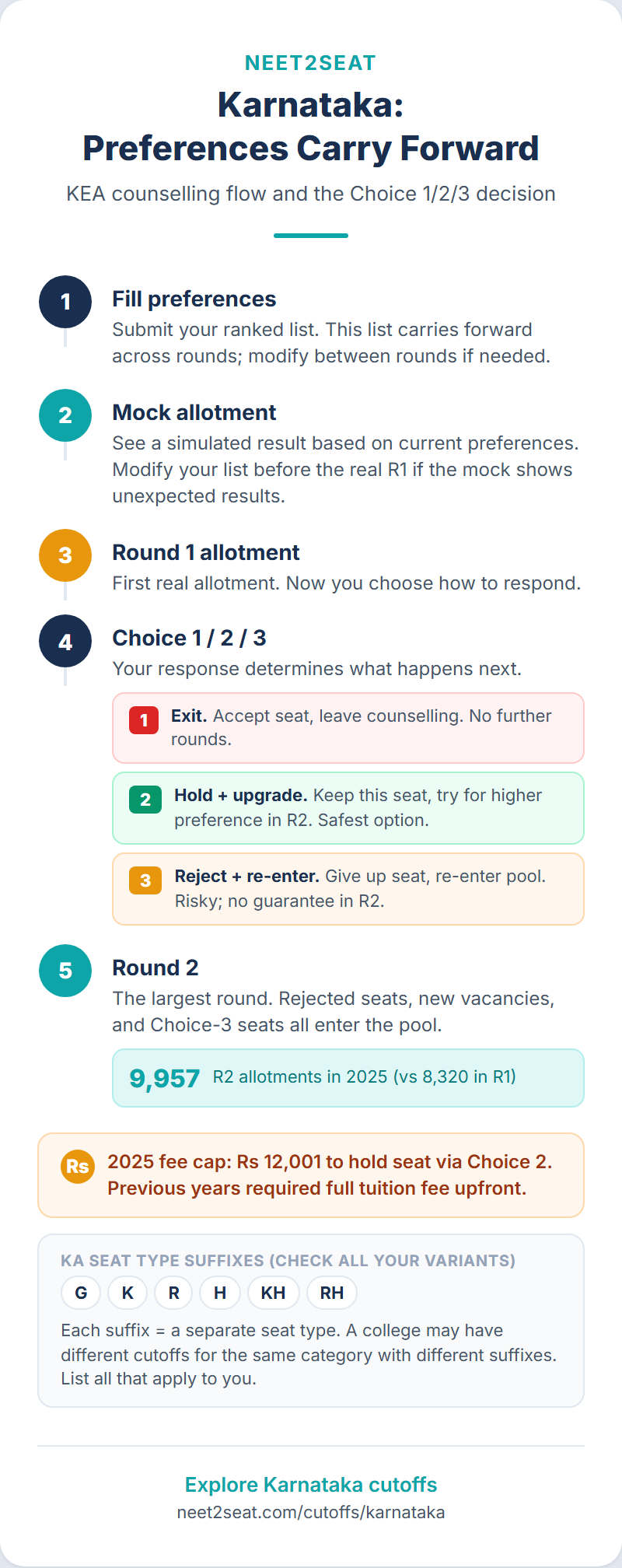
Your Karnataka preference list carries forward across rounds, so the initial ordering is critical.
Use the mock allotment as a free trial run to refine your list before the final lock.
Choice 2 (Accept and Seek Upgrade) preserves your seat with no penalty if not upgraded.
Check cutoffs for all suffix variants you qualify for (G, K, R, H, KH, RH) to find additional options.
Karnataka’s Choice 1/2/3 system changes how you think about preferences
In Karnataka, the preference list you submit before Round 1 carries forward. Unlike Maharashtra, where you file a completely new list each round, Karnataka’s KEA counselling requires you to enter your preferences once, and those preferences shape outcomes across all rounds. The Choice 1/Choice 2/Choice 3 decision after allotment then determines whether you accept, seek an upgrade, or re-enter the pool.
Your initial preference list matters more in Karnataka than in Maharashtra. A poorly ordered list stays with you across all rounds. In Maharashtra, you get a fresh start each round. In Karnataka, you do not.
KEA publishes a mock allotment before the final Round 1 allotment. This is a preview of where you would be allotted based on current preferences and the seat matrix. After seeing the mock results, you can modify, add, delete, or reorder your choices before the final lock.
Treat the mock allotment as a free trial run. After seeing the results, rearrange your list if needed. Move colleges that are clearly out of reach to the bottom (they will not hurt you there, but a cleaner list is easier to review). Promote colleges that are borderline if they match your genuine preferences.
The mock allotment shows you:
Which college and category you would be allotted under current preferences
Whether your top choices are realistic or unreachable
Where you stand relative to closing thresholds at specific colleges
How the Choice 1/2/3 decision interacts with your preference list
After each round’s final allotment, you select one of three options:
Choice 1 (Accept and Exit): you take the allotted seat and leave counselling. Your preference list is no longer relevant. This is final.
Choice 2 (Accept and Seek Upgrade): you accept the allotted seat but want to try for a better seat in Round 2. Your existing preference list is carried forward. In Round 2, the algorithm checks your preferences above your current allotment: if any of those higher-ranked colleges now has a vacancy and your AIR qualifies, you are upgraded. Your old seat is released automatically.
Choice 3 (Decline and Re-enter): you reject the seat entirely and re-enter the pool. Your preferences above the rejected college are active for Round 2. This is the highest-risk option: there is no guarantee you will get any seat in Round 2.
Choice 2 upgrade eligibility is determined by what is above your current allotment on your preference list. If the college you actually want is below your current allotment (because you ranked it lower), you cannot be upgraded to it. This is why getting the initial preference order right is the single most important step in Karnataka counselling.
Building the initial preference list
Since your list carries forward, it needs to be right the first time. The principles:
List every college you would attend, not just your ideal ones
Karnataka has 74 medical colleges in our database: 24 government, 38 private, 12 deemed. Your preference list should cover enough of these to guarantee an allotment in at least one round. If you qualify for 40 colleges but list only 15, and those 15 fill before your rank, you exit Round 1 with nothing.
Separate government and private tiers
Government college fees in Karnataka are approximately Rs 50,000 per year. Private college government quota fees average Rs 14 lakh per year. Management quota fees average Rs 36 lakh per year. The fee multiplier between government and private is 28x to 72x. For most candidates, all government colleges (even in less preferred locations) should come before private colleges.
Account for the suffix system
Karnataka’s categories use suffixes: G (general), K (Kannada medium), R (Rural), H (Hyderabad-Karnataka), KH, RH. If you qualify for multiple suffix codes (say, you are a 2A candidate from a rural school in the HK region, making you eligible for 2AG, 2AR, 2AH, and 2ARH), the algorithm checks your eligibility across applicable codes.
When using the cutoff analyzer to research your options, check cutoffs for all suffix variants you qualify for. A college might be Reach for 2AG but Safe for 2AH, meaning the HK reservation gives you additional options you would otherwise miss.
Include deemed university government quota seats
Approximately 25% of deemed university seats are government quota, filled through KEA. These seats often have different cutoffs from the private and management quota at the same institution. If a deemed university appears in the KEA counselling, check the government quota closing AIR specifically; it may be more accessible than you expect.
Round 2: what changes
In Round 2, the seat pool shifts:
Choice 1 candidates from Round 1 are gone; their seats are not available (they accepted).
Choice 2 candidates retain their Round 1 seats while seeking upgrades. If upgraded, their old seats become available for others.
Choice 3 candidates re-enter the pool. Their vacated Round 1 seats become available.
New seats may be added if the NMC approved additional seats after Round 1.
Round 2 is consistently the largest round in Karnataka. In 2025, Round 2 had 9,957 allotments versus 8,320 in Round 1. Seats freed by Choice 1 and Choice 3 candidates create a large pool of vacancies. Closing AIRs at the most competitive government colleges tend to be slightly less competitive (higher numbers) than Round 1.
The Choice 2 advance fee change in 2025
A significant 2025 rule change: for Choice 2 candidates with allotted seats having course fees exceeding Rs 12 lakh, only Rs 12,001 needs to be paid upfront (previously the full course fee was required). SC/ST/Category 1 candidates pay Rs 2,000 as a caution deposit.
This lowers the financial barrier for Choice 2. Previously, a candidate allotted a private college seat at Rs 15 lakh had to pay the full Rs 15 lakh to keep the seat while seeking an upgrade. Now they pay Rs 12,001. This makes Choice 2 more accessible for candidates who want to hold a private seat while hoping for a government upgrade.
When to choose Choice 3 (decline and re-enter)
Choice 3 is the highest-risk option. Use it only when: (1) the allotted seat is genuinely unacceptable, (2) your AIR is strong enough that historical data strongly suggests a better allotment in Round 2, and (3) you are willing to risk the Rs 1,00,000 caution deposit (Rs 50,000 for SC/ST). If you are on the margin, Choice 2 is almost always better: it preserves your Round 1 seat while giving you a shot at an upgrade.
FAQ
Can I modify my preference list between Round 1 and Round 2?
The general rule is that preferences carry forward from Round 1. Some recent KEA cycles have allowed limited modification. Check the current year’s KEA notification for the exact policy. Even if modification is allowed, the core order established in Round 1 shapes your outcomes.
If I choose Choice 2 and am not upgraded, what happens?
You keep your Round 1 seat. You pay the remaining course fee balance and report to the original college. Choice 2 carries no penalty for non-upgrade.
Does my out-of-state status affect preference filling?
If you are a non-Karnataka candidate, you can only be allotted private college private/management/NRI quota seats through KEA. Your preference list should include only those seat types. Government college state quota seats and government quota at private colleges are restricted to Karnataka domicile candidates.
How do deemed university seats appear in the preference list?
Deemed university government quota seats (filled through KEA) appear alongside other college options. They are treated like any other college in the preference list. Management and NRI quota at deemed universities go through MCC, not KEA, and do not appear in the KEA preference list.
What if I got admission through MCC and also have a KEA allotment?
You can cancel your KEA seat before Round 2 results if you chose Choice 2, without forfeiting fees. If you chose Choice 1 and already reported, the cancellation and refund rules depend on the timing relative to KEA’s cancellation deadline. Check both the MCC and KEA bulletins for exact cross-counselling rules for the current year.
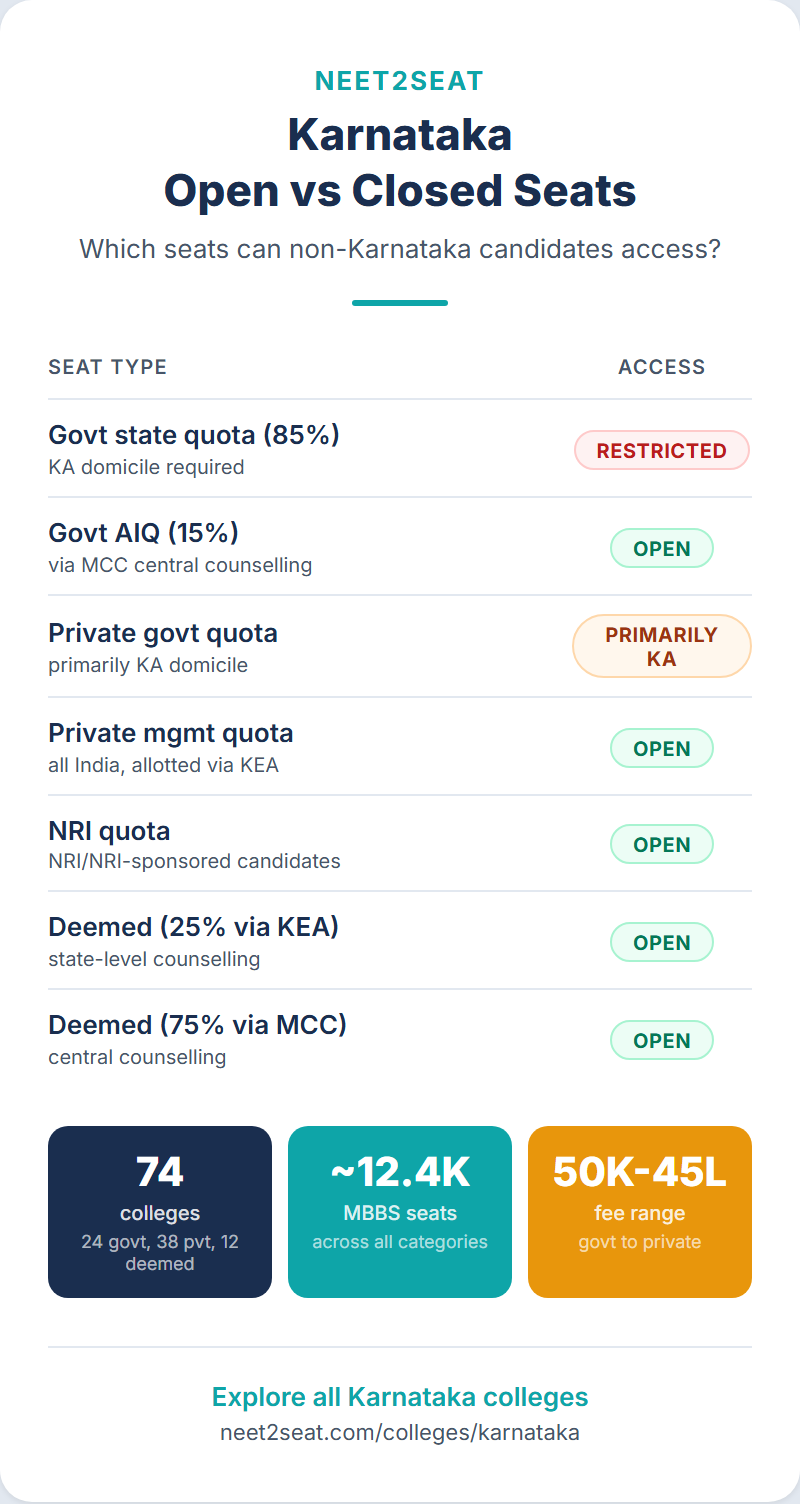
74 colleges (24 govt, 38 private, 12 deemed) with ~12,400 MBBS seats; fees range from Rs 50,000 to Rs 45 lakh per year
Karnataka is an open state: non-domicile candidates can access private and deemed university seats through KEA
Choice 1/2/3 system after each round: accept-and-exit, accept-and-seek-upgrade, or decline-and-re-enter
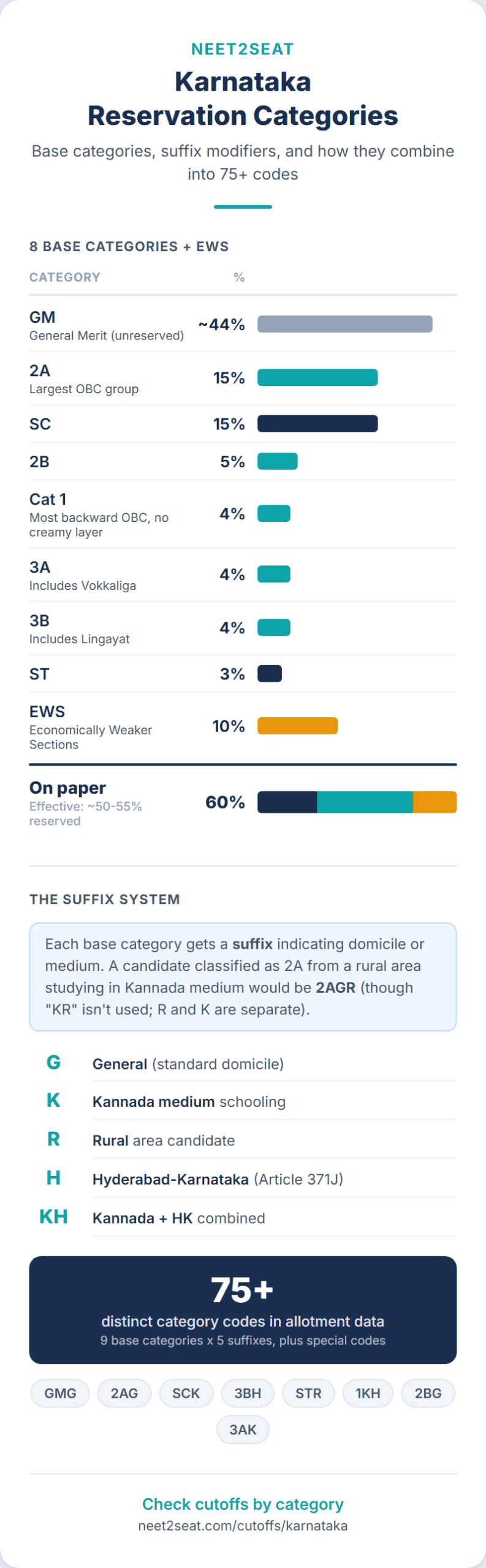
48+ category codes from 8 base categories combined with 6 suffixes (G, K, R, H, KH, RH)
KEA runs Karnataka’s medical counselling
Karnataka NEET counselling 2026 is conducted by the Karnataka Examinations Authority (KEA), operating from Bengaluru under the Department of Higher Education. KEA fills state quota seats at government colleges (85% of intake), government quota seats at private colleges, and coordinates deemed university admissions within its jurisdiction. The counselling portal is cetonline.karnataka.gov.in.
Karnataka had 74 medical colleges in 2025: 24 government, 38 private, and 12 deemed universities. Our database tracks allotment data across all three categories from 2023 through 2025, covering 45,673 individual records. If you are looking for how Karnataka’s process compares to the central MCC process, see our AIQ vs state quota guide. For Maharashtra’s counselling process, see our CET Cell guide.
Seats: government, private, and deemed
Karnataka’s seat pool is split unevenly across three institution types:
Type
Colleges
Approximate MBBS seats
Government
24
~3,800
Private
38
~6,000
Deemed
12
~2,600
Total
74
~12,400
Unlike Maharashtra where government colleges hold the majority of seats, Karnataka’s private sector accounts for nearly half the total MBBS capacity. The fee range spans Rs 50,000/yr (government) to Rs 45 lakh/yr (management quota at deemed universities).
Unlike Maharashtra where government colleges hold the majority of seats, Karnataka’s private sector accounts for nearly half the total MBBS capacity. This has practical consequences: the fee range across Karnataka colleges spans from Rs 50,000 per year at government colleges to over Rs 25 lakh at private ones and Rs 45 lakh for management quota seats at deemed universities.
The seat split for government colleges follows the standard All India pattern: 15% goes to MCC for All India Quota, 85% stays with KEA. Private colleges contribute their government quota seats to KEA and fill management and NRI quotas separately. Deemed universities allocate roughly 25% of seats as government quota through KEA, with the remaining 75% going through MCC.
Karnataka is an open state
Karnataka allows candidates from any state to apply for private college and deemed university seats through KEA counselling. No domicile certificate is required for these seats. Government state quota seats (85%) remain restricted to Karnataka domicile.
This is the single most consequential structural fact about Karnataka’s medical admissions. Karnataka allows candidates from any state to apply for private college and deemed university seats through KEA counselling. No domicile certificate is required for these seats.
Government college state quota seats (the 85%) remain restricted to Karnataka domicile candidates. But private college seats, which are the majority of Karnataka’s capacity, are open to everyone. This makes Karnataka one of the most popular destinations for out-of-state NEET candidates, particularly from states with fewer colleges or higher cutoffs.
The practical split:
Seat type
Open to non-Karnataka?
Government state quota (85%)
No (Karnataka domicile required)
Government AIQ (15%)
Yes (through MCC)
Private government quota
Primarily Karnataka domicile
Private/management quota
Yes (all India, through KEA)
NRI quota
Yes
Deemed university
Yes (25% via KEA, 75% via MCC)
Non-Karnataka candidates cannot claim reservation in state quota seats. They compete on open merit for available seats and must meet the General/UR eligibility threshold (50th percentile) regardless of their home state category.
Reservation categories: the suffix system
Karnataka’s reservation structure differs from both the central government system and Maharashtra’s system. The state recognizes eight base categories for medical admissions:
GM (General Merit): unreserved, open to all on merit. Roughly half of state quota seats fall under GM after all reservations are applied.
Category 1: the most backward among OBC groups. 4% reservation. Unlike other OBC categories, creamy layer exclusion does not apply to Category 1.
Category 2A: the largest OBC subcategory. 15% reservation. This is the most populated reservation category in Karnataka.
Category 2B: 5% reservation. Smaller candidate pool than 2A, with cutoff ranks often higher (less competitive) than 2A at the same college.
Category 3A: 4% reservation. Includes the Vokkaliga community and related groups.
Category 3B: 4% reservation. Includes the Veerashaiva-Lingayat community and related groups.
SC (Scheduled Castes): 15% reservation. In 2024, Karnataka restructured SC reservation internally into four sub-groups (SC Left, SC Right, Touchable, Others), though the total allocation remains the same for counselling purposes.
ST (Scheduled Tribes): 3% reservation. The smallest reservation category in Karnataka’s medical admissions.
EWS (Economically Weaker Sections): 10% reservation for unreserved category candidates with family income below Rs 8 lakh, applied post the 103rd Constitutional Amendment.
These eight base categories are then combined with a suffix system that creates sub-quotas. Each base category can carry one of six suffixes:
G: General (no additional sub-quota; standard pathway)
K: Kannada medium (studied Classes 1 through 10 in Kannada medium schools)
R: Rural (studied in schools in rural areas of Karnataka)
H: Hyderabad-Karnataka region (from the six HK districts under Article 371J)
KH: Kannada medium + HK region (both criteria must be met)
RH: Rural + HK region (both criteria)
This gives 48 regular category codes (8 bases multiplied by 6 suffixes). On top of these, KEA uses special codes for private college seats (GMP, OPN), minority quotas (MA, MC, ME, MM, MU), religious congregation seats at deemed universities (RC1 through RC8), NRI, PWD, Defence, NCC, and Sports quotas. In total, our database tracks 78 distinct category codes in Karnataka’s allotment data.
In the Karnataka cutoff analyzer, you can filter by any of these category codes to see closing ranks for specific sub-quotas.
The Choice 1 / Choice 2 / Choice 3 system
This is Karnataka’s version of the float/freeze mechanism used in other states. After each round’s allotment, every allotted candidate must pick one of three options within the deadline:
Choice 1: accept and exit
You are satisfied with the allotted seat. You pay the full course fee, download the seat guarantee card, and report to the college. You cannot participate in any subsequent round. This is equivalent to “Freeze” in MCC terminology.
Choice 2: accept and seek upgrade
Choice 2 carries no penalty if you are not upgraded. You keep your Round 1 seat and pay the remaining balance. It is the safe way to seek a better seat while holding your current one.
You accept the allotted seat but want to try for a better seat in Round 2. For seats with course fees exceeding Rs 12 lakh, KEA requires only Rs 12,001 as an advance payment (a 2025 rule change; previously the full course fee was required). SC/ST/Category 1 candidates pay Rs 2,000 as a caution deposit. If upgraded in Round 2, the old seat is released automatically. If not upgraded, you keep the original seat and pay the remaining balance. This is equivalent to “Float.”
A notable advantage of Choice 2: you can cancel your KEA seat before Round 2 results without forfeiting fees, if you received admission elsewhere (for example, through MCC).
Choice 3: decline and re-enter
Choice 3 is the highest-risk option. Your Round 1 seat is permanently forfeited. If you receive no allotment in Round 2, you must pay Rs 1,00,000 (Rs 50,000 for SC/ST) just to stay eligible for the mop-up round.
You reject the allotted seat entirely and re-enter the pool for Round 2. No fee payment or college reporting is required. But this carries real risk: your Round 1 seat is forfeited, and there is no guarantee you will get any seat in Round 2. If you chose Choice 3 in Round 1 and do not receive an allotment in Round 2, you must pay a caution deposit of Rs 1,00,000 (Rs 50,000 for SC/ST) to remain eligible for subsequent rounds.
KEA typically runs three counselling rounds plus an optional stray vacancy round:
Round 1: the largest round. After online registration and in-person document verification, candidates receive a secret key to activate their counselling account. KEA publishes a mock allotment first, allowing candidates to modify their preference list. After the final allotment, candidates select Choice 1, 2, or 3. In 2025, Round 1 filled 8,320 seats.
Round 2: Choice 2 and Choice 3 candidates from Round 1 participate. Choice 2 candidates retain their Round 1 seat while seeking an upgrade. The preference list from Round 1 is generally carried forward. Round 2 is consistently the largest round by allotment count: 9,957 seats in 2025, 8,758 in 2024. Many seats become available because of Choice 1 exits and new seats being added.
Round 3 (Mop-up): fills remaining seats across all college types. KEA opens fresh registration for candidates who did not register earlier. This round is much smaller: 967 seats in 2025, 622 in 2024. At government colleges, only a handful of seats remain by this point; in 2025, just 6 government colleges had GM seats in Round 3, filling 11 total.
Stray vacancy round: conducted in person at the KEA office. Only for candidates who were not allotted any seat in previous rounds. This is the final opportunity.
How seat allotment runs inside each round
A round is not a single pass. The software sweeps the seat matrix in three phases and repeats each phase until no candidate’s allotment changes, which is why a category’s closing rank can shift several times within one round. Phase 1 fills General Merit and the special categories (PwD, NCC, Sports) strictly by rank and option, with Medical and Dental allotted first, then AYUSH, then the other streams. Phase 2 folds unfilled Rural and Kannada-medium reserved seats into the parent reserved category (for example, SC-Rural and SC-Kannada become SC-General) and offers them to reserved candidates only. Phase 3 converts any reserved seats still empty into General Merit and opens them to everyone.
The practical takeaway: a seat you could not reach under your sub-quota early in a round can open later in the same round through these conversions. Keep those options on your list rather than deleting them on the assumption they are out of reach.
Fees
The fee structure varies dramatically by seat type. Our database records actual fee amounts from allotment data:
Seat type
Annual fee range (2025)
Average
Government
Rs 50,000 to Rs 6,09,084
~Rs 1,06,911
Private (government quota)
Rs 8,10,535 to Rs 25,15,000
~Rs 14,17,169
Management quota
Rs 25,00,000 to Rs 45,40,750
~Rs 35,87,749
NRI quota
Rs 25,09,350 to Rs 45,40,750
~Rs 36,41,774
The base government MBBS fee in Karnataka is Rs 50,000 per year. SC/ST candidates may pay as little as Rs 500 to Rs 2,000 due to fee exemptions. ESI colleges charge higher: approximately Rs 1,09,350 per year.
Private college fees saw a 10% increase for 2025-26 after the Karnataka government approved the hike. Management and NRI quota fees are set by the Fee Regulatory Committee and can exceed Rs 45 lakh per year at certain deemed universities.
Registration fee
Karnataka candidates of every category pay the same registration fee: Rs 750 (SC/ST/Category 1/PWD and GM/2A/2B/3A/3B alike). Non-Karnataka candidates pay Rs 2,500, and NRI/OCI/PIO/Foreign nationals Rs 5,000. A separate non-refundable option-entry fee of Rs 750 applies to all candidates in each seat-allotment round.
Registration and document verification
The registration process runs in steps:
Register online at cetonline.karnataka.gov.in with personal details and NEET particulars.
Upload passport photo, signature, and thumb impression.
Pay the registration fee online.
Attend in-person document verification at KEA or designated centres. Bring all originals plus self-attested photocopies.
After verification, receive a secret key to activate your counselling account.
Fill college preferences in order of priority. No limit on the number of options.
Review the mock allotment and modify preferences if needed.
Lock final preferences before the deadline.
Candidates who already registered for KCET (Karnataka Common Entrance Test, used for engineering admissions) can link their NEET roll number to the existing registration instead of re-registering from scratch.
For 2026 the process is biometric from start to finish. You log in to option entry by scanning the QR code on your verification slip, entering an OTP sent to your registered mobile, and passing a live face-recognition check. At the college, admission is finalised only after an online face-recognition match and an OTP delivered over WhatsApp, after which the college downloads your admission letter; you cannot download it yourself. Keep the mobile number you registered with active through every round. The 2025 process used only a user ID and secret key. For a summary of what changed this year, see our 2026 KEA rule-change rundown.
Eligibility for state quota seats
Domicile qualification for government seats works through multiple pathways: completing Class 10 and 12 from Karnataka schools, or having at least 7 years of schooling in Karnataka, or having a parent who studied at least 7 years in Karnataka with current residency, or having Kannada, Tulu, or Kodava as mother tongue with a parent currently resident in Karnataka. Children of defence personnel who served at least 1 year in Karnataka also qualify.
All candidates must have passed Class 12 with Physics, Chemistry, Biology, and English. Minimum age is 17 years as of December 31 of the admission year. The NEET percentile requirements are: General/UR 50th percentile, OBC/SC/ST 40th percentile, PWD 45th percentile.
Compulsory rural service
All candidates admitted to medical courses in Karnataka must complete 1 year of compulsory rural service in government hospitals after finishing MBBS, per the Karnataka Compulsory Service Training Act of 2012. There is no monetary penalty for UG rural service non-compliance (unlike PG, which carries a Rs 50 lakh penalty for a 3-year bond).
Hyderabad-Karnataka region reservation
Article 371(J) of the Constitution, inserted by the 98th Amendment in 2012, grants special reservation to candidates from the Hyderabad-Karnataka (now Kalyana-Karnataka) region. Six districts qualify: Bidar, Kalaburagi, Raichur, Yadgir, Koppal, and Ballari. These were part of the erstwhile Hyderabad State under the Nizam and remain among Karnataka’s most economically backward areas.
In medical admissions, 8% of state quota seats across all government colleges statewide are reserved for HK candidates. In colleges located within the HK region, the reservation rises to 70% of state quota seats. This creates a meaningful cutoff advantage, particularly at colleges like Gulbarga Institute of Medical Sciences (GIMS) in Kalaburagi.
HK reservation is encoded in the suffix system. A candidate from Kalaburagi district competing under SC category with rural school background would have the code “SCRH” (SC + Rural + HK). The certificate required is the “Article 371(J) Certificate” or “Hyderabad-Karnataka Domicile Certificate” issued by the Tahasildar’s office.
What our data shows
Bangalore Medical College’s Round 1 closing AIR dropped from 3,508 in 2023 to 1,299 in 2025: a 63% tightening in two years. This pattern holds across top-tier government colleges as competition intensifies.
We track allotment data for all 74 Karnataka colleges across 2023, 2024, and 2025. The 2025 dataset alone contains 19,244 allotment records across three rounds.
Top government colleges by closing AIR (GM category, Round 2, 2025)
College
Opening AIR
Closing AIR
Bangalore Medical College, Bengaluru
398
3,025
Atal Bihari Vajpayee Medical College, Bengaluru
3,240
7,669
Mysore Medical College, Mysuru
2,403
8,394
ESIC Medical College, Bengaluru
5,700
12,937
Karnataka Institute of Medical Sciences, Hubballi
4,941
13,488
Mandya Institute of Medical Sciences
8,509
15,588
Shimoga Institute of Medical Sciences, Shivamogga
8,198
21,676
Hassan Institute of Medical Sciences
5,949
21,862
Belagavi Institute of Medical Sciences
2,968
23,365
Gulbarga Institute of Medical Sciences, Kalaburagi
3,611
23,671
Year-over-year trends
Cutoffs at top government colleges have tightened consistently over the past three years. Using Round 1 GM closing AIRs for comparison:
College
2023
2024
2025
Bangalore Medical College
3,508
2,154
1,299
Mysore Medical College
8,243
7,069
4,053
KIMS Hubballi
13,106
11,378
8,343
Bangalore Medical College’s R1 closing AIR dropped from 3,508 in 2023 to 1,299 in 2025: a roughly 63% decrease over two years. This pattern holds across the top tier. The data reflects increasing competition for government seats as more candidates target Karnataka specifically because of its open-state status for private colleges, pulling the overall applicant pool up.
The full AIR range in Karnataka 2025 allotment data spans from 22 (the most competitive allotment) to 13,19,086 (the least competitive, typically a management quota seat at a private college). You can explore this data in detail using the Karnataka cutoff analyzer.
Seat type distribution (2025)
Our allotment data breaks down by seat type:
Seat type
Allotments
Share
Government
11,180
58%
Private (government quota)
6,195
32%
Management quota
1,680
9%
NRI quota
189
1%
Management and NRI seats together account for 10% of total allotments but carry fees 20 to 40 times higher than government seats.
How KEA differs from MCC
Beyond the obvious difference in seat pools, several structural differences matter for candidates participating in both tracks:
Choice system vs float/freeze: MCC uses Freeze/Float/Slide with an auto-upgrade mechanism. KEA uses Choice 1/2/3 where the candidate explicitly decides whether to accept, upgrade-seek, or decline. The outcome is similar, but the decision framework is different.
Mock allotment: KEA publishes a mock allotment before the final allotment in Round 1, giving candidates a preview of likely outcomes. MCC does not offer a mock round.
Fresh preference entry: KEA requires preference filling before Round 1 and generally carries it forward. MCC allows preference modification between rounds but within constraints.
Categories: MCC recognizes SC, ST, OBC-NCL, and EWS. KEA recognizes eight base categories with suffix variants, producing 48+ regular codes. A candidate who is OBC-NCL under the central government list might be Category 2A, 2B, 3A, or 3B in Karnataka. The two classifications are independent.
FAQ
Can candidates from other states get government college seats in Karnataka?
Not through state counselling. Government college state quota seats (85%) require Karnataka domicile. Non-Karnataka candidates can only get government seats in Karnataka through the 15% All India Quota via MCC. For private and deemed university seats, Karnataka is open to candidates from all states through KEA counselling.
What is the difference between GM and GMP categories?
GM (General Merit) applies to government college seats. GMP (General Merit Private) applies to private college seats. Both are unreserved and merit-based, but they draw from different seat pools with different fee structures and, in some cases, different eligibility rules for out-of-state candidates.
How does the HK reservation help candidates from those six districts?
HK candidates benefit from two layers. First, 8% of seats across all government colleges statewide are reserved for HK candidates (the H, KH, RH suffix codes). Second, at colleges within the HK region, up to 70% of seats are reserved for HK candidates. This creates significantly lower cutoffs: a candidate from Kalaburagi district might secure a government seat with an AIR that would not qualify under the general pool at the same college.
If I choose Choice 2 and don’t get upgraded, do I lose anything?
No. If you are not upgraded in Round 2, you keep your Round 1 seat. You pay the remaining course fee balance and report to the original college. Choice 2 carries no penalty for non-upgrade. The only risk is the opportunity cost of waiting, since you cannot report to your Round 1 college until Round 2 results are out.
What happens if I choose Choice 3 and don’t get any seat in Round 2?
You must pay a caution deposit of Rs 1,00,000 (Rs 50,000 for SC/ST) to remain eligible for the mop-up round. Your Round 1 seat is permanently forfeited; it goes back into the pool for other candidates. This is why Choice 3 is the highest-risk option: you could end up with no seat and a Rs 1 lakh deposit to pay for continued eligibility.
Are deemed university seats filled through KEA or MCC?
Both. Approximately 25% of deemed university seats are government quota, filled through KEA state counselling. The remaining 75% (management and NRI quotas) go through MCC central counselling. If your target is a specific deemed university in Karnataka, register for both tracks.
Do cutoffs change significantly between Round 1 and Round 2?
Yes, particularly at mid-tier colleges. At the most competitive government colleges, cutoffs in Round 2 are typically within 20% to 40% of Round 1 values (less competitive since the highest-ranked candidates have already locked seats). At private colleges, Round 2 cutoffs can shift substantially as seats vacated by Choice 1 and Choice 3 candidates become available.
Karnataka uses 8 base categories plus a 6-suffix system (G, K, R, H, KH, RH), creating 75+ distinct category codes in allotment data.
The HK region suffix (Article 371J) provides the largest advantage: up to 70% reservation at colleges within the Hyderabad-Karnataka region.
Category 1 is exempt from creamy layer exclusion; Categories 2A through 3B require Non-Creamy Layer with income below Rs 8 lakh.
Your Karnataka state category and central MCC category are independent classifications. Check both lists for your specific caste.
Karnataka’s category system has no equivalent at the central level
If you have seen only the MCC categories (SC, ST, OBC-NCL, EWS, General), Karnataka’s system will look unfamiliar. The state divides backward classes into five numbered groups (Category 1, 2A, 2B, 3A, 3B) instead of a single OBC label. It then layers a suffix system on top, creating separate sub-quotas for rural students, Kannada medium students, and Hyderabad-Karnataka region candidates. The result is over 75 distinct category codes in allotment data.
This guide covers every category used in Karnataka NEET UG state counselling, based on KEA’s counselling documentation and the Karnataka Backward Classes Commission’s classification system. If you are looking for Maharashtra categories, see our Maharashtra categories guide.
Base categories: the eight groups
Karnataka recognizes eight base reservation categories for medical admissions. The stated reservation percentages (Cat 1 at 4%, 2A at 15%, 2B at 5%, 3A at 4%, 3B at 4%, SC at 15%, ST at 3%, plus EWS at 10%) add up to 60% on paper. In practice, not all reservation seats are filled (some revert to GM if no eligible candidates remain), and the effective reservation is closer to 50-55% in a given year. Roughly 40-50% of state quota seats end up going to General Merit candidates.
GM (General Merit): unreserved
Open to all candidates irrespective of caste, religion, or community. Approximately 44% of state quota seats fall under GM after all reservations are applied. GM seats are filled strictly on NEET All India Rank merit. Any candidate, including those from reserved categories, can compete for GM seats. No caste certificate is required. GM is the most competitive category in Karnataka counselling.
In 2025, GM closing AIRs at the top government colleges ranged from 3,025 (Bangalore Medical College, Round 2) to approximately 23,700 (Gulbarga Institute of Medical Sciences, Round 2). At private colleges under government quota, GM cutoffs extended to much higher AIRs
Category 1: most backward OBC group (4%)
Category 1 is unique among Karnataka’s OBC groups: the creamy layer exclusion does not apply. High-income families in Category 1 retain reservation eligibility, whereas families in Categories 2A through 3B with annual income above Rs 8 lakh lose eligibility and must compete under GM. This makes Category 1 the only OBC group with no income ceiling.
Category 1 covers the most socially and educationally backward communities among the Other Backward Classes. It carries a 4% reservation. Candidates must submit a Caste/Income Certificate issued by the jurisdictional Tahasildar. Fee exemption may be available for candidates whose family income is below Rs 2.5 lakh per year.
Category 2A: largest OBC group (15%)
The largest reservation category in Karnataka with 15% of state quota seats. Category 2A covers communities classified as backward under Group 2A by the Karnataka State Commission for Backward Classes. Because of the large allocation and large candidate pool, 2A cutoffs at government colleges can be competitive; at less sought-after institutions, they sometimes approach GM cutoffs.
Non-Creamy Layer Certificate with an RD (Registration Department) number is required. Family annual income must not exceed Rs 8 lakh.
Category 2B: OBC Group B (5%)
A 5% reservation for communities classified under Group 2B. Smaller candidate pool than 2A, which means cutoff ranks for 2B tend to be higher (less competitive) than 2A at the same college. The same documentation applies: Caste Certificate specifying 2B subcategory from the Tahasildar, plus Non-Creamy Layer Certificate with RD number and income below Rs 8 lakh.
Category 3A: OBC Group A (4%)
A 4% reservation covering communities classified under OBC Group 3A. Includes the Vokkaliga community and related groups. Same Non-Creamy Layer documentation requirements as 2A and 2B. The smaller seat allocation means cutoffs vary significantly between colleges: at top government colleges, 3A cutoffs can be close to GM, while at private colleges the gap widens.
Category 3B: OBC Group B (4%)
A 4% reservation for communities classified under OBC Group 3B. Includes the Veerashaiva-Lingayat community and related groups. Cutoff patterns are comparable to 3A. Candidates from 3B communities who fall within the creamy layer (income above Rs 8 lakh) must compete under GM instead.
Note: In 2024, the Karnataka government scrapped a 4% Muslim quota that had previously existed within OBC and redistributed portions to Categories 3A and 3B. The exact impact on seat percentages for the 2025 medical counselling cycle should be confirmed against the current KEA bulletin, as some sources report updated percentages while others continue to show the older figures.
SC (Scheduled Castes): 15%
A 15% reservation covering all communities listed under the Constitution (Scheduled Castes) Order for Karnataka. No creamy layer criterion applies. In 2024, Karnataka internally restructured SC reservation into four sub-groups (SC Left, SC Right, Touchable, Others), though the total allocation and the counselling process remain functionally the same for most candidates.
Candidates need a Caste/Income Certificate from the Tahasildar. Fee exemption at government colleges may be available for SC candidates with family income below Rs 10 lakh. Vacant SC seats follow the state’s inter-se vacancy filling rules.
ST (Scheduled Tribes): 3%
A 3% reservation for communities listed under the Constitution (Scheduled Tribes) Order for Karnataka. This is the smallest base reservation category. Given the limited allocation, ST seats at popular government colleges fill quickly; candidates should carefully consider their preference order. Caste/Income Certificate from the Tahasildar is required. No creamy layer exclusion. Fee exemptions available as with SC.
EWS (Economically Weaker Sections): 10%
A 10% reservation for economically weaker candidates from the general (unreserved) category, introduced after the 103rd Constitutional Amendment. EWS candidates cannot belong to any of the above reservation categories. Family annual income must be below Rs 8 lakh, with restrictions on agricultural land and residential property ownership.
The EWS certificate follows the format prescribed by the state government, though Karnataka has largely adopted the central government format following Supreme Court guidance on uniform NEET admission standards.
The suffix system: sub-quotas within each category
Karnataka is unique among Indian states in using a suffix-based encoding for sub-quotas. Each of the eight base categories can carry one of six suffixes, and these suffixes determine additional eligibility criteria:
G (General sub-quota)
The default. No additional eligibility beyond the base category requirements. A candidate coded as “SCG” is an SC candidate with no Kannada medium, rural, or HK region advantage. This is the standard pathway.
K (Kannada medium)
Reserved for candidates who completed 10 years of schooling (Classes 1 through 10) in Kannada medium schools recognized by the Karnataka government. Approximately 5% of government seats are allocated for Kannada medium students within each category. A Kannada Medium Study Certificate is required.
A candidate coded as “2AK” is a Category 2A candidate who studied in Kannada medium. Their cutoff is typically different from “2AG” (Category 2A general), often reflecting the smaller competitive pool.
R (Rural)
Reserved for candidates who studied in schools located in rural areas of Karnataka. Approximately 5% of government seats are set aside for rural area students. A Rural Area Study Certificate is required.
H (Hyderabad-Karnataka region)
The HK reservation is one of the most impactful sub-quotas in Karnataka. Two layers apply: 8% of seats statewide across all government colleges, plus up to 70% of seats at colleges located within the HK region (Bidar, Kalaburagi, Raichur, Yadgir, Koppal, Ballari). A GM candidate from Kalaburagi with HK status (“GMH”) can secure a seat at a Bengaluru government college with a considerably higher AIR than “GMG” would require.
Reserved for candidates from the six districts of the Hyderabad-Karnataka (now Kalyana-Karnataka) region. This sub-quota operates under Article 371(J) of the Constitution. Article 371(J) Certificate or Hyderabad-Karnataka Domicile Certificate from the Tahasildar’s office is required.
KH (Kannada medium + Hyderabad-Karnataka)
Candidates must meet both criteria: Kannada medium schooling and HK region domicile. A candidate coded “SCKH” is SC, Kannada medium, and from the HK region. The competitive pool for combination suffixes is the smallest, and cutoffs can differ substantially from the base category.
RH (Rural + Hyderabad-Karnataka)
Candidates must qualify for both the rural area and HK region criteria. Same logic as KH but with rural schooling instead of Kannada medium.
How the suffix system creates 48+ codes
Eight base categories multiplied by six suffixes gives 48 regular category codes. In practice, not all combinations appear in every counselling round (some combinations have zero eligible candidates for specific colleges), but our database tracks 78 distinct category codes across Karnataka’s allotment data.
Beyond the 48 regular codes, KEA uses special category codes:
GMP, GMPH: General Merit Private, GM Private + HK region. For private college seats specifically.
OPN: Open (private college), similar to GMP.
OTH: Others (miscellaneous seat categories).
MA, MC, ME, MM, MU: Minority quotas. MA = Minority Arabic, MC = Minority Christian, ME = Minority English (often the Christian minority medium), MM = Minority Muslim, MU = Minority Urdu.
RC1 through RC8: Religious Congregation seats at deemed universities, each numbered for a specific congregation or trust.
NRI: Non-Resident Indian quota.
PH, PHM: Persons with Disability. PHM is PWD within the Muslim minority sub-category.
NCC, SPO: NCC (National Cadet Corps) and Sports quota candidates.
XD, D: Defence quota variants.
JK: Jammu & Kashmir migrant quota.
S-G: Special Government seats.
In the Karnataka cutoff analyzer, you can filter by any of these codes to see closing ranks for specific sub-quotas at specific colleges. Start with your base category, add your suffix (e.g., “SCR” for SC Rural), and compare cutoffs across colleges to build your preference list.
Horizontal reservations: parallel to the base categories
Like Maharashtra’s specified reservations, Karnataka operates several horizontal reservations that run in parallel with the base category system:
Women: 30% of seats within each category are reserved for female candidates. A female SC candidate competes for the SC female sub-quota first; if all female SC seats are filled, she competes for general SC seats on merit.
PWD (Persons with Disability): 5% of seats, applied across all categories. Disability certificate from a designated medical board is required.
Rural: approximately 5% of government seats, encoded through the R suffix.
Kannada medium: approximately 5% of government seats, encoded through the K suffix.
Defence/Ex-servicemen: a small quota for children of defence personnel.
NCC and Sports: quotas for NCC cadets and state/national level sportspersons.
Documents needed for each category
Category
Required documents
GM
No category-specific documents (standard NEET + academic documents only)
Category 1
Caste/Income Certificate from Tahasildar
2A, 2B, 3A, 3B
Caste Certificate from Tahasildar + Non-Creamy Layer Certificate with RD number (income below Rs 8 lakh)
SC, ST
Caste/Income Certificate from Tahasildar (no NCL required)
EWS
EWS certificate with income proof (below Rs 8 lakh)
K suffix
Kannada Medium Study Certificate (Classes 1-10)
R suffix
Rural Area Study Certificate
H/KH/RH suffix
Article 371(J) or HK Domicile Certificate from Tahasildar
PWD
Disability certificate from designated Disability Assessment Board
All category claims must be made during KEA registration. You cannot add or change your category after the deadline. If documents are missing or invalid at verification, you are treated as GM. Start gathering certificates immediately after NEET results. NCL certificates from the Tahasildar can take weeks to process. See our documents guide for the full checklist.
Non-Creamy Layer: who needs it and who does not
NCL applies to OBC categories 2A, 2B, 3A, and 3B. It does not apply to Category 1, SC, or ST. The certificate must include an RD (Registration Department) number and confirm family annual income below Rs 8 lakh. An expired or improperly formatted NCL means your reservation claim is denied and you compete under GM for the entire counselling cycle. Apply for NCL as early as possible after receiving your NEET result.
The certificate is issued by the Tahasildar of your taluk. Processing time varies; apply early.
How Karnataka categories map to central government categories
Your category for MCC (All India Quota) counselling is determined by the central government list. Your category for KEA (state) counselling is determined by Karnataka’s list. These are independent classifications. A single candidate can hold different categories in each system.
Karnataka category
Likely central government equivalent
GM
General/Unreserved
Category 1, 2A, 2B, 3A, 3B
OBC-NCL (if your caste is on the central OBC list)
SC
SC
ST
ST
EWS
EWS
The mapping is not automatic. Some Karnataka OBC communities may not appear on the central OBC list, making you General/Unreserved for AIQ purposes. Check your specific caste against the central list independently. Your KEA category and MCC category can be different.
What our data shows about category cutoffs
Our database tracks 45,673 Karnataka allotment records across 2023, 2024, and 2025, with 78 distinct category codes. Some patterns from the data:
The gap between GM and reserved category closing AIRs at government colleges follows a consistent hierarchy. At Bangalore Medical College (Round 2, 2025), the GM closing AIR was 3,025. Category 2A, the largest OBC group, had noticeably higher (less competitive) closing AIRs, while SC and ST closings were higher still. This hierarchy holds across colleges, though the gap narrows at less competitive institutions.
HK region codes (H, KH, RH suffixes) consistently show the largest advantage over their non-HK equivalents at the same college. At colleges within the HK region (Gulbarga, Raichur), HK cutoffs can be multiple times higher than GM cutoffs because those institutions reserve 70% of seats for HK candidates under Article 371(J). Kannada medium (K) and Rural (R) cutoffs fall between the general suffix (G) and HK suffix (H).
Year-over-year, all categories have seen cutoffs tighten. Between 2023 and 2025, closing AIRs at top government colleges dropped by 25% to 63%, depending on the college and category. This trend reflects the growing number of NEET qualifiers competing for a seat pool that has not expanded at the same rate.
I am OBC-NCL under the central government list. Which Karnataka category am I?
Karnataka’s five OBC groups (Category 1, 2A, 2B, 3A, 3B) are based on the Karnataka State Commission for Backward Classes classification, which is separate from the central OBC list. Your specific caste determines your Karnataka OBC sub-category. Check the state backward classes list for your community, or consult the Tahasildar’s office in your taluk.
Can I claim both a base category and a suffix simultaneously?
You always have exactly one code: a base category plus one suffix. If you are Category 2A, studied in Kannada medium, and are from the HK region, you would be “2AKH.” You cannot hold multiple suffix codes simultaneously. KEA assigns the most advantageous applicable code based on your documented eligibility.
If I am from the HK region but studying in Bengaluru, can I claim the H suffix?
HK eligibility is based on your residential origin in one of the six qualifying districts, not on where you attend school. If you are from Kalaburagi district but studied in Bengaluru, you can still claim the H suffix if you hold the Article 371(J) certificate. However, for the KH (Kannada medium + HK) or RH (Rural + HK) suffixes, your school must meet the respective medium or rural criteria.
Does the creamy layer apply to Category 1?
No. Category 1 is exempt from the creamy layer exclusion. This distinguishes it from Categories 2A, 2B, 3A, and 3B, where families with annual income above Rs 8 lakh lose reservation eligibility and must compete under GM.
What are the RC codes (RC1, RC2, etc.) in deemed university allotments?
RC stands for Religious Congregation. Deemed universities in Karnataka often have seats reserved for specific religious congregations or trusts that run the institution. RC1 through RC8 are numbered codes for these specific congregations. The eligibility criteria are set by each institution and involve membership in or affiliation with the specific religious congregation.
How do I know which category codes to filter for in the cutoff analyzer?
Start with your base category, then add your suffix. If you are SC from a rural area, filter for “SCR.” If you are GM with no special sub-quota, filter for “GM” (which includes GMG and all GM variants). The cutoff analyzer shows all available category codes in the filter dropdown for Karnataka.
74 medical colleges across 31 cities, with government seats at Rs 50,000 per year
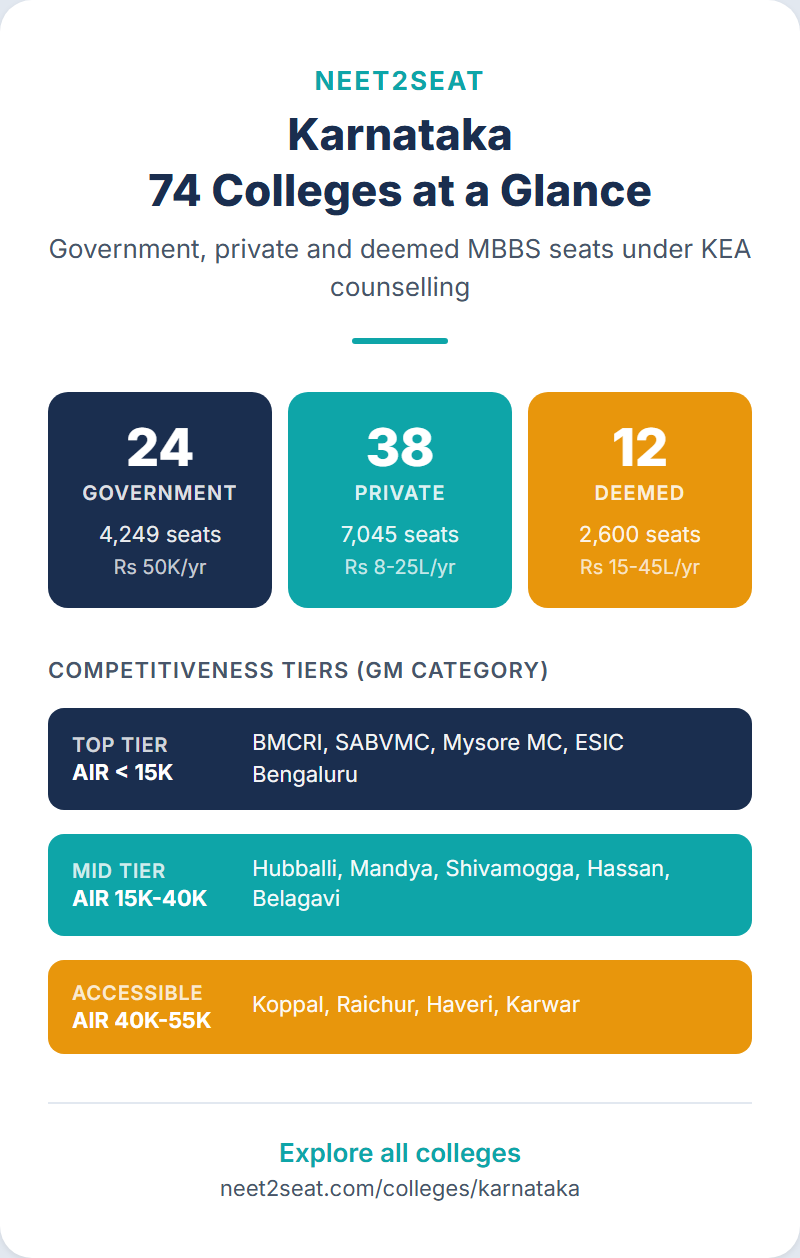
The 74 medical colleges in Karnataka span 24 government, 38 private, and 12 deemed universities, with a combined MBBS intake of 14,094 seats. Unlike many states where government colleges dominate, Karnataka’s private sector is larger (38 colleges, 7,045 seats) than the government sector (24 colleges, 4,249 seats), creating a two-track system where fee considerations heavily influence preference ordering. This guide ranks the top medical colleges in Karnataka by NEET 2026 cutoff competitiveness, using 2023-2025 historical data.
Private sector is larger than government (38 vs 24 colleges) — fee decisions dominate preference ordering
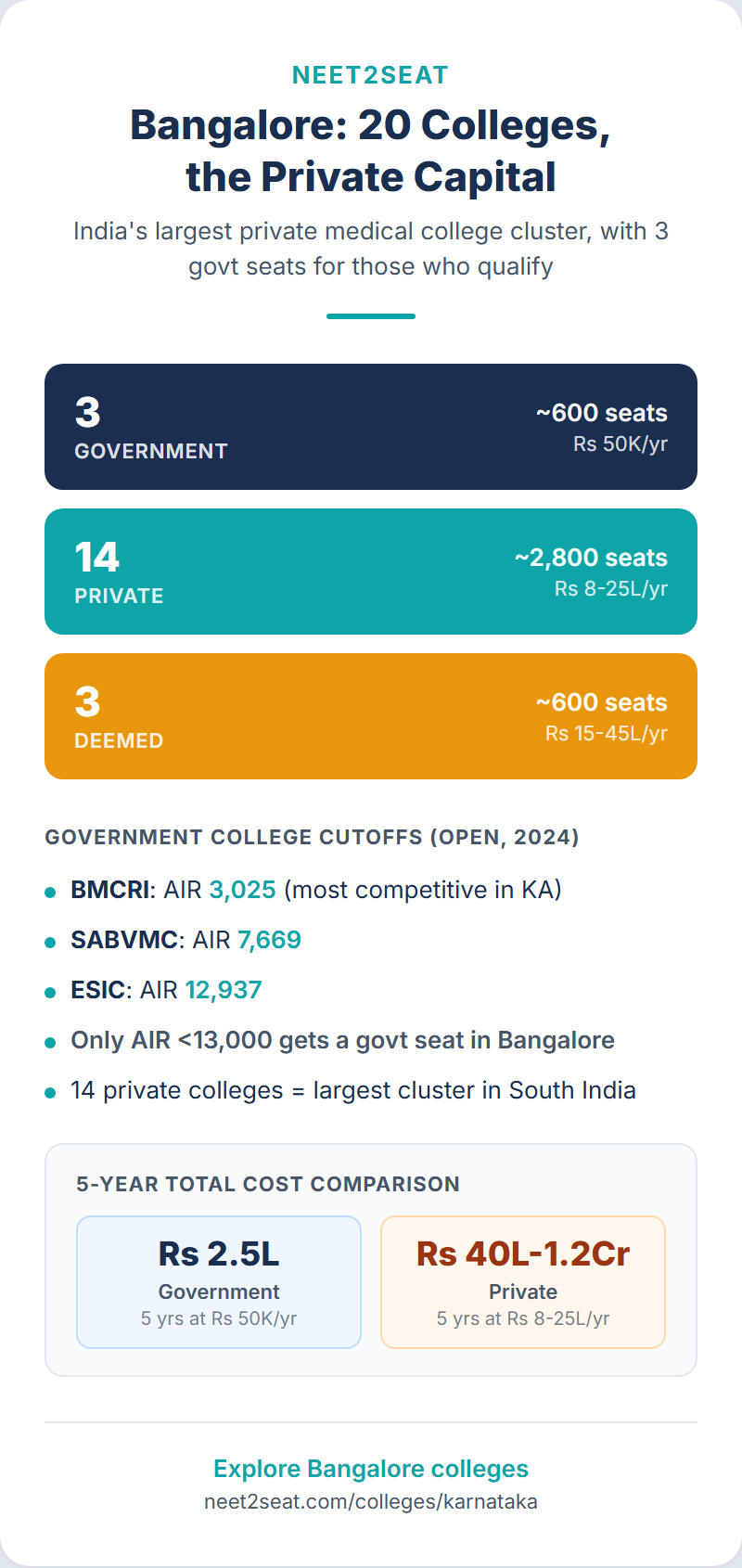
Bengaluru has 20 colleges but only 3 government; AIR under ~13,000 needed for a government seat there
Karnataka’s suffix system (G, K, R, H, KH, RH) creates separate cutoff tracks — check all suffixes you qualify for
Government medical colleges: 24 colleges, 4,249 seats
Karnataka’s 24 government medical colleges charge a uniform Rs 50,000 per year. Over five years, total tuition is approximately Rs 2.5 lakh, among the lowest government medical college fees in India.
The top tier (AIR under 15,000)
Four government colleges consistently close at AIRs below 15,000 for the GM (General Merit) category:
Bangalore Medical College and Research Institute (BMCRI), Bengaluru: AIR 3,025 (2025 R2). The state’s most competitive medical college, affiliated with Victoria Hospital and Bowring Hospital. 250 seats.
Shri Atal Bihari Vajpayee Medical College, Bengaluru: AIR 7,669 (2025 R2). A newer government college in the state capital. The Bengaluru location drives demand.
Mysore Medical College, Mysuru: AIR 8,394 (2025 R2). One of the oldest medical colleges in South India, established in 1924. 250 seats.
ESIC Medical College, Bengaluru: AIR 12,937 (2025 R2). Central government institution with ESIC Hospital affiliation.
The mid tier (AIR 13,000 to 40,000)
Twelve government colleges close in the AIR 13,000 to 40,000 range for GM category. These include established institutions in Karnataka’s secondary cities:
Karnataka Medical College (KRIMS), Hubballi: AIR 13,488. The main government college in North Karnataka’s largest city.
Mandya Institute of Medical Sciences, Mandya: AIR 15,588. Close to Mysuru and Bengaluru, making it geographically accessible.
Shimoga Institute of Medical Sciences, Shivamogga: AIR 21,676.
Hassan Institute of Medical Sciences, Hassan: AIR 21,862.
Belagavi Institute of Medical Sciences, Belagavi: AIR 23,365. In the border district with significant clinical diversity.
Gulbarga Institute of Medical Sciences, Kalaburagi: AIR 23,671. In the Hyderabad-Karnataka region, which has its own reservation provisions.
Vijaynagar Institute of Medical Sciences, Ballari: AIR 23,690.
ESIC Medical College, Kalaburagi: AIR 28,962.
And continuing through Chamarajanagar (31,696), Gadag (32,257), Bidar (37,203), and Kodagu (38,075).
The accessible tier (AIR 38,000 to 55,000)
Eight newer government colleges close at AIRs between 38,000 and 55,000. These include colleges in Chikkaballapura (38,361), Koppal (38,538), Raichur (39,240), Karwar (41,651), Chikkamagaluru (45,629), Haveri (49,827), Yadgiri (52,598), and Chitradurga (55,005).
For candidates in the AIR 40,000 to 55,000 range, these colleges represent genuine government seat opportunities at Rs 50,000 per year. Many candidates in this range skip these colleges in favour of private colleges in Bengaluru, paying 20x to 50x more for a geographically preferred location. The financial case for listing these government colleges ahead of private options is compelling. See our Karnataka fees guide.
A candidate choosing a Bengaluru private college (Rs 15L/yr) over a government college in Haveri or Chitradurga (Rs 50K/yr) pays Rs 72.5 lakh more over five years. The MBBS degree is identical. List accessible-tier government colleges before any private option unless your family can absorb that difference without financial strain.
Private medical colleges: 38 colleges, 7,045 seats
Karnataka’s private medical college sector is large and concentrated in a few urban centres. Bengaluru alone has 14 private medical colleges. Mangaluru has 5. Kalaburagi, Davangere, and Tumakuru have 2 each. The remaining colleges are scattered across 15+ cities.
The most competitive private colleges
From our 2025 data (R2, GM category), the most competitive private college government quota seats:
MS Ramaiah Medical College, Bengaluru: AIR 11,776. Consistently the most competitive private college in the state.
JSS Medical College, Mysuru: competitive government quota cutoffs comparable to mid-tier government colleges.
Kempegowda Institute of Medical Sciences, Bengaluru: strong Bengaluru location drives demand.
Top private college government quota cutoffs in Karnataka overlap with mid-tier government college cutoffs. A candidate with AIR 12,000 faces a choice between a government college in Mandya (Rs 50,000/year) and MS Ramaiah in Bengaluru (Rs 15+ lakh/year). The fee multiplier is 30x for a Bengaluru address.
Top private college cutoffs overlap with mid-tier government college cutoffs. Before choosing a private college for its city, check whether a government college at the same AIR level exists in another city. The fee difference over five years can exceed Rs 70 lakh.
Bengaluru’s private college density
With 14 private medical colleges, Bengaluru has the highest private medical college concentration in South India. GM government quota closing AIRs range from approximately 11,776 (MS Ramaiah) to 74,727 (East Point College). This means a candidate with AIR anywhere between 12,000 and 75,000 has a Bengaluru private college option available.
Bengaluru’s 14 private colleges span AIR 12,000 to 75,000. If Bengaluru is your preferred city, use the cutoff analyzer to identify which private colleges are Safe, Target, and Reach for your specific AIR, then layer government colleges from other cities above them as lower-fee options.
Government quota vs management quota at private colleges
Private colleges in Karnataka allocate approximately 40% to 50% of seats as government quota (filled through KEA) and the remainder as management/institutional/NRI quota. Government quota fees range from Rs 8 lakh to Rs 25 lakh per year. Management quota fees range from Rs 25 lakh to Rs 45 lakh per year.
The same college can have dramatically different cutoffs for government quota vs management quota seats. Government quota requires a lower (better) AIR; management quota accepts higher (worse) AIRs but at significantly higher fees. If your AIR does not qualify for government quota at a preferred private college, the management quota pathway exists, but at 2x to 4x the fee.
Deemed universities: 12 colleges, 2,800 seats
Karnataka’s 12 deemed universities include some nationally recognised institutions:
KMC Mangaluru (Manipal group): AIR 6,786 (2025 R2 GM). The most competitive deemed university seat in Karnataka. Government quota through KEA.
KMC Manipal (Manipal group): Primarily fills through MCC deemed pool. Not typically in KEA government quota data.
JSS Mysuru: Government quota seats through KEA with competitive cutoffs.
St. Johns Medical College, Bengaluru: Primarily MCC/university admission.
Approximately 25% of deemed university seats are government quota (through KEA). The remainder go through MCC’s deemed university pool or the university’s own management/NRI admission process. If your target is a deemed university, check both KEA and MCC counselling tracks.
Deemed universities like KMC Manipal and St. Johns fill most seats through MCC, not KEA. If targeting these institutions, register for MCC’s deemed university counselling in addition to KEA. Government quota cutoffs through KEA are often more competitive than MCC cutoffs for the same college.
Nine deemed universities with no 2025 KEA data
Nine deemed universities in our database do not have 2025 Round 2 GM allotment data through KEA. These include St. Johns, Rajarajeswari, Sri Siddhartha, KMC Manipal, and others. These colleges likely fill their government quota through MCC or have separate counselling processes. If you are targeting these institutions, check MCC’s deemed university schedule rather than KEA.
Geographic distribution across 31 cities
Karnataka’s 74 colleges span 31 cities:
Bengaluru: 20 colleges (3 government, 14 private, 3 deemed). By far the largest cluster.
Mangaluru: 8 colleges (5 private, 3 deemed). A medical education hub in coastal Karnataka.
Kalaburagi: 4 colleges (2 government, 2 private). The HK region centre.
Mysuru, Hubballi, Belagavi, Davangere: 2 to 3 colleges each.
Remaining 24 cities: 1 college each, mostly government.
The state’s geographic spread means government colleges exist in both metro areas (Bengaluru: 3 government colleges) and remote districts (Yadgiri, Koppal, Chitradurga). For candidates willing to study outside Bengaluru, the accessible-tier government colleges offer extraordinary value: Rs 50,000/year in a location where living costs are also low.
The suffix system and its impact on competitiveness
Karnataka’s category system uses suffixes (G, K, R, H, KH, RH) that create separate cutoff tracks at each college. A college with a GM closing AIR of 23,000 might have a 2AH (2A + Hyderabad-Karnataka) closing AIR of 45,000 at the same institution. Candidates with suffix eligibility have access to less competitive cutoff tracks at every college on their list.
When evaluating colleges, check cutoffs for all suffix variants you qualify for. The cutoff analyzer lets you filter by each category code independently. See our Karnataka categories guide for suffix details.
Open the cutoff analyzer, select your category code including suffix (e.g., 2AH, 3BK, GMR), and check closing AIRs across all 74 colleges. Suffix-eligible candidates often qualify for colleges that appear out of reach under GM cutoffs alone.
Which is the most competitive medical college in Karnataka?
Bangalore Medical College and Research Institute (BMCRI) is the most competitive government college (AIR 3,025 for GM, 2025 R2). KMC Mangaluru is the most competitive deemed university (AIR 6,786). MS Ramaiah is the most competitive private college (AIR 11,776).
Are all 24 government colleges in the KEA counselling?
All 24 participate in KEA state quota counselling. ESIC colleges (Bengaluru and Kalaburagi) operate under central government but are included in KEA counselling for state quota seats. AIIMS-type central institutions, if any, have separate processes.
Can out-of-state candidates get government college seats in Karnataka?
Karnataka is an “open state” for NEET counselling, meaning candidates from any Indian state can participate in KEA counselling. However, state quota government college seats are restricted to Karnataka domicile candidates. Out-of-state candidates are eligible for private college management/NRI/institutional quota seats only.
Which college has the lowest fees for MBBS in Karnataka?
All 24 government medical colleges in Karnataka charge the same fee: approximately Rs 50,000 per year. Over five years, total government college tuition is roughly Rs 2.5 lakh. This is uniform across all government institutions, from Bangalore Medical College to the government college in Yadgiri. The cheapest route to an MBBS in Karnataka is any government college seat through KEA state quota counselling. See our Karnataka fees guide for the full breakdown.
20 medical colleges, 3 government options, and a private sector that spans AIR 12,000 to 75,000
Bangalore has 20 medical colleges: 3 government (including ESIC), 14 private, and 3 deemed universities. The best medical colleges in Bangalore are dominated by its private sector, the largest private medical college cluster in South India. This guide covers NEET cutoff data, fees, and what distinguishes each Bangalore institution. For candidates targeting the city, the critical decision is whether Bangalore’s advantages justify private college fees that are 20x to 50x higher than government college fees in other Karnataka cities.
20 colleges (3 government, 14 private, 3 deemed) — the private sector dominates Bengaluru’s medical education
Only AIR under ~13,000 qualifies for a government seat in Bengaluru (BMCRI, SABVMC, ESIC)
Private colleges span AIR 12,000 to 75,000, with fees 20x-50x higher than government colleges in other cities
The Bengaluru premium is worth paying only if your family can absorb the fee difference without financial strain
Government medical colleges in Bengaluru
Bengaluru has 3 government medical colleges, far fewer than Mumbai’s 9. Competition for government seats in Bengaluru is correspondingly intense.
Bangalore Medical College and Research Institute (BMCRI)
The most competitive medical college in Karnataka. GM closing AIR in 2025 Round 2: 3,025. BMCRI is affiliated with Victoria Hospital (1,500+ beds) and Bowring Hospital. Established in 1955, it is the state’s premier government medical institution. 250 seats.
Getting into BMCRI requires an AIR in the top 3,000 to 4,000 nationally. For context, that puts BMCRI’s competitiveness on par with top government colleges in Mumbai and Delhi. Candidates with AIR above 5,000 should treat BMCRI as a Reach.
Shri Atal Bihari Vajpayee Medical College (SABVMC)
A newer government medical college in Bengaluru. GM closing AIR in 2025 R2: 7,669. The Bengaluru location drives its competitiveness higher than its institutional age would suggest. SABVMC fills a capacity gap: BMCRI’s 250 seats were insufficient for a city of 12 million, and SABVMC added another government option.
ESIC Medical College, Bengaluru
Operated under the central government’s ESIC scheme. GM closing AIR in 2025 R2: 12,937. ESIC colleges have a distinct character: they are affiliated with ESIC hospitals that primarily serve insured workers. Clinical exposure skews toward occupational health and primary care, though the hospitals also handle general secondary and tertiary cases.
The government bottleneck
Three government colleges with approximately 600 combined seats for a metropolitan area of 12 million people. The math is stark: only candidates with AIR below approximately 13,000 can realistically get a government seat in Bengaluru. The remaining 7,400+ government college seats in Karnataka are distributed across 21 other cities, many with AIR thresholds between 15,000 and 55,000.
For candidates with AIR 15,000 to 55,000, the choice is: a government seat in Mysuru, Hubballi, Mandya, or another city at Rs 50,000/year, or a private seat in Bengaluru at Rs 8 lakh to Rs 25 lakh/year. The fee difference over five years ranges from Rs 37.5 lakh to Rs 1.2 crore.
600 government seats for 12 million people: Bengaluru’s government-to-population ratio is among the lowest in India for major cities. Candidates with AIR 15,000-55,000 face a binary choice between an affordable government seat in another city and an expensive private seat in Bengaluru. The five-year fee difference can exceed Rs 1 crore.
Private medical colleges in Bengaluru: 14 institutions
Bengaluru’s 14 private medical colleges are the largest such cluster in Karnataka. They span a wide competitiveness range.
The top tier (GM closing AIR under 25,000)
MS Ramaiah Medical College: AIR 11,776 (2025 R2 GM). Consistently Karnataka’s most competitive private college. Ramaiah Hospital is a 1,300-bed facility with strong clinical infrastructure. Government quota fees are in the Rs 15 lakh to Rs 20 lakh/year range.
Kempegowda Institute of Medical Sciences (KIMS): Competitive government quota cutoffs in the top private tier. Established institution with a well-known teaching hospital.
These top-tier private colleges have cutoffs that overlap with mid-tier government colleges in other cities. A candidate choosing MS Ramaiah over a government college in Hassan or Mandya is paying approximately Rs 70 lakh more over five years for a Bengaluru address and Ramaiah’s infrastructure.
MS Ramaiah’s cutoff (AIR 11,776) overlaps with government colleges in Mandya (AIR 15,588) and Shivamogga (AIR 21,676). The five-year fee difference is approximately Rs 70 lakh to Rs 1 crore. Make this a conscious financial decision, not a default assumption that private-in-Bengaluru is always better than government-elsewhere.
The mid tier (GM closing AIR 25,000 to 50,000)
Several private colleges in this range offer solid medical education with moderate (by private college standards) fee levels. Institutions in this tier include colleges in both central Bengaluru and the city’s expanding periphery.
The accessible tier (GM closing AIR 50,000 to 75,000)
Newer or less established private colleges in Bengaluru close at higher AIRs, making them accessible to candidates with AIR 50,000 to 75,000. East Point College, for example, closed at AIR 74,727 in 2025 R2. These colleges offer a Bengaluru location at the cost of higher fees and potentially developing infrastructure.
If your AIR is between 50,000 and 75,000 and Bengaluru is non-negotiable, accessible-tier private colleges are your realistic options. But also list government colleges in Haveri, Chitradurga, and Yadgiri (all under AIR 55,000) as Rs 50K/yr alternatives. The algorithm gives you the highest-ranked option you qualify for.
Deemed universities in Bengaluru
Bengaluru has 3 deemed universities offering MBBS. St. Johns Medical College is the most notable, known for its clinical training and community health programmes. However, St. Johns primarily fills through MCC or its own admission process rather than KEA counselling.
Government quota seats at Bengaluru deemed universities (through KEA) are limited. Check both KEA and MCC tracks if targeting deemed universities in the city.
Living costs in Bengaluru
Bengaluru is a Tier 1 city with corresponding living costs, though cheaper than Mumbai:
Hostel/PG: Rs 6,000 to Rs 15,000 per month (varies by area; colleges in the periphery are cheaper).
Food: Rs 3,000 to Rs 5,000 per month.
Transport: Bengaluru’s traffic is notorious. Colleges closer to your accommodation save significant commute time. Metro connectivity is improving but does not yet cover all medical college locations.
Total monthly: Rs 10,000 to Rs 20,000 per month, or Rs 6 lakh to Rs 12 lakh over five years.
The Bengaluru premium: when it is worth paying
Bengaluru’s private colleges command a premium because the city offers:
High clinical diversity: Teaching hospitals in Bengaluru see patients from across Karnataka and neighbouring states, providing exposure to a wide range of conditions.
Research opportunities: Proximity to IISc, NIMHANS, and multiple biotech companies creates research avenues not available in smaller cities.
Professional network: Bengaluru’s medical community is large and well-connected. Relationships formed during MBBS can help with PG placements and early career opportunities.
Lifestyle: A cosmopolitan city with good food, entertainment, and social infrastructure.
The premium is worth paying if: (a) your family can absorb the fee difference without financial strain, and (b) you value the city-specific advantages enough to prioritise them over the financial savings of a government seat elsewhere.
The premium is not worth paying if: (a) private college fees would require a large education loan that burdens your first 10+ years of practice, or (b) you are indifferent to city-specific factors and primarily want a medical degree at the lowest cost.
Calculate the total five-year cost for your target Bengaluru private college (tuition + living) and compare it with a government college in another city. If the difference exceeds what your family can pay without a large loan, the government college is the financially sound choice. The MBBS degree is identical for PG entrance eligibility.
What AIR do I need for a government seat in Bengaluru?
Based on 2025 data, approximately AIR 13,000 or below for GM category. BMCRI closes at approximately 3,000, SABVMC at approximately 7,700, and ESIC at approximately 13,000.
Is MS Ramaiah worth the fee over a government college in another city?
MS Ramaiah is a well-respected institution with strong infrastructure. The five-year fee difference versus a government college is approximately Rs 70 lakh to Rs 1 crore. For families where this amount is manageable, Ramaiah offers a Bengaluru medical education at a competitive private college. For families where this would mean a large loan, the government college is the better financial choice. The medical degree is equivalent.
Can I get a Bengaluru private college seat with AIR 50,000?
Yes. Multiple Bengaluru private colleges have GM government quota closing AIRs between 50,000 and 75,000. You would have several options in the mid-to-accessible tier. Use the college predictor with your exact AIR to see which ones are Safe, Target, and Reach.