Category: NEET Guides

Editorial guides for NEET UG counselling

  • Best medical colleges in Bangalore with NEET cutoff

    20 medical colleges, 3 government options, and a private sector that spans AIR 12,000 to 75,000

    Bangalore has 20 medical colleges: 3 government (including ESIC), 14 private, and 3 deemed universities. The best medical colleges in Bangalore are dominated by its private sector, the largest private medical college cluster in South India. This guide covers NEET cutoff data, fees, and what distinguishes each Bangalore institution. For candidates targeting the city, the critical decision is whether Bangalore’s advantages justify private college fees that are 20x to 50x higher than government college fees in other Karnataka cities.

    Infographic showing medical colleges in Bangalore

    This guide covers Bengaluru specifically. For the statewide picture, see our Karnataka medical colleges overview. For cutoff data, use the Karnataka cutoff analyzer.

    • 20 colleges (3 government, 14 private, 3 deemed) — the private sector dominates Bengaluru’s medical education
    • Only AIR under ~13,000 qualifies for a government seat in Bengaluru (BMCRI, SABVMC, ESIC)
    • Private colleges span AIR 12,000 to 75,000, with fees 20x-50x higher than government colleges in other cities
    • The Bengaluru premium is worth paying only if your family can absorb the fee difference without financial strain

    Government medical colleges in Bengaluru

    Bengaluru has 3 government medical colleges, far fewer than Mumbai’s 9. Competition for government seats in Bengaluru is correspondingly intense.

    Bangalore Medical College and Research Institute (BMCRI)

    The most competitive medical college in Karnataka. GM closing AIR in 2025 Round 2: 3,025. BMCRI is affiliated with Victoria Hospital (1,500+ beds) and Bowring Hospital. Established in 1955, it is the state’s premier government medical institution. 250 seats.

    Getting into BMCRI requires an AIR in the top 3,000 to 4,000 nationally. For context, that puts BMCRI’s competitiveness on par with top government colleges in Mumbai and Delhi. Candidates with AIR above 5,000 should treat BMCRI as a Reach.

    Shri Atal Bihari Vajpayee Medical College (SABVMC)

    A newer government medical college in Bengaluru. GM closing AIR in 2025 R2: 7,669. The Bengaluru location drives its competitiveness higher than its institutional age would suggest. SABVMC fills a capacity gap: BMCRI’s 250 seats were insufficient for a city of 12 million, and SABVMC added another government option.

    ESIC Medical College, Bengaluru

    Operated under the central government’s ESIC scheme. GM closing AIR in 2025 R2: 12,937. ESIC colleges have a distinct character: they are affiliated with ESIC hospitals that primarily serve insured workers. Clinical exposure skews toward occupational health and primary care, though the hospitals also handle general secondary and tertiary cases.

    The government bottleneck

    Three government colleges with approximately 600 combined seats for a metropolitan area of 12 million people. The math is stark: only candidates with AIR below approximately 13,000 can realistically get a government seat in Bengaluru. The remaining 7,400+ government college seats in Karnataka are distributed across 21 other cities, many with AIR thresholds between 15,000 and 55,000.

    For candidates with AIR 15,000 to 55,000, the choice is: a government seat in Mysuru, Hubballi, Mandya, or another city at Rs 50,000/year, or a private seat in Bengaluru at Rs 8 lakh to Rs 25 lakh/year. The fee difference over five years ranges from Rs 37.5 lakh to Rs 1.2 crore.

    600 government seats for 12 million people: Bengaluru’s government-to-population ratio is among the lowest in India for major cities. Candidates with AIR 15,000-55,000 face a binary choice between an affordable government seat in another city and an expensive private seat in Bengaluru. The five-year fee difference can exceed Rs 1 crore.

    Private medical colleges in Bengaluru: 14 institutions

    Bengaluru’s 14 private medical colleges are the largest such cluster in Karnataka. They span a wide competitiveness range.

    The top tier (GM closing AIR under 25,000)

    MS Ramaiah Medical College: AIR 11,776 (2025 R2 GM). Consistently Karnataka’s most competitive private college. Ramaiah Hospital is a 1,300-bed facility with strong clinical infrastructure. Government quota fees are in the Rs 15 lakh to Rs 20 lakh/year range.

    Kempegowda Institute of Medical Sciences (KIMS): Competitive government quota cutoffs in the top private tier. Established institution with a well-known teaching hospital.

    These top-tier private colleges have cutoffs that overlap with mid-tier government colleges in other cities. A candidate choosing MS Ramaiah over a government college in Hassan or Mandya is paying approximately Rs 70 lakh more over five years for a Bengaluru address and Ramaiah’s infrastructure.

    MS Ramaiah’s cutoff (AIR 11,776) overlaps with government colleges in Mandya (AIR 15,588) and Shivamogga (AIR 21,676). The five-year fee difference is approximately Rs 70 lakh to Rs 1 crore. Make this a conscious financial decision, not a default assumption that private-in-Bengaluru is always better than government-elsewhere.

    The mid tier (GM closing AIR 25,000 to 50,000)

    Several private colleges in this range offer solid medical education with moderate (by private college standards) fee levels. Institutions in this tier include colleges in both central Bengaluru and the city’s expanding periphery.

    The accessible tier (GM closing AIR 50,000 to 75,000)

    Newer or less established private colleges in Bengaluru close at higher AIRs, making them accessible to candidates with AIR 50,000 to 75,000. East Point College, for example, closed at AIR 74,727 in 2025 R2. These colleges offer a Bengaluru location at the cost of higher fees and potentially developing infrastructure.

    If your AIR is between 50,000 and 75,000 and Bengaluru is non-negotiable, accessible-tier private colleges are your realistic options. But also list government colleges in Haveri, Chitradurga, and Yadgiri (all under AIR 55,000) as Rs 50K/yr alternatives. The algorithm gives you the highest-ranked option you qualify for.

    Deemed universities in Bengaluru

    Bengaluru has 3 deemed universities offering MBBS. St. Johns Medical College is the most notable, known for its clinical training and community health programmes. However, St. Johns primarily fills through MCC or its own admission process rather than KEA counselling.

    Government quota seats at Bengaluru deemed universities (through KEA) are limited. Check both KEA and MCC tracks if targeting deemed universities in the city.

    Living costs in Bengaluru

    Bengaluru is a Tier 1 city with corresponding living costs, though cheaper than Mumbai:

    • Hostel/PG: Rs 6,000 to Rs 15,000 per month (varies by area; colleges in the periphery are cheaper).
    • Food: Rs 3,000 to Rs 5,000 per month.
    • Transport: Bengaluru’s traffic is notorious. Colleges closer to your accommodation save significant commute time. Metro connectivity is improving but does not yet cover all medical college locations.
    • Total monthly: Rs 10,000 to Rs 20,000 per month, or Rs 6 lakh to Rs 12 lakh over five years.

    The Bengaluru premium: when it is worth paying

    Bengaluru’s private colleges command a premium because the city offers:

    • High clinical diversity: Teaching hospitals in Bengaluru see patients from across Karnataka and neighbouring states, providing exposure to a wide range of conditions.
    • Research opportunities: Proximity to IISc, NIMHANS, and multiple biotech companies creates research avenues not available in smaller cities.
    • Professional network: Bengaluru’s medical community is large and well-connected. Relationships formed during MBBS can help with PG placements and early career opportunities.
    • Lifestyle: A cosmopolitan city with good food, entertainment, and social infrastructure.

    The premium is worth paying if: (a) your family can absorb the fee difference without financial strain, and (b) you value the city-specific advantages enough to prioritise them over the financial savings of a government seat elsewhere.

    The premium is not worth paying if: (a) private college fees would require a large education loan that burdens your first 10+ years of practice, or (b) you are indifferent to city-specific factors and primarily want a medical degree at the lowest cost.

    Calculate the total five-year cost for your target Bengaluru private college (tuition + living) and compare it with a government college in another city. If the difference exceeds what your family can pay without a large loan, the government college is the financially sound choice. The MBBS degree is identical for PG entrance eligibility.

    FAQ

    How many medical colleges are in Bengaluru?

    20 total: 3 government, 14 private, 3 deemed universities.

    What AIR do I need for a government seat in Bengaluru?

    Based on 2025 data, approximately AIR 13,000 or below for GM category. BMCRI closes at approximately 3,000, SABVMC at approximately 7,700, and ESIC at approximately 13,000.

    Is MS Ramaiah worth the fee over a government college in another city?

    MS Ramaiah is a well-respected institution with strong infrastructure. The five-year fee difference versus a government college is approximately Rs 70 lakh to Rs 1 crore. For families where this amount is manageable, Ramaiah offers a Bengaluru medical education at a competitive private college. For families where this would mean a large loan, the government college is the better financial choice. The medical degree is equivalent.

    Can I get a Bengaluru private college seat with AIR 50,000?

    Yes. Multiple Bengaluru private colleges have GM government quota closing AIRs between 50,000 and 75,000. You would have several options in the mid-to-accessible tier. Use the college predictor with your exact AIR to see which ones are Safe, Target, and Reach.

  • Float vs freeze: when to hold your NEET seat and when to accept

    • Floating is a no-lose proposition: you either upgrade to a better college or keep your current seat.
    • The government-private fee gap (Rs 35 lakh to Rs 65 lakh over 5 years) makes floating almost always worthwhile when government colleges are on your upgrade path.
    • Use multi-year Round 2 closing AIR data to assess realistic upgrade targets; do not float for aspirational colleges far beyond your rank.
    • Terminology varies (MCC: Float/Freeze, Maharashtra: Status Retention, Karnataka: Choice 1/2/3) but the underlying decision is the same.

    The single decision that costs more candidates seats than any other

    The float vs freeze decision in NEET counselling is the single choice that costs more candidates seats than any other. After each round, allotted candidates face a binary choice: keep the seat and try for something better, or accept it and walk away. The terminology varies by counselling authority (MCC calls it “Float” and “Freeze”; Maharashtra calls it “Status Retention”; Karnataka calls it “Choice 1, Choice 2, Choice 3”), but the underlying decision is the same everywhere. Get it right, and you either upgrade to a better college or keep a solid backup. Get it wrong, and you either lose a seat you should have kept or stay locked into one you could have improved.

    Infographic explaining float vs freeze in NEET counselling

    This guide covers the general framework for making this decision in NEET 2026 counselling. For state-specific mechanics, see our Maharashtra Status Retention guide and our Karnataka Choice 1 vs Choice 2 guide.

    The terminology, mapped across systems

    Three counselling systems, three vocabularies, one underlying decision:

    ActionMCC termMaharashtra termKarnataka term
    Accept seat, exit counsellingFreezeDo not retain (report and accept)Choice 1
    Keep seat, seek upgrade in next roundFloatStatus RetentionChoice 2
    Reject seat, re-enter poolNot available (must float or freeze)Free Exit (Round 1 only)Choice 3

    MCC’s system is the simplest: two options, Float or Freeze. Maharashtra adds a free exit option in Round 1 and a binding Status Retention mechanism in Round 2. Karnataka adds a third path (Choice 3: reject and re-enter) that carries genuine risk of ending up with no seat at all.

    The rest of this guide uses “float” (lowercase) to mean “keep current seat while seeking upgrade” and “freeze” to mean “accept current seat and exit.” These are the most widely understood terms, even outside MCC counselling.

    How floating works at a mechanical level

    When you float (or declare Status Retention, or choose Choice 2), the system does three things:

    1. Your current seat is reserved for you. No other candidate can take it during the next round. It is held in your name until the round concludes.
    2. Your preference list is checked for upgrades. The algorithm looks at colleges ranked higher than your current allotment on your preference list. If any of those colleges has a vacancy and your AIR qualifies, you are upgraded.
    3. If upgraded, your old seat is released. It becomes available for other candidates in the current round. If not upgraded, you keep your original seat with no penalty.

    Floating is a no-lose proposition in most counselling systems. You either get something better or keep what you have. The only costs are financial (a deposit or partial fees to hold the seat) and logistical (waiting longer for a final answer). The algorithm cannot downgrade you to a college ranked lower on your preference list.

    When to freeze

    Freeze when any of these conditions is true:

    You got your first or second choice

    If the allotted college is at or near the top of your preference list, there is little room for upgrade. Floating would keep you in the system for another round with almost no chance of improvement. Freeze, report to the college, and start preparing for MBBS.

    The financial cost of floating is unacceptable

    In Karnataka, Choice 2 candidates with allotted seats having course fees above Rs 12 lakh previously had to pay the full fee upfront. The 2025 rule change capped this at Rs 12,001, making floating much more accessible. But in some counselling tracks, the deposit or advance fee required to hold a seat while floating can be substantial. If paying that amount creates financial strain with minimal upgrade probability, freezing is the safer financial decision.

    The college meets your minimum requirements

    If the allotted college is a government college with acceptable fees, reasonable location, and adequate infrastructure, and the only colleges ranked higher are marginal improvements (say, a government college in a slightly larger city), the risk-reward calculus favours freezing. A guaranteed seat at a good college is worth more than a slim chance at a marginally better one.

    You are in Round 3 or a mop-up round

    Late rounds have smaller seat pools and fewer upgrade opportunities. If you have a seat in Round 3, freeze it. The probability of meaningful improvement in subsequent rounds is low, and the risk of administrative complications increases.

    When to float

    Float when any of these conditions is true:

    Your current allotment is significantly below your preference list position

    If you listed 30 colleges and got allotted number 25, there are 24 colleges above your allotment that you prefer. Even if only 2 or 3 of those colleges have vacancies in the next round, your chances of an upgrade are real. The gap between your allotment and your top choices determines the upside of floating.

    The government-private gap applies

    You are allotted a private college at Rs 14 lakh per year but have government colleges ranked higher on your list. Government college fees in Maharashtra are approximately Rs 1.62 lakh per year; in Karnataka, approximately Rs 50,000 per year. The five-year savings from upgrading to a government seat range from Rs 35 lakh to Rs 65 lakh. Even if the upgrade probability is only 15%, the expected value (probability times savings) far exceeds the cost of holding the seat.

    You are in Round 1 or Round 2

    Early rounds have the largest seat pools and the most movement. In Karnataka, Round 2 had 9,957 allotments versus 8,320 in Round 1 in 2025, meaning significant seat turnover between rounds. In Maharashtra, Round 2 closes at higher (less competitive) AIRs than Round 1 at most colleges, creating upgrade opportunities that did not exist in Round 1.

    Historical data supports the upgrade

    Check the cutoff analyzer for the colleges above your allotment. Filter by Round 2, your category, and multiple years (2023-2025). If their Round 2 closing AIRs were at or above your AIR in at least 2 of 3 years, the upgrade is plausible. If they were well below your AIR in all years, the upgrade is not realistic regardless of floating.

    The data behind round-to-round movement

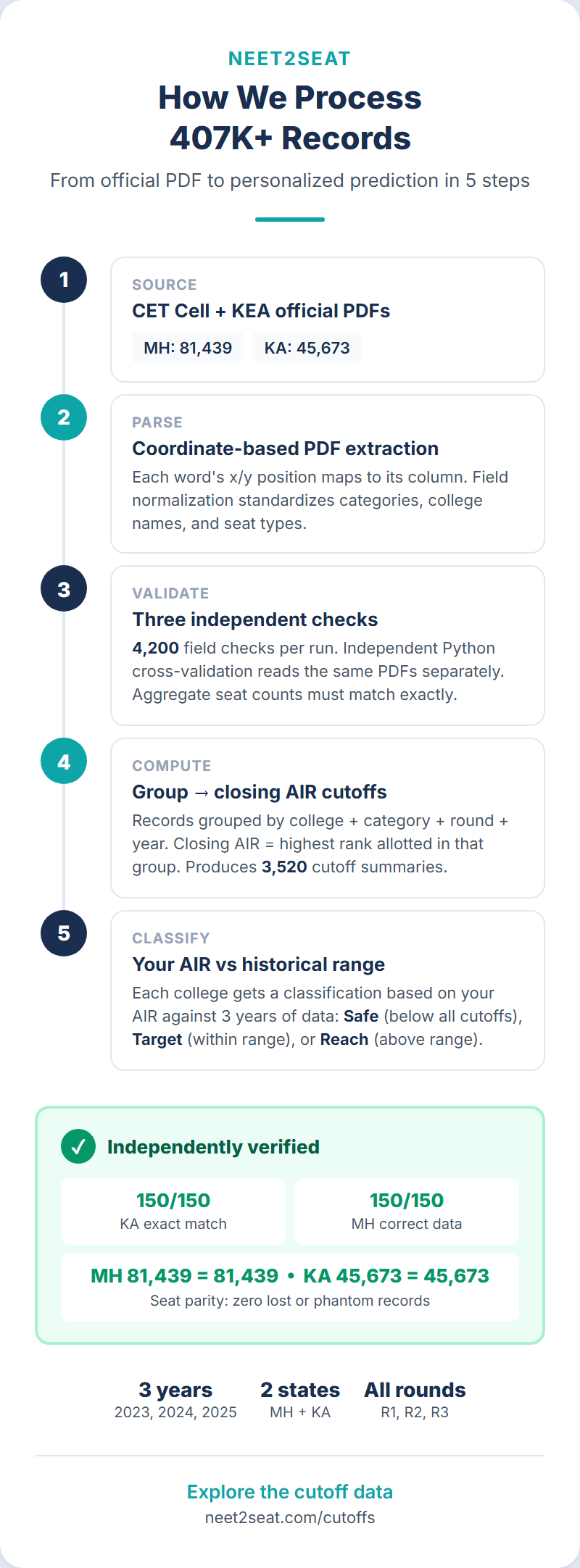
    From our database of 407,000+ allotment records across Maharashtra and Karnataka (2023 to 2025), several patterns affect the float-vs-freeze decision:

    Round 2 closing AIRs are consistently higher than Round 1

    At government colleges in Maharashtra, Round 2 closing AIRs for OPEN category averaged 15% to 25% higher (less competitive) than Round 1 across 2023 to 2025. At Karnataka government colleges, the shift was similar: Round 2 typically closed at 10% to 20% higher AIRs than Round 1.

    The easing pattern is not uniform. Top-5 government colleges show only 5% to 10% easing (their candidates freeze immediately). Mid-tier colleges (ranked 10th to 25th) show 15% to 25% easing: the sweet spot for upgrades. Lower-ranked colleges can ease by 30% to 40%.

    Top colleges show the smallest movement

    The most competitive government colleges (Seth GS Medical College in Mumbai, Bangalore Medical College in Karnataka) show minimal closing AIR movement between rounds. These colleges fill with top-ranked candidates who freeze immediately. If your upgrade target is a top-5 college, floating is less likely to help unless your AIR is very close to the Round 1 closing.

    Mid-tier colleges show the largest movement

    Government colleges ranked 10th to 25th in each state show the most Round 1 to Round 2 movement. These colleges experience the most seat turnover from candidates who were allotted there but chose to float (hoping for a top college) or who took free exit. If your upgrade targets are in this mid-tier range, floating has the highest probability of success.

    Private college movement is volatile

    Private college closing AIRs can shift by 30% to 50% between rounds, depending on fee changes, new seat additions, and candidate behaviour. If your backup is a private college and your upgrade targets are also private colleges, the outcome is harder to predict from historical data alone.

    The reject-and-re-enter option (Karnataka Choice 3)

    Karnataka’s Choice 3 is unique and high-risk: you reject the allotted seat entirely and re-enter the candidate pool for Round 2. Unlike floating, you have no safety net. If Round 2 does not produce an allotment, you are left with no seat and a forfeited caution deposit (Rs 1,00,000 general; Rs 50,000 SC/ST). For strategic upgrades, Choice 2 is almost always better because it preserves your Round 1 seat.

    The only scenario where Choice 3 makes strategic sense: your AIR is strong enough that historical data across multiple years confirms you would be allotted in Round 2, and the Rs 1,00,000 deposit is an acceptable cost if the prediction is wrong. Even then, Choice 2 achieves the same upgrade with zero risk.

    Financial analysis: when is floating worth the deposit?

    The financial question is straightforward: does the expected savings from an upgrade exceed the cost of holding the seat?

    Scenario 1: Private to government upgrade

    Current allotment: private college, Rs 14 lakh/year fees. Target upgrade: government college, Rs 50,000/year (Karnataka) or Rs 1.62 lakh/year (Maharashtra). Floating cost: Rs 12,001 (Karnataka 2025 rule) or deposit amount per Maharashtra rules.

    Five-year savings if upgraded: Rs 60 lakh to Rs 67.5 lakh. Even if the upgrade probability is only 15%, the expected value (probability times savings) is Rs 9 lakh to Rs 10 lakh. Against a floating cost of Rs 12,001, this is a clear float.

    Scenario 2: Government to better government upgrade

    Current allotment: government college in a smaller city. Target upgrade: government college in a metropolitan area. Fees are the same at both colleges. The financial savings are zero.

    The value here is non-financial: clinical exposure, research access, professional network, quality of life. If those factors are important enough to justify waiting another round, float. If the current college is acceptable, freeze and save the time.

    Scenario 3: Private to slightly cheaper private

    Current allotment: private college at Rs 18 lakh/year. Target upgrade: private college at Rs 12 lakh/year. Five-year savings if upgraded: Rs 30 lakh. If the upgrade probability is reasonable (check historical cutoffs), float. If the target college’s closing AIR is far below your AIR even in Round 2, the savings are theoretical and freezing is more practical.

    The psychological trap: anchoring to a specific college

    Many candidates float not because the math supports it, but because they are fixated on a specific college. “I want Seth GS” or “I only want Bangalore Medical College.” If your AIR is 20,000 and the target college closed at AIR 3,000, no amount of floating will get you there. The college’s Round 2 closing AIR might ease to 3,500 or 4,000, still far beyond your reach.

    Use the cutoff analyzer to check multi-year closing AIR ranges for your target colleges. If the best-case scenario across three years of data still does not reach your AIR, the upgrade is not realistic. Float for achievable upgrades, not aspirational ones.

    Decision framework

    Follow these steps: (1) Identify colleges above your allotment on your preference list. (2) Check Round 2 closing AIRs for those colleges in the cutoff analyzer, filtering by your category. (3) Count how many have closings at or above your AIR. (4) If 3+ colleges qualify, float. (5) If 1-2 qualify, float if the fee savings exceed Rs 10 lakh over five years. (6) If zero qualify, freeze.

    FAQ

    If I float and am not upgraded, do I lose my current seat?

    No. In all three counselling systems (MCC Float, Maharashtra Status Retention, Karnataka Choice 2), failing to upgrade means you keep your existing seat. The float mechanism is designed to be risk-free in terms of seat retention. The only costs are financial (deposit or advance fees) and time.

    Can I float in one counselling track and freeze in another?

    If you are participating in both MCC and state counselling simultaneously, each track’s decisions are independent until you receive a final allotment from both and must choose one. Floating in MCC does not affect your state counselling seat, and vice versa. However, the timelines may overlap, so track both deadlines carefully.

    What happens to my seat if I do not respond to the float/freeze deadline?

    Policies vary. In MCC, failure to exercise the option by the deadline typically results in seat cancellation. In Maharashtra, the default may be treated as free exit (Round 1) or seat cancellation (later rounds). In Karnataka, missed deadlines can result in forfeiture. Never rely on defaults; always submit your decision before the deadline.

    Is there a limit to how many times I can float?

    In MCC, you can float after each round until you either freeze or the final round concludes. In Maharashtra, Status Retention applies between specific rounds (Round 1 to Round 2 primarily). In Karnataka, the Choice 1/2/3 decision occurs after each round’s allotment. Check the current year’s counselling bulletin for exact rules on sequential floating.

    Does floating affect my deposit or fees?

    In MCC, the initial security deposit (typically Rs 25,000 for government quota; Rs 2,00,000 for deemed/private management quota) must remain deposited while floating. In Karnataka, the 2025 rule caps the advance fee at Rs 12,001 for seats above Rs 12 lakh. In Maharashtra, the deposit requirements for Status Retention are specified in the CET Cell information bulletin. The deposit is adjusted against the final college’s fees if you eventually freeze or are upgraded.

    What if I float and get upgraded to a college I like less than my current allotment?

    This cannot happen. The algorithm only upgrades you to colleges ranked higher (better) on your preference list than your current allotment. If you have College A at position 5 and College B (your current seat) at position 12, you can only be upgraded to colleges at positions 1 through 11. You will never be moved to a college ranked lower than your current seat.

    What is the difference between freeze and float in counselling?

    Float means you accept your current allotment but remain in the pool for an upgrade in the next round. If a better college (higher on your preference list) becomes available, you are automatically upgraded. If not, you keep your current seat. Freeze means you accept your current allotment and exit the counselling process entirely; you will not be considered for any further rounds. The terminology varies by state: Maharashtra calls it “Status Retention” (equivalent to float), and Karnataka uses “Choice 1” (freeze) and “Choice 2” (float).

  • Medical college fees in Maharashtra: government, private, and deemed university costs

    Maharashtra medical college fees range from Rs 1.62 lakh to Rs 25 lakh per year, depending on three variables

    The cost of an MBBS degree in Maharashtra depends on three factors: whether the college is government, private, or deemed; which seat type you hold (state quota, institutional quota, or management quota); and whether your category qualifies for fee concessions. Over a five-year MBBS programme, these variables create a total cost range from under Rs 10 lakh to over Rs 1.25 crore.

    Infographic showing medical college fees in Maharashtra

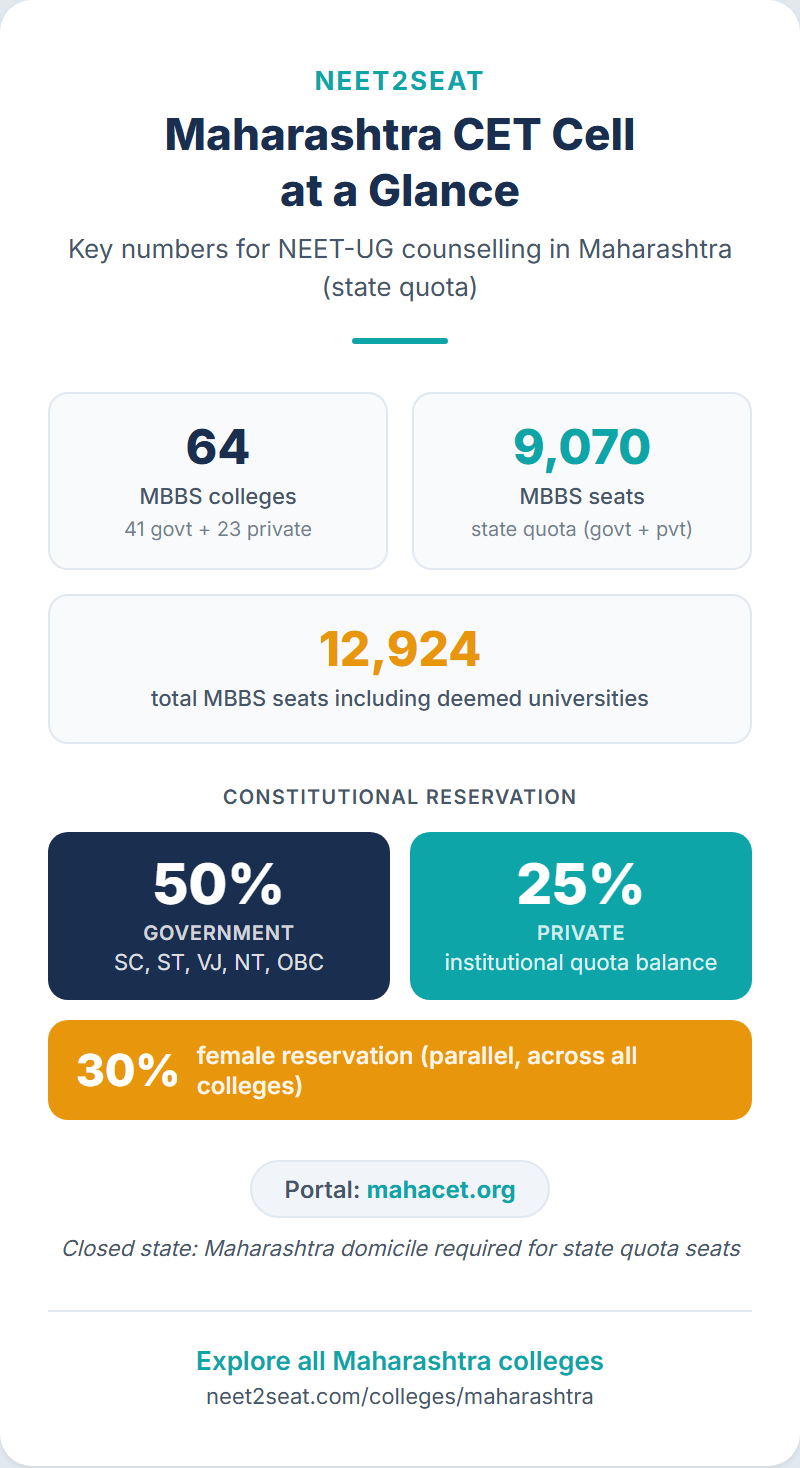
    This guide breaks down the fee structures across all three college types in Maharashtra, using current fee data. For college-specific cutoff data, see the Maharashtra cutoff analyzer. For a full list of colleges, see our Maharashtra college directory.

    • Government: Rs 1.62L/yr (total Rs 15-25L over 5 years including living expenses)
    • Private state quota: Rs 5-15L/yr; institutional quota: 2-3x state quota; management quota: Rs 20-25L+/yr
    • The 5-year total cost gap spans Rs 10L (government) to Rs 1.25 crore (private management quota) — an 8x spread
    • A Rs 50L education loan at 9.5% with moratorium accumulates Rs 36L in interest before the first EMI

    Government medical colleges: Rs 1.62 lakh per year

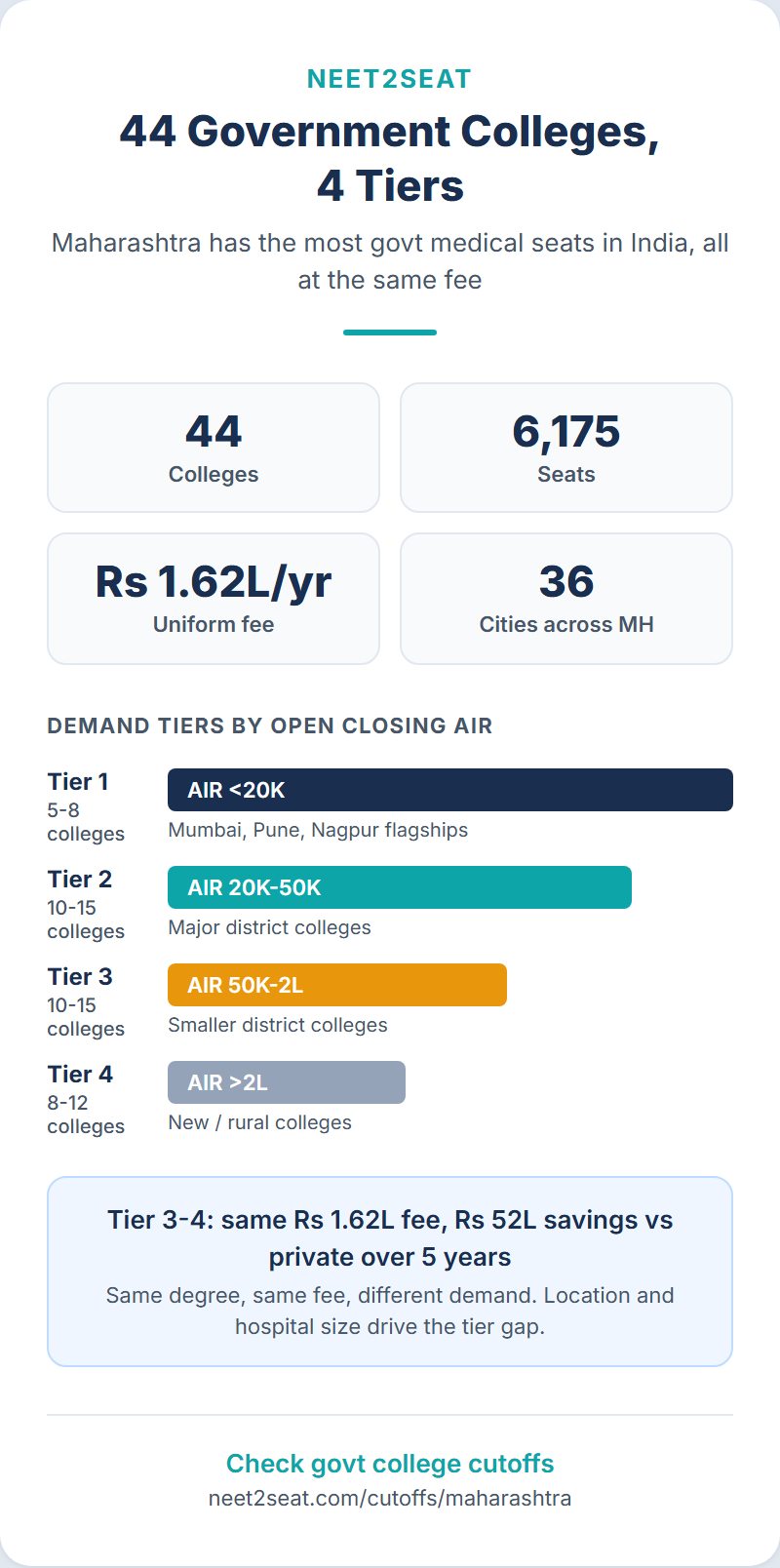
    Maharashtra has 44 government medical colleges with a combined intake of 6,175 MBBS seats. Government college fees are set by the state government and are uniform across all 44 institutions. Whether you attend Seth GS Medical College in Mumbai or the government medical college in Nandurbar, the tuition fees are the same.

    The current annual fee at Maharashtra government medical colleges is approximately Rs 1.52 lakh for tuition, plus a development fee of approximately Rs 10,000, bringing the total to roughly Rs 1.62 lakh per year. Over five years, total tuition costs come to approximately Rs 8.1 lakh.

    Additional costs beyond tuition include hostel fees (Rs 10,000 to Rs 30,000 per year depending on the institution), mess charges (Rs 30,000 to Rs 60,000 per year), and examination fees. Total out-of-pocket cost for five years at a Maharashtra government college, including living expenses in a mid-range city, typically falls between Rs 15 lakh and Rs 25 lakh.

    Fee concessions for reserved categories

    SC, ST, VJ/NT, and OBC candidates in Maharashtra may be eligible for government fee reimbursement schemes. Several state scholarship programmes cover tuition fees partially or fully for economically weaker reserved category students. The exact reimbursement depends on family income thresholds set by the Social Justice Department or Tribal Development Department. Check the current year’s eligibility criteria; the schemes are revised periodically.

    If you belong to SC, ST, VJ/NT, or OBC categories, check your eligibility for state fee reimbursement schemes before assuming you need to pay full tuition. At Rs 1.62L/yr, government college fees are often covered entirely by state scholarships for eligible candidates.

    The hidden cost advantage of government colleges

    Government college fees are indexed to government pay commissions and rarely increase by more than 5% to 10% per year. Private college fees, by contrast, are subject to fee regulatory committee approvals and can increase by 10% to 15% annually. A government college seat that costs Rs 1.62 lakh per year in Year 1 might cost Rs 1.80 lakh by Year 5. A private college seat at Rs 15 lakh in Year 1 could be Rs 20 lakh by Year 5, depending on the approved escalation clause.

    Fee escalation compounds the gap over five years. Government fees increase 0-5% annually; private fees increase 10-15%. A private college starting at Rs 15L/yr can reach Rs 20L/yr by Year 5, while a government college stays near Rs 1.62L/yr. The cumulative difference exceeds the Year 1 gap by 20-30%.

    Private medical colleges: Rs 5 lakh to Rs 25 lakh per year

    Maharashtra has 26 private medical colleges with 3,699 MBBS seats. Private college fees are set by the state Fee Regulatory Authority (FRA), which approves fee structures based on the college’s infrastructure, faculty, and operational costs.

    State quota seats

    85% of private college seats fall under state quota, filled through CET Cell counselling. State quota fees at private colleges range from approximately Rs 5 lakh to Rs 15 lakh per year. The exact amount varies by institution. Well-established private colleges with good infrastructure and hospital facilities tend to be at the higher end; newer or less established institutions charge less.

    Over five years, state quota fees at private colleges total Rs 25 lakh to Rs 75 lakh, excluding living expenses. Adding hostel, mess, and other charges, the total cost ranges from Rs 35 lakh to Rs 90 lakh.

    Institutional quota seats

    15% of private college seats are institutional quota, also filled through CET Cell but with different fee structures. Institutional quota fees are typically 2x to 3x the state quota fees at the same college. A college charging Rs 10 lakh per year for state quota might charge Rs 20 lakh to Rs 25 lakh per year for institutional quota.

    Institutional quota seats are open to NRI, OCI, and out-of-state candidates in addition to Maharashtra domicile candidates. The higher fees reflect the broader eligibility pool and the college’s discretion in setting institutional quota pricing (within FRA limits).

    Management quota

    Private colleges also have management quota seats, which are filled through a separate process (not through CET Cell counselling). Management quota fees are the highest, often Rs 20 lakh to Rs 25 lakh per year or more. These seats are typically filled last and may be available to candidates who did not secure seats through regular counselling.

    Deemed universities: Rs 10 lakh to Rs 25 lakh per year

    Maharashtra has 16 deemed universities with 3,050 MBBS seats. Deemed university fee structures are more complex because they have multiple seat types with different fee levels.

    Government quota seats (through state counselling)

    Approximately 25% of deemed university seats are government quota, filled through CET Cell counselling in Maharashtra. Government quota fees at deemed universities are typically lower than the institution’s private fees but higher than state government college fees. Expect Rs 10 lakh to Rs 18 lakh per year for government quota at most deemed universities.

    Private/management quota seats (through university or MCC)

    The remaining seats are filled through MCC counselling or the university’s own admission process. Fees for these seats range from Rs 15 lakh to Rs 25 lakh per year, depending on the institution’s reputation and location.

    Five deemed universities are concentrated in Navi Mumbai. Others are located across Pune, Wardha, and other cities. The geographic concentration in the Mumbai-Pune corridor means these colleges cater to urban candidates willing to pay premium fees for metro-area clinical exposure.

    The five-year cost comparison

    College typeSeat typeAnnual fees (approx.)5-year tuition5-year total (with living)
    GovernmentState quotaRs 1.62 lakhRs 8.1 lakhRs 15-25 lakh
    PrivateState quotaRs 5-15 lakhRs 25-75 lakhRs 35-90 lakh
    PrivateInstitutional quotaRs 15-25 lakhRs 75 lakh-1.25 crRs 85 lakh-1.4 cr
    DeemedGovernment quotaRs 10-18 lakhRs 50-90 lakhRs 60 lakh-1.05 cr
    DeemedPrivate quotaRs 15-25 lakhRs 75 lakh-1.25 crRs 85 lakh-1.4 cr

    The gap between government (Rs 15-25L total) and private management quota (Rs 1.25 crore+ total) is 5x to 8x. This difference affects student loan burdens, early-career financial flexibility, and even specialisation choices. Factor the full five-year cost, not just annual tuition, into your preference ordering.

    The gap between the cheapest option (government state quota at Rs 15-25 lakh total) and the most expensive (deemed/private management quota at Rs 1.25 crore+ total) is roughly 5x to 8x. Over a doctor’s career, this fee difference affects student loan burdens, early-career financial flexibility, and specialization choices (candidates with large education debts may prioritize high-paying specializations over research or public health).

    How fees affect preference ordering

    For most candidates, the fee structure should be a primary factor in preference list ordering. A government medical college in Latur at Rs 1.62 lakh per year provides the same MBBS degree as a private college in Mumbai at Rs 15 lakh per year. The five-year savings of Rs 65 lakh or more can fund an entire postgraduate education, clear a family’s other financial obligations, or provide a financial cushion during residency.

    When building your preference list on the choice filling optimizer, order all government colleges (even in less preferred cities) above private colleges, unless your family can comfortably absorb the fee difference. The optimizer shows fee tiers alongside cutoff data to help you make this trade-off explicitly rather than by default.

    For a detailed framework on preference ordering, see our choice filling strategy guide.

    Open the choice filling optimizer and sort your preference list with all government colleges (positions 1-44) above all private colleges. The optimizer shows fee tiers alongside cutoff data so you can see the cost impact of each ordering decision. Adjust only if your family can comfortably absorb the fee difference.

    Education loans and financial planning

    Most nationalised banks offer education loans for MBBS at recognised institutions. What to know:

    • Collateral: Loans above Rs 7.5 lakh typically require collateral (property, fixed deposits). Government college costs often fall below this threshold; private college costs almost always exceed it.
    • Interest rates: Education loan interest rates from public sector banks range from 8% to 10.5% per annum. The interest compounds during the moratorium period (study years + 1 year post-graduation). A Rs 50 lakh loan at 9.5% interest with a 6-year moratorium accumulates approximately Rs 36 lakh in compound interest before the first EMI payment, bringing the outstanding balance to roughly Rs 86 lakh.
    • Repayment burden: A doctor’s starting salary as a junior resident is Rs 50,000 to Rs 80,000 per month in most states. Monthly EMI on the capitalized Rs 86 lakh balance (15-year tenure at 9.5%) is approximately Rs 90,000. Even calculated on the original Rs 50 lakh principal alone, the EMI would be Rs 52,000. Either way, repayment consumes most or all of a junior doctor’s income for years.

    Run the loan math before committing to a private college. Rs 50L at 9.5% with a 6-year moratorium becomes Rs 86L by repayment start. The monthly EMI (Rs 90,000) exceeds most junior residents’ salaries. A government college loan of Rs 10-15L produces EMIs of Rs 15-20K/month — a manageable burden.

    These numbers reinforce the financial case for prioritising government college seats. The total loan required for a government MBBS (if any) is under Rs 15 lakh, resulting in manageable EMIs of Rs 15,000 to Rs 20,000 per month.

    FAQ

    Do government college fees increase during the five years?

    Government fees may have annual increments, but they are modest (typically 0% to 5%). The fee structure is set by state government order and revised infrequently. Your Year 1 fee is a reasonable estimate for all five years.

    Can I negotiate private college fees?

    No. Private college state quota and institutional quota fees are regulated by the Fee Regulatory Authority. The approved fee is the fee you pay. Management quota fees may have some flexibility in specific cases, but this varies by institution and is not guaranteed.

    Are NRI quota fees different?

    Yes. NRI quota fees are significantly higher, typically Rs 25 lakh to Rs 40 lakh per year or more, depending on the institution. NRI fees are set by the institution (with regulatory oversight) and are denominated in USD at some deemed universities.

    Do I need to pay the full five-year fee upfront?

    No. Fees are paid annually (or sometimes semester-wise). At the time of admission, you pay the first year’s tuition, development fees, and any required security deposit. Subsequent years are billed at the start of each academic year.

    What happens to my fees if I upgrade through Status Retention?

    If you are upgraded from a private college to a government college (or to a cheaper private college), the fee deposit paid at the original college is adjusted or refunded per CET Cell rules. You then pay the new college’s fee structure. Check the information bulletin for exact refund timelines and any processing deductions.

    How much fees for MBBS in private college in Maharashtra?

    Private medical college MBBS fees in Maharashtra range from approximately Rs 5 lakh to Rs 15 lakh per year for state quota seats (85% of intake), Rs 15 lakh to Rs 25 lakh per year for institutional quota seats (15% of intake), and Rs 20 lakh to Rs 25 lakh per year for management quota seats. Over five years, the total tuition at a private college ranges from Rs 25 lakh (state quota, lower-end) to Rs 1.25 crore (management quota, higher-end). Fees are set by the Fee Regulatory Authority and vary by institution.

  • Medical college fees in Karnataka: government, private, and deemed university costs

    Karnataka’s fee structure has a 90x gap between the cheapest and most expensive medical seat

    A government medical college seat in Karnataka costs approximately Rs 50,000 per year. A management quota seat at a top private college can exceed Rs 45 lakh per year. That is a 90x annual multiplier. Over five years, the total cost ranges from Rs 2.5 lakh (government seat, tuition only) to Rs 2.25 crore (private management quota with hostel and living expenses). This makes the seat type and college category the most consequential financial variables in the counselling process.

    Infographic showing medical college fees in Karnataka

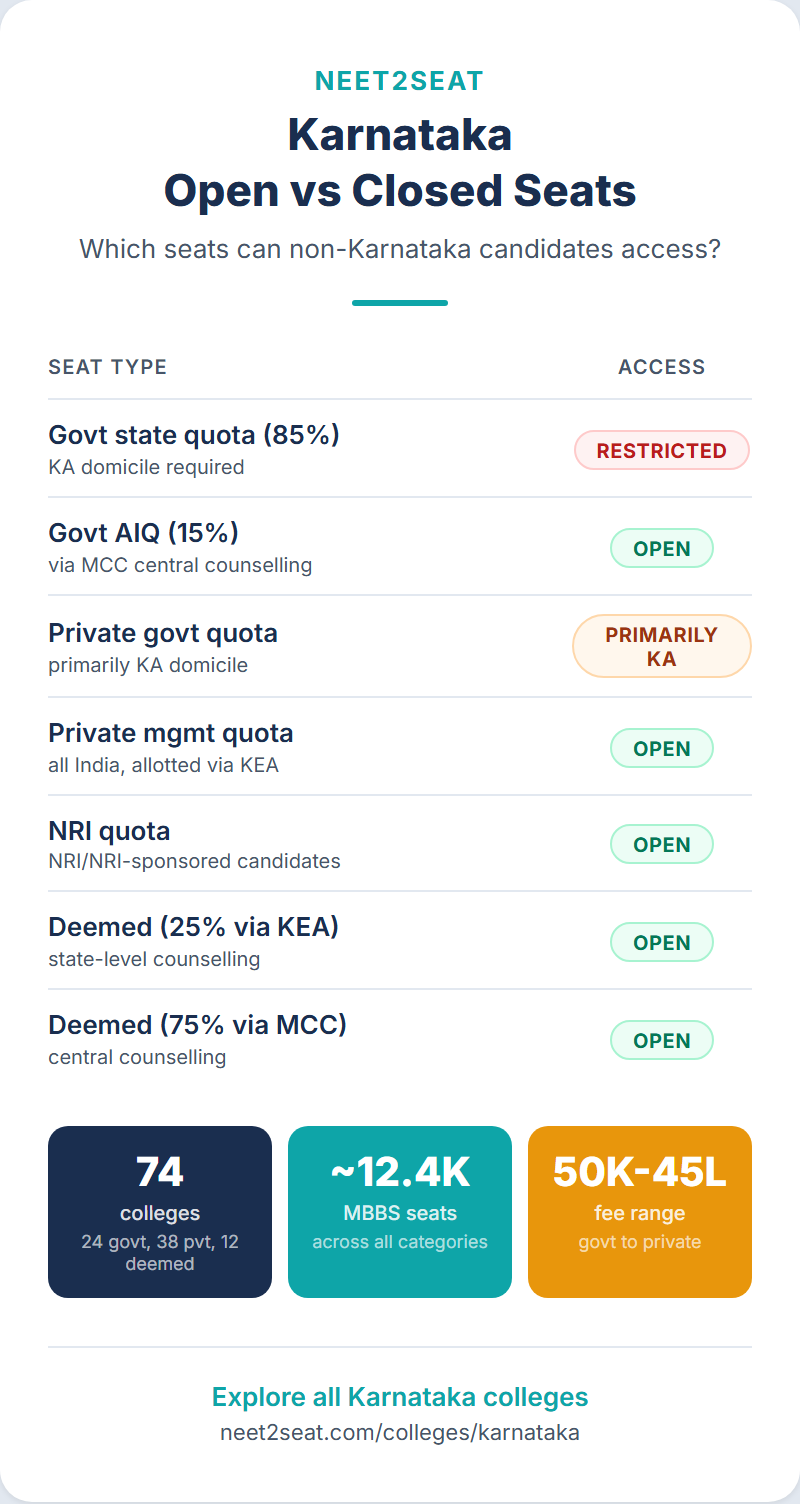
    This guide covers fee structures for all three college types in Karnataka. For college-specific cutoff data, see the Karnataka cutoff analyzer. For a full list of colleges, see our Karnataka college directory.

    • Government: Rs 50K/yr (total Rs 8-15L over 5 years) — among the lowest government medical college fees in India
    • Private government quota: Rs 8-25L/yr; management quota: Rs 25-45L/yr — a 90x gap from cheapest to most expensive
    • 2025 Choice 2 fee cap (Rs 12,001) removed the primary financial barrier to floating for government seat upgrades
    • Rs 67.5L five-year savings from government vs mid-range private represents 7.5-11 years of a junior resident’s salary

    Government medical colleges: Rs 50,000 per year

    Karnataka has 24 government medical colleges with 4,249 MBBS seats. Government college fees are set by the state government and are uniform across all institutions. Bangalore Medical College, Mysore Medical College, and the government college in Yadgiri all charge the same tuition.

    The annual tuition fee at Karnataka government medical colleges is approximately Rs 50,000. Over five years, tuition totals approximately Rs 2.5 lakh. Additional costs (hostel, mess, examination fees, books, equipment) bring the five-year total to roughly Rs 8 lakh to Rs 15 lakh, depending on the city and personal spending.

    Karnataka’s government college fees are among the lowest in India. Maharashtra charges approximately Rs 1.62 lakh per year at government colleges; Karnataka charges roughly one-third of that. For a candidate eligible for both state’s counselling, this fee difference adds up to Rs 5.6 lakh over five years in tuition alone.

    Fee concessions

    SC, ST, Category 1, and other backward class students in Karnataka may be eligible for state government scholarship programmes that reimburse tuition fees. The Department of Social Welfare and Backward Classes Welfare Department operate separate schemes with different income ceilings. At Rs 50,000 per year, the tuition amount is modest enough that several scholarship programmes cover it fully.

    At Rs 50,000/yr, Karnataka government college tuition is low enough that multiple state scholarship programmes cover it entirely. SC, ST, and Category 1 candidates should check the Social Welfare Department and Backward Classes Welfare Department websites for current eligibility and application deadlines.

    Private medical colleges: Rs 8 lakh to Rs 25 lakh per year (government quota)

    Karnataka has 38 private medical colleges with 7,045 MBBS seats. Private college fees in Karnataka are regulated by the Karnataka Private Medical Establishment Fee Committee. Fees vary significantly by institution.

    Government quota seats (filled through KEA)

    State counselling (KEA) fills government quota seats at private colleges. Approximately 40% to 50% of private college seats are government quota. The fees for these seats are regulated and range from approximately Rs 8 lakh to Rs 25 lakh per year, depending on the institution.

    Top private colleges in Bengaluru (MS Ramaiah Medical College, St. Johns Medical College, JSS Medical College, Kempegowda Institute) tend to be at the higher end (Rs 15 lakh to Rs 25 lakh per year). Private colleges in smaller cities (Bagalkot, Davangere, Tumakuru) tend to be at the lower end (Rs 8 lakh to Rs 14 lakh per year).

    Over five years, government quota at private colleges costs Rs 40 lakh to Rs 1.25 crore in tuition. With living expenses, the total ranges from Rs 50 lakh to Rs 1.4 crore.

    Private/institutional quota seats

    The remaining seats at private colleges are institutional or management quota. These seats carry higher fees, typically Rs 20 lakh to Rs 35 lakh per year. They are filled through a separate process (sometimes through KEA’s management quota round, sometimes through the college’s own admission office).

    Management quota

    Management quota fees at Karnataka private colleges range from Rs 25 lakh to Rs 45 lakh per year. These are the most expensive seats in the state. Over five years, management quota tuition alone can total Rs 1.25 crore to Rs 2.25 crore. Management quota seats are the last to be filled and are available to candidates who did not secure seats through any other pathway.

    Management quota is the last resort, not a parallel option. Exhaust all KEA rounds (R1, R2, R3, mop-up) before considering management quota. The fee difference between government quota and management quota at the same private college can exceed Rs 1 crore over five years.

    Deemed universities: Rs 10 lakh to Rs 30 lakh per year

    Karnataka has 12 deemed universities with 2,800 MBBS seats. Deemed university fees are partially regulated but tend to be higher than private college government quota fees.

    Government quota seats (filled through KEA)

    Approximately 25% of deemed university seats are government quota, filled through KEA counselling alongside regular private college government quota seats. Fees for government quota at deemed universities range from Rs 10 lakh to Rs 20 lakh per year.

    KMC Mangaluru (Manipal group) and JSS Mysuru are among the most competitive deemed university seats in Karnataka. Their government quota closing AIRs are comparable to top private colleges.

    MCC and management quota seats

    The remaining deemed university seats are filled through MCC counselling (for deemed university pool seats) or through the university’s own management/NRI quota process. These fees range from Rs 18 lakh to Rs 30 lakh per year. NRI quota fees at some institutions are denominated in USD and can exceed Rs 35 lakh per year equivalent.

    The five-year cost comparison

    College typeSeat typeAnnual fees (approx.)5-year tuition5-year total (with living)
    GovernmentState quotaRs 50,000Rs 2.5 lakhRs 8-15 lakh
    PrivateGovernment quotaRs 8-25 lakhRs 40 lakh-1.25 crRs 50 lakh-1.4 cr
    PrivateManagement quotaRs 25-45 lakhRs 1.25-2.25 crRs 1.35-2.4 cr
    DeemedGovernment quotaRs 10-20 lakhRs 50 lakh-1 crRs 60 lakh-1.15 cr
    DeemedMCC/management quotaRs 18-30 lakhRs 90 lakh-1.5 crRs 1-1.65 cr

    The 2025 Choice 2 fee cap and its financial impact

    Before 2025, a candidate allotted a private college seat at Rs 15 lakh per year through KEA had to pay the full Rs 15 lakh upfront to use Choice 2 (hold seat and seek upgrade). This meant that only candidates with Rs 15 lakh in liquid funds could float for a government upgrade.

    The 2025 rule caps the Choice 2 advance payment at Rs 12,001 for seats with fees above Rs 12 lakh. SC/ST/Category 1 candidates pay Rs 2,000. This change removed the primary financial barrier to floating. A middle-income candidate allotted a private seat can now hold it for Rs 12,001 while attempting to upgrade to a government seat at Rs 50,000 per year, potentially saving Rs 37 lakh to Rs 1.1 crore over five years depending on the private college’s fees.

    The 2025 Choice 2 fee cap is a game-changing rule. Previously, floating from a Rs 15L/yr private seat required Rs 15L upfront. Now it costs Rs 12,001. If you get a private seat in Round 1, always choose Choice 2 to attempt a government upgrade — the potential savings over five years can exceed Rs 1 crore.

    For the full Choice 2 decision framework, see our Karnataka Choice 1 vs Choice 2 guide.

    Why fee differences should dominate preference ordering

    The gap between a government seat (Rs 50,000/year) and a mid-range private seat (Rs 14 lakh/year) totals Rs 67.5 lakh over five years. To put this in perspective:

    • A junior resident in Karnataka earns approximately Rs 50,000 to Rs 75,000 per month. Rs 67.5 lakh represents 7.5 to 11 years of gross salary at that level.
    • A postgraduate (MD/MS) seat at a government college costs approximately Rs 2 lakh to Rs 5 lakh per year. The savings from a government MBBS seat would fund the entire PG education.
    • Education loan interest on Rs 67.5 lakh at 9.5% over 15 years adds approximately Rs 45 lakh in interest charges, making the effective cost difference over Rs 1.1 crore.

    All 24 government colleges, even those in smaller cities (Yadgiri, Koppal, Haveri, Chitradurga), should appear above private colleges on your preference list unless private college fees are financially inconsequential for your family. The MBBS degree from every NMC-approved college qualifies you for PG entrance exams equally. See our choice filling guide for the complete preference ordering framework.

    When building your KEA preference list, place all 24 government colleges (even in smaller cities) above all private colleges. The Rs 67.5L five-year savings from a government seat in Yadgiri vs a mid-range Bengaluru private college would fund your entire PG education and leave money to spare.

    Compulsory rural service and its financial implications

    Karnataka mandates compulsory rural service for government medical college graduates. The duration is typically one year (subject to state government orders). During rural service, the government pays a stipend. Failure to complete rural service can result in penalties, including being barred from PG admissions in the state.

    Some candidates factor rural service into their cost-benefit analysis: “If I attend a private college, I avoid rural service.” This calculation is flawed for two reasons. First, the fee savings from a government seat (Rs 35 lakh to Rs 67 lakh) far exceed any income difference during the one-year service period. Second, rural service provides clinical experience in primary healthcare that is increasingly valued in PG selections and public health careers.

    Do not choose a private college to avoid rural service. The one-year service period costs far less than the Rs 35-67L fee savings from a government seat. Rural postings also build primary care experience that strengthens PG applications in community medicine and public health tracks.

    FAQ

    Are government college fees the same across all 24 institutions?

    Yes. The state government sets a uniform fee for all government medical colleges. Bangalore Medical College in the state capital and the government college in Yadgiri (a remote district) charge the same tuition.

    Can private college fees increase during my five years?

    Yes. Private college fees are approved by the Fee Regulatory Committee, and annual increments of 5% to 10% are common. Some colleges have a fixed fee structure for the entire five-year duration (locked at admission), while others apply annual increases. Check the specific college’s fee notification before admission.

    What is the NRI quota fee at Karnataka deemed universities?

    NRI quota fees vary significantly. At top deemed universities (Manipal group, JSS), NRI fees can range from Rs 30 lakh to Rs 50 lakh per year or more. Some institutions quote fees in USD. NRI quota is the most expensive pathway to an MBBS seat in Karnataka.

    Is there a bond for government college graduates?

    Karnataka government college graduates are subject to a service bond (compulsory rural service). The duration and terms are set by state government order and can change. Currently, the requirement is approximately one year of rural service. Non-compliance penalties include bond amount payment and potential restrictions on state PG admissions.

    How do I find the exact fee for a specific college?

    Fee details are published in the KEA information bulletin and on the Fee Regulatory Committee’s website. The Karnataka college directory on our platform shows fee ranges by college. For the exact current-year fee, refer to the official KEA notification for the counselling cycle.

    What is the fees of MBBS in Bangalore?

    MBBS fees in Bangalore depend entirely on the college type. The three government colleges (BMCRI, KIMS, ESIC) charge approximately Rs 50,000 per year. Private colleges in Bangalore range from Rs 8 lakh to Rs 25 lakh per year for government quota seats. Private management quota fees can reach Rs 45 lakh per year. Deemed universities (like MS Ramaiah) fall in the Rs 10 lakh to Rs 30 lakh per year range. The cheapest MBBS option in Bangalore is a government college seat at Rs 50,000/year; the most expensive exceeds Rs 2 crore over five years.

  • NEET counselling FAQ: 25 answers for Maharashtra and Karnataka candidates

    Answers to the 25 questions candidates ask most about NEET counselling

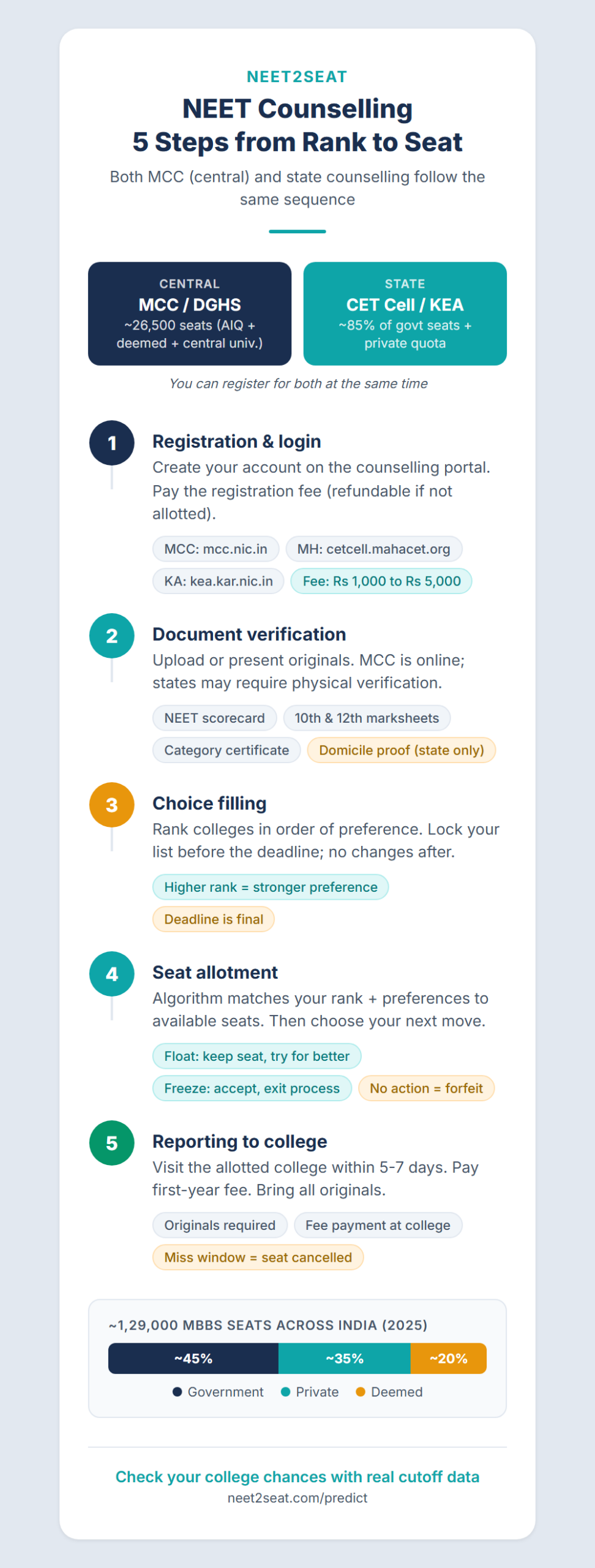
    This NEET counselling FAQ collects the 25 most frequently asked questions about NEET-UG medical college counselling in Maharashtra and Karnataka. Each answer is sourced from official counselling processes and our analysis of 407,000+ allotment records across 2023-2025. For detailed coverage of any topic, follow the linked guides.

    Infographic with NEET counselling frequently asked questions
    • Participate in both MCC and state counselling simultaneously; choose one seat at the deadline
    • List as many preferences as possible — there is no penalty, and extras are invisible safety nets
    • Round 1 exit is free in both states; only list colleges you would attend in later binding rounds
    • Government colleges (any city) should rank above private colleges unless fees are financially immaterial

    General counselling questions

    What is the difference between AIQ (All India Quota) and state quota?

    15% of government medical college MBBS seats across India are pooled into the All India Quota, managed by MCC (Medical Counselling Committee). The remaining 85% are filled through state counselling authorities. In Maharashtra, CET Cell manages state quota. In Karnataka, KEA manages state quota. You can participate in both AIQ and state counselling simultaneously, but you must eventually hold only one seat. See our AIQ vs state quota guide for the full comparison.

    Can I participate in both MCC and state counselling?

    Yes. Registration and choice filling for MCC and state counselling are separate processes. You can fill preferences in both tracks. If allotted in both, you must choose one and surrender the other before the specified deadline. Holding two seats simultaneously beyond the deadline is not permitted and can result in cancellation of both seats.

    What documents do I need for counselling?

    The standard set includes: NEET-UG admit card and scorecard, Class 10 and 12 mark sheets and certificates, domicile certificate (for state quota eligibility), category/caste certificate (if applicable), income certificate (for fee concessions), transfer certificate, passport-size photographs, Aadhaar card, and medical fitness certificate. Maharashtra and Karnataka each have specific additional requirements. See our documents guide for the complete list by state.

    What happens if I miss the choice-filling deadline?

    If you do not submit and lock your preference list before the deadline, the system may auto-lock the last saved version (in some counselling tracks) or you may be treated as having not participated in that round. Neither outcome is desirable. Always lock your preferences manually well before the deadline. Do not rely on auto-lock.

    Never rely on auto-lock. Lock your preference list manually at least 2-3 hours before the deadline. State counselling portals experience heavy traffic in the final hours, and a technical issue during auto-lock could leave your list in an unintended state.

    Is the counselling portal available 24/7 during the choice-filling window?

    Technically yes, but state counselling portals (both CET Cell and KEA) have experienced performance issues during peak hours, especially in the final 24 hours before deadlines. Access the portal during off-peak hours (early morning or late night) for a smoother experience. Prepare your preference list offline first, then enter it on the portal.

    Preference filling questions

    Does listing a less competitive college first reduce my chances at a better college?

    No. The allotment algorithm processes your list from top to bottom and assigns you the highest-ranked choice where your AIR qualifies. If you list College A (less competitive) at position 1 and College B (more competitive) at position 2, the algorithm checks College A first. If your AIR qualifies for College A and a seat is available, you get it. But if College B had a vacancy and your AIR also qualified, you would have gotten College B if you had ranked it higher. The algorithm never penalises you for what is listed below your allotment. See our choice filling strategy guide.

    The algorithm processes your list top to bottom and stops at the first match. It never penalises you for what is listed below your allotment. This means listing extra colleges at the bottom can only help (as safety nets), never hurt. The only ordering that matters is: put more-preferred colleges higher.

    How many preferences should I fill?

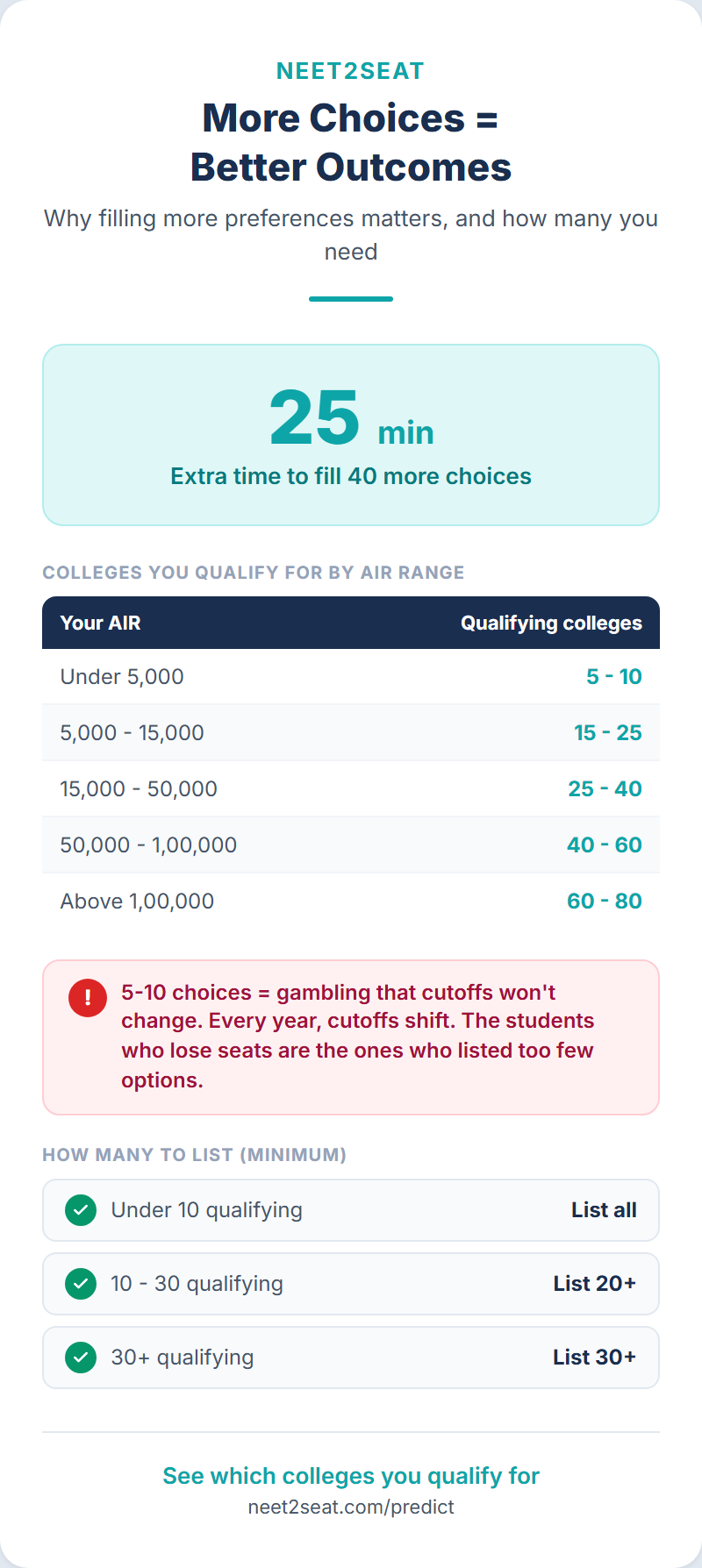
    As many as possible. There is no penalty for filling additional choices. If you qualify for 40 colleges, list all 40. The downside risk of too few choices (no allotment in a round) far outweighs the time cost of filling more choices (approximately 20 extra minutes for 40 additional entries). See our guide on how many choices to fill.

    Spend the extra 20 minutes to list every college where your AIR qualifies. The worst outcome of listing too many is nothing (the extras are never reached). The worst outcome of listing too few is no allotment at all. The asymmetry makes maximal listing a clear win.

    Should I list colleges I do not want to attend?

    In Round 1, where exit is free, yes. Listing a college does not commit you to attending it. If allotted a college you do not want in Round 1, simply do not report, and your deposit is refunded. In later rounds where allotments may be binding, only list colleges you would genuinely attend.

    Can I change my preference list after locking it?

    No. Once locked, the list is final for that round. In Maharashtra, you get a fresh preference-filling window in each round, so Round 2 preferences are independent of Round 1. In Karnataka, the list carries forward (with limited modification in some years). Always review your list carefully before locking.

    Should I list government colleges in small cities above private colleges in Mumbai or Bengaluru?

    For most candidates, yes. Government college fees (Rs 50,000/year in Karnataka; Rs 1.62 lakh/year in Maharashtra) are a fraction of private college fees (Rs 8 lakh to Rs 25 lakh/year). Over five years, the savings can exceed Rs 50 lakh. The MBBS degree is equivalent regardless of college location. Unless private college fees are financially immaterial to your family, government colleges should come first on your list. See Maharashtra fees and Karnataka fees guides.

    Order your preference list with all government colleges (any city) above all private colleges. The fee savings over five years can exceed Rs 50 lakh, and the MBBS degree is equivalent for PG entrance eligibility regardless of college location or tier.

    Round and allotment questions

    What is “free exit” and when is it available?

    Free exit means you can decline a Round 1 allotment without financial penalty. Your counselling deposit is refunded, and you re-enter Round 2 as a fresh candidate. Free exit is available in Round 1 of both MCC and state counselling. Later rounds may have financial penalties for non-reporting or cancellation.

    What is the difference between float and freeze?

    Float (MCC terminology) means you keep your current seat while seeking an upgrade in the next round. Freeze means you accept the seat and exit counselling. Maharashtra calls floating “Status Retention.” Karnataka calls it “Choice 2.” The mechanics differ slightly by state, but the core concept is the same: float to try for better, freeze to accept what you have. See our float vs freeze guide.

    Do Round 2 cutoffs always ease compared to Round 1?

    In most cases, yes. Round 2 closing AIRs are typically 15% to 25% higher (less competitive) than Round 1 at mid-tier government colleges, due to the candidate pool shrinking and seats being freed up. However, 5% to 10% of colleges may see tighter Round 2 cutoffs due to seat additions, cross-counselling timing, or other structural factors. See our Round 2 cutoff changes guide.

    What happens if I am not allotted in any round?

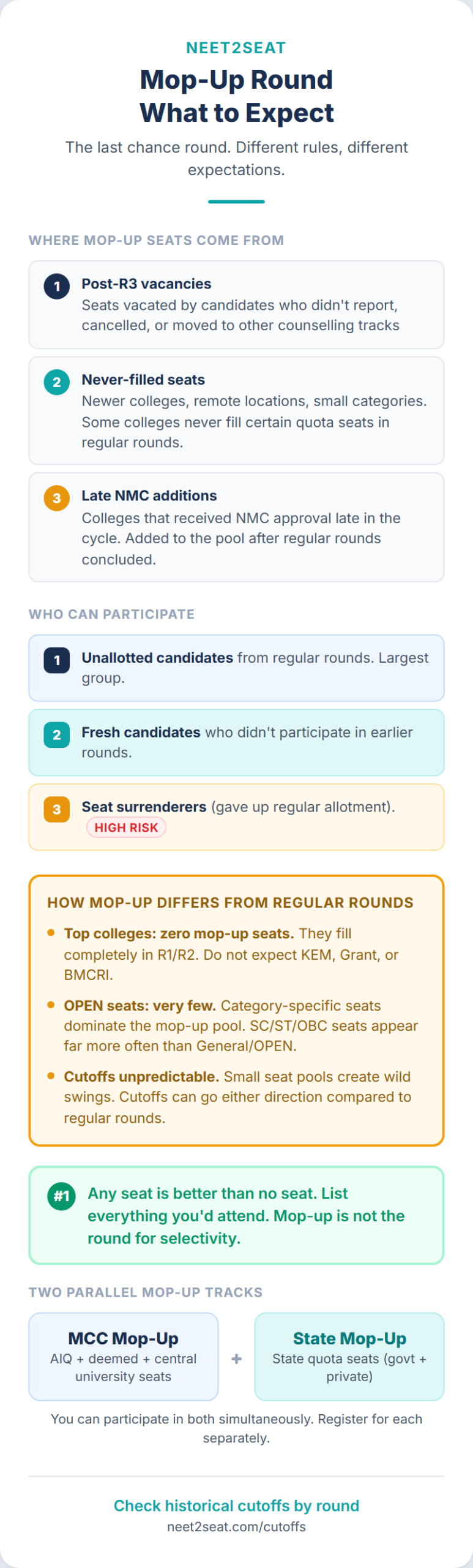
    If regular rounds (1, 2, 3) do not produce an allotment, you can participate in the mop-up/stray vacancy round. If the mop-up round also does not yield a seat, your remaining options are management quota at private colleges (expensive), NRI quota (if eligible), or preparing for the next year’s NEET. See our mop-up round guide.

    Maharashtra-specific questions

    What is Status Retention in Maharashtra?

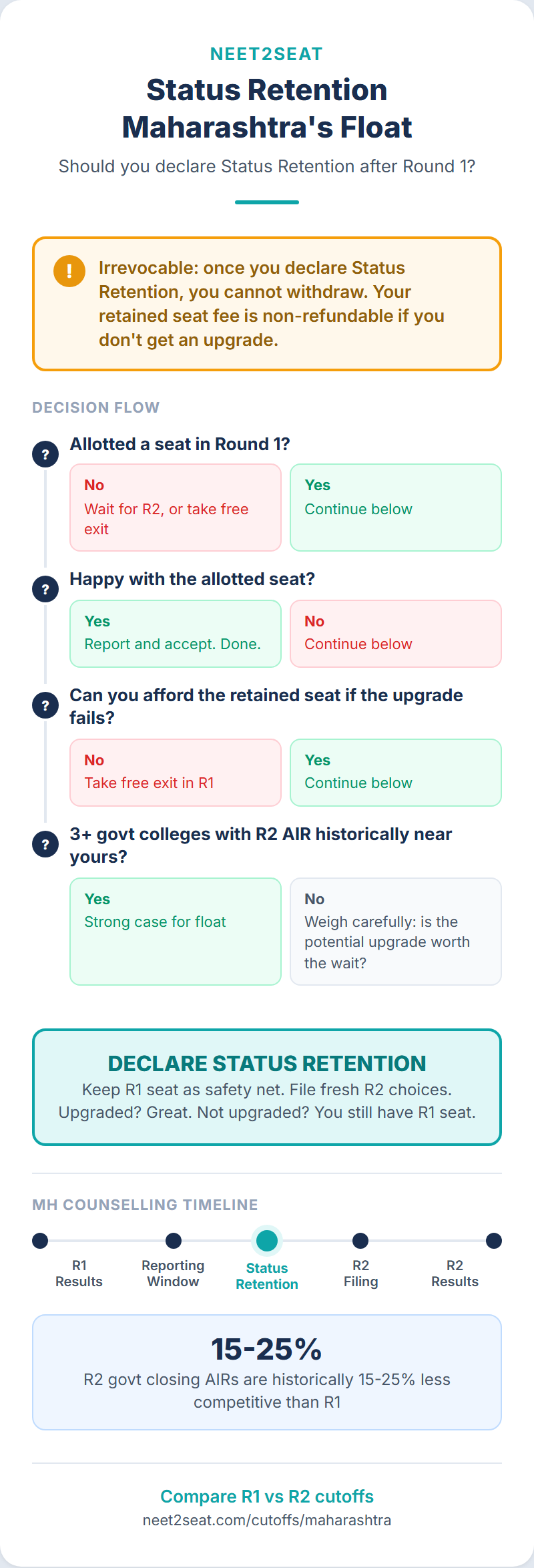
    Status Retention is Maharashtra’s mechanism for keeping your Round 1 seat while seeking a Round 2 upgrade. It is irrevocable: once declared, you cannot withdraw from the retained seat. If upgraded in Round 2, you move to the new college. If not upgraded, you must report to the original college. See our Status Retention guide.

    How many categories does Maharashtra have?

    Maharashtra uses 41 distinct category codes in its counselling process. These are compound categories combining constitutional reservations (OPEN, OBC, SC, ST, VJ, NTB, NTC, NTD, SEBC, EWS) with horizontal reservations (Female W, Defence DEF, PWD PH, Minority MN, Orphan ORP). For example, OPENW is Open + Female; SCDEF is SC + Defence. See our Maharashtra categories guide.

    Can I fill a completely new preference list in Round 2?

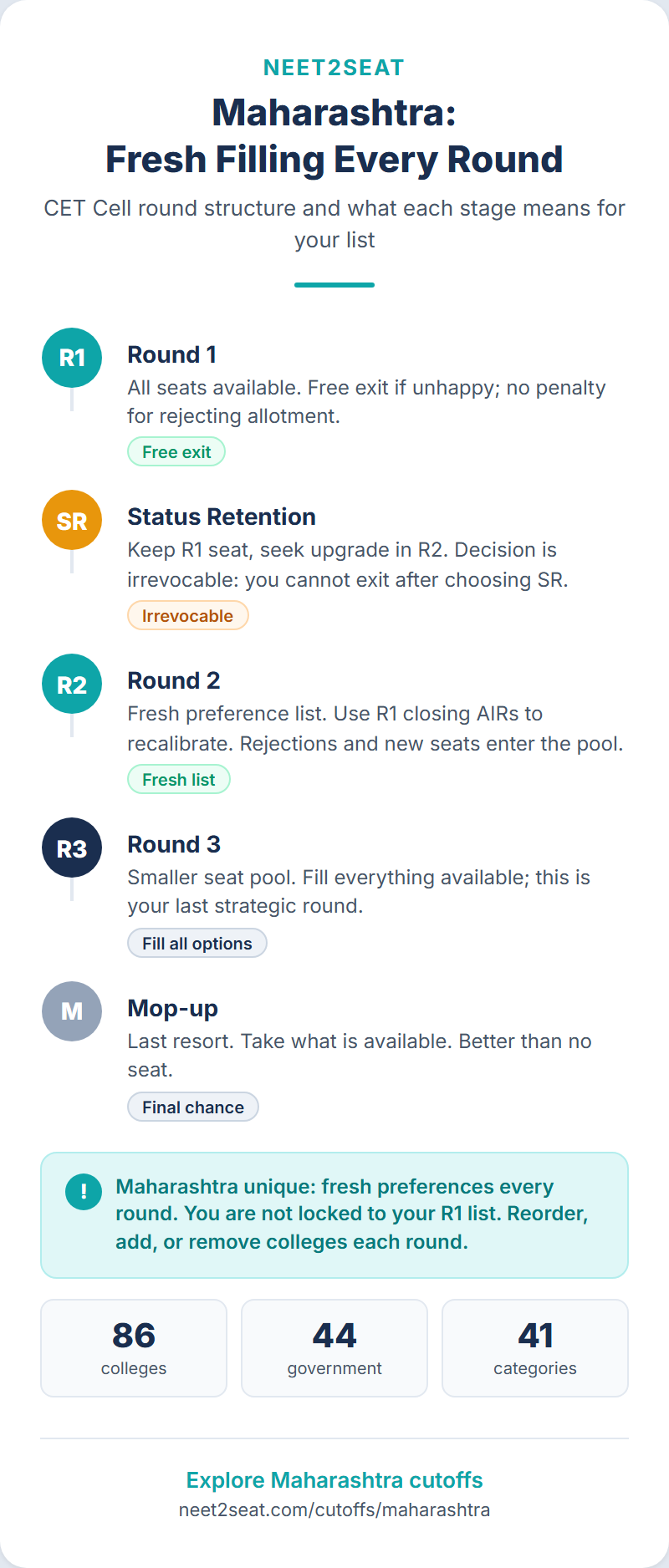
    Yes. Maharashtra allows fresh preference filling in every round. Your Round 2 list is completely independent of Round 1. You can add new colleges, remove old ones, and reorder everything based on Round 1 closing AIR data. See our Maharashtra choice filling guide.

    Karnataka-specific questions

    What are Choice 1, Choice 2, and Choice 3 in Karnataka?

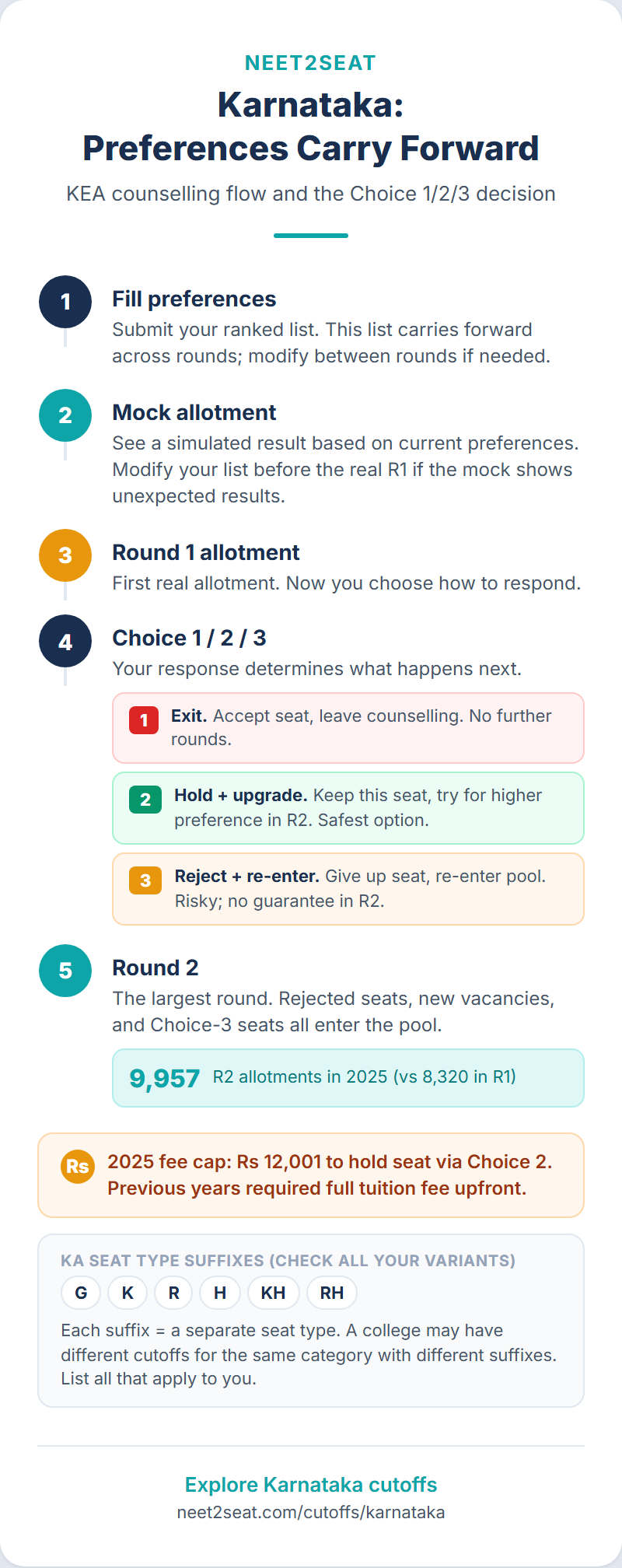
    After each round’s allotment, Karnataka candidates choose: Choice 1 (accept seat, exit counselling), Choice 2 (accept seat, seek upgrade in next round), or Choice 3 (reject seat, re-enter pool with no guarantee). Choice 2 is the safe upgrade path. Choice 3 risks ending up with no seat. See our Choice 1 vs Choice 2 guide.

    Does my preference list carry forward in Karnataka?

    Yes. Unlike Maharashtra (where you fill fresh preferences each round), Karnataka’s KEA carries your initial preference list forward across rounds. If you choose Choice 2, the algorithm checks colleges ranked above your current allotment on that original list. This makes getting the initial order right more critical in Karnataka. See our Karnataka choice filling guide.

    What is the suffix system in Karnataka categories?

    Karnataka adds suffixes to base categories: G (general merit), K (Kannada medium schooling), R (Rural), H (Hyderabad-Karnataka region). Combinations include KH and RH. A candidate might qualify for 2AG, 2AK, 2AR, and 2AH depending on their schooling, location, and region. Each suffix has separate cutoffs at each college. See our Karnataka categories guide.

    What is the mock allotment in Karnataka?

    KEA publishes a mock allotment before the final Round 1 allotment. This preview shows where you would be allotted based on current preferences and the seat matrix. After seeing the mock results, you can modify your preference list before the final lock. This is a significant advantage: it lets you test your preferences against real data before the results are binding. See our KEA counselling guide.

    Using neet2seat questions

    What data does neet2seat use?

    All predictions and cutoff data come from official allotment PDFs published by CET Cell (Maharashtra) and KEA (Karnataka). The database contains 407,658 records across 2023, 2024, and 2025 for both states. We do not use self-reported data, surveys, or social media sources. See our methodology guide.

    How do I use the cutoff analyzer?

    Go to the cutoff analyzer. Select your state, then filter by year, round, category, and optionally by college name. The results show closing AIRs (the last rank allotted) for each college-category combination. You can view results grouped by college to see multi-year trends at a glance. See our cutoff analyzer tutorial.

    How does the college predictor classify colleges as Safe, Target, or Reach?

    The college predictor compares your AIR against historical closing AIRs at each college for your category. Safe means your AIR has been below (better than) the closing AIR in all recent years. Target means your AIR falls near the historical range (sometimes in, sometimes out). Reach means your AIR has been above (worse than) the closing AIR in all years. See our predictor tutorial.

    Can I build my preference list on neet2seat?

    Yes. The choice filling optimizer lets you build and order your preference list using drag-and-drop. It shows historical cutoff data alongside each college to help you make informed ordering decisions. You can export the final list and enter it on the official counselling portal.

    Is 550 a good score in NEET for OBC?

    550 marks in NEET typically corresponds to an AIR in the 30,000 to 60,000 range (depending on the year). For OBC candidates in Maharashtra, this AIR range puts multiple government colleges in the Target zone; in Karnataka, OBC (Category 2A/2B/3A/3B) candidates at this range have even more government options available because reserved category cutoffs are less competitive. Use the college predictor with your exact AIR, state, and category to see your specific Safe, Target, and Reach colleges.

    What NEET cutoff is required for OBC category?

    The NEET qualifying cutoff (minimum marks to be eligible for counselling) is set by NTA and varies by year; for OBC-NCL candidates, it has historically been around the 40th percentile (approximately 115-120 marks out of 720). But qualifying is not the same as getting a seat. For an actual government college MBBS seat, OBC candidates in Maharashtra typically need AIRs below 2,00,000 (marks above 350-400). In Karnataka, OBC categories like 2A can access government colleges at even higher AIRs Check the cutoff analyzer filtered by your category for specific college-level data.

  • Best medical colleges in Mumbai with NEET cutoff

    16 medical colleges in one city: Mumbai has the densest medical education ecosystem in India

    Mumbai and Navi Mumbai together house the best medical colleges in Mumbai with approximately 2,700 MBBS seats across 16 institutions. The breakdown: 9 government colleges (approximately 1,400 seats), 2 private colleges, and 5 deemed universities. No other Indian city comes close to this concentration. This guide covers NEET cutoff data, fees, and what distinguishes each Mumbai medical college.

    Infographic showing medical colleges in Mumbai

    For most Maharashtra candidates, the top portion of their preference list is dominated by Mumbai colleges. Understanding which institutions are here, how competitive they are, and what distinguishes them helps you order those top choices correctly.

    This guide covers Mumbai specifically. For the statewide picture, see our Maharashtra medical colleges overview. For cutoff data, use the Maharashtra cutoff analyzer.

    • 16 colleges (9 government, 2 private, 5 deemed) with ~2,700 MBBS seats in Mumbai and Navi Mumbai
    • AIR under 20,000 gives access to multiple government colleges; AIR 20,000-50,000 gives 1-3 realistic options
    • Government college total annual cost (tuition + hostel + living) is approximately Rs 2.5-3 lakh
    • Always list safety colleges outside Mumbai — a government seat in another city at Rs 1.62L/yr beats no seat at all

    Government medical colleges in Mumbai

    Mumbai’s 9 government medical colleges form the backbone of Maharashtra’s state healthcare system. They are affiliated with the city’s largest public hospitals, providing clinical exposure that few other cities can match.

    The established four

    Seth GS Medical College (affiliated with KEM Hospital, Parel): One of India’s oldest and most competitive medical colleges. 250 seats. Consistently among the top 2 to 3 most competitive government colleges in Maharashtra. KEM Hospital is a 1,800-bed tertiary care centre with nearly every medical and surgical speciality.

    Grant Medical College (affiliated with JJ Hospital, Byculla): Another heritage institution, established in 1845. 250 seats. JJ Hospital is a major trauma centre and one of Mumbai’s busiest public hospitals. Closing AIR is consistently competitive, typically in the top 5 government colleges statewide.

    Topiwala National Medical College (affiliated with BYL Nair Hospital, Mumbai Central): 200 seats. Nair Hospital is centrally located and handles high patient volumes. Slightly less competitive than Seth GS and Grant but still among the top Mumbai colleges.

    LTMMC (Lokmanya Tilak Municipal Medical College, affiliated with Sion Hospital): 200 seats. Sion Hospital serves the eastern suburbs and handles significant trauma caseload. Competitive within the Mumbai cluster.

    Mumbai’s four established government colleges (Seth GS, Grant, Topiwala, LTMMC) are affiliated with hospitals that collectively see over 10,000 outpatients daily. This clinical volume translates directly into hands-on training that few other Indian cities can match at the MBBS level.

    The ESIC and newer institutions

    ESIC Medical College Andheri: Operated under the central government’s ESIC (Employees’ State Insurance Corporation) scheme. 50 seats (expanding). In 2025, it had the most competitive OPEN closing AIR among all Maharashtra government colleges at AIR 12,566. The small seat count and central government affiliation create distinct dynamics.

    ESIC Andheri’s AIR 12,566 closing rank is driven by its small seat count (50 seats), not necessarily by institutional superiority. When comparing colleges, look at hospital bed strength and department coverage alongside closing AIRs

    Gokuldas Tejpal Medical College: A newer/revived institution. Data availability may be limited for recent years. Check the current year’s CET Cell seat matrix for exact seat count and participation.

    Additional government medical colleges in the Mumbai metropolitan area include institutions in Thane and other suburban areas. Check the college directory for the current list.

    How competitive are Mumbai government colleges?

    From our 2025 data, Mumbai government colleges close at OPEN category AIRs ranging from approximately 12,566 (ESIC Andheri) to approximately 50,000 for the four established colleges (Seth GS, Grant, Topiwala, LTMMC). When you include reserved category allotments, closing AIRs extend well above 1,00,000 at some institutions. The OPEN category range at the established four typically falls between AIR 15,000 and 50,000, with variation across rounds and years.

    For candidates with AIR under 20,000, multiple Mumbai government colleges are within reach. For candidates with AIR 20,000 to 50,000, 1 to 3 Mumbai government colleges are realistic targets. For candidates above AIR 50,000, Mumbai government colleges are mostly in the Reach zone.

    A candidate with AIR 35,000 (OPEN) might find 1 Mumbai government college as Target and 2-3 as Reach. At this AIR, listing 5+ government colleges outside Mumbai (Nagpur, Aurangabad, Solapur) as Safe options provides a guaranteed government seat if Mumbai does not work out.

    Private medical colleges in Mumbai

    Mumbai has fewer private medical colleges than government ones. The main institutions:

    KJ Somaiya Medical College, Sion: One of Mumbai’s most competitive private colleges, closing at approximately AIR 38,067 for OPEN category in 2025. KJ Somaiya has a well-established hospital and research programme. State quota fees are in the Rs 10 lakh to Rs 15 lakh per year range.

    Other private colleges in the Mumbai metropolitan area fill at higher AIRs, providing options for candidates in the 40,000 to 2,00,000+ AIR range.

    Deemed universities in Navi Mumbai

    Five of Maharashtra’s 16 deemed universities are located in Navi Mumbai, making it a deemed university hub:

    • DY Patil Medical College (multiple campuses in Navi Mumbai): The DY Patil group operates several medical college campuses. Each has its own fee structure and seat count.
    • MGM Medical College, Navi Mumbai: Part of the MGM group of institutions.
    • Terna Medical College, Navi Mumbai.

    Deemed universities in Navi Mumbai typically do not appear in CET Cell’s state counselling allotment data for the OPEN category in the way government colleges do. Their seats are primarily filled through MCC’s deemed university pool or the university’s own admission process. Government quota portions (filled through CET Cell) represent a smaller share.

    If you are targeting Navi Mumbai deemed universities, check both CET Cell and MCC counselling schedules. The cutoffs and fee structures differ between the two tracks.

    Living costs in Mumbai

    Mumbai is the most expensive city in Maharashtra for medical students. Monthly living costs (excluding tuition):

    • Hostel: Government college hostels charge Rs 1,000 to Rs 3,000 per month. Private hostel/PG accommodation near medical colleges ranges from Rs 8,000 to Rs 20,000 per month.
    • Mess/food: Rs 3,000 to Rs 6,000 per month.
    • Transport: Mumbai’s suburban railway system is cheap (monthly pass under Rs 1,000), but commuting from distant locations adds 2 to 3 hours per day.
    • Books, equipment, miscellaneous: Rs 2,000 to Rs 5,000 per month.

    Total monthly living cost: Rs 6,000 to Rs 15,000 at a government college with hostel; Rs 15,000 to Rs 35,000 if living off-campus. Over five years, living costs alone add Rs 3.6 lakh to Rs 21 lakh to the tuition cost.

    Compare with cities like Latur or Nanded, where monthly living costs are Rs 4,000 to Rs 8,000 total. The living cost difference partially offsets Mumbai’s infrastructure advantage.

    Factor total cost (tuition + living + transport), not just tuition, when comparing Mumbai with smaller cities. A government college in Mumbai costs Rs 2.5-3L/yr total. A government college in Latur costs Rs 2-2.5L/yr total. The gap narrows for government seats, but widens dramatically for private colleges.

    Why candidates prioritise Mumbai (and when they should not)

    Mumbai attracts candidates for legitimate reasons: high patient volumes, exposure to rare cases, access to research institutions (TIFR, ACTREC, Haffkine Institute), and proximity to PG entrance exam preparation resources.

    The mistake is prioritising Mumbai at the expense of guaranteed allotment. A candidate with AIR 45,000 who lists only 4 Mumbai government colleges (all in the Target/Reach zone) and no colleges from other cities may end up with no allotment in Round 1. Adding government colleges in Aurangabad, Solapur, and Nagpur at positions 5 through 15 provides a safety net at the same Rs 1.62 lakh/year fee.

    The MBBS degree from any government medical college is equivalent for PG entrance eligibility. Mumbai’s advantages are real but not irreplaceable. A seat in Nagpur at Rs 1.62 lakh/year is objectively better than no seat at all.

    After listing your preferred Mumbai colleges, add at least 10-15 government colleges from other Maharashtra cities as safety options. Sort them by your location preference within that tier. In Round 1, these extras cost nothing to list and prevent the worst outcome: no allotment at all.

    FAQ

    How many medical colleges are in Mumbai?

    16 total across Mumbai and Navi Mumbai: 9 government, 2 private, 5 deemed universities. Approximately 2,700 MBBS seats combined.

    Which Mumbai medical college is the most competitive?

    ESIC Medical College Andheri had the lowest OPEN closing AIR in 2025 (AIR 12,566), though with only 50 seats. Among traditional government colleges, Seth GS (KEM) and Grant (JJ) are consistently the most competitive.

    Can I afford to study in Mumbai on a government college budget?

    Yes. Government college tuition is Rs 1.62 lakh/year. With government hostel and mess, total annual cost is approximately Rs 2.5 lakh to Rs 3 lakh. This is affordable for most families. The challenge is getting allotted, not affording it.

    Are Navi Mumbai deemed universities in CET Cell counselling?

    Partially. A portion of their seats (government quota) may appear in CET Cell counselling. The majority of deemed university seats are filled through MCC or the university’s own process. Check both tracks if targeting these institutions.

    Which government college is best for MBBS in Mumbai?

    Seth GS Medical College (KEM Hospital) and Grant Medical College (JJ Hospital) are consistently the two most competitive government colleges in Mumbai, with OPEN closing AIRs typically below 15,000. Both have large teaching hospitals (1,800+ beds at KEM, 1,300+ at JJ), full-spectrum clinical departments, and long institutional histories. The choice between them comes down to location preference and marginally different clinical volumes. Check the cutoff analyzer to compare their closing AIRs across years and categories.

  • NEET choice filling strategy: how to order your preference list

    • The allotment algorithm processes your list top to bottom; listing a competitive college higher never reduces your chances at colleges below it.
    • Use the Reach-Target-Safe framework: top 20% aspirational, middle 40% realistic, bottom 40% safety net.
    • Fill as many choices as possible. There is no penalty for additional entries, and every unfilled slot is a missed safety net.
    • Round 1 exit is free in all counselling tracks, so list aggressively in the first round.

    Choice filling is where most candidates lose seats they could have won

    Your NEET choice filling strategy determines your outcome more than almost any other variable you control. The seat allotment algorithm is mechanical: it takes your NEET All India Rank, your locked preference list, the available seats, and your category eligibility, then assigns you the highest-ranked choice where your AIR meets the threshold. The algorithm does not know which college you “really” want. It only sees the order you gave it.

    Infographic showing NEET choice filling strategy

    A badly ordered preference list can put you in a college you ranked 15th when your AIR qualifies for one you ranked 12th. It can cost you a government seat and land you in a private college that charges Rs 15 lakh more per year. Over five years of MBBS, a preference ordering mistake translates directly into lakhs of rupees and years of regret.

    This guide covers the structural principles behind preference ordering: how the algorithm processes your list, what the common mistakes are, and how to build a list that maximizes your chances. For state-specific guidance, see our Maharashtra choice filling guide and our Karnataka choice filling guide.

    How the allotment algorithm works

    Both MCC and state counselling authorities use a variant of the Gale-Shapley algorithm (also called deferred acceptance). The properties that matter:

    1. Your list is processed top to bottom. The algorithm checks your first choice first. If your AIR qualifies and a seat is available, you get it. If not, it moves to your second choice. Then third. And so on until either you are allotted a seat or your entire list is exhausted.
    2. Higher-ranked candidates are processed first. A candidate with AIR 5,000 has their full preference list processed before a candidate with AIR 5,001. If both want the same seat, the higher-ranked candidate gets it.
    3. The order of your list cannot hurt you. Listing a more competitive college at position 1 does not reduce your chances at the college you listed at position 5. If you do not get choice 1, the algorithm simply moves to choice 2 as if choice 1 never existed. This is the most misunderstood property of the algorithm.

    Because of property 3, there is no strategic reason to put a “safer” college higher in your list. You should always list colleges in your genuine order of preference, most desired first. The algorithm guarantees this is optimal.

    The three-tier framework

    Divide your list into three sections:

    Top tier: Reach colleges (positions 1 through ~20%)

    These are colleges where your AIR is above (worse than) the historical closing rank. You would not get in based on past data, but cutoffs shift every year. Listing them costs nothing. If cutoffs ease in your favour, you get a seat you would have missed entirely. If they do not, the algorithm moves down your list without penalty.

    Use the college predictor to identify which colleges are classified as Reach for your AIR and category. Start your list with all Reach colleges, ordered by genuine preference.

    Middle tier: Target colleges (positions ~20% through ~60%)

    These are colleges where your AIR falls near the historical closing range. In some past years you would have made the cut; in others you would not. This is where ordering matters most: among colleges where your chances are uncertain, the one you want more should come first.

    Within the Target tier, order by genuine preference: academic reputation, location, fees, infrastructure, or whatever factors matter to you. Do not order by “likelihood of getting in.” That calculation is already embedded in the algorithm; your job is to express preference, not predict probability.

    Bottom tier: Safe colleges (positions ~60% through 100%)

    These are colleges where your AIR has been comfortably within the closing rank in recent years. These are your safety net. You should list enough Safe colleges to ensure you get allotted something, even in a worst-case scenario where cutoffs tighten across the board.

    Within the Safe tier, order by preference. Even though you are likely to get any of these, you want the algorithm to assign you the best one first.

    How many choices to fill

    More is better. There is no penalty for filling additional choices. If you qualify for 40 colleges, list all 40. If you qualify for 80, list all 80. Every unfilled choice is a missed opportunity if cutoffs shift unexpectedly.

    Some candidates fill only 5 to 10 choices, reasoning that they only want those specific colleges. This works if their AIR comfortably clears all 10. It fails spectacularly if cutoffs tighten and none of the 10 are available. The candidate ends up with no allotment in that round.

    The time cost of filling 50 choices vs 10 choices is about 20 extra minutes. The downside risk of having too few choices is potentially catastrophic. Fill more. For a detailed analysis of optimal list length, see our guide on how many choices to fill.

    Government vs private: the fee multiplier

    At government colleges in Maharashtra, MBBS costs approximately Rs 1.62 lakh per year (tuition plus development fee). At private colleges, it ranges from Rs 5 lakh to Rs 25 lakh per year. Over five years, the difference between a government seat and a mid-range private seat can exceed Rs 50 lakh.

    A common mistake: candidates list a well-known private college above a mid-tier government college because the private college “feels” better. They get allotted the private seat, spend Rs 60 lakh more over five years, and end up with the same MBBS degree. Unless your family’s financial situation makes the fee difference irrelevant, government colleges should rank above private colleges of similar academic standing.

    Location considerations

    Location affects your medical education in ways beyond convenience. Colleges in metropolitan areas (Mumbai, Pune, Bengaluru) typically have higher patient volumes, more clinical exposure in specialized departments, and better access to research opportunities and postgraduate preparation resources. Colleges in smaller cities may have lower living costs and less competition for clinical rotations.

    If you plan to practice in a specific region after MBBS, attending a college there builds local professional networks that matter for internship and residency placements. This is particularly relevant in Karnataka, where compulsory rural service after MBBS is mandated by state law.

    Category-specific ordering

    Your preference list should be built for your specific category, not the general pool. If you are an SC candidate in Maharashtra, the cutoffs relevant to you are SC cutoffs, not OPEN cutoffs. A college that is Reach for OPEN might be Safe for SC. Use the cutoff analyzer to check historical closing AIRs for your exact category at each college.

    If you are eligible for multiple categories (for example, both OBC and OPEN in Maharashtra), model both scenarios using the cutoff analyzer. Some colleges may be reachable under your reserved category but not under OPEN.

    Round-specific strategy

    Round 1: fill aggressively

    In both MCC and state counselling, Round 1 offers a free exit: if you receive an allotment you do not want, you simply do not report. Your deposit is refunded, and you remain eligible for Round 2. This means Round 1 carries no downside risk.

    Fill your Round 1 list as ambitiously as possible. Include Reach colleges you would not normally bet on. The worst outcome is you get nothing and enter Round 2 in the same position. The best outcome is you lock a seat that opens up from an unexpected shift in preferences.

    Round 2: adjust based on Round 1 data

    After Round 1, you have concrete information: which colleges were allotted in Round 1, at what closing AIRs, and how many seats were vacated by candidates who took free exit. Use this data to refine your Round 2 preferences.

    If a college’s Round 1 closing AIR was 20,000 and your AIR is 22,000, that college moves from Reach to Target for Round 2, because Round 2 closing AIRs are typically higher (less competitive) than Round 1 as more seats become available from exits and upgrades.

    Round 3 and mop-up: take what you can get

    By Round 3, the seat pool is small and the choices are limited. If you are still in the pool at this stage, your priority should be ensuring you get any medical seat rather than optimizing for the perfect one. Fill every available option.

    Using our tools for preference ordering

    The recommended workflow:

    1. Run the college predictor with your AIR, state, and category. This gives you the Safe/Target/Reach classification for every college.
    2. Check individual college cutoffs using the cutoff analyzer. For each Target college, look at the year-to-year variation in closing AIR. Colleges with volatile cutoffs are higher-risk (could swing either way). Colleges with stable cutoffs are more predictable.
    3. Build your preference list in the choice filling optimizer. Drag and drop colleges into your preferred order, using the Reach-Target-Safe framework. The optimizer shows historical cutoff data alongside each college to help you make informed ordering decisions.

    What the data says about preference behaviour

    From our analysis of 407,000+ allotment records across Maharashtra and Karnataka (2023-2025), several patterns emerge:

    Government college cutoffs cluster tightly at the top. In Maharashtra 2025, the top 5 government colleges had OPEN closing AIRs between 2,571 and 11,360 (Round 2). That is a relatively narrow band for the most competitive seats in the state. A candidate with AIR 8,000 has a reasonable shot at multiple top-5 colleges, making preference order among them the deciding factor.

    Private college cutoffs have a wider spread. The closing AIR range at private colleges extends from under 50,000 to over 5,00,000 depending on the institution and seat type. This means the Target zone for private colleges is broader, giving you more colleges to rank in your middle tier.

    Cutoffs tighten year over year at top colleges. The top government colleges in both Maharashtra and Karnataka showed a 25% to 63% drop in closing AIRs from 2023 to 2025. If you are using last year’s cutoffs to judge your NEET 2026 chances, build in a safety margin: this year’s cutoffs may be tighter still.

    FAQ

    Does the order of my preference list affect my chances at any specific college?

    No. Whether you list a college at position 1 or position 50, the algorithm checks whether your AIR qualifies for that college when it reaches that position on your list. Listing a college higher does not increase your chances of getting it. It only means the algorithm checks it earlier.

    Should I list only colleges I would actually attend?

    Yes and no. In Round 1, where exit is free, list broadly because there is no commitment. In later rounds where the allotment may be binding or involve deposit forfeiture, only list colleges you would genuinely attend. Getting allotted a college you do not want in Round 3 creates a painful choice between accepting an unwanted seat or forfeiting your deposit.

    How do I handle colleges where I have no historical data?

    New colleges or colleges with very recent NMC approval may not have historical cutoff data. Place them in the Target or Safe zone of your list based on their location, fee structure, and management type (government vs private). A new government college in a major city will likely have cutoffs in the same range as similarly positioned existing colleges.

    What if I am participating in both MCC and state counselling?

    Fill preference lists independently for each track. The colleges available, the category definitions, and the seat pools are different between MCC and state counselling. Your MCC list should reflect your AIQ options; your state list should reflect your state quota options. The two do not interact until you receive allotments from both and must choose one.

    Can I change my preference list after locking?

    In most counselling tracks, no. Once locked, the list is final for that round. If you forget to lock it manually, the system auto-locks the last saved version. Never rely on auto-lock: review your list carefully and lock it yourself well before the deadline.

    What is the 80-20 rule in NEET choice filling?

    The “80-20 rule” in NEET choice filling refers to a common guideline where candidates allocate roughly 80% of their preference list to colleges they can realistically get (Target and Safe zones) and 20% to aspirational Reach colleges. The idea is that your list should be dominated by practical options while still allowing for upside if cutoffs shift in your favour. Our framework (Reach at top 20%, Target at middle 40%, Safe at bottom 40%) follows a similar logic with more granularity.

    How to do choice filling in NEET?

    Choice filling is the process of creating your ranked preference list on the counselling portal (MCC, CET Cell, or KEA). You log in, see the available colleges and seat types, drag them into your preferred order, and lock the list before the deadline. The allotment algorithm processes your list top to bottom and assigns you the highest choice where your AIR qualifies. For a complete walkthrough, see our Maharashtra choice filling guide or our Karnataka guide.

  • Best medical colleges in Pune with NEET cutoff

    Pune has 8 medical colleges spanning all three categories, including one of India’s most selective military medical colleges

    Pune is Maharashtra’s second-largest medical education hub after Mumbai. The best medical colleges in Pune span 8 institutions: 2 government (including AFMC), 3 private, and 3 deemed universities, with approximately 1,450 MBBS seats across multiple counselling tracks. This guide covers each Pune medical college with NEET cutoff data and fees.

    Infographic showing medical colleges in Pune

    Pune’s medical colleges attract candidates for the city’s academic culture, moderate living costs relative to Mumbai, and the presence of established hospitals. This guide covers what distinguishes each Pune institution and how to position them on your preference list.

    For the statewide overview, see our Maharashtra medical colleges guide. For cutoff data, use the Maharashtra cutoff analyzer.

    • 8 colleges: 2 government (including AFMC), 3 private, 3 deemed, with ~1,450 MBBS seats across multiple counselling tracks
    • BJ Medical College (Sassoon Hospital) is the clear first-choice Pune college — consistently top 5 statewide in competitiveness
    • AFMC has a separate admission process and is NOT part of CET Cell counselling
    • Pune is 20-30% cheaper than Mumbai with comparable clinical training quality

    Government medical colleges

    BJ Government Medical College (Sassoon Hospital)

    BJ Medical College (BJM), affiliated with Sassoon Hospital, is Pune’s primary government medical college. 250 seats. Established in 1878, it is one of the oldest medical colleges in western India. Sassoon Hospital is a 1,300-bed public hospital and the primary tertiary care and trauma centre for the Pune region.

    BJM is consistently among the top 3 to 5 most competitive government colleges in Maharashtra for the OPEN category. The combination of a historic reputation, a large teaching hospital, and Pune’s livability makes it a first-choice college for many candidates.

    BJM’s competitiveness is driven by three factors: Sassoon Hospital’s 1,300-bed clinical volume, Pune’s academic ecosystem (including SPPU, IISER, and NCL), and living costs that are 20-30% lower than Mumbai. For candidates who value lifestyle alongside medical training, BJM often ranks ahead of several Mumbai colleges on their preference lists.

    Armed Forces Medical College (AFMC)

    AFMC Pune is one of India’s most selective medical institutions, but it does not participate in CET Cell counselling. Admission is through a separate AFMC-specific process based on NEET scores plus an interview and service eligibility screening. AFMC graduates are commissioned as officers in the Indian Armed Forces and serve a minimum bond period.

    AFMC is mentioned here for completeness, but it is not part of the CET Cell preference list. If you are interested in AFMC, apply through its separate admission portal alongside your CET Cell participation.

    AFMC does not appear in CET Cell counselling. It has a completely separate admission process (NEET score + interview + service eligibility). Apply through AFMC’s own portal; do not wait for it to appear in the CET Cell seat matrix.

    Private medical colleges

    Pune has 3 private medical colleges. State quota fees range from approximately Rs 5 lakh to Rs 15 lakh per year, depending on the institution.

    Private colleges in Pune tend to close at AIRs in the 50,000 to 2,00,000+ range for OPEN state quota, making them accessible to candidates who find Pune government colleges out of reach. The city’s infrastructure (IT sector presence, educational institutions, moderate climate) keeps demand for Pune private colleges higher than for private colleges in smaller Maharashtra cities.

    Deemed universities

    Pune has 3 deemed universities offering MBBS through a combination of CET Cell, MCC, and institutional processes. These include:

    • DY Patil Medical College, Pimpri (not to be confused with the Navi Mumbai campus): Part of the DY Patil group.
    • Symbiosis Medical College: Part of the Symbiosis International University. Relatively newer entrant in medical education.
    • Bharati Vidyapeeth Medical College: Well-established deemed university with a large hospital complex.

    Deemed university government quota seats in Pune have fees in the Rs 10 lakh to Rs 20 lakh per year range. Their cutoffs are less competitive than BJ Government Medical College but can overlap with the private college range.

    Pune vs Mumbai: the comparison candidates make

    Many candidates agonise over whether to rank Mumbai government colleges above Pune’s BJM or vice versa. The relevant differences:

    • Clinical volume: Mumbai’s hospitals see higher patient volumes due to the city’s larger population. KEM, JJ, and Sion hospitals are among the busiest in India. Sassoon Hospital in Pune also handles high volumes but is somewhat smaller in scale.
    • Living costs: Pune is approximately 20% to 30% cheaper than Mumbai for housing, transport, and food. A student spending Rs 12,000 per month in Mumbai might spend Rs 8,000 to Rs 9,000 for an equivalent lifestyle in Pune.
    • Academic environment: Pune is home to Savitribai Phule Pune University, the National Chemical Laboratory, IISER, and multiple research institutions. The academic ecosystem outside the medical college is broader than in most cities.
    • PG preparation: Both cities have coaching institutes and study groups for NEET PG. Mumbai has a slight edge in the density of PG preparation resources.

    The honest answer for most candidates: rank both Mumbai and Pune government colleges in your top 10, in whatever order reflects your genuine preference. The fee is the same (Rs 1.62 lakh/year). Both cities offer excellent clinical training. The marginal differences are real but not large enough to justify leaving either city out of your top choices.

    Do not overthink the Mumbai vs Pune decision. Rank both cities’ government colleges in your top 10 in your preferred order. The fee is identical (Rs 1.62L/yr), both offer strong clinical training, and the algorithm will give you whichever you qualify for at the highest position.

    Preference ordering for Pune colleges

    For a candidate targeting Pune:

    1. BJM (Sassoon Hospital): The clear first choice among Pune colleges for most candidates. Government fees, established reputation, large hospital.
    2. Private colleges in Pune: If your AIR makes BJM a Reach, Pune private colleges provide a city backup at higher fees.
    3. Deemed universities: Government quota portions offer moderate-fee options. Check both CET Cell and MCC tracks.

    Use the college predictor with your AIR, state MH, and category to see whether BJM is Safe, Target, or Reach for you specifically.

    Enter your AIR in the college predictor with state=MH and your category. If BJM shows as Reach, add Pune private colleges as city-specific backups, then layer government colleges from Nagpur, Aurangabad, and Kolhapur as fee-saving alternatives.

    FAQ

    How many medical colleges are in Pune?

    8 total: 2 government (including AFMC), 3 private, 3 deemed universities. Approximately 1,450 MBBS seats combined, though AFMC’s seats are not part of CET Cell counselling.

    Is AFMC included in CET Cell counselling?

    No. AFMC has a separate admission process based on NEET scores plus interview and service eligibility. Apply through AFMC’s own portal. It does not appear in the CET Cell preference list.

    How competitive is BJ Medical College (Sassoon)?

    Consistently in the top 5 most competitive government colleges in Maharashtra for OPEN category. Check the cutoff analyzer for the most recent closing AIRs Expect OPEN category closing AIRs below 15,000 in most years.

    Is Pune a good city for MBBS?

    Yes. Pune offers strong clinical training at BJM/Sassoon, a broad academic ecosystem, moderate living costs, and good connectivity. For candidates who value lifestyle and affordability alongside medical education, Pune is competitive with Mumbai.

  • Private medical colleges in Maharashtra: fees, competitiveness, and when they make sense

    26 private colleges with fees from Rs 5 lakh to Rs 25 lakh per year: when they make sense and when they do not

    Maharashtra’s 26 private medical colleges offer 3,699 MBBS seats across state quota, institutional quota, and management quota pathways. For candidates whose AIR does not reach any government college, or who strongly prefer a specific city where no government option exists, private colleges are the primary pathway to an MBBS seat through CET Cell counselling.

    Infographic showing private medical colleges in Maharashtra

    This guide covers private colleges in detail: fee structures, how competitive they are, and how to position them on your preference list. For the full statewide overview, see our Maharashtra overview. For fee details, see our Maharashtra fees guide.

    • 26 private colleges with 3,699 seats across state quota (85%), institutional quota (15%), and management quota
    • State quota fees: Rs 5-15L/yr (regulated by FRA); institutional quota: 2-3x state quota; management quota: Rs 20-25L+/yr
    • OPEN closing AIRs range from ~38,000 (KJ Somaiya, Mumbai) to above 5,00,000
    • Always list private colleges as safety nets below government colleges — free exit in Round 1 if you prefer not to attend

    The three seat types at private colleges

    State quota (85% of seats)

    85% of private college MBBS seats are state quota, filled through CET Cell counselling alongside government college seats. State quota fees are regulated by the Fee Regulatory Authority (FRA) and range from Rs 5 lakh to Rs 15 lakh per year. This is the most affordable private college pathway.

    State quota seats at private colleges are available to Maharashtra domicile candidates through the same preference-filling process used for government colleges. On your CET Cell preference list, private college state quota seats appear alongside government colleges. You can interleave them in any order.

    Institutional quota (15% of seats)

    15% of seats are institutional quota, also filled through CET Cell but open to a broader pool (NRI, OCI, out-of-state candidates in addition to Maharashtra domicile). Institutional quota fees are typically 2x to 3x state quota: Rs 15 lakh to Rs 25 lakh per year at most institutions.

    Institutional quota appears as a separate option on the CET Cell preference list. You can list the same college twice: once for state quota and once for institutional quota. Place state quota above institutional quota for the same college (it is cheaper). If your AIR does not qualify for state quota, the algorithm falls through to the institutional quota option at a later position.

    List state quota and institutional quota as separate entries for the same college, with state quota ranked higher. The algorithm tries state quota first (cheaper); if your AIR does not qualify, it falls through to institutional quota automatically. This maximises your chances at the lower fee.

    Management quota

    Management quota seats are filled through the college’s own admission process, not CET Cell. Fees range from Rs 20 lakh to Rs 25 lakh per year or more. Management quota is the last resort: it is available to candidates who did not secure seats through state or institutional quota in any round. The process, timeline, and exact fees vary by institution.

    Management quota fees are 2-5x higher than state quota at the same college, and the admission process is outside CET Cell. Exhaust all CET Cell options (state quota, institutional quota, all three rounds, mop-up) before considering management quota. The fee savings can exceed Rs 50 lakh over five years.

    How competitive are private colleges in Maharashtra

    Private college state quota OPEN closing AIRs range from approximately 38,000 (top private colleges in Mumbai) to above 5,00,000 (less established institutions). The distribution:

    • AIR 30,000 to 60,000: Top private colleges (Mumbai and Pune locations). KJ Somaiya in Mumbai is the most competitive private college in the state.
    • AIR 60,000 to 1,50,000: Mid-tier private colleges in secondary cities (Ahmednagar, Kolhapur, Nashik, Sangli). Established institutions with adequate infrastructure.
    • AIR 1,50,000 to 5,00,000+: Newer or less established private colleges. These fill last and may have seats available in Round 2 or Round 3.

    For exact cutoffs by college, use the cutoff analyzer.

    The largest private institutions

    NKP Salve Institute of Medical Sciences, Nagpur: 250 seats. One of the largest private medical colleges in Maharashtra. Located in Nagpur, which also has 2 government colleges, giving the city a substantial medical education cluster.

    Dr. Vithalrao Vikhe Patil Foundation Medical College, Ahmednagar: 200 seats. Located in Ahmednagar district, centrally positioned in Maharashtra.

    Other notable private colleges include institutions in Kolhapur, Latur, Karad (Sangli district), and Nashik, each with 100 to 200 seats.

    When to list private colleges on your preference list

    As a safety net after all government colleges

    This is the most common and financially sound approach. List all government colleges you qualify for (up to 44) in order of preference, then add private colleges below them. In Round 1, where exit is free, the private college listing costs nothing. If you are allotted a private college you would rather not attend, do not report, take free exit, and enter Round 2.

    The value of this approach: if cutoffs tighten and none of your government colleges are available, the private college catches you. Without it, you have no allotment at all.

    Listing a private college below your government options is a zero-cost insurance policy. If you get allotted to a private college in Round 1 and prefer not to attend, take free exit and enter Round 2. If you do not list it and no government college allots you, you have no seat at all. The asymmetry makes listing them a clear win.

    When geography overrides fees

    Some candidates have non-negotiable location constraints (family responsibilities, medical needs, spousal employment). If you must be in Mumbai and your AIR does not reach Mumbai government colleges, Mumbai private colleges become your primary option. Acknowledge the fee premium (Rs 30 lakh to Rs 65 lakh more over five years) as the cost of the location constraint.

    In later rounds, when the seat pool has shrunk

    By Round 2 and Round 3, many government seats are filled. The remaining available seats are disproportionately at private colleges. If you enter Round 2 with no seat, private colleges may be your only realistic options. List them without hesitation at this stage. Having a medical seat (even at Rs 12 lakh/year) is better than having no seat and waiting another year.

    When private colleges are not worth the premium

    Government colleges in smaller cities are available but unlisted

    If your AIR qualifies for 15 government colleges but you listed only 5 (all in Mumbai), and those 5 were all Reach, you may end up at a private college at position 6 that costs Rs 60 lakh more over five years than the government college in Latur that you chose not to list. The government college in Latur grants the same degree. List it.

    Skipping government colleges in smaller cities and then landing at a private college is the single most expensive mistake in preference filling. The Rs 60 lakh fee difference buys nothing the government college does not already provide: the same MBBS degree, the same PG entrance eligibility, the same medical licence.

    The education loan burden is unsustainable

    A Rs 50 lakh education loan at 9.5% interest with a 6-year moratorium (5 years of study plus 1 year grace) accumulates approximately Rs 36 lakh in compound interest before the first EMI. The outstanding balance at repayment start is roughly Rs 86 lakh. Monthly EMI on that capitalized balance (15-year tenure): approximately Rs 90,000. A junior resident earning Rs 60,000 to Rs 80,000 per month cannot cover this. Even on the original Rs 50 lakh (ignoring moratorium interest), the EMI is Rs 52,000, leaving almost nothing for living expenses.

    If a private college requires a loan that creates this kind of burden, and government colleges are available at 20x to 30x lower fees, the government option is financially superior even with a less preferred location.

    Comparing private colleges: what to look for

    Among private colleges at similar fee levels, the differentiators are:

    • Hospital bed strength: Larger teaching hospitals provide more clinical exposure. Check the affiliated hospital’s bed count and average occupancy.
    • Department coverage: Does the hospital have all major departments (medicine, surgery, OBG, paediatrics, orthopaedics, radiology, pathology) with active PG programmes? PG departments mean more teaching faculty and more structured training.
    • Location: A college in a city with additional hospitals (for externship/elective rotations) offers broader clinical exposure than one in an isolated location.
    • NMC compliance history: Colleges with recent NMC compliance issues (conditional approval, reduced intake) may face disruptions. Check the NMC website for the college’s current approval status.

    Before finalising any private college on your preference list, check three things: (1) affiliated hospital bed count and department coverage, (2) NMC approval status on the NMC website, (3) fee escalation policy (fixed vs annual increment). These three data points separate solid private institutions from risky ones.

    FAQ

    Can I list both state quota and institutional quota at the same private college?

    Yes. They appear as separate options in CET Cell’s preference list. State quota is cheaper, so list it first. Institutional quota provides a higher-fee backup at the same college.

    Are management quota seats available through CET Cell?

    No. Management quota is filled through the college’s own admission process, separate from CET Cell counselling. Contact the college directly for management quota availability, process, and fees.

    Do private college fees increase every year?

    Most private colleges have annual fee increments of 5% to 10%, approved by the FRA. Some offer a fixed fee for the full five-year duration. Ask about the fee escalation policy before confirming admission.

    What if I cannot afford even the cheapest private college?

    Focus your preference list entirely on government colleges (44 institutions at Rs 1.62 lakh/year). If no government college allots you in regular rounds, consider the mop-up round for any remaining government seats. Education loans for government college fees (Rs 8 to Rs 10 lakh total) are far more manageable than private college loans. See our mop-up round guide.

  • Karnataka Choice 1 vs Choice 2: accept, upgrade, or re-enter

    • Choice 2 is risk-free: you either upgrade to a better college or keep your Round 1 seat with no penalty.
    • The 2025 fee cap (Rs 12,001 advance) makes Choice 2 accessible to virtually all candidates regardless of the allotted college’s fees.
    • Upgrade eligibility is limited to colleges ranked above your current allotment on your original preference list.
    • Choice 3 (reject and re-enter) carries genuine risk of ending up with no seat; use it only when the allotted seat is genuinely unacceptable.

    Choice 1 ends your counselling. Choice 2 keeps it alive. The wrong pick costs lakhs.

    After Karnataka’s KEA publishes each round’s allotment, every allotted candidate selects one of three options: Choice 1 (accept and exit), Choice 2 (accept and seek upgrade), or Choice 3 (reject and re-enter). The decision between Choice 1 and Choice 2 is the Karnataka equivalent of “freeze vs float” in MCC terminology. Choice 3 is a separate, higher-risk path covered at the end of this guide.

    Infographic comparing Karnataka Choice 1 and Choice 2

    This guide covers Karnataka-specific mechanics. For the general float-vs-freeze framework, see our float vs freeze pillar guide. For Maharashtra’s Status Retention system, see our Maharashtra Status Retention guide.

    What each choice does, precisely

    Choice 1: accept and exit

    You take the allotted seat and leave the counselling process. Your preference list becomes irrelevant. You pay the full course fees and report to the college. This is final: you cannot re-enter counselling in later rounds (for the current year’s KEA process).

    Choose Choice 1 when the allotted college is at or near the top of your preference list and no realistic upgrade exists.

    Choice 2: accept and seek upgrade

    You accept the allotted seat as your guaranteed minimum while the system checks for upgrades in the next round. In Round 2, the algorithm looks at your preference list for colleges ranked above your current allotment. If any of those colleges has a vacancy and your AIR qualifies, you are automatically upgraded. Your old seat is released for other candidates.

    If no upgrade is available, you keep your Round 1 seat. Choice 2 is the no-risk path for upgrade-seeking candidates in Karnataka.

    The 2025 advance fee change made Choice 2 significantly more accessible. Previously, candidates allotted seats with course fees above Rs 12 lakh had to pay the full fee upfront. The 2025 rule caps the advance at Rs 12,001. SC/ST/Category 1 candidates pay just Rs 2,000 as a caution deposit. A candidate allotted a private seat at Rs 20 lakh now pays Rs 12,001 to hold it, down from Rs 20 lakh previously.

    Choice 3: reject and re-enter

    You decline the allotted seat entirely. Your seat is released immediately. You re-enter the candidate pool for Round 2 with no guaranteed seat. The preferences above your rejected college are active for Round 2.

    Choice 3 requires a caution deposit of Rs 1,00,000 (Rs 50,000 for SC/ST). If you are not allotted in Round 2, this deposit is forfeited. Choice 3 is the only option that carries genuine risk of ending up with no seat.

    The preference list interaction that most candidates miss

    In Karnataka, your initial preference list carries forward across rounds. When you select Choice 2, the upgrade algorithm checks only colleges ranked above your current allotment on that original list. If a college you now want was ranked below your allotment (say, at position 22 when you were allotted position 18), you cannot be upgraded to it. The algorithm only looks upward. This is why the initial preference order is the most critical decision in Karnataka counselling.

    Example: you ranked 30 colleges. You were allotted college number 18 on your list. Choice 2 means the algorithm checks colleges 1 through 17 for vacancies in Round 2. If one of those colleges has an opening and your AIR qualifies, you are upgraded.

    See our Karnataka choice filling guide for preference list construction.

    When to choose Choice 1 (accept and exit)

    Choice 1 is correct when:

    You were allotted one of your top 3 preferences

    If colleges ranked 1, 2, or 3 on your list have marginal differences (same city, same fee tier, similar reputation), and you got one of them, the upgrade potential is negligible. Accept and focus on starting MBBS.

    Every college above your allotment is unrealistic

    Check the Karnataka cutoff analyzer. Filter by Round 2, your category (including all suffix variants), and multiple years. If every college above your allotment closed at AIRs 5,000+ below your rank in Round 2 across all years, the upgrade is not happening. Round 2 easing of 10% to 20% will not bridge that gap.

    You need to start clinical preparations

    Choice 2 delays your final admission confirmation. If you need time-sensitive access to college facilities (hostel allocation, library access, bank loan processing that requires confirmed admission), the delay from Choice 2 may carry practical costs beyond the financial deposit.

    When to choose Choice 2 (accept and seek upgrade)

    Choice 2 is correct when:

    The government-private gap applies

    You were allotted a private college. Government colleges ranked higher on your list had tighter cutoffs in Round 1 than expected. Government fees in Karnataka are approximately Rs 50,000 per year versus Rs 8 lakh to Rs 25 lakh at private colleges. The five-year savings from upgrading to a government seat can exceed Rs 35 lakh to Rs 1.2 crore depending on the private college’s fee level.

    With the 2025 fee cap, holding the private seat costs only Rs 12,001 (versus previously paying full fees upfront). The upgrade attempt now costs almost nothing financially.

    Round 2 data supports the upgrade

    Karnataka Round 2 is consistently the largest round. In 2025, Round 2 saw 9,957 allotments compared to 8,320 in Round 1. Seats vacated by Choice 1 and Choice 3 candidates create a substantial pool of opportunities. At mid-tier government colleges (ranked 10th to 24th), closing AIRs in Round 2 are typically 10% to 20% less competitive than Round 1.

    Use the cutoff analyzer to compare your AIR against Round 2 closing AIRs for colleges above your allotment. If 2 or more colleges had Round 2 closings at or above your AIR in previous years, the upgrade probability is meaningful.

    Your preference list has good colleges above your current allotment

    This is where Karnataka’s carry-forward system matters. If you ranked 12 colleges above your current allotment and 5 of them are realistic targets based on historical data, the upgrade pool is large enough to justify Choice 2. If only 1 college is above your allotment and its closing AIR is far below your rank, Choice 2 adds time and paperwork with minimal payoff.

    The 2025 advance fee rule change in detail

    Before 2025, Choice 2 had a significant financial barrier. A candidate allotted a private college seat at Rs 15 lakh per year had to pay the full Rs 15 lakh upfront to hold the seat while seeking an upgrade. This effectively priced out many candidates from using Choice 2, forcing them into either Choice 1 (accept a seat they did not want) or Choice 3 (reject and risk everything).

    The 2025 rule change:

    • For seats with course fees exceeding Rs 12 lakh: advance payment capped at Rs 12,001
    • For seats with course fees Rs 12 lakh or below: the full course fee is still required
    • SC/ST/Category 1 candidates: caution deposit of Rs 2,000

    The practical impact: a candidate allotted a private seat at Rs 20 lakh now pays Rs 12,001 to hold it while seeking a government upgrade (where fees are Rs 50,000 per year). Previously, they would have needed Rs 20 lakh in hand. This change significantly expanded access to the Choice 2 pathway for middle-income families.

    If upgraded, the Rs 12,001 is refunded or adjusted against the new college’s fees. If not upgraded, the candidate pays the remaining balance at the original college.

    Choice 3: when it makes sense and when it does not

    Choice 3 (reject and re-enter) is the highest-risk option. You give up your Round 1 seat entirely. If Round 2 does not allot you a seat, you have no MBBS admission for the year and you forfeit Rs 1,00,000 (Rs 50,000 for SC/ST). For strategic upgrades, Choice 2 is almost always better. Reserve Choice 3 only for genuinely unacceptable seats.

    When Choice 3 makes sense

    • The allotted seat is genuinely unacceptable. The college is in a location you cannot physically reach (extreme distance, no transport), or the fees are completely unaffordable, or the seat type was not what you intended (NRI quota allotted when you wanted government quota).
    • Your AIR strongly predicts a Round 2 allotment. If historical data across 2023 to 2025 shows that candidates with your AIR range were consistently allotted in Round 2 (not just occasionally, but in every year), the risk is lower.

    When Choice 3 does not make sense

    • You want an upgrade but have a decent current seat. Use Choice 2 instead. Choice 2 gives you the same upgrade opportunity without risking your current seat.
    • Your AIR is borderline. If you are near the tail end of the allotment pool (close to the last person allotted), Round 2 is not guaranteed. Borderline candidates should never use Choice 3.
    • You are using it as a negotiating tactic. Some candidates believe rejecting a seat signals to the system that they deserve better. The algorithm does not work this way. Your AIR determines your allotment, not your prior choices. Choice 3 carries real risk with no strategic advantage over Choice 2.

    Choice 2 with suffix categories: a Karnataka-specific consideration

    Karnataka’s suffix system (G, K, R, H, KH, RH) expands your effective upgrade pool. A college unreachable for your base category (2AG) might have a vacancy in a suffix variant (2AH) where competition is lower. When evaluating Choice 2, check cutoffs across all applicable suffix codes in the cutoff analyzer. Filter by each suffix variant separately to see the full picture.

    When you select Choice 2, the upgrade algorithm checks all suffix variants you are eligible for at each college above your allotment. This expands the effective upgrade pool beyond what a simple base-category analysis would suggest.

    Round 2 to Round 3: does the choice system repeat?

    Yes. After Round 2 allotment, candidates again face the Choice 1/2/3 decision. The mechanics are the same. However, by Round 3 the seat pool is much smaller, and upgrade opportunities are limited. Most counselling advisors recommend choosing Choice 1 after Round 2 unless you have very strong data supporting a Round 3 upgrade at a specific college.

    Round 3 in Karnataka is a smaller round. The allotment numbers drop significantly from Round 2. Candidates who still have not been allotted after Round 2 face a thin pool of remaining seats. At this stage, securing any medical seat matters more than optimizing for the perfect one.

    Decision framework for Karnataka

    Step-by-step: (1) Count colleges above your allotment on your preference list. (2) Check Round 2 closing AIRs in the cutoff analyzer for your category and all suffix variants. (3) Count realistic upgrades (Round 2 closings at or above your AIR). (4) If 3+ exist: Choice 2. (5) If 1-2 exist and fee savings exceed Rs 10 lakh: Choice 2. (6) If zero exist: Choice 1. (7) Choice 3 only if the seat is genuinely unacceptable AND your AIR strongly predicts a Round 2 allotment.

    FAQ

    If I choose Choice 2 and am not upgraded, do I lose anything?

    No. You keep your Round 1 seat. You pay the remaining course fee balance at the original college. Choice 2 carries no penalty for non-upgrade. The only cost is time (waiting for Round 2 results) and the advance payment (which is adjusted against your final fees).

    Can I modify my preference list after choosing Choice 2?

    The general rule in Karnataka is that preferences carry forward. Some recent KEA cycles have allowed limited modification between rounds. Check the current year’s KEA notification. Even if modification is allowed, the structural constraint remains: upgrades can only happen to colleges above your current allotment on the (potentially modified) list.

    What happens if I choose Choice 3 and am not allotted in Round 2?

    You exit the KEA counselling process with no seat. Your caution deposit (Rs 1,00,000; Rs 50,000 for SC/ST) is forfeited. You can still participate in MCC mop-up rounds or management quota counselling if seats remain, but the KEA process is over for you.

    Can I choose Choice 2 after Round 2 (for Round 3)?

    Yes, the Choice 1/2/3 mechanism repeats after each round. However, the Round 3 seat pool is much smaller, and upgrade odds are reduced. Most candidates should choose Choice 1 after Round 2 unless specific data supports a Round 3 upgrade.

    Does the Rs 12,001 fee cap apply to Choice 3 as well?

    No. The Rs 12,001 cap applies specifically to Choice 2 (where you are holding a seat). Choice 3 rejects the seat entirely, so no course fees are involved. The Choice 3 caution deposit is a separate Rs 1,00,000 (Rs 50,000 SC/ST), unrelated to the course fee cap.

    I am an out-of-state candidate. Do the same rules apply?

    Yes, the Choice 1/2/3 mechanism applies to all candidates allotted through KEA. However, out-of-state candidates are only eligible for private college management/NRI/institutional quota seats. Your upgrade pool is limited to those seat types at colleges ranked above your current allotment.